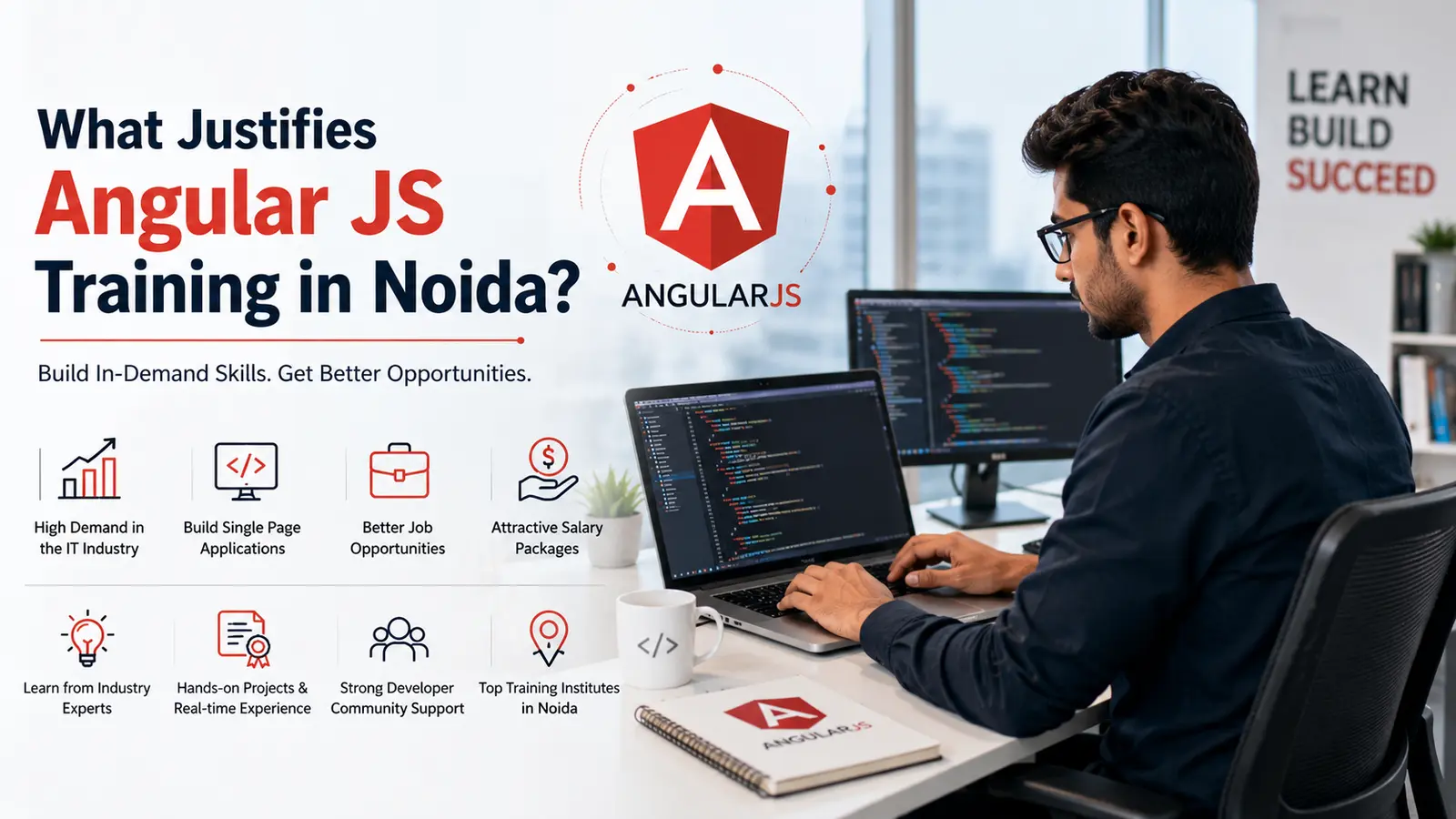
Web development moves fast, but a few frameworks stick around because they solve real problems. Angular JS is one of them. Companies in Noida’s IT corridor, from Sector 62 startups to bigger service firms in Sector 132, still run projects on Angular, and that demand hasn’t dried up the way some trend-chasers predicted.
If you’re weighing whether Angular JS training in Noida is worth your time and money, here’s the honest answer: it depends on how you approach it. Done right, with live projects and a trainer who’s actually shipped Angular code, it can open doors fast. Done as a weekend crash course with recorded videos, it won’t.
Noida has become one of the go-to cities for IT training in North India. Lower fees than Delhi, proximity to Gurugram’s job market, and a cluster of institutes that specialize in frontend and full-stack courses. That combination is why so many freshers and career switchers land here first.
What is Angular JS?
Angular JS is a JavaScript framework built by Google back in 2010, designed to make building dynamic, single-page web applications easier. Instead of writing raw DOM manipulation code for every interaction, Angular gives you a structured way to bind data, manage components, and handle logic.
It follows an MVC-style architecture (Model-View-Controller), which separates how data is stored, how it’s displayed, and how user actions are processed. This separation is why large teams can work on the same codebase without stepping on each other’s toes.
Common features you’ll work with during Angular JS training in Noida include two-way data binding, directives, dependency injection, and a templating system that keeps your HTML clean. You’ll see Angular JS used in admin dashboards, internal enterprise tools, and SPAs (single-page applications) where the page updates without a full reload.
A lot of learners confuse Angular JS with Angular (the version 2+ rewrite). They’re different beasts under the hood, but the core concepts, components, services, routing, carry over. So learning Angular JS still builds a foundation that transfers.
Why is Angular JS training in Noida worth it?
Growing IT industry in Noida
Noida’s tech sector has expanded well beyond BPOs and call centers. Sectors 62, 63, and 132 host IT parks with companies building products, not just maintaining legacy systems. That shift means more roles for developers who can build interfaces, not just fix bugs.
Demand for Angular developers
Recruiters searching for “Angular developer jobs in Noida” aren’t hunting for unicorns. Mid-size product companies and IT services firms both need people who can maintain and extend Angular applications, especially in banking, healthcare, and logistics software, where a lot of legacy Angular JS code is still running.
Affordable training options
Compare Noida’s course fees to Bangalore or Delhi’s premium institutes, and the gap is real. You can find a solid Angular JS training institute in Noida for a fraction of what similar quality costs elsewhere, without cutting corners on curriculum.
Access to experienced trainers
The better institutes in Noida hire trainers who’ve actually worked on Angular projects in industry, not just people who memorized the documentation. Ask before you enroll: has this trainer built and deployed an Angular app? If the answer is vague, keep looking.
Live project exposure
This is where theory turns into skill. A good angular js coaching in Noida program will have you building something real, a task manager, an inventory tracker, a small e-commerce frontend, instead of just following along with slides.
Placement assistance
Angular JS Placement Training in Noida programs typically include mock interviews, resume reviews, and direct connections to hiring partners. That support matters more than people expect, especially for your first job.
Top skills you learn during Angular JS training
JavaScript fundamentals
You can’t skip this. Angular sits on top of JavaScript, so weak fundamentals here will slow you down everywhere else. Expect to revisit closures, promises, and async patterns even if you’ve touched JS before.
TypeScript basics
Most modern Angular training touches TypeScript, since it’s become the standard for writing cleaner, typed code. Even in Angular JS-focused courses, instructors often introduce TypeScript basics to prepare you for Angular 2+ roles down the line.
MVC architecture
Understanding how models, views, and controllers talk to each other is the backbone of Angular development. Once this clicks, reading any Angular codebase gets a lot easier.
Single Page Applications (SPA)
You’ll learn why SPAs load faster after the initial hit, and how Angular handles routing without full page reloads. This is a core selling point of the framework and a common interview topic.
Components and modules
Angular apps are built from small, reusable pieces. You’ll learn to break a UI into components and organize related components into modules, a pattern you’ll use in nearly every frontend framework, not just Angular.
Routing
Multi-page-feeling apps built as SPAs need routing logic to switch views without reloading. You’ll configure routes, handle navigation guards, and pass data between views.
REST API integration
Real apps talk to backends. You’ll practice calling REST APIs, handling responses, and managing loading and error states, skills that show up in almost every technical interview.
Forms and validation
Login forms, registration flows, checkout pages: they all need validation. Angular’s form handling (both template-driven and reactive forms) is a heavily tested skill in job interviews.
Dependency injection
This is one of Angular’s more distinctive features. It lets you supply a component with what it needs (services, data) without hardcoding dependencies, making your code easier to test and maintain.
Git and GitHub
Not Angular-specific, but no training program worth its fee skips this. You’ll learn to commit, branch, and collaborate the way real dev teams do, because showing a GitHub profile with actual projects matters more than a certificate alone.
Who should join an Angular JS course?
Students still in college who want a head start on frontend development find Angular JS classes in Noida a practical add-on to their degree. It’s hands-on in a way most college curriculums aren’t.
Freshers looking for their first developer job benefit from the structured, project-heavy format. It gives you something concrete to show in interviews beyond a resume.
Working professionals in QA, support, or backend roles who want to pivot toward frontend development often take evening or weekend batches. Many institutes design their schedules specifically around this group.
Web developers who know HTML and CSS but haven’t worked with a JS framework will find Angular a logical next step, since it builds directly on what they already know.
JavaScript developers who’ve worked with vanilla JS or jQuery gain the most immediate benefit, since a lot of the mental shift is learning Angular’s structure rather than the language itself.
Career changers, people coming from non-tech backgrounds, do need to put in extra hours on JavaScript fundamentals before diving into Angular. It’s doable, but it’s not a shortcut.
Career opportunities after Angular JS training
Once you’ve completed a solid Angular JS certification course, a few roles typically open up:
Angular Developer. Builds and maintains Angular applications, works closely with backend teams on API integration.
Front-End Developer. Broader role covering HTML, CSS, JavaScript, and whichever framework the company uses, often Angular or React.
UI Developer. Focuses more on interface design implementation, translating Figma or Adobe XD designs into working code.
JavaScript Developer. A general title that covers frontend, sometimes backend (Node.js) work too.
Full Stack Developer. Combines Angular on the frontend with a backend stack like Node.js, Java, or .NET.
On salary: freshers in India with Angular skills typically start somewhere between 3 and 5 lakhs per year, depending on the city and company size. With 2 to 4 years of experience, that range moves up to 6 to 10 lakhs. Senior Angular developers with 5+ years, especially those who’ve worked on large enterprise applications, can cross 15 lakhs, sometimes more in product-based companies. These numbers shift with the market, so treat them as a rough compass, not a guarantee.
How to choose the best Angular JS training institute in Noida
Updated curriculum
Angular’s ecosystem changes. A course still teaching outdated syntax or skipping TypeScript entirely is a red flag. Ask to see the actual syllabus, not just a marketing brochure.
Industry-expert trainers
Look up the trainer’s background. LinkedIn profiles don’t lie as often as institute websites do.
Practical assignments
Weekly assignments that build on each other beat one-off exercises. You want to leave with muscle memory, not just notes.
Live projects
This is non-negotiable if you want a portfolio piece for job interviews. Ask specifically what projects past batches have built.
Certification
An Angular JS certification course adds credibility to your resume, especially for freshers with no work history to point to. It won’t replace a strong project portfolio, but it helps you clear the first resume screen.
Placement support
Ask how many students from the last 2 batches actually got placed, and where. Vague answers about “100% placement assistance” without specifics are worth questioning.
Student reviews
Google reviews and Google, Justdial, or course-comparison forums give you a less filtered picture than testimonials on the institute’s own site.
Flexible learning modes
Weekday, weekend, or online batches matter if you’re working or studying alongside the course. The best angular js training in Noida providers usually offer more than one format.
Why practical projects matter
Reading about routing is one thing. Debugging a routing issue at midnight because your app crashes on page refresh is another. That second experience is what actually sticks.
Employers know the difference too. A candidate who can walk through a project they built, explain a bug they hit, and describe how they fixed it, stands out immediately in an interview compared to someone who can only recite Angular concepts from memory.
Project-based learning also forces you to deal with the messy parts of real development: version control conflicts, API errors, styling inconsistencies across browsers. None of that shows up in a slide deck.
Online vs classroom Angular JS training in Noida
Classroom training works well if you learn better with in-person accountability and want direct access to a trainer for quick doubt-clearing. It also tends to build a peer group you can lean on during and after the course.
Online training in Angular JS gives you flexibility, useful if you’re working a job or managing family responsibilities alongside the course. The trade-off is you need more self-discipline to actually finish assignments on time.
A hybrid approach, live online classes with scheduled doubt-clearing sessions, has become common in Noida institutes over the last couple of years. It’s a reasonable middle ground if you’re unsure which format suits you.
Final word
AngularJS training in Noida makes sense if you treat it as skill-building, not just a certificate to collect. The city gives you affordable access to decent trainers, live project work, and a job market that’s still hiring for Angular roles, particularly in companies maintaining existing applications.
Pick a program with real projects, a trainer who’s actually worked in the field, and honest placement numbers. Skip the ones promising shortcuts. Angular rewards people who put in the practice hours, and Noida gives you a reasonably priced place to do that.
Frequently asked questions
1. Is Angular JS still worth learning?
Yes, particularly if you’re targeting maintenance and enhancement roles at companies with existing Angular JS codebases. It also builds a foundation that transfers to modern Angular versions.
2. What are the prerequisites for Angular JS training?
Basic HTML, CSS, and JavaScript knowledge. You don’t need prior framework experience, but weak JavaScript fundamentals will slow your progress.
3. How long does Angular JS training take?
Most structured programs run 2 to 4 months, depending on whether you’re attending full-time or part-time batches.
4. What is the average Angular developer salary in India?
Freshers typically start around 3 to 5 lakhs annually. Experienced developers with 4+ years can earn 8 to 15 lakhs or more, depending on company and location.
5. Does Angular JS training include projects?
Any program worth enrolling in should. If a course description doesn’t mention projects at all, ask directly before signing up.
6. Can beginners learn Angular JS?
Yes, as long as they’re willing to put in time on JavaScript basics first. Skipping that step makes everything harder later.
7. Is certification helpful for job applications?
It helps you get past initial resume screening, especially with limited work experience. It won’t replace a demonstrable project portfolio though.
8. Which institute offers placement support in Noida?
Several do, but the quality varies widely. Ask for specific placement numbers and company names from recent batches rather than relying on general claims.