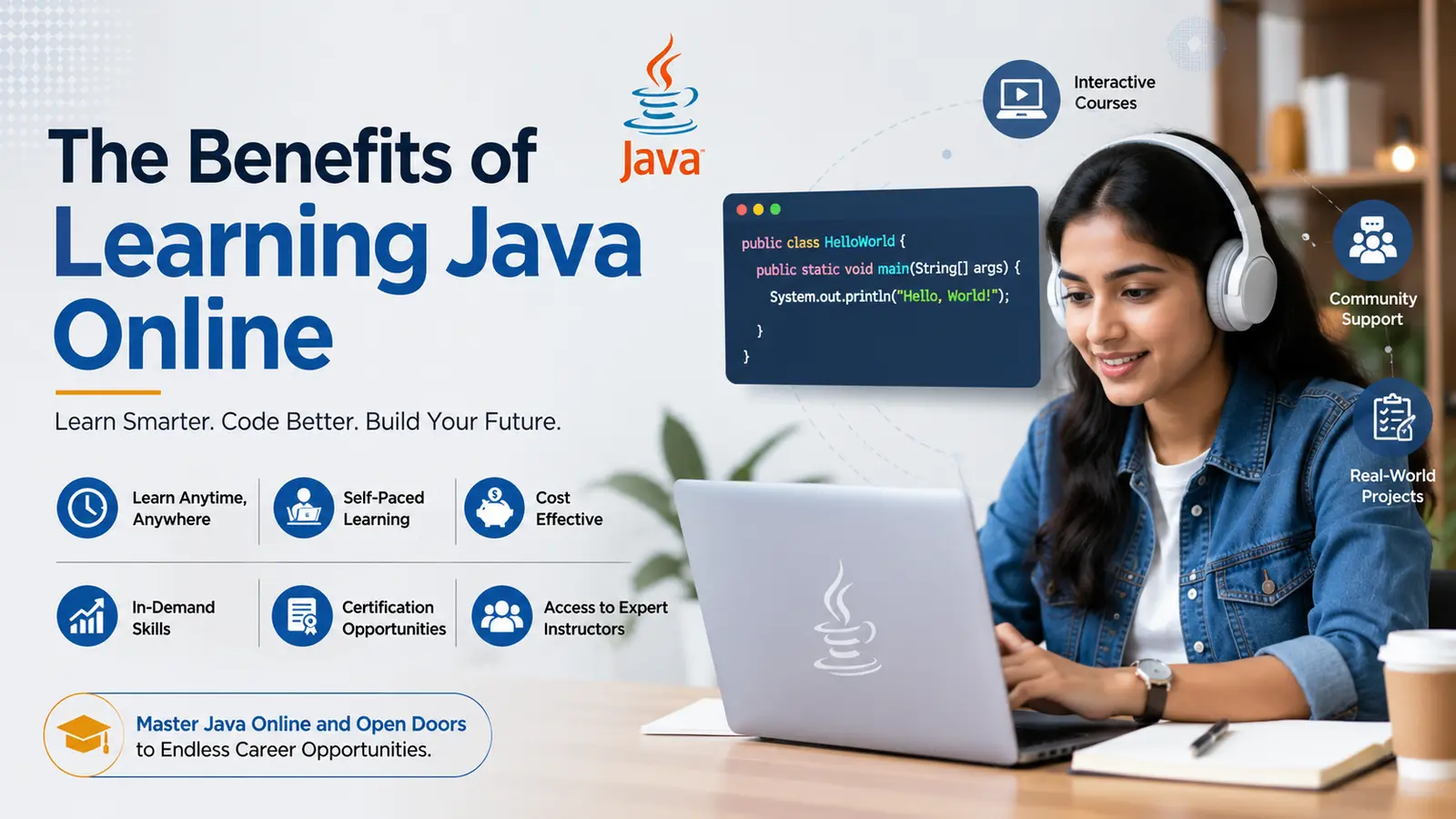
A few years back, if you wanted to learn Java, you signed up for a coaching center near your house and showed up at 6 PM after college or work. Today, that same person opens a laptop, picks a course, and starts coding from their bedroom. That shift isn’t small. It’s changed who gets to learn programming and how fast they can do it.
Java sits right in the middle of that shift. It’s one of the oldest programming languages still standing, and it’s still one of the most requested skills on job portals. Combine that with the flexibility of online learning, and you get a genuinely good option for anyone who wants to build a career in tech without quitting their job or moving to a new city.
This article walks through the real benefits of learning Java online, how it stacks up against classroom training, what skills you’ll actually pick up, and how to choose a course that doesn’t waste your money.
Why Java remains one of the most popular programming languages
Java has been around since 1995, and it’s still one of the top 5 languages by usage on every major developer survey. That’s not nostalgia. That’s demand.
Banks run their core systems on Java. Airlines use it for booking engines. E-commerce platforms use it for inventory and payment processing. When a system needs to handle millions of transactions without falling over, Java is usually somewhere in that stack.
Android development is another big reason Java stays relevant. Millions of Android apps were built using Java before Kotlin came along, and a large share of existing Android codebases still run on it. If you want to work on mobile apps at an enterprise level, Java knowledge helps.
Web development and backend systems lean on Java too, especially through frameworks like Spring and Spring Boot. Companies building REST APIs, microservices, or large-scale backend systems often default to Java because it’s stable, well-documented, and has a massive talent pool to hire from.
And here’s the career angle: Java developer roles aren’t disappearing. They’re just evolving. Someone who learns Core Java, then picks up Spring Boot and REST APIs, has a genuine shot at backend developer, full-stack developer, or software engineer roles. That’s a long runway for a language that’s nearly 30 years old.
What does learning Java online actually mean?
“Learning Java online” isn’t one single format. It usually blends a few different modes depending on the platform you choose.
Live classes put you in a virtual classroom with an instructor teaching in real time, similar to a physical classroom but over Zoom or a similar tool. You can ask questions immediately and get answers on the spot.
Self-paced learning gives you pre-recorded video lessons you work through on your own schedule. This suits people juggling a job or college alongside their Java course.
Recorded lectures matter even in live courses, because they let you rewatch a topic you didn’t fully get the first time. Nobody remembers everything after one explanation of, say, multithreading.
Coding exercises and projects are where the real learning happens. Watching a video about loops is not the same as writing 20 loops yourself and breaking them in new ways each time.
Mentor support rounds this out. Good online Java courses assign a mentor or provide a doubt-clearing forum so you’re not stuck for three days on a single error message.
Top benefits of learning Java online
You can learn from anywhere
You don’t need to live near a coaching institute anymore. Someone in a small town in Rajasthan can take the exact same Java course as someone in Bangalore. All you need is a laptop and a decent internet connection.
Your study schedule bends around your life
A working professional can study at 9 PM after their shift. A college student can squeeze in a lesson between classes. Nobody has to rearrange their entire day around a fixed classroom slot.
It costs less than classroom training
Physical institutes charge for rent, staff, and infrastructure, and that cost gets passed to you. Online Java courses cut most of that overhead, so the same quality of instruction often costs a fraction of the price.
You move at your own speed
Struggling with exception handling? Take three extra days on it. Already comfortable with loops and arrays? Skip ahead. Classroom batches move at one fixed pace for everyone, which helps nobody in particular.
Recorded sessions become your personal reference library
Six months into a job, when you forget how JDBC connections work, you can go back to the exact recording instead of googling through five different blogs with conflicting advice.
Hands-on coding practice is built into the format
Most decent online Java platforms include a code editor right in the browser. You write, run, and debug code without installing anything extra, which lowers the barrier for absolute beginners.
You build real-world projects, not just toy examples
A good Java course pushes you to build something like a library management system, a student database, or a basic e-commerce backend. That’s what actually shows up well on a resume, far more than a certificate alone.
The curriculum tends to track what companies are hiring for
Since online platforms compete for students, they update their syllabus faster than most static classroom programs. You’re more likely to see Java 8+ features, Spring Boot, and REST APIs included, because that’s what recruiters are asking for right now.
You learn from instructors who’ve actually worked in the industry
Many online Java trainers have spent years as developers before teaching. That means you get answers grounded in real production experience, not just textbook explanations.
Some platforms offer placement assistance
This varies a lot by provider, so check this carefully before paying. The better ones offer resume reviews, mock interviews, and direct referrals to hiring partners.
You walk away with a certificate
A Java certification online won’t replace skill, but it does help your resume clear the first filter, especially for entry-level roles where recruiters are scanning hundreds of applications.
Debugging your own code sharpens your problem-solving
Every error you fix by yourself teaches you more than watching someone else fix theirs. Online courses that force you to submit working code (not just watch a solution) build this skill faster.
You get better prepared for technical interviews
Courses with mock interviews and coding assessments built in mean you walk into a real interview having already faced similar pressure once before.
All of this adds up to better career opportunities
Combine practical skills, a portfolio of projects, a certificate, and interview prep, and you’ve got a genuinely competitive candidate profile for Java developer roles.
Online Java learning vs classroom training
| Factor | Online Java Learning | Classroom Training |
| Flexibility | Study any time, from anywhere | Fixed schedule, fixed location |
| Cost | Generally lower, fewer overheads | Higher due to infrastructure costs |
| Learning pace | Self-paced or hybrid | One fixed pace for the whole batch |
| Accessibility | Open to anyone with internet | Limited to those near the institute |
| Networking | Limited to online forums and chat groups | Face-to-face networking with peers |
| Practical sessions | Browser-based coding, virtual labs | Hands-on lab access, in-person guidance |
| Convenience | High, fits around work or college | Lower, needs travel and fixed hours |
Neither format wins on every point. Classroom training still has an edge for people who genuinely learn better with in-person accountability and face-to-face networking. But for cost, flexibility, and reach, online Java training is hard to beat.
Who should learn Java online?
Beginners with zero coding background can start an online Java course for beginners without feeling out of place, since most platforms build up from absolute basics.
College students preparing for campus placements often use online Java classes to supplement what their curriculum covers too slowly or too theoretically.
Working professionals looking to switch from a non-tech role, or from a different tech stack, use online learning because it doesn’t require quitting their current job.
Career changers, including people from completely unrelated fields like mechanical engineering or commerce, use structured online Java programs to make a real pivot into software development.
Freelancers add Java to their skill set to take on backend or Android projects that pay better than basic scripting work.
Software developers already working in one language often pick up Java online to widen their opportunities, especially for enterprise-level roles.
Skills you can gain from an online Java course
A solid Java course starts with Core Java: variables, data types, loops, and functions. From there, it moves into Object-Oriented Programming, which is really the backbone of how Java is used in real projects (classes, objects, inheritance, polymorphism).
The Collections Framework teaches you how to store and manipulate groups of data efficiently, using structures like ArrayList, HashMap, and HashSet. Exception Handling teaches you to write code that doesn’t crash the moment something unexpected happens.
Multithreading introduces you to running multiple operations at once, a skill that matters a lot in performance-heavy applications. JDBC and File Handling cover how Java talks to databases and reads or writes files, both everyday tasks in real development work.
Java 8+ features, including lambda expressions and streams, show you the more modern, efficient way of writing Java code that most current codebases now expect.
From there, many courses layer in Spring Boot basics and REST APIs, which is where Java meets real backend development and web services. Git and GitHub round out the practical side, teaching you version control, a non-negotiable skill for working on any team.
Database fundamentals, debugging, and general problem-solving tie everything together. None of these skills exist in isolation. A good online Java course makes sure you practice them together, on actual projects, not in separate silos.
How to choose the best online Java course
Start with the syllabus. If it hasn’t been updated to include Java 8+ features, Spring Boot, or REST APIs, it’s teaching you 2015-era Java, and that’s a problem.
Check whether the course includes live projects, not just isolated coding exercises. A project that mimics real-world requirements teaches you far more than 50 disconnected practice problems.
Look at who’s teaching. Experienced trainers who’ve actually built software professionally tend to explain concepts with context, not just definitions memorized from a textbook.
Hands-on assignments matter more than lecture hours. A 40-hour course with heavy coding practice beats a 100-hour course that’s mostly passive watching.
Read student reviews carefully, especially the ones that mention specific outcomes (job offers, salary hikes, skill gains), not generic praise. Check if placement support is real and specific, or just a marketing line with no actual process behind it.
Certifications help your resume clear automated filters, so confirm the course offers one recognized by employers in your target industry. Mentor guidance and mock interviews are worth paying extra for if you’re serious about interview readiness.
Finally, compare fees against everything above, not in isolation. The cheapest course that skips projects and mentorship isn’t actually cheaper once you count the time you’ll spend fixing gaps later.
Common mistakes to avoid while learning Java online
Watching hours of video without writing a single line of code feels productive. It isn’t. Programming is a skill you build with your hands, not your eyes.
Skipping practice problems because they feel repetitive is another common trap. Repetition is exactly how syntax and logic become automatic instead of something you have to look up every time.
Ignoring projects in favor of just finishing the course syllabus leaves you with theoretical knowledge and nothing to show a recruiter. Not revising older concepts, like OOP principles or collections, means you’ll forget them right when an interviewer asks about them.
Avoiding data structures because they feel harder than the rest of the course is a mistake that catches up with you at almost every technical interview. Giving up the moment your code throws an error, instead of debugging it, robs you of the single most useful learning moment in the entire process.
And trying to learn from five different resources at once (one YouTube channel, two courses, three blogs) usually creates more confusion than clarity. Pick one structured path and stick with it until you finish it.
Career opportunities after learning Java online
A Java Developer builds and maintains Java-based applications, writing code, fixing bugs, and working closely with a broader engineering team.
A Backend Developer focuses on the server side of applications: databases, APIs, and business logic that the user never sees directly but depends on constantly.
A Full-Stack Java Developer handles both backend Java work and frontend development, often using frameworks like Angular or React alongside Spring Boot.
An Android Developer builds mobile applications, historically using Java (and increasingly Kotlin alongside it), for phones and tablets.
A Software Engineer works across the wider software development lifecycle, from design to testing to deployment, often specializing but not limited to one language.
An API Developer designs and builds the interfaces that let different software systems talk to each other, a role that’s grown fast as companies split large applications into smaller services.
A Junior Java Programmer, usually an entry-level title, works under senior developers, writing and testing code while learning the codebase and team practices.
Final thoughts
Learning Java online genuinely works if you treat it the way you’d treat any serious skill: consistent practice, real projects, and enough patience to push through the parts that feel confusing at first. The flexibility, lower cost, and updated curriculum give online learning a real edge over traditional classroom training for most people today.
If you’re ready to start, look for a course with hands-on assignments, live projects, and mentor support, then commit to finishing it. Build something with what you learn, even something small, and keep adding to it. That project, more than any certificate, is what will actually get you the interview.
Frequently asked questions
1. Is learning Java online effective?
Yes, provided the course includes hands-on coding practice and real projects, not just video lectures. The format itself works fine; the quality of the course content is what actually determines the outcome.
2. Can beginners learn Java online?
Absolutely. Most platforms design their Java training for beginners from the ground up, assuming zero prior coding experience.
3. How long does it take to learn Java?
Basic proficiency usually takes 3 to 6 months of consistent practice. Reaching a job-ready level, with projects and interview prep included, often takes closer to 6 to 9 months.
4. Is Java still worth learning?
Yes. It remains one of the most used languages in enterprise software, Android development, and backend systems, and that demand hasn’t shown signs of disappearing.
5. Do online Java certificates help in getting a job?
They help your resume pass initial screening and show a recruiter you’ve completed structured training. They work best alongside a portfolio of projects, not as a replacement for one.
6. Which projects should beginners build?
Start with something small like a to-do list app, then move to a student management system, a basic banking application, or a library management system. Each one forces you to use OOP, collections, and exception handling together.
7. Is Java difficult for beginners?
It has more syntax rules than some newer languages, so it takes a bit more patience early on. Most beginners find it manageable within a few weeks of consistent practice.
8. What should I learn after Java?
Spring Boot and REST APIs are the natural next step for backend development. If you’re aiming for full-stack roles, pair that with a frontend framework like React or Angular.
Read also more:- Java developer roadmap