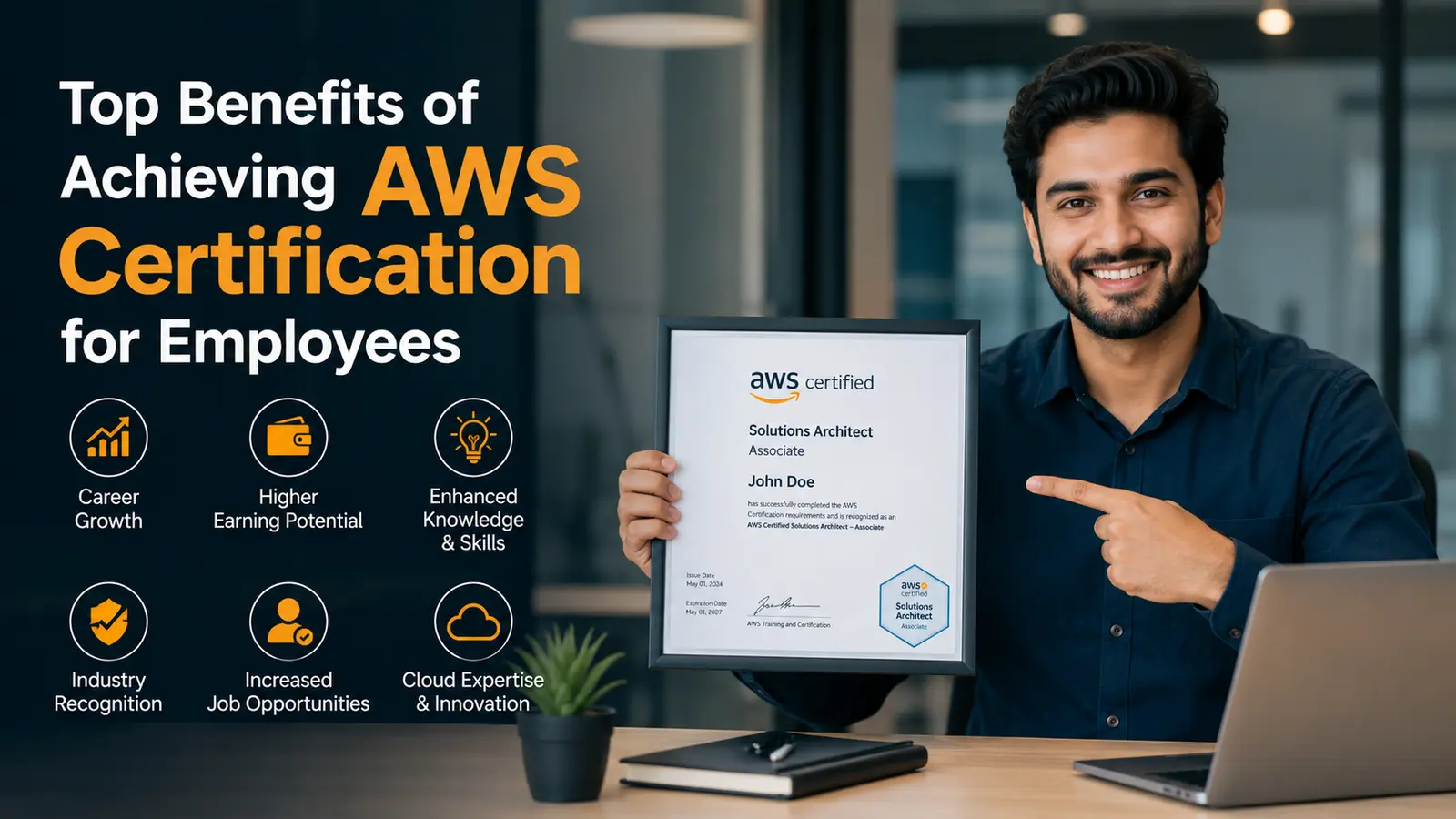
Cloud budgets have exploded over the past 5 years, and most of that money is flowing straight into AWS. Companies aren’t asking “should we move to the cloud” anymore. They’re asking who on the team actually knows how to run it. That’s exactly why AWS certification for employees has turned into one of the fastest ways to stand out in IT. Many professionals first build their cloud knowledge through an AWS training program or AWS course before preparing for certification exams.
What is AWS certification?
AWS certification is a credential you earn by passing an exam that proves you can actually work with Amazon Web Services, not just talk about it. Amazon designed these exams around real job roles, so the badge means something specific to whoever’s reading your resume.
There are 4 levels. Foundational is for people brand new to cloud concepts. Associate is where most working professionals start, covering hands-on skills for specific roles like developer or architect. Professional digs deeper into designing and managing complex AWS environments. Specialty certifications target one area, like security, machine learning, or networking, and they’re usually for people who already have a few years in the field.
Anyone who touches infrastructure, code, or data at a company using AWS should think about this. That includes people who’ve never written a line of code and people who’ve been coding for 15 years.
Why AWS skills are in high demand
Cloud computing stopped being optional a while back. Retail chains, banks, hospitals, even government agencies are running workloads on AWS because building your own data center is slower and more expensive than renting Amazon’s.
Digital transformation projects need people who can actually execute, not just plan. Every migration, every new app, every AI pipeline needs someone who understands how AWS services fit together. And there simply aren’t enough of those people yet. That gap is why recruiters are pinging AWS-certified professionals on LinkedIn before the job posting even goes live.
This demand isn’t local either. A company in Singapore, a startup in Austin, and a bank in London are all hiring for the same skill set. That’s a rare thing in tech, and it’s worth taking seriously if you’re planning your next 5 years.
Benefits of AWS certification for employees
Better career opportunities
Recruiters often filter resumes using relevant keywords, and “AWS Certified” is one of the qualifications many employers look for when hiring cloud professionals. During a quick resume scan, an AWS certification can help your profile stand out and increase the chances of being shortlisted for interviews.
AWS certification can also strengthen your professional profile during organizational changes by demonstrating validated cloud knowledge and a commitment to continuous learning. Beyond your current employer, it can open opportunities with multinational companies, remote-first organizations, and global teams that actively hire certified cloud professionals across different regions.
Completing a structured AWS training course not only prepares you for the AWS certification exam but also helps you build practical cloud computing skills through hands-on projects and real-world scenarios. As a result, employees gain greater confidence, improve their technical expertise, and enhance their career growth opportunities in today’s cloud-driven job market.
Higher salary potential
Money talks, so let’s talk numbers. Global salary surveys have consistently placed AWS certifications among the highest-paying IT credentials, with some specialty certifications adding 15,000 to 25,000 dollars to average base pay in the US alone. In India, certified cloud engineers routinely negotiate 20 to 30 percent higher offers compared to non-certified peers with similar experience.
Employers pay more because certified staff need less hand-holding. A certified DevOps engineer can walk into a migration project on day one instead of spending 3 months learning AWS on the job. That saved time is worth real money, and companies are willing to pay for it upfront.
Industry-recognized credential
An AWS certification means the same thing whether you’re applying in Mumbai, Berlin, or Toronto. That consistency is rare. A lot of internal company certifications or bootcamp certificates don’t carry weight outside the organization that issued them. AWS’s badge does.
Hiring managers trust it because Amazon controls the exam content and keeps it updated as services change. That trust translates into faster interview processes, since the interviewer already knows what you’re capable of before you say a word.
Stronger cloud computing skills
Studying for these exams forces you past surface-level familiarity. You’ll learn how EC2, S3, Lambda, and IAM actually work together, not just what they’re called. AWS certification prep involves real labs: spinning up instances, configuring security groups, breaking things and fixing them.
That hands-on repetition is what separates someone who can talk about serverless architecture from someone who can actually build one. When a production issue hits at 2 AM, that practical knowledge is what gets the system back online.
Increased confidence at work
There’s a specific kind of confidence that comes from knowing you’re not guessing. Certified employees speak up in architecture meetings because they understand the tradeoffs between, say, RDS and DynamoDB. They make calls faster because they’ve already worked through similar scenarios in their exam prep.
I’ve watched junior engineers go from staying quiet in planning sessions to leading them within a year of getting certified. The certification itself doesn’t do that. The depth of understanding behind it does.
Opportunities for promotion
Managers look for people who can own a system end to end, and certification signals exactly that. It’s often the deciding factor between two candidates for a lead role, especially when the job involves owning cloud architecture decisions.
Certified employees also tend to get pulled into cross-team initiatives, migration projects, cost optimization efforts, security audits, because leadership trusts them to represent the technical side. That visibility compounds over time into bigger titles and bigger teams to manage.
Ability to work on modern cloud projects
Companies aren’t hiring for maintenance work anymore. They want people who can lead migrations off legacy systems, build out DevOps pipelines, plug machine learning models into production, or handle big data at scale using services like Redshift and EMR.
Serverless is a good example. A lot of engineers know the theory but freeze when asked to actually deploy a Lambda function with proper IAM permissions. Certification prep puts you through that exact scenario, so when the project lands on your desk, you’re not learning on the client’s dime.
Improved productivity
Understanding AWS architecture properly means fewer wasted hours. Certified employees know which services fit which job, so they stop over-engineering solutions or reaching for expensive tools when a cheaper one does the job just as well.
Cost optimization is a big piece of this. I’ve seen certified engineers cut a company’s monthly AWS bill by 30 percent just by right-sizing EC2 instances and switching idle workloads to spot pricing. That kind of judgment comes from actually understanding the pricing model, not just clicking through the console.
Global job mobility
Once you’re certified, geography matters less. Remote cloud roles have grown fast since 2021, and most of them list AWS certification as a preferred or required qualification. Freelancers with an AWS badge on their Upwork or LinkedIn profile get noticed faster too, since clients want proof of skill without having to test it themselves.
This matters if you’re thinking about relocating, going remote, or picking up freelance contracts on the side. The certification does some of the vetting work for you before the client even gets on a call.
Continuous learning and professional growth
AWS updates its services constantly, and certifications expire every 3 years, which forces you to stay current instead of coasting on knowledge from 2019. That built-in refresh cycle keeps your skills relevant in a field that changes fast.
It also builds a habit. Once you’ve gone through one certification cycle, picking up the next one (or a specialty badge) feels a lot less intimidating. That compounding habit of learning is often worth more long-term than any single exam.
Which employees should pursue AWS certification?
Software developers benefit because a huge share of applications now run on AWS infrastructure, and understanding the underlying services makes you a better coder, not just a better ops person. System administrators use certification to shift from traditional server management into cloud operations, which is where the job market is heading anyway.
DevOps engineers and cloud engineers are the most obvious fit, since AWS skills are baked directly into their job descriptions. Network engineers benefit too, since AWS networking (VPCs, subnets, routing) mirrors traditional networking concepts but with cloud-specific quirks worth mastering.
Security professionals increasingly need cloud-specific credentials as more sensitive data moves off-premises. IT support engineers use certification to move up into more technical, better-paying roles. And both fresh graduates and working professionals gain from it in different ways: graduates use it to break into the industry, while experienced professionals use it to pivot into cloud-focused roles without starting over.
Popular AWS certifications for employees
| Certification Name | Skill Level | Best For | Career Benefits |
| AWS Certified Cloud Practitioner | Foundational | Beginners, non-technical staff | Builds baseline cloud knowledge, opens door to associate-level study |
| AWS Certified Solutions Architect – Associate | Associate | Developers, architects | Widely recognized, strong salary boost, common hiring filter |
| AWS Certified Developer – Associate | Associate | Software developers | Deepens AWS SDK and deployment knowledge |
| AWS Certified SysOps Administrator – Associate | Associate | System admins, support engineers | Strengthens operations and troubleshooting skills |
| AWS Certified Solutions Architect – Professional | Professional | Senior architects | Qualifies for lead architecture and consulting roles |
| AWS Certified DevOps Engineer – Professional | Professional | DevOps engineers | Positions you for senior DevOps and platform roles |
| AWS Certified Security – Specialty | Specialty | Security professionals | High demand, often commands top-tier pay |
| AWS Certified Machine Learning – Specialty | Specialty | Data scientists, ML engineers | Opens doors into AI/ML-focused cloud roles |
How to prepare for AWS certification
Start with AWS fundamentals rather than jumping straight into practice exams. You need to understand core concepts, regions, availability zones, IAM, before memorizing exam-specific details. The AWS Free Tier is genuinely useful here: create an account and actually build something small, a static website on S3, a simple Lambda function, anything that gets your hands on the console instead of just reading about it.
Official AWS learning resources, AWS Skill Builder in particular, map directly to exam objectives and save you from studying the wrong things. Once you’ve covered the material, practice tests reveal gaps you didn’t know you had; they’re not just a formality before exam day.
Building a small project, even something as simple as a 3-tier web app hosted on EC2 with an RDS backend, cements the knowledge far better than flashcards. And joining a study community, whether that’s a Discord server or a local meetup, keeps you accountable and gives you someone to ask when a concept doesn’t click.
Common mistakes to avoid during AWS certification preparation
Studying theory without touching the console is probably the most common mistake I see. You can read about EC2 all day, but you won’t understand security groups until you’ve actually locked yourself out of an instance once and had to fix it.
Skipping hands-on labs is a close second. AWS exams test practical scenarios, not textbook definitions, so labs aren’t optional if you want to pass comfortably. Skipping practice exams is another one; they’re the best way to gauge your actual readiness before you spend the exam fee.
Choosing the wrong certification level trips up a lot of people too. Jumping straight to Professional without Associate-level experience usually ends in a failed attempt and a bruised ego. And ignoring AWS documentation is a mistake because Amazon’s own docs are often more current and detailed than any third-party course.
Conclusion
AWS certification for employees isn’t a box to check for a resume. It’s a practical investment that pays off in salary, job security, and the kind of confidence that comes from actually understanding the systems you work with every day. Whether you’re a developer trying to move into architecture, a support engineer aiming for a DevOps role, or a fresh graduate trying to get noticed, the benefits stack up: better pay, stronger skills, wider job mobility, and a credential that means something anywhere in the world.
Cloud computing isn’t slowing down, and neither is the demand for people who can run it properly. If you’ve been putting off starting your AWS certification journey, this is a good time to stop putting it off. Pick a level that matches where you are, start with the Free Tier, and build from there.
Frequently asked questions
1. Is AWS certification worth it for employees?
Yes, for most people in tech roles. It typically pays for itself within a year through salary increases or new job opportunities, and the skills transfer directly to daily work.
2. Which AWS certification is best for beginners?
AWS Certified Cloud Practitioner is the standard starting point. It covers foundational concepts without requiring hands-on technical experience.
3. Does AWS certification increase salary?
In most markets, yes. Salary surveys consistently show certified professionals earning more than uncertified peers in comparable roles, sometimes by a significant margin at the specialty level.
4. How long does it take to prepare?
Foundational certifications usually take 4 to 6 weeks of part-time study. Associate-level exams take 2 to 3 months, and Professional or Specialty exams often need 3 to 6 months depending on your starting experience.
5. Can non-programmers earn AWS certification?
Absolutely. Cloud Practitioner and SysOps Administrator certifications don’t require coding skills, and plenty of non-technical staff, project managers, sales engineers, earn them to better understand the products they work around.
6. Is AWS certification valid internationally?
Yes. The credential is recognized globally since Amazon controls the exam standard everywhere it’s offered.
7. Do employers prefer AWS-certified candidates?
Generally, yes, especially for roles involving cloud infrastructure. It’s often listed as a preferred qualification even when not strictly required.
8. How often should AWS certifications be renewed?
Every 3 years. You can recertify by retaking the current version of the exam or, in some cases, a higher-level exam that covers the same domain.
Read also more:- Best AWS Training Institute in Noida