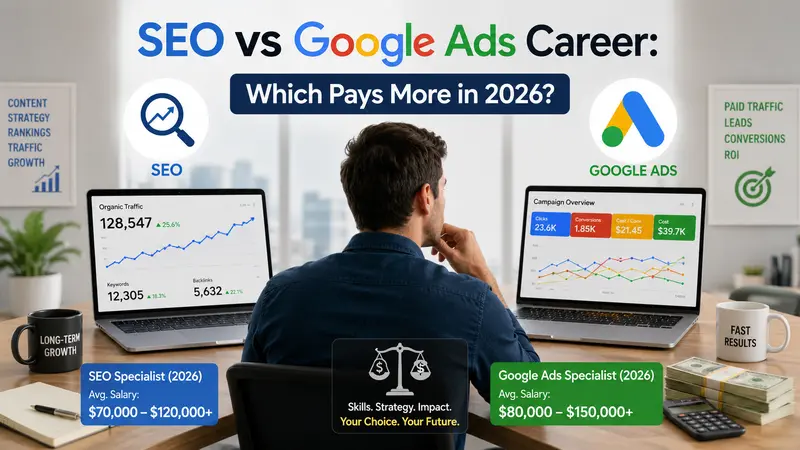
Two students finish the same digital marketing course. One picks SEO. One picks Google Ads. Five years later, their job titles, paychecks, and daily work look nothing alike.
If you’re weighing an SEO vs Google Ads career, you’re really choosing between two different games. SEO is a long game built on patience and technical skill. Google Ads is a fast game built on budgets and split-second decisions.
I’ve watched both paths play out over a decade of training students and hiring marketers. Here’s what actually separates an SEO career vs PPC career, what each one pays in 2026, and which one fits how you like to work.
What Is a Career in SEO?
SEO is the practice of getting a website to rank higher on Google without paying for clicks. Someone has to plan that, build it, and keep it working as Google’s algorithm shifts underneath them. That someone is the SEO specialist.
What does an SEO specialist do?
An SEO specialist researches keywords, audits technical issues on a website, builds content strategies, and earns backlinks from other sites. On a Monday, you might be checking page speed and crawl errors. By Friday, you’re writing a content brief for a writer or arguing with a developer about why a redirect broke rankings. The job moves between engineering, writing, and strategy in the same week, which is why generalist SEOs take longer to feel fully confident than PPC beginners do.
Skills required for SEO
You need keyword research, on-page optimization, technical SEO (crawlability, site speed, schema markup), content strategy, and enough HTML to read a page’s source code without panicking. Tools like Google Search Console, Ahrefs, SEMrush, and Screaming Frog show up in nearly every job posting. Analytical thinking matters more than people expect going in. You’re reading data and predicting how an algorithm update will respond months before you get proof you were right.
Types of SEO jobs
SEO Executive, SEO Analyst, SEO Specialist, Technical SEO Lead, Content SEO Strategist, SEO Manager, and Head of SEO. Agencies tend to hire generalists who can juggle five clients at once. In-house teams at larger companies hire specialists who own just technical SEO or just content, which pays more once you’ve built that depth.
Get Free Career Counseling ➔What Is a Career in Google Ads?
Google Ads, also called PPC or pay-per-click, is the paid side of search marketing. You bid on keywords, write the ad, and pay every time someone clicks through.
What does a Google Ads specialist do?
A Google Ads specialist builds campaigns, writes ad copy, sets bidding strategies, and manages budgets that can run from ₹10,000 a month for a local business to ₹50 lakh a month for an e-commerce brand during a sale. You’re checking cost-per-click, conversion rate, and return on ad spend daily, sometimes hourly when a campaign is live and money is moving.
Skills required for PPC
Campaign structuring, bid strategy, A/B testing ad copy, conversion tracking, a Google Ads certification, and real comfort with spreadsheets. Most specialists also pick up Meta Ads, LinkedIn Ads, and Microsoft Advertising once they’ve got Google Ads down. Numbers drive every decision here. If a campaign isn’t converting, you fix it that afternoon, not next quarter.
Types of Google Ads jobs
PPC Executive, Google Ads Specialist, Performance Marketing Analyst, PPC Manager, Paid Media Strategist, and Head of Paid Media. E-commerce and lead-generation businesses hire PPC specialists fastest, since ad spend ties straight to revenue and owners want someone accountable for it.
SEO vs Google Ads Career: Key Differences
Job responsibilities. SEO builds visibility that compounds over months. Google Ads buys visibility that starts the moment you launch a campaign and stops the moment you pause it.
Daily work. SEO work is research-heavy: content plans, technical audits, and outreach for links. PPC work is dashboard heavy: bid adjustments, ad copy tests, and budget pacing checks.
Required skills. SEO leans on writing, technical troubleshooting, and patience. PPC leans on math, quick decisions, and comfort spending someone else’s money.
Learning curve. SEO takes months to show results, so beginners often feel like they’re guessing for a while. PPC hands you a performance report within 24 hours, which makes the early learning curve feel faster even though mastering strategy underneath takes just as long.
SEO vs Google Ads Salary Comparison
Salary is usually where the SEO career vs PPC career debate starts, so let’s get specific. These are India-based ranges for 2026, pulled from current market data across multiple industry sources.
Entry-level salary
- SEO Executive: ₹2.5 to 4.5 LPA
- PPC Executive: ₹3 to 4.5 LPA
Both start close. PPC occasionally edges ahead early, since paid media ties directly to a live budget and companies pay a small premium for someone they trust to handle it responsibly.
Mid-level salary
- SEO Specialist or Manager (3 to 5 years): ₹4.5 to 9 LPA
- PPC Specialist or Manager (3 to 5 years): ₹5 to 10 LPA
Senior-level salary
- Senior SEO Manager or Head of SEO: ₹12 to 25 LPA, with SEO Directors at bigger companies crossing ₹35 LPA
- Senior PPC Manager or Head of Paid Media: ₹11 to 25 LPA
Freelance earnings SEO freelancers typically bill by project (₹5,000 to ₹50,000 for a site audit or a content package) or by monthly retainer. Freelancers running several retainers at once can clear ₹1 to 2.5 lakh a month.
PPC freelancers usually charge a percentage of ad spend, often 10 to 20%, or a flat monthly management fee. Someone managing 4 to 6 clients with a combined ₹10 to 15 lakh in monthly ad spend can pull in ₹1.5 to 3 lakh a month.
The SEO specialist salary vs PPC specialist salary gap stays narrow at the entry level and widens slightly near the top, where PPC managers handling big ad budgets sometimes out-earn SEO managers with similar experience. But SEO’s freelance and consulting ceiling climbs just as high once you’ve got case studies proving your work.
Which Career Has Better Job Demand?
Current hiring trends. SEO job postings in India have held steady through 2026, with more than 50,000 active openings at any given time. Google Ads and performance marketing roles are growing faster right now, pushed by e-commerce brands and D2C startups that need trackable revenue immediately, not in six months.
Industry demand. SEO demand runs strongest in content-heavy sectors: education, SaaS, media, and healthcare. PPC demand runs strongest wherever there’s a transaction to close fast: e-commerce, real estate, and lead-gen businesses. That’s the future scope of SEO or Google Ads in one line: both are growing, just on different timelines and in different industries.
Remote job opportunities. Both roles work remotely without much friction. SEO is arguably easier to freelance remotely, since deliverables like audits, content, and reports don’t need real-time client contact. PPC often needs faster back-and-forth around campaign launches, so remote PPC work leans toward async-friendly agencies or clients in a similar time zone.
SEO vs Google Ads: Career Growth Opportunities
Career progression in SEO. Executive to Specialist to Manager to Head of SEO to Director of Organic Growth. Some SEOs move sideways into content strategy or product marketing once they understand user intent at a deep level, since that skill transfers almost directly.
Career progression in Google Ads. Executive to Specialist to Manager to Head of Paid Media to Director of Performance Marketing. PPC skills translate directly into growth marketing and marketing analytics roles too, since the daily work already involves budgets and ROI reporting that leadership cares about.
Leadership roles. Both paths land you in leadership within 6 to 8 years if you stay consistent and keep learning. SEO leaders usually end up owning organic strategy for an entire company. PPC leaders usually end up owning a chunk of the marketing budget itself, which brings more visibility to leadership and more pressure to hit numbers every single month.
Which Is Easier to Learn?
Time required to learn SEO. Expect 3 to 6 months to understand the fundamentals, then another year of hands-on project work before you can run a strategy alone with confidence. Google’s algorithm keeps changing, so the learning never really finishes.
Time required to learn Google Ads. You can run your first campaign within 4 to 6 weeks. Google’s own certifications (Search, Display, Shopping, Video) give you a structured path, and the ad platform itself teaches you a lot just by clicking around and watching what happens to your numbers.
Recommended learning path. Start with Google Ads if you want to feel productive fast and enjoy watching a dashboard move. Start with SEO if you’re patient and want a skill that keeps paying off for years without a monthly ad budget attached to it.
Get Free Demo Class ➔SEO vs Google Ads for Freelancing
Client availability. Small businesses want both, but SEO clients often come looking for cheaper, ongoing help with a smaller monthly budget. PPC clients come looking for someone who can spend their money wisely, which usually means they’ve already set money aside for it.
Project pricing. SEO projects are priced by scope: an audit, a content sprint, and a link-building campaign. PPC projects price by spend, a percentage of the monthly ad budget that scales automatically as the client’s business grows.
Income potential. PPC freelancing tends to scale faster because your fee grows alongside the client’s ad spend. SEO freelancing scales through volume and reputation. It takes longer to build, but it’s often steadier once your case studies start doing the selling for you.
SEO vs Google Ads for Freshers and Students
Best option for beginners. If you want a quick win to show a client or an employer, start with Google Ads. If you want a skill that compounds for years and doesn’t depend on a client’s monthly budget, start with SEO. Plenty of people asking, “Which is better, SEO or Google Ads for a career?” end up doing both within their first two years anyway.
Internship opportunities. Both show up constantly as intern roles at agencies. SEO interns usually start with keyword research and content audits. PPC interns usually start by shadowing campaign setups and learning the ad platform interface before anyone lets them touch real budget.
Skill-building roadmap. Learn Google Analytics and Search Console first, since both careers run on them. Then branch out. An SEO roadmap for students should build a personal blog and try to rank it for a real keyword. PPC students should run a small ₹2,000 to ₹5,000 test campaign just to see the platform respond to real money.
Can You Learn Both SEO and Google Ads?
Yes, and a lot of working professionals do exactly that.
Benefits of combining both skills. You understand the whole search results page, not just half of it. You can recommend the right channel for a client’s actual goal instead of pushing whatever you happen to know. Agencies also pay more for marketers who can run both, since that means one hire instead of two.
Becoming a full-stack digital marketer. Combine SEO with Google Ads and you’re close to a performance marketer’s skill set already. Add basic analytics on top and you can run an entire acquisition strategy on your own, which is exactly what small businesses and early-stage startups are hiring for right now.
SEO vs Google Ads: Pros and Cons
SEO pros: compounding results over time, no ongoing ad spend required, strong long-term ROI, steady demand from freelance clients.
SEO cons: slow to show results, exposed to Google algorithm updates, hard to prove short-term value to an impatient client.
Google Ads pros: fast results, easy to measure ROI, quick to learn the basics, strong demand from e-commerce and lead-gen businesses.
Google Ads cons: results stop the moment the budget stops, rising cost-per-click in competitive industries, and needs hands-on management every single day.
Explore Trending Courses ➔SEO vs Google Ads Career Comparison Table
| Factor | SEO Career | Google Ads Career |
|---|---|---|
| Entry salary | ₹2.5 to 4.5 LPA | ₹3 to 4.5 LPA |
| Mid-level salary | ₹4.5 to 9 LPA | ₹5 to 10 LPA |
| Senior salary | ₹12 to 25+ LPA | ₹11 to 25+ LPA |
| Time to learn basics | 3 to 6 months | 4 to 6 weeks |
| Results speed | Months | Days |
| Freelance pricing | Per project or retainer | Percentage of ad spend |
| Best suited for | Patient, writing-focused learners | Fast, numbers-focused decision makers |
Which Career Should You Choose in 2026?
Pick Google Ads if you want to see results fast and you’re comfortable managing someone else’s money under pressure. Pick SEO if you’d rather build something that keeps paying off long after you’ve stopped actively working on it.
AI search, GEO, and zero-click results are changing how both careers work right now. Neither is disappearing. Companies still need organic visibility, and they still need paid traffic that converts on day one. That’s really the honest answer to which is better SEO or Google Ads for career : it depends on whether you’d rather earn trust slowly or prove value immediately.
If you’re still unsure, learn the fundamentals of both before picking a lane. Most structured digital marketing programs cover both tracks in the first few months for exactly this reason. Choose your specialty once you’ve felt what each job actually feels like day to day, not before.
Related Blogs: Google Ads or Facebook Ads, Digital Marketing Roadmap