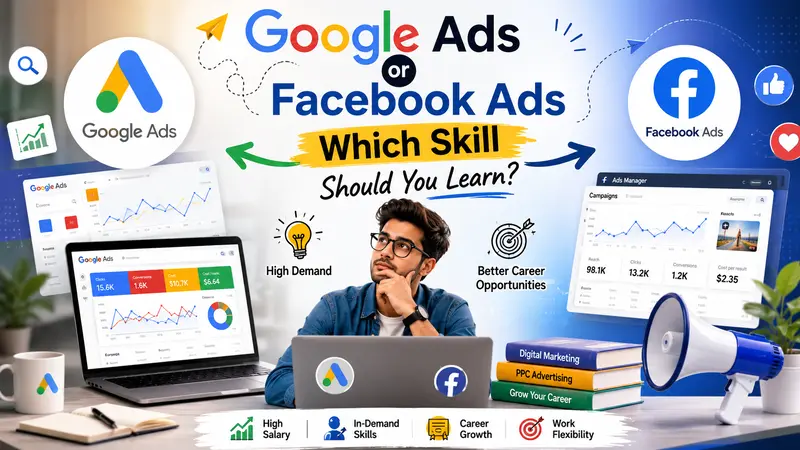
I get this question almost every week from students picking their first digital marketing skill. Google Ads or Facebook Ads? Which one pays better? Which one’s easier to learn? Which one actually gets you hired faster?
There’s no universal answer. But there is a right answer for you, based on where you’re starting and what you want out of this career.
Let’s break it down properly, with real scenarios, so you can stop going back and forth and actually pick one.
Why this question even matters
Both platforms run on completely different logic.
Google Ads is about intent. Someone types “best running shoes under 3000,” and you show up because you bid on that exact phrase. They’re already looking. You’re just the answer.
Facebook Ads (now under Meta Ads) works on interruption. Nobody’s searching for your product on Instagram. You’re showing up in their feed while they’re watching reels or stalking an ex’s vacation photos. You have to stop the scroll and create the want.
That difference changes everything: how you write copy, how you target, how you measure success, even how you think.
So when people ask, “Google Ads or Meta Ads,” they’re really asking: do I want to learn how to capture demand or how to create it?” Both are valuable. But they pull on different muscles.
Search engine advertising: the logic of Google Ads

Search engine advertising works because intent is sitting right there, typed out by the user.
I worked with a client years ago who ran a small water purifier business in Noida. We didn’t need flashy creatives. We needed three things: the right keywords, tight ad copy, and a landing page that didn’t waste the click.
Within 6 weeks, his cost per lead dropped from 850 rupees to 310. Not because we got smarter overnight. Because Google Ads rewards relevance. Match the search query, write copy that speaks to that exact need, and the algorithm does the rest.
This is what makes Google Ads such a strong starting skill. The cause and effect are visible. You bid on “water purifier service Noida”; someone searches that exact phrase, they click, and they convert. You can trace the whole path.
What you’ll actually learn
- Keyword research (match types, search terms reports, negative keywords)
- Quality Score and how ad rank actually works
- Bidding strategies: manual CPC, target CPA, target ROAS
- Landing page alignment (this trips up beginners constantly)
- Conversion tracking through Google Tag Manager and Analytics
Learning this stuff isn’t glamorous. It’s a lot of spreadsheets, search term reports, and small tweaks. But it teaches you how paid media math works at a fundamental level. That foundation carries over to every other platform later.
Get Free Demo Class ➔Meta Ads: the logic of demand creation
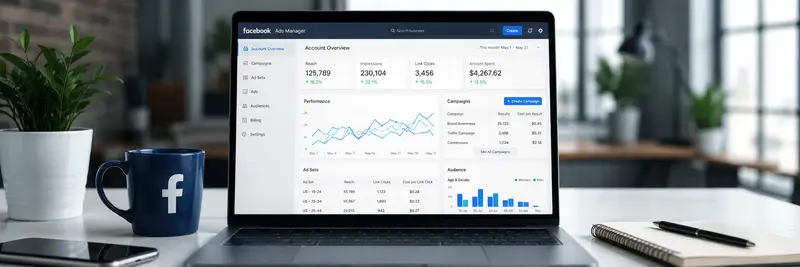
Here’s where it gets interesting. Facebook and Instagram don’t know what someone wants right now. They know who someone is: age, interests, behavior, and what they’ve engaged with before.
I had a friend launch a skincare brand on Instagram with zero existing audience. No search demand for her product name (nobody was googling it, obviously, since it didn’t exist yet). The entire job was to stop the scroll with a video, build curiosity, and convert cold traffic into a sale.
That’s a completely different skill than search ads. You’re not answering a question. You’re creating one.
Meta Ads rewards creative testing. Same offer, five different video hooks, and you’ll often see a 3x difference in click-through rate just from how the first 3 seconds look. The algorithm (Meta’s, I mean) is genuinely good at finding your audience once you give it the right signals through pixel data and conversion events.
What you’ll actually learn
- Audience targeting: interests, lookalikes, custom audiences
- Creative testing (this is 70% of the job, no exaggeration)
- Pixel setup and event tracking
- Funnel structure: top-of-funnel awareness, retargeting, conversion campaigns
- Ad fatigue and frequency management
If Google Ads is a science experiment with clear variables, Meta Ads is closer to filmmaking with a budget cap. Both require discipline. They just require different kinds.
Explore Trending Courses ➔Google Ads vs Meta Ads: the actual comparison
| Factor | Google Ads | Meta Ads |
|---|---|---|
| Buyer intent | High (they’re searching) | Low to medium (you create it) |
| Learning curve | Steep at first, logical once it clicks | Easier to start, harder to master creative testing |
| Best for | Services, local business, high-intent products | Lifestyle products, impulse buys, brand building |
| Skill type | Analytical, keyword-driven | Creative, audience-driven |
| Job demand in India | Very high, especially agencies | High, especially D2C and e-commerce brands |
Neither platform is “better.” They solve different problems. A real estate agent in Delhi probably needs Google Ads more than Meta Ads since people search for “2BHK flat for rent Dwarka” with real urgency. A jewelry brand selling trendy, affordable pieces probably leans Meta first because nobody’s searching for a product they don’t know exists yet.
Best PPC platform for beginners: my honest take
If you’re asking which is the best PPC platform to learn first, I’d lean toward Google Ads for one practical reason: it teaches you the underlying logic of paid media.
You learn how auctions work. You learn what the Quality Score actually rewards. You learn to read a search terms report and catch wasted spend before it bleeds your budget. These skills transfer to Meta, LinkedIn, and even Amazon Ads later.
Meta Ads, learned first, can sometimes give people a false sense of mastery. The interface is friendlier. Campaigns launch faster. But if your only metric is “did the ad get likes,” you haven’t actually learned PPC. You’ve learned to make content that performs in a feed, which is valuable, but it’s not the same skill.
That said (okay, I said I wouldn’t use that phrase, but here it actually fits), if your dream job is at a D2C brand or an e-commerce startup, Meta Ads might get your foot in the door faster. A lot of small brands hire Meta-first marketers before they ever touch Google.
So the honest answer: learn Google Ads for the foundation and learn Meta Ads for the creative and audience instincts. Ideally both, in that order.
Building a Google Ads career
A Google Ads career usually starts in one of three places: an agency, an in-house marketing team, or freelancing.
Agencies move fast. You’ll likely manage 4 to 8 client accounts within your first year, across different industries: healthcare, real estate, e-commerce, and education. That variety is brutal at first and incredibly useful later, because you learn how different industries convert differently.
In-house roles go deeper but narrower. You own one brand’s account; you know its history, its seasonality, and its customer behavior cold.
Freelancing is the long game. It takes longer to build trust, but the upside is real: I know PPC freelancers in Delhi NCR charging 15,000 to 40,000 rupees per month per client, managing 5 to 6 clients comfortably.
Certifications help, but they’re not the whole story. Google’s Ads certification (free, through Skillshop) proves you know the theory. What gets you hired is showing you’ve actually run campaigns, even small ones, even on your own money. A 5,000 rupee test campaign for a local bakery, documented properly with screenshots and learnings, beats a certificate with no proof behind it.
Get Free Career Counseling ➔Building a Meta Ads career
A Meta Ads career path looks a little different, mostly because the industry expects you to think like a marketer, not just a media buyer.
You’ll need to understand basic copywriting, since ad creative and copy are inseparable on this platform. You’ll need comfort with Canva or basic video editing, because static images alone rarely cut it anymore. Reels-style creative dominates right now.
I’ve seen people land their first Meta Ads role purely by running ads for their own small Instagram shop, even one that barely broke even. Hiring managers don’t expect profit from a beginner’s portfolio. They expect proof you understand funnels: cold audience, warm retargeting, lookalike scaling.
Salaries track close to Google Ads roles in most Indian agencies, sometimes slightly higher for people who can also shoot or edit creative, since that’s a rarer combined skill.
Mistakes beginners make on each platform
I’ve reviewed a lot of beginner ad accounts, both Google Ads and Meta Ads, and the mistakes tend to repeat.
On Google Ads, the biggest one is broad match keywords with no negative keyword list. I once audited an account for a coaching institute where 40% of the budget went to clicks from people searching “how to become a teacher” instead of “teacher training course. “Same general topic, completely wrong intent. A negative keyword list built in week one would’ve saved them roughly 18,000 rupees a month.
The second mistake: sending traffic to a homepage instead of a dedicated landing page. Search engine advertising only works if the click lands somewhere relevant to the exact query. A homepage forces the visitor to hunt for what they searched for. Most leave before they find it.
On Meta Ads, the most common mistake is launching with one creative and calling it a test. One video, one audience, no variation, then giving up after 3 days because “it didn’t work.” Meta Ads needs volume to learn. Without at least 3 to 4 creative variations running simultaneously, you’re not really testing anything; you’re guessing once and calling it data.
The second Meta mistake: ignoring frequency. I’ve seen campaigns where frequency hit 6 or 7 (meaning the same person saw the ad 6 or 7 times) and the marketer kept the budget flat, wondering why CPM kept climbing. Ad fatigue is real. Fresh creative every 2 to 3 weeks isn’t optional; it’s maintenance.
Real scenario: how I’d advise three different people
Scenario 1: Riya, 22, wants to work at a performance marketing agency in Gurgaon. My advice: start with Google Ads. Agencies almost always test Google Ads knowledge first in interviews, even for “social media” roles, because the underlying PPC math gets tested across platforms.
Scenario 2: Aman, 27, wants to launch his own D2C clothing brand. My advice: start with Meta Ads. He needs to create demand for a brand nobody’s heard of. Search intent doesn’t exist yet for his product.
Scenario 3: Priya, 35, runs a local dental clinic and wants more patients. My advice: Google Ads, no contest. People search “dentist near me” with real urgency. That’s intent you can’t manufacture through a feed ad.
See the pattern? It’s not about which platform is objectively stronger. It’s about matching the platform’s strength (intent vs. attention) to your actual goal.
What this means for your first 90 days
If you’re picking Google Ads first, your first month should be entirely keyword research and account structure. Don’t touch bidding strategy until you understand match types cold. Most beginners rush to “optimize” campaigns they haven’t even built correctly.
If you’re picking Meta Ads first, your first month should be creative volume. Shoot or source 10 to 15 different video and image variations before you even open Ads Manager properly. The targeting matters less than people think early on. The hook in your first 3 seconds matters more.
Either path, by day 90, you should be able to read your own account’s data without help and explain why a campaign is winning or losing. If you can’t do that yet, slow down. Speed without understanding just means you’ll repeat the same mistakes at a bigger budget later.
This is also where a lot of self-taught marketers get stuck. Watching YouTube tutorials teaches you which buttons to click. It doesn’t teach you why a campaign is bleeding money or how to diagnose a sudden CPM spike at 11pm before your client notices. That diagnostic instinct usually comes from either running your own money into the ground a few times or learning under someone who’s already made those mistakes for you.
Can you learn both at the same time?
Honestly, yes, and a lot of working professionals end up doing exactly that within their first year. The platforms reinforce each other.
Google Ads teaches you to read data coldly: CTR, CPC, conversion rate, and Quality Score. Once you understand that discipline, applying it to Meta’s dashboard (which has its own version of all these metrics) gets a lot less intimidating.
I’d still suggest sequencing it, though. Spend 2 to 3 months going deep on one platform before splitting your attention. Trying to learn both from day one usually means learning neither well. You end up with surface-level knowledge of two tools instead of real competence in one.
If structured learning suits you better than trial and error on your own ad account, a proper Digital marketing course in Noida covering both Google Ads and Meta Ads, with live campaigns and real budgets, will save you months of guesswork. The mentorship piece matters more than people expect, especially for catching mistakes before they cost real client money.
So, which should you learn first, Google Ads or Facebook Ads?
If I had to give you one line (and only one): learn Google Ads first for the analytical foundation, then add Meta Ads for the creative and audience-building skill set.
But don’t treat this as gospel. If your goals point clearly toward e-commerce, content-driven brands, or influencer-style marketing, start with Meta. If your goals point toward local business, lead generation, or B2B services, start with Google.
The platform you start with isn’t the platform you’ll stay with forever. Most performance marketers I know, myself included, end up running both within 2 years, regardless of where they started. The real skill isn’t “Google Ads” or “Meta Ads.” It’s understanding how people behave when they’re searching versus when they’re scrolling and writing campaigns that match that behavior.
Pick one. Get good at it. Add the other. That’s the path that actually works.