Every third “how do I become a backend developer” question on Reddit‘s r/developersIndia ends the same way: someone drops a link to a random Spring Boot roadmap image and says “follow this.” Half of those images are outdated. Some still list Spring Boot 2.x as current when Spring Boot 4 is already standard in most new projects.
So here’s a Spring Boot roadmap that’s actually current for 2026, built the way I’d explain it to a batch of students on day one: what to learn, in what order, and why each step matters for the job you’re trying to get.
Java isn’t fading. According to the Stack Overflow Developer Survey, Java sits consistently among the top 5 most-used languages worldwide, and most of that usage is backend, enterprise, and Spring-based work. Spring Boot alone powers a huge share of that. Recruiters searching Naukri and LinkedIn for “backend developer” overwhelmingly expect Spring Boot on the resume, not just Java.
Why Spring Boot, specifically
Plain Spring existed long before Spring Boot, and it worked. It also needed dozens of lines of XML configuration to wire up a single bean. Spring Boot’s whole pitch is auto-configuration: sensible defaults that get a working REST API running in minutes instead of days.
That’s why almost every Java backend job posting in India, from three-person startups to TCS-scale service companies, lists Spring Boot as a core requirement. Banks use it for internal tooling. E-commerce platforms use it for order and inventory services. Fintech companies lean on it for payment gateways where reliability actually matters. It’s boring in the best way: predictable and backed by a company that isn’t going anywhere.
Compare that to picking up Node.js or Django instead. Both are fine choices for backend work. But if you already know Java, or you’re choosing your first backend stack in India specifically, Spring Boot has more open roles, more senior mentors in the market who can review your code, and a much longer shelf life on your resume.
Who this spring boot roadmap is for
This guide works whether you’re
- A student who knows Core Java and wants a structured path into backend development
- A working professional switching from manual testing, support, or another stack into Java backend roles
- A self-taught developer who’s built a few small apps but keeps stalling before “production-ready”
If you haven’t touched Java yet, start there first. Our Java developer roadmap covers Core Java, OOP, and collections in depth before you even open a Spring Boot tutorial. Trying to learn Spring Boot without solid Java fundamentals is like learning to drive a manual car without knowing what a clutch does. You’ll copy code that works, then have no idea why it breaks.
Prerequisites before you start
Before the actual Spring Boot roadmap, lock down these basics:
| Skill | Why it matters | Time needed |
|---|---|---|
| Core Java (OOP, collections, exceptions) | Spring Boot is Java underneath; weak fundamentals show up fast | 6-8 weeks |
| SQL basics | Every real app talks to a database | 1-2 weeks |
| Git and GitHub | Every team, every job, uses version control | 3-5 days |
| Maven or Gradle | Spring Boot projects are built and packaged with these | 3-4 days |
Skip any of these and you’ll hit a wall around week 3 of Spring Boot itself. I’ve watched it happen with batch after batch: students rush past Java collections, then spend two extra weeks confused about why a List<Optional<User>> behaves the way it does.
The complete spring boot roadmap, stage by stage
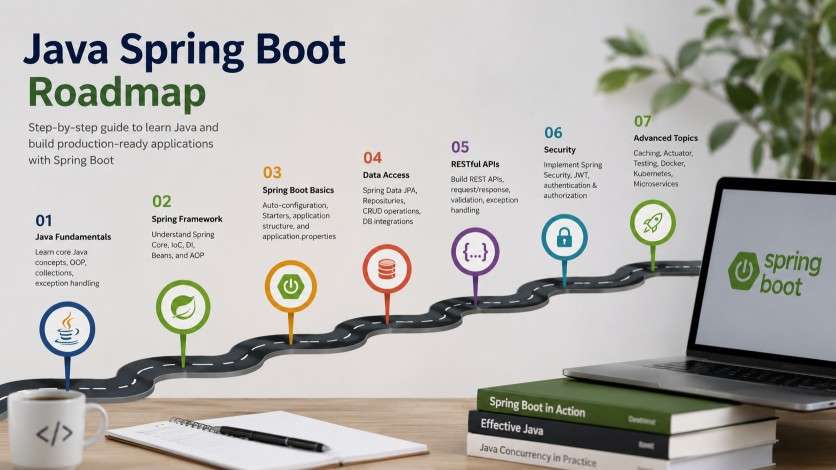
Here’s the Java Spring Boot roadmap broken into 8 stages. Timelines assume 2-3 focused hours a day, adjusted for a beginner starting from scratch.
Stage 1: Spring Core and Dependency Injection (weeks 1-2)
Before Spring Boot auto-configures everything for you, understand what it’s automating. Learn inversion of control, dependency injection, beans, and the application context. Skipping this stage is the single biggest reason developers can use Spring Boot but can’t debug it when something goes wrong.
Stage 2: Spring Boot fundamentals (weeks 3-5)
This is where the spring boot roadmap actually starts producing visible results. Cover:
- Auto-configuration and starter dependencies
@RestController,@Service,@Repository,@Component- Building your first REST API with GET, POST, PUT, DELETE endpoints
- application.properties vs application.yml
- Profiles for dev, test, and production environments
Build a small CRUD API here. A “notes app” or “task tracker” is fine for practice, even if it’s not resume-worthy yet.
Stage 3: Data access with Spring Data JPA and Hibernate (weeks 6-8)
Connect your API to a real database. PostgreSQL or MySQL both work; pick one and stick with it. Learn entities, repositories, JPQL, pagination, and how Hibernate actually generates SQL under the hood (turn on show-sql and read the output; it teaches you more than any tutorial).
Stage 4: Validation, exception handling, and API design (week 9)
A REST API that returns a raw 500 error with a stack trace is a rejection letter in interview terms. Learn @Valid, custom exception handlers with @ControllerAdvice, and proper HTTP status codes. This is the stage most self-taught developers skip, and it’s the one interviewers notice first.
Stage 5: Spring Security and authentication (weeks 10-12)
Add JWT-based authentication, role-based authorization, and password encryption with BCrypt. Nearly every Spring Boot developer roadmap I’ve seen from hiring managers lists security as a hard requirement, not a bonus skill. Companies won’t put an unauthenticated API into production, and they won’t hire someone who’s never built one either.
Stage 6: Testing (weeks 13-14)
Write unit tests with JUnit 5 and Mockito. Write integration tests with @SpringBootTest. If your only testing experience is manually hitting endpoints with Postman, this stage is where you close that gap. Teams doing code reviews will ask about test coverage before they ask about anything else.
Stage 7: Microservices, Docker, and messaging (weeks 15-20)
Split a monolith into two or three services. Learn Spring Cloud basics: service discovery, API gateways, and config servers. Add Docker so your app runs the same way on your laptop and on a server. RabbitMQ or Kafka for async messaging rounds this out. This stage is optional for junior roles but expected for mid-level ones.
Stage 8: Deployment and CI/CD (weeks 21-24)
Deploy to AWS, Azure, or Render. Set up a GitHub Actions pipeline that builds, tests, and deploys automatically. This is the difference between “I built an app” and “I ship software,” and interviewers can tell the difference in about 90 seconds.
Spring boot learning roadmap timeline: what’s realistic
| Background | Time to junior-ready |
|---|---|
| Complete beginner (learning Java from zero) | 8-10 months |
| Knows Core Java, new to Spring | 4-5 months |
| Experienced in another backend stack (Node, Django) | 2-3 months |
These numbers assume daily practice, not weekend-only effort. A Spring Boot learning roadmap followed for 45 minutes every few days will stretch a 5-month plan into 14 months. I’ve seen that happen more times than I can count.
Spring boot developer roadmap: skills recruiters actually check
Job descriptions list a lot. Interviews test a smaller, sharper set:
- Can you explain what happens when a request hits a Spring Boot controller, end to end?
- Can you design a database schema for a given problem, not just use one that’s handed to you?
- Do you understand transaction management (
@Transactional) and when it’s needed? - Can you talk through N+1 query problems in Hibernate and how to fix them?
- Have you handled pagination and filtering on a real dataset, not a 10-row demo table?
If you can answer all five with a real project behind each answer, you’re ahead of most candidates with the same years of experience on paper.
Projects to build along your spring boot roadmap
Reading documentation doesn’t get you hired. Projects do. Build these in order of increasing complexity:
- A task management API with user authentication and role-based access
- An e-commerce backend with product catalog, cart, and order processing
- A blog platform with comments, likes, and admin moderation
- A booking system (appointments, seats, or slots) that handles concurrency correctly
For a longer, more detailed list with build times and skill breakdowns, check our Java project ideas guide. Each project there maps to a specific stage of this roadmap, so you can match your build to what you’ve just learned instead of guessing.
Spring boot career roadmap: roles, salaries, and what comes next
A typical spring boot career roadmap in India looks roughly like this:
| Role | Experience | Approximate salary (India) |
|---|---|---|
| Junior Backend Developer (Spring Boot) | 0-2 years | ₹4-8 LPA |
| Backend Developer / SDE-1 | 2-4 years | ₹8-15 LPA |
| Senior Backend Developer | 4-7 years | ₹15-28 LPA |
| Backend Architect / Tech Lead | 7+ years | ₹28-45 LPA+ |
Numbers vary a lot by city, company size, and whether you’re also comfortable with cloud and microservices. Specializing in Spring Boot plus Kubernetes plus one cloud platform (AWS is the most commonly requested in Indian job postings) tends to push offers toward the higher end of each band.
Common mistakes on the spring boot roadmap
A few patterns show up again and again in students who stall out:
- Jumping into Spring Boot before Java fundamentals are solid
- Watching tutorials without typing the code themselves
- Building only tutorial-clone projects with no personal twist or added feature
- Skipping testing entirely because “it slows me down”
- Never deploying anything, so every project stays a localhost demo
Fixing any one of these and your resume already looks different from 80% of the applicants doing the same course.
Tools you’ll actually use
A roadmap without tools is just theory. Here’s what to install and get comfortable with early:
| Tool | Purpose |
|---|---|
| IntelliJ IDEA (Community Edition) | Primary IDE; free tier covers everything you need for this roadmap |
| Postman | Test your REST endpoints before a frontend exists |
| DBeaver or pgAdmin | Browse and query your database visually |
| Docker Desktop | Package and run your app in containers |
| Git + GitHub | Version control, non-negotiable for any job application |
Get comfortable with these in month one. Fumbling with your IDE during an interview coding round costs more time than most candidates realize.
Where to learn Spring Boot properly
A structured spring boot roadmap works best with a mentor checking your code, not just a YouTube playlist. At Appwars Technologies, our Java course in Noida covers Core Java through Spring Boot, security, and deployment, with real projects reviewed by trainers who’ve worked in production teams. If you’re comparing institutes first, our breakdown of the top Java courses in Noida is a good place to check curriculum and placement support side by side before you commit.
FAQs for Java Spring Boot Roadmap
How long does it take to learn Spring Boot from scratch?
For someone starting with zero Java knowledge, budget 8-10 months for a job-ready level. If you already know Core Java well, 4-5 months is realistic.
Is Spring Boot still relevant in 2026?
Yes. Spring Boot 4 shipped with a modular codebase and better cloud-native support, and job postings for Java backend roles overwhelmingly list it as a requirement, not an option.
Do I need to learn Spring MVC before Spring Boot?
Not strictly. Spring Boot builds on Spring’s core concepts, but you can learn dependency injection and REST fundamentals directly through Spring Boot without a separate Spring MVC detour.
What should I build first?
A CRUD REST API with a database connection. Keep it small. A finished notes app teaches you more than a half-built e-commerce platform.
Is Spring Boot harder than Node.js or Django?
It has a steeper initial learning curve because of annotations and configuration conventions, but it pays off in structure once you’re working on a large codebase with a team.
Can I get a job with only Spring Boot and no microservices experience?
Yes, for junior and mid-level roles. Most companies hiring for their first two or three years of experience care more about solid REST API fundamentals, clean database design, and testing than microservices exposure. Microservices matter more once you’re targeting senior or architect-level roles.
Should I learn Spring Boot 3 or wait for Spring Boot 4 features to stabilize?
Learn whichever version your target companies are running today, and check job descriptions in your city for the specific version mentioned. Most production codebases in India are still on Spring Boot 3.x, so that’s the safer starting point even as Spring Boot 4 adoption grows.
Follow this Spring Boot roadmap in order; build something at every stage, and don’t skip testing or deployment just because they feel less exciting than writing controllers. That’s the part that actually separates hired candidates from the rest of the pile.