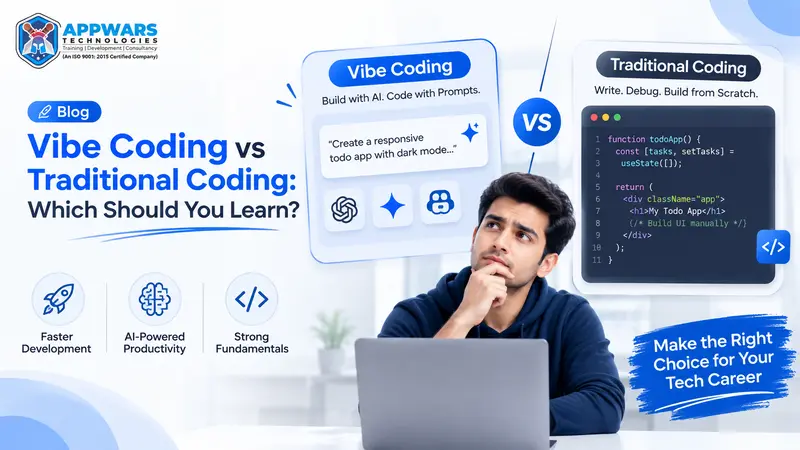
Coding changed entirely over the last 18 months. You type a prompt. Claude AI spits out a functioning web app in 30 seconds. You guide the machine using natural language.
Traditional coding means you write every line. You memorize syntax. You track down a missing semicolon in your JavaScript file for three hours at 2 AM. You manually wire up the database, the server, and the frontend.
So which one matters now?
Students and working professionals constantly ask me this. They want to know if manual coding is a waste of time. They see tools like ChatGPT and GitHub Copilot doing the heavy lifting. They wonder if they should just learn to prompt.
The choice between vibe coding vs traditional coding dictates how you will spend the next five years of your career. I think you need both. But the order you learn them matters.
Here is a look at exactly how these two approaches work in the real world.
What exactly is vibe coding?
Vibe coding is prompt-driven development. You act as the architect. The AI acts as the bricklayer.
You open a tool like Cursor or ChatGPT. You describe what you want in plain English.
You might type something like this:
"Build a Python script that scrapes the top 10 headlines from Hacker News.
Format the output as a JSON file.
Include error handling if the site is down."
The AI generates 50 lines of Python. You paste it into your editor. You run it. It usually works on the first try.
You skipped the manual labor. You bypassed reading the Beautiful Soup documentation. You just gave an instruction and got a result.
This is incredibly fast. Working professionals use this to blast through boilerplate code. They can spin up the skeleton of an application in minutes.
The reality of traditional coding
Traditional coding requires you to build the mental model yourself. You start with a blank file.
If you want a login screen, you write the HTML. You style it with CSS. You write the JavaScript to capture the form submission. You manually configure the server to hash the password and store it in a database.
You have to understand how data moves. You must know the difference between a string and an integer. You need to know how memory works (especially if you touch languages like C++ or Java).
It is slow. It is frustrating. It requires months of dedicated study just to build something ugly that barely works.
But traditional coding builds a foundational map in your brain. You understand the machine. You know exactly why a piece of code behaves the way it does.
The core difference between vibe coding and traditional coding
We can break down the vibe coding vs coding debate into a few specific categories. The approaches require completely different mental muscles.
| Feature | Vibe Coding | Traditional Coding |
|---|---|---|
| Speed to prototype | 5 minutes | 5 hours |
| Required knowledge | System design, logic, clear communication | Syntax, algorithms, specific language rules |
| Debugging process | Pasting errors back into the AI | Reading stack traces, stepping through code |
| Best suited for | Boilerplate, quick scripts, exploring ideas | Complex logic, custom architecture, performance tuning |
| Risk factor | Hallucinations, security vulnerabilities | Human error, typos, burnout |
AI coding vs manual coding in the real world
The industry numbers tell a clear story.
GitHub reports that developers using Copilot code 55% faster. Stack Overflow’s 2023 survey showed over 70% of professional developers actively use AI tools in their daily workflow.
AI coding is the new baseline. You will fall behind if you refuse to use it.
But those stats hide a massive trap for beginners.
Professional developers get that 55% speed boost because they already know how to code. They know what to ask the AI. They can spot a hallucination instantly.
When a beginner relies entirely on AI, they hit a wall. I call it the loop of despair.
The student asks ChatGPT for a React component. ChatGPT provides it. The student runs the code. It throws a vague dependency error. The student copies the error and pastes it back to ChatGPT. ChatGPT apologizes and gives new code. That code breaks something else.
An hour later, the project is a tangled mess of conflicting libraries. The student has no idea how to fix it because they never understood the code in the first place.
A senior developer spots that same initial error. They realize it is just a mismatched version number in the package.json file. They manually fix it in 10 seconds and keep moving.
This is the main difference between vibe coding and traditional coding. One creates dependency. The other creates autonomy.
Why beginners must learn manual coding first
You have to learn how to read before you can edit. AI generates code. You have to edit it.
If you start your journey by exclusively vibe coding, you are building a house on sand. You will freeze the second the AI gives you a bad answer.
You need to understand the underlying mechanics of the languages you use. You must know how a loop iterates. You need to understand API rate limits. You have to grasp object-oriented programming.
If you plan to build enterprise applications, you need strict foundational logic. Taking a structured Java course forces you to understand types, classes, and memory management. Java does not let you cheat. It forces you to write exact, intentional code.
That manual struggle wires your brain for problem-solving.
When you learn manually, you build an internal compiler. You learn to read a block of code and predict what it will do before you press run. AI cannot give you that intuition. Only hours of manual typing and debugging can.
Navigating the full stack manually
Modern web development requires managing multiple layers of technology at once. You have a database, a backend server, and a frontend interface.
You can ask Claude AI to build a full web app. It will try. It usually struggles to connect all the pieces perfectly.
The database might use a different data structure than the frontend expects. The authentication token might not pass correctly between the server and the client. AI struggles with context across multiple large files.
You need to know how these pieces fit together. You must understand the data pipeline.
A complete MERN Stack course (MongoDB, Express, React, Node.js) teaches you that plumbing. You learn how data flows from the database to the screen.
Once you understand that flow, your vibe coding improves drastically. You stop asking the AI to “build an app.” You start asking it to “write an Express route that accepts a POST request and inserts a document into MongoDB.”
Specific prompts yield better code. You only learn those specific technical terms by studying traditional coding.
How working professionals use vibe coding
Senior engineers use AI differently than juniors. They use it as a highly capable intern.
A professional does not ask the AI to design the system architecture. They do that on a whiteboard. They decide where the microservices live. They design the database schema.
Then they use vibe coding to execute the tedious parts.
They need a Python script to parse a massive CSV file and clean the data. Writing that manually takes 45 minutes of looking up pandas documentation.
They type a quick prompt instead. ChatGPT generates the script in 10 seconds. The professional reviews it, tweaks one line of logic, and runs it. They just saved 44 minutes.
Python is specifically built for this kind of rapid execution. It reads like English. It is the dominant language for data science and AI. If you want to master this rapid prototyping workflow, completing a Python full-stack course gives you the exact skills needed to review and modify AI-generated scripts safely.
Professionals vibe code the syntax. They manually code the business logic.
The risk of security flaws
Security is a major factor in the AI coding vs manual coding conversation.
AI models train on public repositories. Those repositories contain millions of lines of outdated, insecure code. When you ask an AI for a login system, it might give you a solution using an outdated hashing algorithm.
If you do not know how to evaluate the code, you will push a security vulnerability to production.
A traditional coder knows to check the dependencies. They know how to sanitize user inputs to prevent SQL injection. They understand the principles of least privilege.
You cannot outsource security to an LLM. You are legally and professionally responsible for the code you deploy. You must be able to read it manually.
Breaking down specific languages
The success rate of vibe coding depends heavily on the language you use.
Python is the easiest language to vibe code. The syntax is clean. The AI models have ingested billions of lines of Python. ChatGPT can write complex Python algorithms with shocking accuracy.
JavaScript is messy. It has a massive ecosystem of constantly changing frameworks. Vibe coding a React component works well. Vibe coding a complex Webpack configuration usually results in broken builds. You need deep manual JavaScript knowledge to fix the AI’s mistakes.
Java and C# are strict. They require heavy boilerplate and strict type definitions. Vibe coding helps generate the initial class structures. You still need strong manual skills to integrate those classes into a large enterprise codebase.
The hybrid approach
You do not have to choose just one. The best developers merge both skills.
They use traditional coding to build their foundation. They learn the hard way. They suffer through the syntax errors. They build ugly apps from scratch.
Once they understand the rules, they use vibe coding to break them. They use AI to speed up their workflow by 10x.
They open their editor. They use an AI autocomplete tool. They write the first line of a function, and the AI suggests the rest. They read the suggestion. If it matches their mental model, they hit tab to accept it. If it looks wrong, they keep typing manually.
This is the sweet spot. You get the speed of AI with the safety of human oversight.
Which skill should you learn first?
If you are a student, you must learn traditional coding first.
Ignore the people on Twitter saying coding is dead. Syntax is just the surface layer of programming. Coding teaches you how to break massive, complex problems into tiny, solvable steps. AI cannot do your critical thinking for you.
Pick a language. Build small projects. Debug them manually. Feel the pain of a broken application. That pain is where the actual learning happens.
If you are a working professional in a non-technical role (like marketing or product management), you can start with vibe coding.
You do not need to build enterprise software. You just need a script to automate your weekly report. You need a quick HTML landing page for a campaign. AI can do that for you right now.
You can prompt your way to a solution. As your needs get more complex, you will naturally hit the limits of vibe coding. That is when you can go back and learn the underlying traditional coding concepts.
The future of the developer
We are moving toward a world where developers write less syntax.
Ten years ago, developers managed physical servers. Now we use cloud providers. We abstracted the hardware layer.
AI is abstracting the syntax layer. You will spend less time typing brackets and more time designing systems.
But the fundamental job remains the same. You have to tell a computer exactly what to do. The computer is stupid. It only does what you specify.
When you evaluate vibe coding vs traditional coding, remember that the core skill is logic. Traditional coding is the gym where you build that logical muscle. Vibe coding is the tool you use to apply that muscle at scale.
Start with the fundamentals. Understand the machine. Then use AI to build faster than ever before.