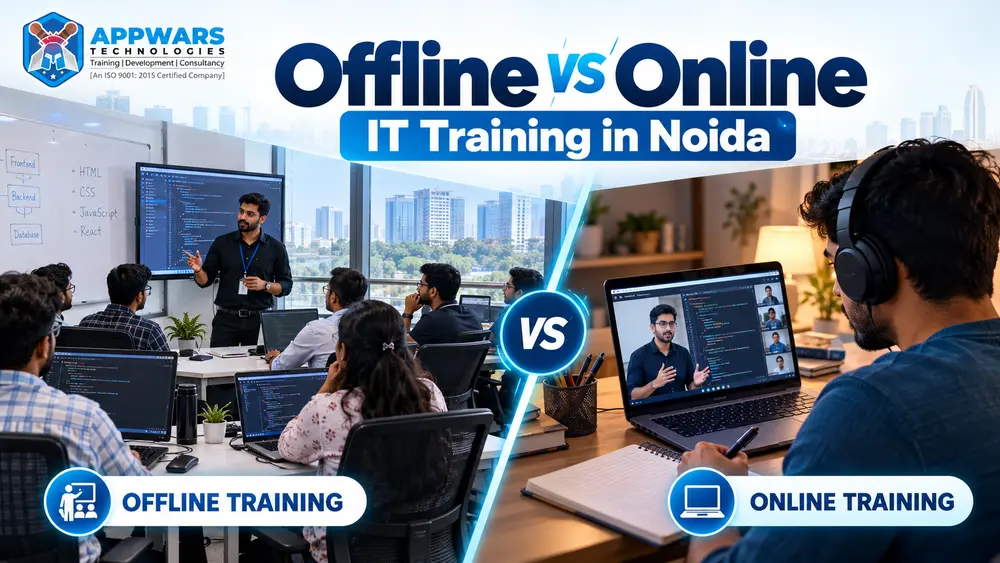
Most students weighing IT courses in Noida get stuck on the same question: classroom or laptop? The fee, the commute, and the timetable all matter. But the question that should carry the most weight is which format gets you hired.
I’ve spent over a decade in digital marketing and training, and I’ve watched students from both formats land jobs and struggle to find them. Here’s what actually separates the two.
Get Free Demo Class ➔What “Placement Success” Really Means
Placement success is more than a signed offer letter. It usually covers:
- Interview calls you get in the first three months after finishing
- Offers that match the role you trained for
- Time from course completion to your first paid job
- Confidence you can explain and defend the projects on your resume
Keep these four points in mind as we compare formats.
Offline Classroom Training
A classroom batch in Noida gives you face-to-face access to your trainer, the lab machines, and your batchmates. You can ask a question mid-lecture and get an answer before the topic moves on.
Where offline training helps:
- Immediate doubt clearing during live coding
- Access to on-site systems and software you may not have at home
- In-person mock interviews with feedback on body language and communication
- Easier attendance at walk-in drives and employer visits
- A peer group that keeps you accountable on the days you’d rather skip
Where it falls short:
- Fixed timings that don’t suit people who already have a job
- Daily commute, which eats time and energy in Noida traffic
- Limited flexibility if you miss a session
Online IT Training
Online training lets you learn from home, your office, or a hostel room. Most programs record sessions, so you can revisit a difficult topic at your own pace.
Where online training helps:
- Flexible schedules for working professionals and career switchers
- Recorded sessions for revision
- Access to students outside Noida
- Often lower overall cost once you factor in transport
Where it falls short:
- Requires strong self-discipline, especially without a fixed routine
- Fewer spontaneous conversations with trainers and peers
- Weak results if the institute doesn’t provide structured labs and live project reviews
Offline vs. Online: Side-by-Side
| Factor | Offline classroom | Online IT training |
|---|---|---|
| Live doubt clearing | Immediate, in person | Through live calls or chat, may be slower |
| Hands-on lab access | On-site systems | Depends on the remote lab setup |
| Mock interviews | Face-to-face, easier to practice body language | Video-based, usually easier to schedule |
| Placement drives | Easier to attend in person | Mostly invitation-based, sometimes remote |
| Schedule flexibility | Low | High |
| Commute cost and time | Yes | None |
| Self-discipline needed | Moderate | High |
| Best suited for | Freshers who need structure | Working professionals and self-driven learners |
So, Which Gives Higher Placement Success?
Here’s my honest read. The format matters less than the practice and support around it. Still, the two formats tend to favor different people.
For most freshers in Noida, an offline or hybrid batch with regular live mock interviews gives a stronger push toward a first job. The structure, the lab time, and the in-person placement access tend to matter more when you have no work experience yet.
Working professionals who want to upgrade a skill often do just as well online. They already have a daily routine and a reason to show up, and a flexible schedule keeps them from quitting halfway. I think this holds for most learners, though I can’t prove it with a clean dataset.
The real test is whether the institute gives you projects, feedback, and interview practice. Any format without those will struggle to produce placements.
How to Evaluate IT Training Institutes in Noida with Placement Support
Before you pay anything, ask these questions:
- Can you see placement records with details? Ask for batch-wise data with role, company type, and month of joining. Vague claims like “100% placement” with no names or dates deserve skepticism.
- What does placement support include? Look for resume review, mock interviews, aptitude preparation, and employer tie-ups. Find out whether these apply to online students too.
- How big is the batch? Smaller batches usually mean more individual feedback.
- Who teaches, and what have they built? Check the trainer’s industry experience and whether they’ve worked on real projects.
- Will you build a portfolio? Ask what projects you’ll finish and whether you’ll get code or design reviews.
- What’s the refund or re-attend policy? A fair policy shows the institute expects to deliver.
Be wary of any institute that promises a guaranteed job. Nobody can guarantee an offer, and anyone who does is selling you a feeling.
Get Free Demo Class ➔Which Format Fits Your Situation?
| Your situation | Likely better fit | Why |
|---|---|---|
| Fresh graduate with no work experience | Offline or hybrid | Structure, mock interviews, and in-person drives help most. |
| Working professional upskilling | Online | Schedule flexibility keeps you consistent. |
| Career switcher from a non-IT field | Offline first, then online for revision. | Foundations are easier to build with a trainer nearby. |
| Student living outside Noida | Online | Avoids relocation costs |
Final Thought
Pick the format you’ll actually attend every week. A slightly less convenient classroom beats a recorded course you never finish, and a flexible online program beats a classroom you drop after two weeks. Whichever you choose, insist on real projects, honest placement data, and regular interview practice.
If you’re comparing options in Noida, you can explore our trending courses or visit our Sector 2 center for a free counselling session.