If you’re still running SEO like it’s 2022, you’re going to have a rough year.
Google’s AI Mode crossed 1 billion monthly users in 2026. Queries are doubling every quarter. AI Overviews now show up in roughly 26% of US searches, and when one appears, the top organic result loses more than half its usual clicks. That’s not a future problem. That’s what’s happening to your traffic right now, this month, on pages you’ve already published.
So you need an SEO roadmap that actually accounts for this. Not a checklist from 2019 with “add AI” sprinkled on top. A real plan, the kind you can hand to a junior team member and say, “Follow this in order.”
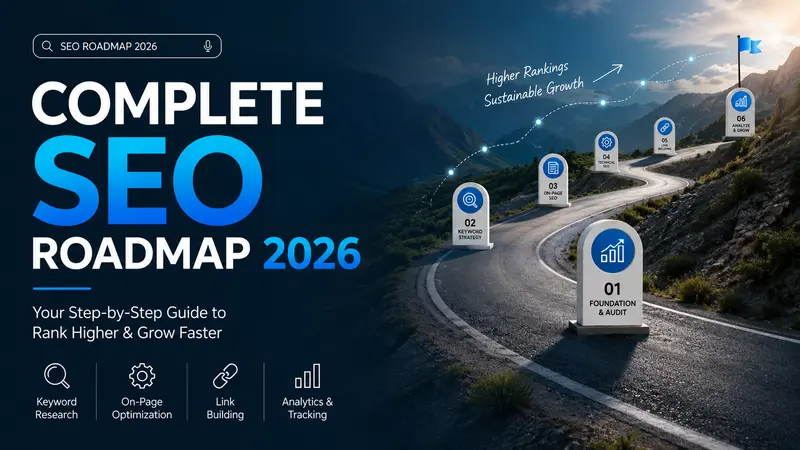
That’s what this is. A complete SEO roadmap strategy broken into phases, with the technical groundwork, the content engine, and the AI-search layer all mapped out. I’ll flag where old advice is dead wrong, where it still holds, and where the AI SEO roadmap diverges from what you learned three years ago.
Why your old SEO playbook is leaking traffic
Here’s the uncomfortable part first.
Impressions are up. Clicks are down. If your Search Console graph looks like a pair of scissors opening, that’s not a glitch. That’s AI Overviews and AI Mode absorbing the answer before the user ever reaches your page.
Danny Sullivan, Google’s search liaison, said something in early 2026 that should be printed and stuck above every content team’s desk: Google’s engineers specifically advised against chopping content into tiny chunks meant for AI to “snack on.” Google’s systems read full pages. They extract what’s relevant. Writing disjointed 50-word answer blocks doesn’t help you; it just makes your page worse for the humans who do click through.
So the fix isn’t gaming a new system. It’s getting better at the old one, with a few additions for how AI surfaces actually pull and cite content.
That’s the whole premise of any SEO roadmap worth following in 2026: foundational SEO, done properly, plus a citation layer on top.
Phase 1: Technical foundation (weeks 1-4)
Skip this phase and everything after it wobbles. I’ve seen teams pour budget into content while their site couldn’t get crawled properly. Waste of money.
Crawlability and indexing
Pull your Search Console coverage report. Look for:
- Pages marked “crawled, not indexed” (usually a thin content or duplication problem)
- Orphan pages with zero internal links pointing in
- Redirect chains longer than 2 hops
- XML sitemap entries that 404 or redirect
Fix the sitemap first. It sounds boring. It’s also the thing most often half-broken on sites that have been live for 3+ years and changed CMS or URL structure at some point.
Core Web Vitals
INP (Interaction to Next Paint) replaced FID as the responsiveness metric, and it’s stricter. A button that takes 250 ms to respond used to pass under FID. Under INP, that’s borderline.
Run your top 20 pages by traffic through PageSpeed Insights. Don’t fix everything. Fix whatever’s pushing INP over 200ms and LCP over 2.5 seconds, because those are the two that move the needle.
Schema markup
Google retired FAQ-rich results from search listings in May 2026. People read that and assumed FAQ schema was dead. It’s not; it just stopped getting the visual snippet in regular results.
What it still does: helps AI systems parse your page structure and resolve entities faster. Article schema, organization schema, and person schema for your authors still earn their place. Skip FAQPage schema unless you’re running genuine user-submitted Q&A. Otherwise it’s just markup for markup’s sake now.
Mobile and security basics
HTTPS everywhere, no mixed content warnings, mobile rendering matches desktop. If you’re still checking these in 2026, something went wrong upstream. But check anyway. I’ve audited “modern” sites with broken HTTPS on subdomains nobody remembered existed.
Get Free Career Counseling ➔Phase 2: Keyword and intent mapping (weeks 3-6)
Old-school keyword research grabbed a list of terms and matched volume to pages. That’s still step one. It’s just not the whole job anymore.
Map intent, not just volume
A search like “best running shoes for wide feet, half marathon, under $150” used to be impossible to target. Now it’s exactly the kind of query AI Mode handles well, and Jeffrey Cohen at Skai pointed out something useful here: shoppers aren’t typing “running shoes” anymore. They’re asking full, specific questions.
That means your keyword research needs a second column: not just search volume, but query length and specificity. Short head terms still matter for top-of-funnel awareness. But the conversational, multi-clause queries are where commercial intent concentrates now.
Build topic clusters, not keyword lists
One pillar page. Several supporting articles, each targeting a related question or sub-topic. Internal links running both directions. Hub-and-spoke architecture has been good for SEO since 2017. What’s changed is the stakes: AI systems lean toward sources that demonstrate depth across a whole topic, not a single strong page surrounded by thin ones.
Run a content gap audit against your sitemap. Export 12 months of Search Console data, cross-reference against your existing URLs, and look for queries you’re getting impressions on with zero matching pages. That gap is your content calendar for the next quarter.
AI SEO roadmap addition: query fan-out
Multi-turn queries are growing fast inside AI Mode; follow-up questions are increasing by roughly 40% month over month in the US. A user asks something broad, gets an answer, then asks something narrower.
Practical move: for every pillar topic, list out the 3-4 obvious follow-up questions a reader would ask next, and make sure you have a page (or a clear section) answering each one. If your content only answers the first question in the chain, the AI surface moves on to whoever answers the second and third.
Phase 3: Content production (ongoing, weeks 5+)
This is where most roadmaps for SEO get vague. Mine won’t.
Write for the “who, how, why” test
Google’s own helpful content guidance boils down to three questions: Who made this? How was it made? Why does it exist? If the honest answer to “why does it exist” is “to rank for this keyword,” the content is going to struggle no matter how well-optimized the H2s are.
Practically, this means:
- Real bylines with actual credentials, not “Admin” or “Team”
- First-hand specifics: a number you measured, a screenshot from your own dashboard, a mistake you made and fixed
- Original framing. Don’t just answer the question; answer it in a way that required you to actually know something
Keyword density, the boring but necessary part
Primary keyword (SEO roadmap) in the title, H1, and first 100 words. Secondary terms (SEO roadmap strategy, roadmap SEO, roadmap for SEO, AI SEO roadmap) are distributed naturally through subheads and body copy, not stuffed into one paragraph.
Target density: 1% to 2.5%. Above that, it reads like keyword soup, and Google’s spam systems have gotten good at spotting it. Below 1%, you’re probably under-optimized for the term you actually want to rank for.
Structure for citation
This is the part that’s genuinely new. AI Overviews and AI Mode pull specific passages, not whole articles. The passages that get pulled tend to share traits:
- A direct, complete answer in the first sentence or two of a section (no throat-clearing)
- A specific number or stat with a clear source
- Comparison tables for anything involving 2+ options
- Headings written as actual questions where that matches how people search
92.36% of AI citations come from pages that are already ranking in the top 10 organically. That’s the part people skip past when they get excited about “optimizing for AI.” Ranking well the old-fashioned way is still the price of entry. The citation-friendly formatting is what happens after you’ve earned the ranking, not instead of it.
Refresh cadence
Anything older than 12 months on a topic that moves (which, in 2026, is most topics touching AI, tools, or anything regulatory) needs a review. Update the date, fix the stats, and add a section if the landscape shifted. A visible “last updated” date matters more now than it did even two years ago, because freshness is one of the few trust signals readers can check themselves before AI even gets involved.
Get Free Demo Class ➔Phase 4: E-E-A-T and brand signals (weeks 6-10, then continuous)
E-E-A-T isn’t new. What’s new is how much weight it’s carrying.
Experience and expertise
Author bios need actual substance: years in the field, specific credentials, a link to other work. If you’ve got a writer who’s spent 4 years doing hands-on SEO work, say that with specifics, not “passionate digital marketing professional.”
Authoritativeness, the part that lives off your site
This is the one most teams under-invest in. Authoritativeness gets built through being mentioned, cited, and discussed in places you don’t control: industry forums, LinkedIn posts from people in your space, and other sites linking to your research.
AI systems build their sense of “who’s an authority here” partly from training data and citation patterns across the web, not just from crawling your homepage. So digital PR, guest contributions, and getting quoted in roundups all matter more in 2026 than they did when backlinks were mostly about anchor text and domain authority scores.
Trustworthiness, the unglamorous checklist
Contact info that’s real and findable. Privacy policy that’s current. Author pages that aren’t 404ing. Reviews and testimonials where relevant. None of this is exciting. All of it gets checked by raters and increasingly by AI systems deciding whether to trust a source enough to cite it.
Phase 5: AI search visibility (continuous from week 1)
Treat this as a parallel workstream, not a separate project that starts after “real” SEO finishes.
Track citations as their own KPI
Rankings and clicks don’t capture the full picture anymore. Set up tracking for whether you’re showing up inside AI Overviews and AI Mode responses, separate from organic position. Tools for this are still maturing through 2026, so manual spot checks (search your money queries; see what’s cited) are still worth doing weekly.
Brands that get cited inside AI Overviews see roughly 35% more organic clicks than competitors who rank but don’t get cited. That’s a real number, not a vanity metric. Visibility inside the AI answer drives clicks to the answer’s source, sometimes more reliably than a plain blue link does.
Don’t chase fake brand mentions
Google’s May 2026 optimization guide specifically called out seeding fake mentions across forums and blogs as a tactic that carries real downsides. Spam filtering systems are built to catch exactly this. If your “digital PR strategy” is paying for placements that exist only to manufacture brand signal, you’re not ahead of the curve; you’re building a liability.
Prepare for agent traffic
This one’s still early but worth a line item. Google’s information agents and similar tools from other providers are starting to browse and act on behalf of users, not just answer questions. For e-commerce or booking-heavy sites, that means structured product feeds and clean, predictable page markup aren’t optional extras anymore; they’re how an agent finds out you exist at all.
Explore Trending Courses ➔Phase 6: Measurement and reporting (ongoing)
Your reporting needs an update too, or you’ll be explaining “good” numbers as if they’re bad ones. A solid seo roadmap tracks the full picture, not just rank position.
Track these together, not in isolation:
| Metric | Why it matters now |
|---|---|
| Organic rankings | Still the entry ticket, especially for AI citation eligibility |
| Impressions vs. clicks | A growing gap isn’t failure; it might mean AI Overviews are absorbing clicks |
| AI citation appearances | Manual or tool-based tracking of when you show up inside AI answers |
| Branded search volume | Recognition and recall, harder to fake than rankings |
| Direct and referral traffic | Signals of brand strength that don’t depend on any single algorithm |
If clicks dip but branded search and direct traffic climb, that’s not a crisis. That’s recognition compounding. Read the whole picture before panicking over one chart.
A realistic 90-day timeline
Putting the phases on a calendar, roughly:
Days 1-30: Technical audit and fixes. Keyword and intent mapping. Content gap analysis against your sitemap.
Days 31-60: Content production ramps up. The first batch of pillar and cluster content goes live, structured for both human readers and AI citation. Author bios and E-E-A-T signals get fixed across existing pages.
Days 61-90: Digital PR push for off-site authority signals. AI citation tracking goes from “occasional manual check” to a real weekly habit. First refresh pass on content older than 12 months.
After day 90, most of this becomes a recurring cycle rather than a project with an end date. SEO in 2026 isn’t a sprint you finish; it’s closer to maintaining a car you actually plan to keep driving.
The roadmap for SEO that actually holds up
Plenty of “2026 SEO strategies” floating around right now are just 2021 checklists with “AI” pasted into the title. I get why, AEO and GEO sound like they need a whole separate playbook.
They don’t. Google’s own May 2026 guidance says it plainly: AEO and GEO are SEO fundamentals applied to AI surfaces. Same quality bar, same ranking systems underneath, with citation-friendly structure layered on top.
So if you’re building or rebuilding your SEO roadmap strategy this year, the order matters: fix the technical foundation, map intent properly, produce content that could only come from someone who actually knows the subject, build real authority off-site, and track citations alongside rankings. Skip a phase and the ones after it just don’t hold weight.
Three years from now, somebody’s going to write “Complete SEO Roadmap 2029,” and the core of it will probably look a lot like this one. The surface tactics keep shifting. Helping the actual reader, in a way Google and Gemini can both verify, hasn’t gone anywhere.