A full-stack developer builds the part of a website you click on and the part running quietly on a server somewhere, handling your data. That’s the whole pitch in one line. Companies used to hire separate teams for frontend and backend. Now a lot of them just want one person, or a small team, who can do both.
That shift is why full-stack development has become one of the most searched career paths in tech. It pays well, it’s flexible, and it gives you a shot at building something end to end instead of just one slice of it. This guide walks through what full-stack development actually means, why it’s worth learning, what skills you need, and whether it still makes sense as a career choice heading into 2026.
What is full-stack development?
Full-stack development means working across both the frontend (what users see) and the backend (what runs behind the scenes). A full-stack developer writes the HTML, CSS, and JavaScript that render a page, and also the server logic, database queries, and APIs that make the page actually do something.
Frontend vs backend
Frontend is everything visual: layout, buttons, forms, animations. It runs in the browser. Backend is server-side: business logic, authentication, data processing. It runs on a machine the user never sees. A full-stack developer moves between both without needing a handoff to another team.
Databases and APIs
Databases store the data an app depends on: user accounts, orders, messages, whatever the product needs to remember. APIs are the bridge. They let the frontend ask the backend for data and get an answer back in a format it can use. Full-stack developers design both sides of that conversation, which is why they tend to understand a product more completely than a specialist on either end.
Full-stack architecture overview
A typical full-stack app has four layers: the client (browser or app), the server, the database, and the APIs connecting them. Understanding how these layers talk to each other is what separates a full-stack developer from someone who just knows a framework. You’re not memorizing syntax. You’re learning how a request travels from a click to a database and back.
Why is full-stack development so popular?
A few forces are pushing this trend, and none of them are going away soon.
Digital transformation
Every business, from a local clinic to a logistics company, needs a working website or app now. That demand didn’t exist at this scale 10 years ago. It does now, and it needs developers who can ship fast.
Startup demand
Startups run lean. A 5-person startup can’t afford separate frontend, backend, and DevOps teams. They need one developer who can build the whole product, or close to it. Full-stack skills solve that problem directly.
Cost efficiency
Hiring one full-stack developer instead of two specialists cuts payroll and reduces coordination overhead. For a small company, that’s often the difference between shipping a product and not shipping one at all.
Faster product development
When one person (or a tight team) owns both ends of the stack, there’s less waiting around for another team’s sign-off. Features move from idea to production faster because the same person who built the UI also wired up the backend that feeds it.
Cross-functional collaboration
Full-stack developers speak both languages: frontend and backend. That makes them useful in meetings where a pure specialist might get lost, and it makes handoffs between teams smoother because someone in the room understands the whole picture.
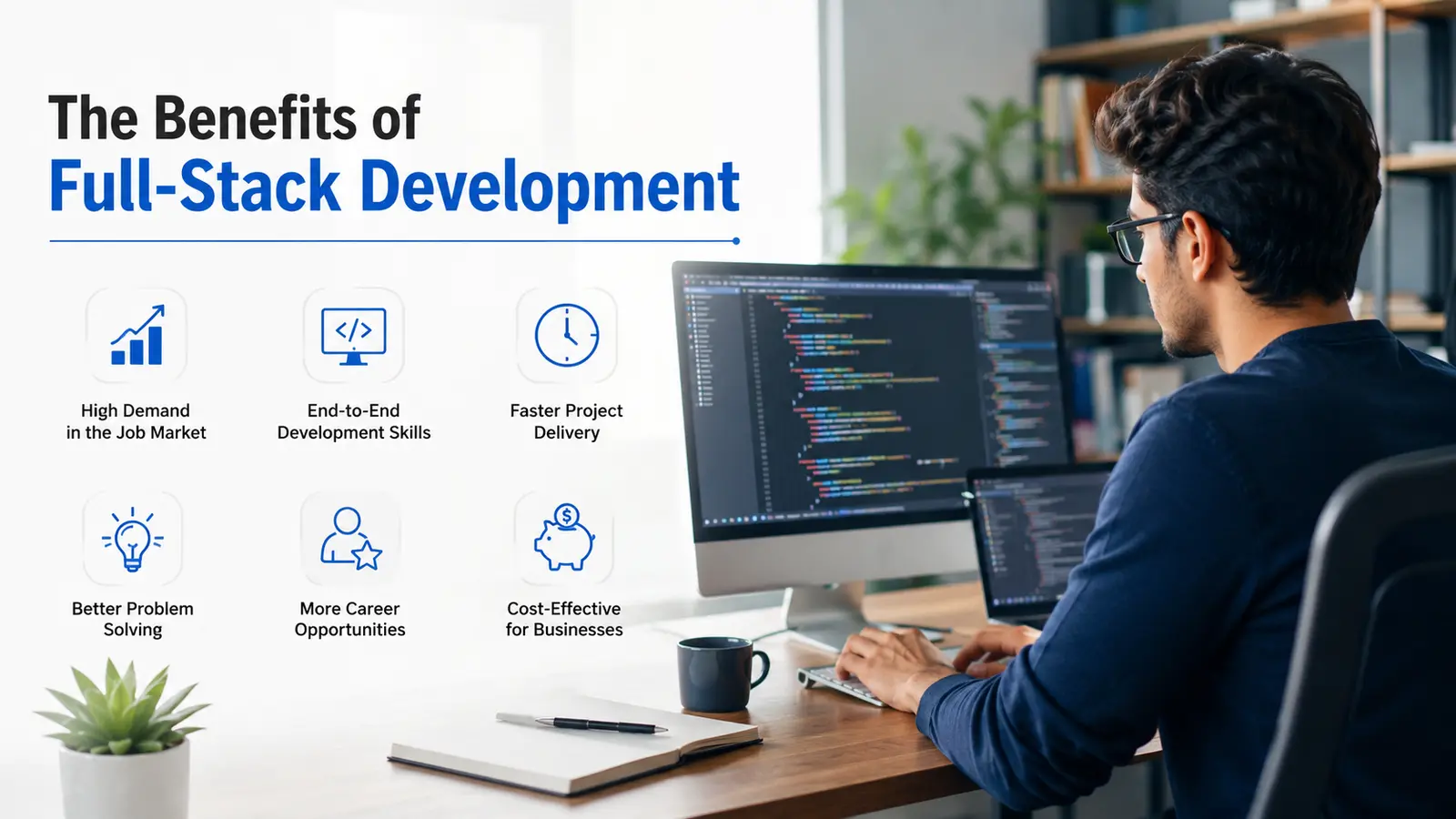
Top benefits of full-stack development
High salary potential
Full-stack developers usually earn more than single-stack specialists because they cover more ground. In India, entry-level full-stack developers often start around 4 to 6 lakhs a year, and experienced ones can cross 15 to 20 lakhs, depending on the company and city. Salaries vary by market, but the trend holds globally: broader skills, higher pay.
Strong job demand
Job boards are full of full-stack listings, and that’s not changing anytime soon. Companies would rather hire one versatile developer than manage two separate hires for the same project. That preference keeps demand high across almost every industry.
Ability to build complete applications
A full-stack developer can take a product from a blank folder to a live app without waiting on anyone else. That’s a real advantage if you want to freelance, build your own product, or just move fast without depending on a large team.
Better understanding of software architecture
When you’ve built both the frontend and backend, you understand why an app behaves the way it does. You’re not guessing what’s happening on the other side of an API call. You wrote it. That depth of understanding makes you a better problem solver on any part of the stack.
Freelancing opportunities
Clients on freelance platforms usually want one person who can handle the whole project, not two separate hires. Full-stack skills let you take on complete projects and charge for the full scope of work instead of splitting the job (and the payment) with someone else.
Startup opportunities
If you want to build your own product someday, full-stack skills mean you don’t need a co-founder just to get an MVP live. You can build the whole thing yourself, test it, and bring in help once you’ve proven the idea works.
Faster career growth
Full-stack developers often move into senior roles, tech lead positions, or architecture roles faster than specialists, simply because they already understand more of the system. Managers trust people who can see the whole picture, and that trust translates into promotions.
Greater flexibility across industries
Full-stack skills aren’t tied to one industry. E-commerce, healthcare, finance, EdTech: they all need the same core stack, just applied to different problems. That flexibility means you’re never locked into one sector if you want to switch.
Improved problem-solving skills
Debugging a full-stack app means tracing a bug across the frontend, the API, and the database until you find where it actually broke. That kind of end-to-end troubleshooting sharpens your problem-solving in a way that working on just one layer doesn’t.
Continuous learning and adaptability
The stack keeps changing. New frameworks, new tools, new deployment methods. Full-stack developers get used to learning constantly, and that habit makes them adaptable when the industry shifts, which it always does.
Essential skills every full-stack developer should learn
The foundation starts with HTML, CSS, and JavaScript. These three build every interface on the web, and there’s no skipping them.
From there, you’ll want a frontend framework like React, since it’s the most in-demand right now, though Angular and Vue both have solid footholds depending on the company. On the backend, Node.js paired with Express.js is a common combination, especially since it lets you use JavaScript on both ends of the stack. Python and Java are strong alternatives, particularly in enterprise environments.
You’ll also need to work with databases: SQL for structured data like PostgreSQL or MySQL, and MongoDB if you’re dealing with more flexible, document-based data. Git and GitHub are non-negotiable for version control; you can’t work on a real team without them.
Round it out with REST APIs (how frontend and backend actually talk), authentication (login systems, tokens, sessions), and basic deployment and cloud knowledge, since AWS, Azure, or similar platforms are how your app actually reaches users. None of this needs to be mastered overnight. Most developers pick these up one project at a time.
Industries that hire full-stack developers
IT companies remain the biggest employers, building everything from internal tools to client products. E-commerce platforms need full-stack developers to build product pages, checkout flows, and inventory systems that all talk to each other in real time.
Healthcare has moved deep into digital record systems and patient portals, and finance runs on secure, fast web applications for banking and trading. EdTech exploded after 2020 and hasn’t slowed down, with platforms needing full-stack teams to build course delivery and student tracking systems.
AI startups need full-stack developers to build the interfaces that sit on top of their models, since a good model with no usable interface doesn’t get adopted. SaaS companies are built almost entirely on full-stack architecture by definition. Even government projects, digitizing public services and records, increasingly hire full-stack talent to build citizen-facing portals.
Is full-stack development a good career choice in 2026?
Short answer: yes, and the demand isn’t slowing down. Market demand for full-stack roles has stayed strong for years, and companies keep favoring versatile hires over narrow specialists, especially as budgets stay tight.
AI-assisted development is changing the daily workflow (tools like Copilot handle a lot of boilerplate now), but that doesn’t remove developers from the equation. It shifts the job toward architecture, debugging, and decision-making, which is exactly where full-stack knowledge matters more, not less.
Remote work has also opened up full-stack roles globally. A developer in Noida can work for a company in Berlin without relocating, and that’s not a fluke, it’s just how hiring works now for this kind of role. Salary growth has kept pace too, and long-term prospects look solid as long as you keep learning alongside the tools.
How to become a full-stack developer
Start with HTML, CSS, and JavaScript. Don’t rush this stage; it’s the foundation everything else sits on.
Once you’re comfortable, pick a frontend framework and go deep on it rather than skimming three at once. Move to backend development next, learning Node.js, Python, or Java, whichever fits the jobs you’re targeting. Learn how databases work, both SQL and NoSQL, since real apps almost always need one or the other.
Then build real projects. Not tutorials you copy line by line, actual projects with your own decisions baked in. Learn Git and how to deploy an app to a live server, because a project sitting on your laptop doesn’t count for much on a resume.
Put together a portfolio with 3 or 4 solid projects that show range: something with authentication, something with a database, something deployed live. A relevant certification can help you get noticed by recruiters, particularly if you’re switching careers and don’t have a CS degree to point to.
Apply for internships or entry-level roles once your portfolio’s in decent shape, and don’t wait for it to feel perfect. Keep learning new tools after you land the job too. The stack you learn today isn’t the exact stack you’ll use in 3 years.
Common challenges and how to overcome them
The learning curve is real. You’re covering frontend, backend, databases, and deployment, and that’s a lot to hold in your head at once. Break it into stages instead of trying to learn everything simultaneously, and give each stage real time before moving to the next.
Keeping up with new tools can feel exhausting, especially when a new framework seems to show up every few months. Pick your core stack, get genuinely good at it, and treat new tools as optional extras rather than things you have to chase immediately.
Debugging complex applications gets harder once you’re managing bugs that span multiple layers. Learn to isolate the problem: check the frontend first, then the API response, then the database. Most bugs live at the boundary between two layers, so that’s usually where to look first.
Time management is a common struggle too, since full-stack work means juggling more moving parts than a single-stack job. Set clear priorities for each day instead of trying to touch every layer of the app at once.
Building practical experience without a job is possible. Clone a real app you use daily (a to-do list, a small store, a blog) and build your own version from scratch. That’s worth more on a resume than a dozen half-finished tutorials.
Conclusion
Full-stack development gives you range: you can build a complete product, understand how every piece connects, and adapt to whatever a company or client throws at you. That range shows up in the numbers too, stronger salaries, wider job demand, and more freelance and startup opportunities than most single-stack paths offer.
2026 doesn’t look like a slowdown for this field. If anything, AI tools are making the developers who understand full systems more valuable, not less. The path isn’t instant. It takes consistent practice, real projects, and a willingness to keep learning as the stack shifts under you.
If you’re considering it, start small: pick HTML, CSS, and JavaScript, build something real within a few weeks, and keep stacking skills from there. A structured training course can help if you want guided support, but the projects you build yourself are what will actually get you hired.
Frequently asked questions
1. Is full-stack development difficult to learn?
It takes time, but it’s not out of reach for a beginner. Breaking it into frontend, then backend, then databases, makes it manageable instead of overwhelming.
2. How long does it take to become a full-stack developer?
Most people get to a job-ready level in 6 to 12 months with consistent daily practice, though it depends heavily on how much time you can put in.
3. Which programming language is best for full-stack development?
JavaScript is the most practical starting point since it works on both frontend and backend through Node.js. Python and Java are strong choices too, especially for backend-heavy roles.
4. Is full-stack development a good career in 2026?
Yes. Demand is strong, salaries are rising, and remote opportunities have widened the job market considerably.
5. Do I need a degree to become a full-stack developer?
No. A strong portfolio and demonstrated skills matter more to most employers than a specific degree.
6. Which full-stack technology stack should beginners learn?
The MERN stack (MongoDB, Express.js, React, Node.js) is a popular starting point because it uses JavaScript throughout, which cuts down on context switching while you’re learning.
7. Can I become a full-stack developer through online training?
Yes, plenty of developers working today learned entirely through structured online courses and self-built projects, no traditional classroom involved.
8. How does full-stack development improve development efficiency?
One developer who understands the whole system can make decisions faster and doesn’t need to wait on a handoff between teams, which cuts delays significantly on smaller projects.