
A friend of mine spent 8 years in retail merchandising before she opened a spreadsheet, taught herself SQL on weekends, and landed a data analyst role at a logistics company 14 months later. She didn’t have a computer science degree. She had a portfolio, a few Kaggle projects, and the guts to apply anyway.
That story isn’t rare anymore. It’s becoming the norm.
Data analytics is one of the few careers still growing while entire departments in other industries shrink. Companies are drowning in data and starving for people who can turn it into decisions. That gap is exactly where the opportunity sits in 2026.
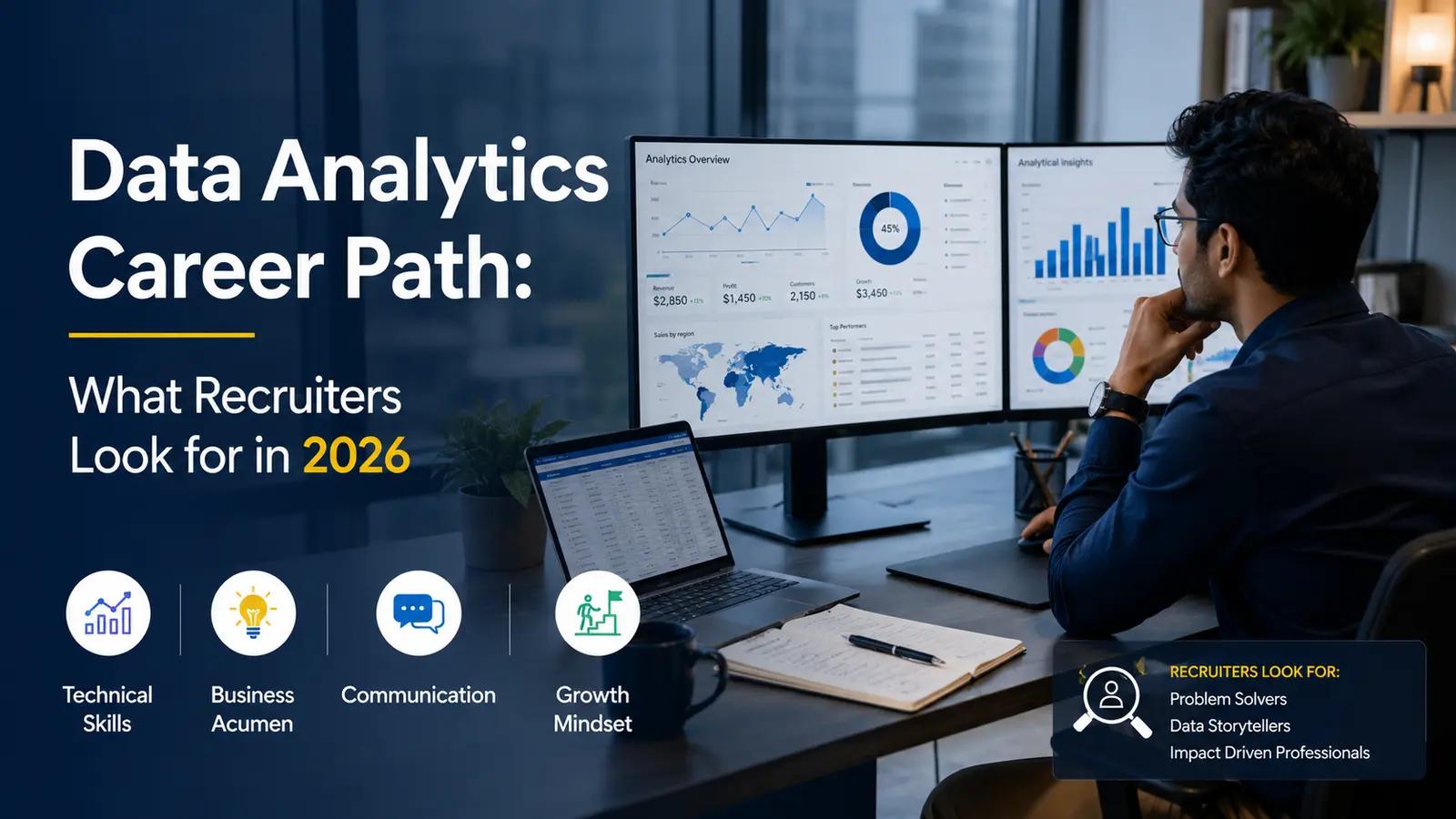
This guide walks through the full data analytics career path: what recruiters actually screen for, which skills matter, which certifications are worth your time, and how to position yourself whether you’re a student, a fresh graduate, or someone switching careers entirely.
What is a data analytics career path?
A data analytics career path is the progression from entry-level analyst work to senior, strategic roles that shape business decisions. It’s rarely a straight line, and that’s the point. Most people start in a junior analyst seat, cleaning data and building basic reports, then move into roles with more ownership over insights and stakeholder communication.
A typical progression looks something like this: junior data analyst, then data analyst, then senior data analyst, then analytics manager or lead. Some analysts branch sideways into business intelligence, product analytics, or marketing analytics. Others push forward into data science once they pick up machine learning and more advanced statistics.
The titles vary by company. A “BI Analyst” at one firm might do the exact same work as a “Data Analyst II” at another. What matters more than the label is the scope: are you answering questions someone else asks, or are you the one framing the questions in the first place? That shift is what separates junior from senior in this field.
Why recruiters are hiring more data analysts in 2026
Demand for data analyst jobs hasn’t slowed down. If anything, it’s shifted shape.
Industry demand
Retail, healthcare, finance, logistics: they’re all sitting on more data than they know what to do with. Someone has to make sense of it, and that someone is increasingly a dedicated analyst rather than a generalist wearing five hats.
AI adoption
Here’s the part that surprises people. AI tools haven’t replaced analysts, they’ve raised the bar for what analysts are expected to do. Recruiters now want candidates who can use AI-assisted analytics tools to move faster, not candidates who fear being replaced by them.
Business decision-making
Executives don’t want opinions anymore. They want numbers backing every major call, from pricing changes to headcount planning. That pressure trickles straight down to analyst hiring.
Digital transformation
Companies that were still running on spreadsheets in 2020 are now building proper data pipelines. Someone needs to interpret what comes out the other end.
Put those four forces together and you get a hiring market that’s still hungry for talent, even in a year where tech hiring overall has been choppy.
Technical skills recruiters look for
Recruiters scanning resumes for data analyst jobs in 2026 are looking for a fairly consistent toolkit. Miss too many of these and you’ll struggle to get past the first screen.
SQL
Still the backbone. If you can’t write a join, a group by, and a window function without Googling every step, you’re not ready for most analyst interviews. SQL is the one skill that shows up in nearly every job posting, regardless of industry.
Excel
Old, unglamorous, and still everywhere. Pivot tables, VLOOKUP (or XLOOKUP now), and basic formula logic are assumed knowledge. Recruiters don’t ask about Excel directly as often, but they’ll test it in a live exercise.
Python or R
You don’t need to be a software engineer. You need to clean data, run basic statistical tests, and maybe build a simple model. Python has pulled ahead of R in most job postings, largely because of its overlap with data science and AI tooling.
Power BI and Tableau
Visualization tools are how analysts communicate. A recruiter wants to see that you can build a dashboard someone outside the data team can actually read. Power BI shows up more in corporate and enterprise roles; Tableau still holds ground in marketing and consulting.
Data visualization
This is a skill on its own, separate from the tools. Knowing when to use a bar chart instead of a pie chart, or when a table beats a graph entirely, is what separates a cluttered dashboard from one people trust.
Statistics
You don’t need a PhD. You need to understand distributions, correlation versus causation, and basic hypothesis testing well enough to not draw false conclusions from noisy data.
AI-assisted analytics tools
This is new territory for a lot of hiring managers. Tools that auto-generate SQL queries or summarize datasets in plain language are showing up in workflows fast. Recruiters increasingly ask candidates how they’d use these tools responsibly, not whether they’ve used them at all.
Soft skills that make candidates stand out
Technical skills get you the interview. Soft skills get you the offer.
Communication
An analyst who can explain a churn spike to a marketing VP in two sentences is worth more than one who buries the same insight in a 40-slide deck nobody reads.
Problem-solving
Data rarely arrives clean. Knowing how to work around a missing column or a broken data pipeline without asking for permission at every step matters.
Critical thinking
Numbers lie if you let them. Recruiters want people who question their own results before presenting them.
Collaboration
Analysts sit between engineering, product, and leadership. You need to speak all three dialects, at least a little.
Adaptability
Tools change every 18 months in this field. The people who last are the ones who pick up new software without treating it as a crisis.
Educational background and certifications
You don’t need a computer science degree to get into analytics, and recruiters know that better than most job seekers assume.
For beginners who prefer structured learning over self-study, comprehensive data analytics training can combine SQL, Excel, Python, Power BI, statistics, and portfolio projects into a single roadmap. The right training won’t replace hands-on practice, but it can help you learn the core skills in the order recruiters expect.
Degrees in statistics, economics, business, or even psychology translate well because they train you to think in patterns and probabilities. That said, plenty of analysts come from backgrounds with zero quantitative training and just built the skills separately.
Career transitions from non-technical backgrounds are common enough that most hiring managers won’t blink at a resume that shows 5 years in teaching or sales, as long as the projects and certifications back up the claim that you can actually do the work.
Speaking of certifications, a few carry real weight in 2026:
The Google Data Analytics Professional Certificate is still the most recognized entry point, especially for career changers with no formal background.
The Microsoft Data Analyst Certification (built around Power BI) matters a lot if you’re targeting corporate or enterprise roles where Microsoft’s stack dominates.
Tableau Certification helps if you’re aiming at marketing, consulting, or agency-side analyst roles.
The AWS Data Analytics Certification signals cloud fluency, which matters more every year as companies move their data infrastructure off-premise.
SAS Certification still holds ground in healthcare, insurance, and government sectors, industries that never fully left SAS behind even as Python took over elsewhere.
None of these guarantee a job. But they close the credibility gap for people without a traditional analytics degree, and recruiters do notice them on a resume.
Industry trends shaping recruiter expectations
AI-powered analytics
Predictive dashboards and auto-generated insights are becoming standard, not a novelty feature. Analysts are expected to interpret and validate what these tools produce.
Real-time analytics
Retail and finance especially want dashboards refreshing in minutes, not overnight batch jobs. That shift favors analysts comfortable with streaming data concepts, even at a basic level.
Data privacy and ethics
Regulations keep tightening. Analysts who understand basic data governance and privacy rules save their teams from expensive mistakes.
Cloud analytics
Snowflake, BigQuery, Redshift: recruiters want at least passive familiarity with one cloud data warehouse, since almost nobody stores data purely on local servers anymore.
Cross-functional collaboration
Analysts increasingly sit inside product or marketing teams rather than a separate data department, which means recruiters are screening for domain knowledge, not just technical chops.
Remote work and global hiring
Plenty of data analytics career opportunities are fully remote now, which means you’re competing with candidates across the world, not just your city. That raises the bar, but it also widens your own options.
Common mistakes that prevent candidates from getting hired
Weak portfolio
A GitHub with three half-finished tutorials copied from a course isn’t a portfolio. Recruiters want to see a problem you picked, data you found or cleaned yourself, and a conclusion you can defend.
No practical projects
Certifications without applied work read as theoretical. Build something, even something small and imperfect.
Poor resume
Generic bullet points like “worked with data” tell a recruiter nothing. Specifics: which tools, what outcome, what scale.
Lack of communication skill
Candidates who ace the technical screen and then can’t explain their own project in plain language lose offers constantly.
Ignoring business understanding
An analyst who can run a regression but can’t explain why it matters to the business isn’t ready for a senior role, and often isn’t ready for a junior one either.
How to prepare for a data analytics career in 2026
Start with a learning roadmap: SQL first, then Excel fundamentals, then a visualization tool, then Python or R. Layer in statistics as you go rather than trying to master it upfront.
If you’re unsure how to structure your learning, enrolling in a beginner-friendly data analytics course can provide a clear roadmap and reduce the time spent figuring out what to learn next. Just make sure the course includes practical projects instead of only video lessons.
Build portfolio projects around real questions. Pull public datasets on something you actually care about, sports stats, local housing prices, whatever keeps you interested past week two.
Look for internships even if they’re unpaid or short-term. The experience line on a resume matters more than people expect at the entry level.
Keep your GitHub clean and updated. A messy repo with unfinished notebooks does more harm than an empty one.
Optimize your LinkedIn with specific skills and project links, not vague phrases like “passionate about data.”
Practice interview questions out loud, not just in your head. The gap between knowing an answer and explaining it clearly under pressure is bigger than most candidates expect.
Future career opportunities in data analytics
The data analyst title is just the starting point. From there, a few paths tend to open up.
A business analyst role shifts the focus toward process and strategy rather than pure data work. A BI analyst leans harder into dashboards and reporting infrastructure. A product analyst works inside a product team, tracking feature usage and user behavior. A marketing analyst focuses on campaign performance, attribution, and customer segmentation.
And for those who want to go deeper into modeling and machine learning, data science is the natural next step, though it usually requires picking up more advanced statistics and programming along the way.
None of these paths is objectively “better.” They just suit different interests, whether that’s storytelling, engineering, or strategy.
Conclusion
The data analytics career path in 2026 rewards people who can pair technical skill with plain communication. Recruiters aren’t just hunting for someone who knows SQL. They want someone who can find a problem in the data, explain it clearly, and connect it to something the business actually cares about.
If you’re a student, start building projects now, before you even graduate. If you’re a fresh graduate, lean on certifications to fill the experience gap. If you’re a working professional or career changer, your existing industry knowledge is an asset, not a liability, pair it with the technical skills above and you’ll stand out more than you think.
Whether you learn through self-study or a structured data analytics course, consistent practice and real-world projects will matter far more than collecting certificates.
The roadmap is clear enough. SQL, a visualization tool, some statistics, a portfolio that proves you can do the work, and the communication skills to explain it. Start with one project this week. That’s how every analyst on this path got started.
FAQ
1. What is the average timeline to become a data analyst?
Most people with no prior background can reach entry-level readiness in 4 to 8 months of consistent, focused learning, faster if you already have some quantitative or spreadsheet experience.
2. Do I need a degree to start a data analytics career?
No. Plenty of analysts enter through certificates and self-built portfolios rather than a formal degree, though a related degree can shorten the learning curve.
3. Which certification is best for beginners?
The Google Data Analytics Professional Certificate is generally the strongest starting point for people with no prior technical background.
4. Is Python or SQL more important to learn first?
SQL. It shows up in nearly every data analyst job posting and is usually tested first in interviews, before Python skills even come up.
5. Can data analysts transition into data science later?
Yes, and it’s a common path. It usually requires adding stronger statistics, machine learning, and more advanced programming to your existing analyst toolkit.
6. Are data analyst jobs still in demand in 2026?
Yes. Industry demand, AI adoption, and continued digital transformation are all keeping data analyst hiring strong, even as some other tech roles have slowed down.
Read also this article- Role of Data Analytics in E-Commerce