
Every industry claims to be “data-first” these days. Most aren’t.
Some industries have built entire operations around data analytics: how they price products, catch fraud, route trucks, and decide what to stock next week. Others still run on gut calls and last year’s spreadsheet.
If you’re trying to find the top industries for data analytics jobs, or you just want to know which of the industries that use data analytics actually pay well, this list covers the ones that matter, with real examples instead of vague claims.
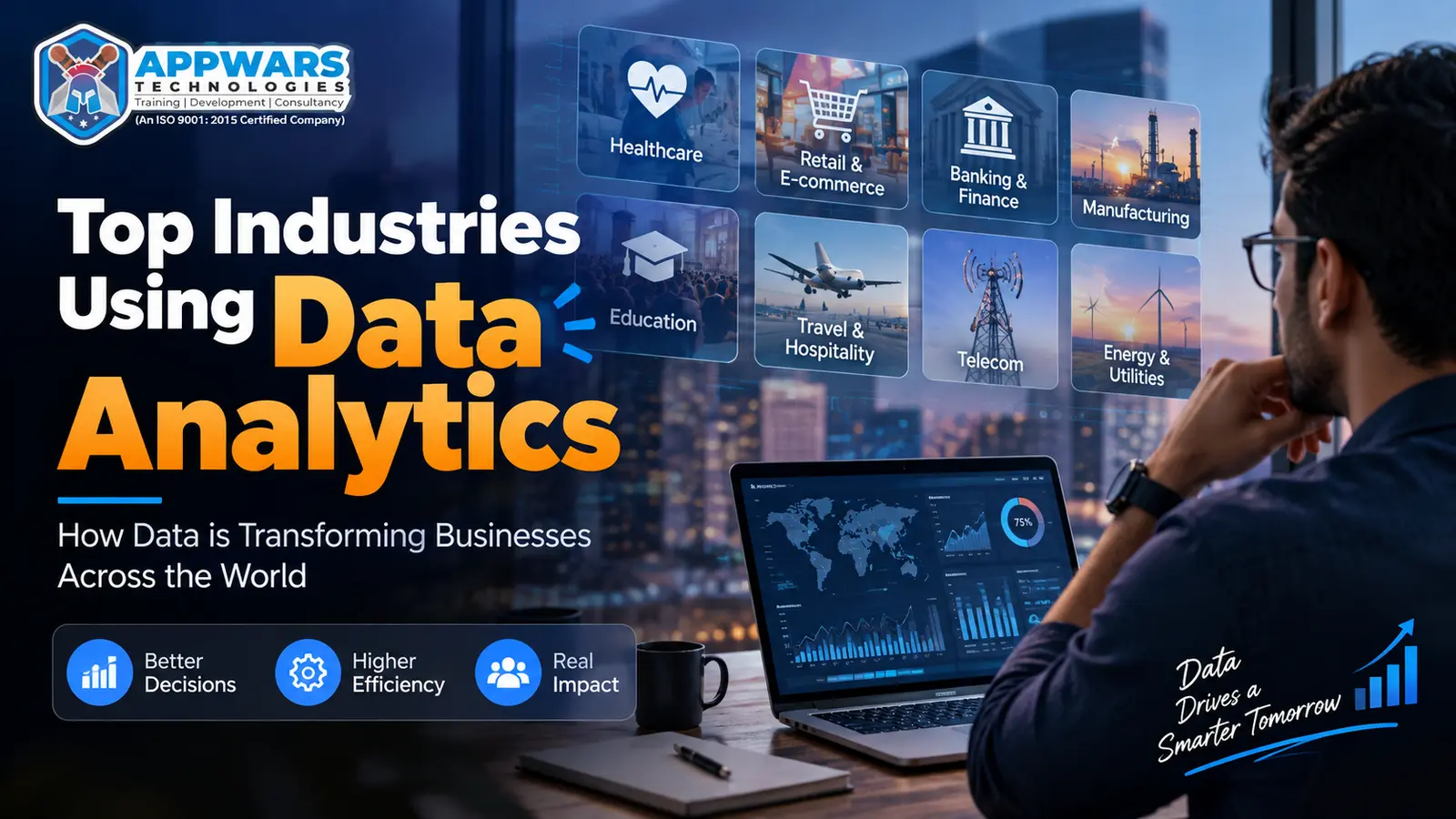
Quick snapshot: industries using data analytics
Here’s a quick look at data analytics applications in different industries before we go deep on each one.
| Industry | Main use case | Real example |
|---|---|---|
| Healthcare | Patient risk prediction, hospital operations | AI-assisted diagnostics in Indian hospital chains |
| Banking and finance | Fraud detection, credit scoring | Real-time transaction monitoring at Indian banks |
| E-commerce and retail | Personalization, demand forecasting | Amazon’s recommendation engine |
| Manufacturing | Predictive maintenance, quality control | Tata Motors’ plant sensors |
| Telecom | Churn prediction, network planning | Jio and Airtel usage analytics |
| Media and entertainment | Content recommendations | Netflix’s personalization engine |
| Transportation and logistics | Delivery route planning | UPS’s ORION system |
| IT and software | Product analytics, A/B testing | Feature rollout decisions at product companies |
| Marketing and advertising | Campaign targeting, attribution | Google and Meta ad platforms |
| Government and public sector | Resource planning, policy evaluation | Smart city traffic and utility data |
Now let’s break each one down.
Healthcare
Hospitals sit on years of patient records, lab results, and billing data. Most of it used to just sit there.
That’s changing fast. Data analytics in healthcare now covers everything from predicting which patients are likely to be readmitted within 30 days to spotting supply shortages before they become a crisis. Apollo Hospitals and Fortis have both invested in analytics teams that track patient flow, bed occupancy, and diagnostic accuracy.
A few real applications:
- Predicting ICU admissions from vitals trends, hours before a human would catch it
- Flagging drug interactions automatically at the point of prescription
- Smarter scheduling so operation theatres and diagnostic equipment don’t sit idle
Analysts in this space need to be comfortable with messy, sensitive data and strict compliance rules. That’s part of why healthcare analytics roles pay well once you clear the entry bar.
Get Free Career Counseling ➔Banking and finance
Data analytics in banking and finance is old news by industry standards. Banks were running statistical models on credit risk long before “analytics” became a buzzword.
What’s different now is speed. HDFC Bank, ICICI, and most major Indian banks run real-time fraud detection models that flag suspicious transactions within seconds, not after a customer complaint. Credit scoring has moved past just checking a CIBIL score. Banks now factor in spending patterns, repayment behavior across products, and even utility bill payment history for thin-file customers.
Common analyst tasks in BFSI (banking, financial services, and insurance):
- Building models that predict loan default risk
- Monitoring transaction patterns for fraud in real time
- Segmenting customers for cross-sell campaigns (credit cards, insurance, mutual funds)
This is also one of the highest paying industries for data analysts in India. BFSI roles typically carry a 20 to 35 percent premium over general analytics roles at the same experience level, mostly because the regulatory stakes are higher and the data is genuinely harder to work with.
E-commerce and retail
Data analytics in e-commerce and retail is probably the most visible use case to a regular consumer. Every “you might also like” section, every price that shifts by the hour, every out-of-stock alert traces back to an analytics pipeline.
Amazon’s recommendation system is the classic example. Cross-sell recommendations have long been credited with a large chunk of Amazon’s online sales, a figure the company’s own executives have cited publicly. Flipkart and Meesho run similar engines tuned for Indian buying patterns: festival season spikes, regional preferences, and cash-on-delivery behavior that international platforms don’t deal with as much.
Retailers use analytics for:
- Demand forecasting so shelves don’t sit empty or overstocked
- Prices that shift based on competitor moves and demand signals
- Customer segmentation for targeted discounts and loyalty programs
If you’ve ever wondered which industries hire data analysts the fastest, e-commerce is near the top. Hiring volume is high, and the data (clickstream, cart behavior, delivery logs) is abundant and relatively easy to access compared to something like healthcare.
Manufacturing
Manufacturing doesn’t get the same attention as tech or finance in analytics conversations, but the use cases are just as real.
Predictive maintenance is the big one. Sensors on factory equipment feed data into models that predict when a machine part is likely to fail, so it gets replaced before it breaks down mid-shift. Tata Motors and Mahindra both run programs like this across their plants. It cuts unplanned downtime, which is expensive in ways that go beyond the repair bill: missed delivery targets, idle labor, and line stoppages that ripple through the supply chain.
Quality control is the other major use case. Computer vision paired with analytics now catches defects on assembly lines that a human inspector might miss on a tired afternoon shift.
Get Free Demo Class ➔Telecom
Telecom generates a staggering amount of data every second: call records, data usage, tower load, app-level bandwidth consumption.
Jio and Airtel both run churn prediction models that flag customers likely to switch networks, usually based on falling usage, complaint patterns, or a competitor’s promotional push in their area. Catching that early means a retention offer goes out before the customer has already made up their mind.
Network planning is the other big application. Analytics decides where new towers go, which areas need bandwidth upgrades, and how to route traffic during peak load without degrading call quality.
Media and entertainment
Netflix built its entire business model around personalization, and it’s paid off in a very measurable way. By the company’s own account, the majority of what people watch comes from personalized recommendations rather than search, and the combined effect of personalization and recommendations reportedly saves the company more than a billion dollars a year in retained subscriptions.
Indian streaming platforms and music services run similar models, tuned for regional language preferences and viewing habits that differ sharply from Western audiences. A recommendation engine trained on US viewing data doesn’t work well here without serious retraining.
Transportation and logistics
If you want one real-world example that shows exactly what data analytics applications look like in a physical, unglamorous industry, look at UPS’s ORION system.
ORION analyzes each driver’s daily deliveries and calculates the most efficient route out of hundreds of thousands of possible combinations. The result: UPS has reported saving around 100 million miles of driving and 10 million gallons of fuel every year since rolling it out, translating into hundreds of millions of dollars in annual savings.
In India, Delhivery and Blue Dart run comparable systems for last-mile delivery, factoring in traffic patterns, delivery windows, and driver capacity across cities that don’t always have clean address data to work with. That messiness is actually a good training ground for analysts, since real Indian logistics data rarely looks like a tidy Kaggle dataset.
IT and software
Product companies live and die by analytics now. Every feature rollout, pricing change, or UI tweak gets tested on a slice of users before it ships to everyone.
Zomato, Swiggy, and most product-led Indian startups run continuous A/B tests: does a new checkout flow increase conversions, does a different delivery-time estimate reduce cancellations, and does a push notification at 7 PM outperform one at 9 PM? Product analysts sit close to engineering and design teams, translating experiment results into decisions that ship the following sprint.
This is also where the line between a data analyst and a data scientist gets blurry. If you’re weighing the 2 paths, our data science vs data analytics comparison breaks down the actual differences in skills, tools, and pay.
Marketing and advertising
Every rupee spent on Google Ads or Meta Ads is tracked, attributed, and adjusted by an analytics layer running in the background. Marketing teams use analytics for campaign targeting, attribution modeling (figuring out which channel actually drove a sale), and customer lifetime value predictions that decide how much to spend acquiring a new customer.
This is one of the more accessible entry points into analytics for people from a non-technical background, since a lot of marketing analytics work starts in Excel and Google Analytics before it ever touches SQL or Python.
Government and public sector
This one pays less on average, but the scale of impact is different. State governments and municipal bodies use analytics for traffic signal timing, utility load forecasting, and evaluating whether welfare programs are actually reaching the people they’re meant for.
Smart city projects across India rely heavily on sensor data and dashboards to manage everything from waste collection routes to water supply planning. The pay ceiling here is lower than BFSI or product companies, but the roles tend to be stable, and the work has a visible civic impact that private sector analytics rarely offers.
Which industries hire data analysts (and pay the most)
Not every industry pays the same for the same title. Here’s a realistic breakdown for the Indian market in 2026.
| Industry | Entry-level (0-2 yrs) | Mid-level (3-5 yrs) | Hiring volume |
|---|---|---|---|
| BFSI (banking, finance, insurance) | ₹4.5 – 7 LPA | ₹9 – 16 LPA | High |
| Product / tech companies | ₹6–8 LPA | ₹12–22 LPA | High |
| E-commerce | ₹5 – 7.5 LPA | ₹10–16 LPA | Very high |
| IT services | ₹3.5 – 5 LPA | ₹6–10 LPA | Highest (by volume) |
| Manufacturing | ₹3.5 – 6 LPA | ₹7 – 12 LPA | Moderate |
| Telecom | ₹4 – 6.5 LPA | ₹8 – 13 LPA | Moderate |
| Government / public sector | ₹3 – 5 LPA | ₹6–9 LPA | Low |
A pattern worth noticing: IT services firms hire the most analysts by sheer volume, but they pay the least per role. Product companies and BFSI pay more, but the interview process actually tests your SQL and Python skills instead of just aptitude scores.
For a full breakdown by experience, city, and company type, our data analyst salary in India guide has the complete numbers.
Explore Trending Courses ➔Data analyst career scope
Here’s the part that matters if you’re actually choosing a career path, not just reading for curiosity.
Data analytics use cases by industry keep multiplying every year. Healthcare, manufacturing, and government are catching up to where e-commerce and banking already were 5 years ago. The jobs have spread well past a handful of sectors. A person trained in SQL, Python, and a BI tool like Power BI or Tableau can realistically move between banking, retail, and telecom without starting over.
The typical growth path looks like this:
- Data analyst (SQL, Excel, dashboards) for the first 2 to 3 years
- Senior analyst or analytics engineer, owning full reporting pipelines
- A branch point: move toward data science and machine learning, or toward analytics leadership and strategy
If you want to see what the work itself looks like before committing, our collection of data analytics project ideas walks through real, buildable projects across several of these industries: retail dashboards, churn models, and sales forecasting, among them. And if you’re mapping out the full path from beginner to job-ready, the data analytics career roadmap covers the skill order and timeline in more detail.
Real-world examples of data analytics, side by side
To pull the whole picture together, here’s how a few of the examples above compare on what they actually solve.
| Company | Industry | Problem solved with analytics |
|---|---|---|
| Amazon | E-commerce | Product recommendations driving a large share of sales |
| Netflix | Media | Content recommendations, cutting churn |
| UPS | Logistics | Smarter delivery routes, saving fuel and miles |
| HDFC Bank | Banking | Real-time fraud detection |
| Tata Motors | Manufacturing | Predictive maintenance on plant equipment |
None of these companies got here overnight. Each one built the capability over years, starting with basic reporting before moving to the predictive models they run today. That’s usually how it goes for individual analysts too: you start with dashboards and pivot tables, and the harder, better-paid work comes once you’ve proven you can be trusted with it.
Getting started
If any of these industries using data analytics sound like a place you’d want to work, the entry point is the same regardless of sector: SQL, a BI tool, and enough Python to clean and analyze data without relying on someone else to do it for you.
A structured data analytics course in Noida can compress that learning curve, especially the parts that are hard to self-teach: live project work, mentor feedback on your dashboards, and exposure to the kind of messy data you’ll actually see on the job. Appwars Technologies runs its Data Analytics program out of its Noida training center, with SQL, Python, and Power BI training built around live projects and placement support.
Frequently asked questions
Which industries use data analytics the most?
The industries using data analytics most heavily right now are banking and finance, e-commerce and retail, healthcare, telecom, and IT and software product companies, both in terms of maturity and hiring volume.
Which industry pays data analysts the highest salary in India?
BFSI and product-based tech companies consistently pay the most, often 20 to 50 percent more than IT services firms for the same experience level.
Do I need a different skill set for different industries?
The core tools stay the same (SQL, Excel, a BI tool, and Python), but domain knowledge matters. A banking analyst needs to understand risk and compliance basics. A retail analyst needs to understand seasonality and inventory cycles.
Is data analytics a good career choice across industries?
Yes. The advantage of this field over a narrow specialization is portability. The same core skills apply whether you end up in healthcare, banking, or e-commerce, which makes switching industries far easier than switching from, say, one narrow engineering discipline to another.