
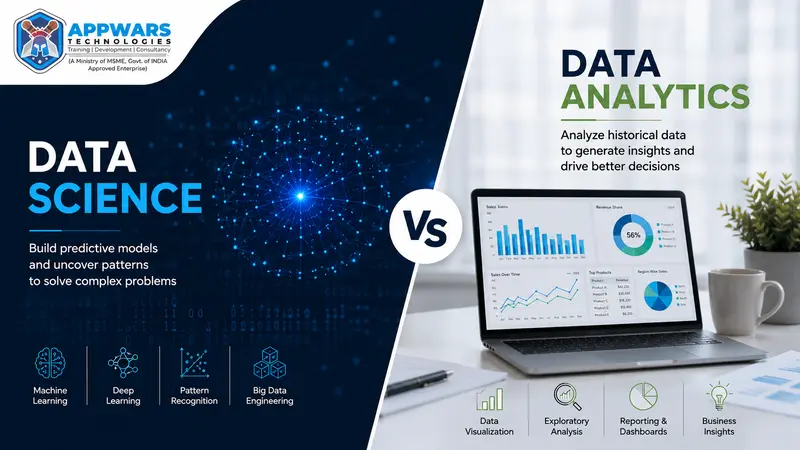
If you’ve been going back and forth on data science vs data analytics, you’re not alone. Every week, thousands of students and working professionals search this exact comparison trying to figure out which path to take. Both fields sound similar on the surface. Both deal with data. Both pay well above average. And both are hiring aggressively in 2026.
But they’re not the same job, not the same skill set, and definitely not the same career trajectory.
This blog gives you a straight, no-fluff comparison of data science and data analytics so you can stop second-guessing and start moving.
What exactly is data science?
Data science is about building systems that predict the future. You’re not just reading data. You’re teaching machines to learn from it.
A data scientist builds recommendation engines, trains fraud detection models, develops natural language processing systems, and writes algorithms that automate decisions. The technical depth is real. You need Python or R at a professional level, a solid grip on statistics and linear algebra, and hands-on experience with ML libraries like scikit-learn, TensorFlow, XGBoost, or PyTorch.
Real examples of data science at work: Amazon’s product recommendations, Google’s search ranking, Zomato’s delivery time predictions, and PhonePe’s real-time fraud alerts. None of those run on dashboards. They run on models built by data scientists.
Data science roles often fall under titles like Data Scientist, Machine Learning Engineer, AI Engineer, Research Scientist, or Applied Scientist. The exact title varies by company, but the core work is the same: build something that learns.
What exactly is data analytics?
Data analytics is about understanding what already happened. You take existing data and extract meaning from it so businesses can make better decisions.
A data analyst answers questions like, “Why did customer retention drop in February?” Which marketing channel drove the most conversions last quarter? What’s the churn rate among users who didn’t complete onboarding? They pull SQL queries, build Tableau or Power BI dashboards, run pivot tables in Excel, and present findings to stakeholders who need answers fast.
The famous Target story is a good example of data analytics in action. Their analysts found that customers who bought certain combinations of products, like unscented lotion, calcium supplements, and cotton balls, were likely pregnant. They didn’t need a machine learning model. They found patterns in purchase history and built a targeted coupon campaign around it. That’s analytics.
Data analytics roles show up as “Data Analyst,” “Business Analyst,” “BI Analyst,” “Reporting Analyst,” “Product Analyst,” or “Marketing Analyst” depending on the industry.
Data science vs data analytics: core differences broken down
The data science vs data analytics comparison gets clearer when you look at each dimension separately.
Purpose: Data science predicts what will happen. Data analytics explains what has happened. One is forward-looking; the other is backward-looking.
Tools and tech stack Data science: Python, R, Jupyter Notebooks, TensorFlow, PyTorch, scikit-learn, Apache Spark, Hadoop, SQL. Data analytics: SQL, Excel, Power BI, Tableau, Google Looker, SAS, and sometimes Python for basic analysis.
Skill requirements: Data science roadmap demands advanced statistics, machine learning theory, model deployment knowledge, and strong programming. Data analytics needs business acumen, SQL fluency, data visualization skills, and the ability to communicate complex findings simply.
Output: Data science produces models, algorithms, and automated pipelines. Data analytics produces reports, dashboards, and insights decks.
Who do you work with? Data scientists typically work with engineering and product teams. Data analysts work closely with business stakeholders, marketing, finance, and operations.
Here’s the full data science and data analytics comparison in a table:
| Factor | Data Science | Data Analytics |
|---|---|---|
| Primary goal | Predict future outcomes | Explain past behavior |
| Core tools | Python, R, ML frameworks | SQL, Excel, Tableau, Power BI |
| Skill focus | Statistics, ML, coding | Business logic, visualization |
| Output type | Models, algorithms, pipelines | Reports, dashboards, insights |
| Education | Often needs a postgraduate degree. | Bachelor’s usually sufficient |
| Entry barrier | High technical bar | More accessible entry |
| Collaboration | Engineering and product | Business and operations |
| Time horizon | Future-focused | Past and present-focused |
The data science and data analytics comparison above tells one clear story. Choose based on what kind of problems you actually want to spend 8 hours a day solving.
Data analytics vs data science salary in 2026
Let’s be direct about money because it matters.
India salaries
The data analytics vs data science salary difference in India is real and significant. Here’s how it breaks down:
Data analysts at entry level (0-2 years) earn ₹4 LPA to ₹8 LPA. Mid-level analysts with 3-5 years experience typically earn ₹10 LPA to ₹18 LPA. Senior data analysts or analytics leads with 6+ years can reach ₹20 LPA to ₹30 LPA at companies like Amazon, Flipkart, or Paytm.
Data scientists start higher. Entry-level data scientists earn ₹7 LPA to ₹14 LPA. Mid-level earns ₹15 LPA to ₹28 LPA. Senior data scientists and ML engineers at Flipkart, Walmart Global Tech India, CRED, Razorpay, or Meesho regularly earn ₹30 LPA to ₹50 LPA. At top-tier firms like Google India or Microsoft India, the number goes higher.
US salaries
In the US, the data analytics vs data science salary gap widens further. Data analysts average $72,000 to $98,000 per year depending on location and seniority. Senior analysts in New York or San Francisco can hit $120,000.
Data scientists average $120,000 to $160,000. At FAANG companies, senior data scientists regularly cross $200,000 in total compensation when you include stock and bonuses.
The salary premium for data science is real. So is the complexity and the time investment to get there. There’s no shortcut around that trade-off.
Data science vs data analytics career paths
The data analytics career path
The typical data science vs data analytics career progression on the analytics side goes: Junior Analyst → Data Analyst → Senior Analyst → Analytics Manager → Director of Analytics or Head of BI. From there, some move into VP of Data or Chief Data Officer roles at mid-size companies.
Laterally, analysts often move into product management, growth, strategy, or operations. The analytical thinking transfers well into those functions. Many great PMs at Indian startups started as analysts.
Timeline to senior: 4-6 years is typical. Faster if you’re in a high-growth startup environment.
The data science career path
The data science vs data analytics career progression on the science side looks different. It usually goes: Junior Data Scientist → Data Scientist → Senior Data Scientist → Staff Scientist or ML Engineer → Principal Scientist or Director of Data Science. Some go into AI research. Some start companies.
The path is slower to advance because the bar at each level is genuinely high. You’re expected to ship models that work in production, not just notebooks that look good in demos.
Timeline to senior: 5-8 years typically. Faster if your models actually drive business outcomes, not just AUC scores in a vacuum.
Both paths are strong in 2026. The data science vs data analytics career choice ultimately depends on how you want to spend your time, not which title sounds better at a dinner party.
Which industries are hiring the most?
For data science: BFSI (banking, financial services, insurance) is the biggest employer. Credit risk modeling, fraud detection, algorithmic trading, and customer lifetime value prediction are all core data science functions. HDFC Bank, ICICI Bank, Bajaj Finserv, and hundreds of fintech startups are constantly hiring.
E-commerce is the second major employer. Demand forecasting, pricing optimization, personalization engines. Flipkart, Amazon India, Myntra, and Nykaa all run large data science teams.
Healthcare and pharma are growing fast. Drug discovery models, patient outcome prediction, hospital operations optimization. Companies like Practo, Pristyn Care, and MedGenome are building these functions now.
For data analytics: Every industry needs analysts. But the highest concentration of analytics roles is in retail, telecom, FMCG, and SaaS.
Telecom companies like Airtel and Jio run enormous analytics operations around subscriber churn, network performance, and pricing. FMCG giants like HUL, ITC, and Nestle India use analytics for demand planning and distribution. SaaS companies need product analysts to understand user behavior and reduce churn.
The point: data analytics roles are more widely distributed across industries, which gives you more options when job hunting.
Data science or data analytics: which one fits you?
This question gets asked constantly. The honest answer is that the right fit depends on 4 things.
Your math comfort level Data science genuinely needs linear algebra, probability theory, and calculus at a working level. If those subjects stressed you out in college, that’s useful information. Data analytics needs statistical thinking but far less mathematical depth. Correlation, distributions, and hypothesis testing. That’s the core of it.
Your coding preference Data science requires strong programming. You’ll write code every day, debug models, and eventually deploy things to production. Data analytics uses code too, mainly SQL and sometimes Python, but the depth is different. If you like solving business problems more than debugging training loops, analytics is a better fit.
How much you like ambiguity Data science projects often run for months with unclear outcomes. You might build 6 models before one actually works. Data analytics moves faster. You get a question, you find an answer, you present it, and you move to the next one. If you need faster feedback loops, analytics will feel more satisfying day-to-day.
Your communication instincts Data analysts spend a lot of time presenting findings to non-technical stakeholders. If you’re good at translating numbers into stories, analytics uses that skill constantly. Data scientists present to technical teams and engineering leads. Different audience, different communication style.
The honest answer on data science or data analytics: most people who are genuinely undecided between the two are better suited for analytics. Data science is a very specific type of problem-solving. If you’re not already drawn to the math and the model-building, the job will feel like a slog.
Data science alternative careers worth exploring
If data science is almost right but something feels off, these adjacent roles are worth considering.
Machine learning engineers (ML engineers) productionize the models data scientists build. They write the serving code, build the pipelines, and monitor model performance in production. It’s more software engineering than statistics, pays similarly to senior data science, and is in very high demand. If you like building systems over doing research, this fits.
Data engineering: Data engineers build the infrastructure that everyone else depends on. They design data pipelines, manage warehouses on Snowflake or BigQuery, and make sure clean data flows where it needs to go. The pay is comparable to data science, and the job market is consistently strong. Companies like Zomato, Swiggy, and Razorpay hire aggressively for this.
AI product management AI PMs define what AI products should do, not how to build them. They work at the intersection of user needs, business goals, and technical feasibility. Google, Microsoft, Salesforce, and dozens of Indian unicorns are hiring for this. Background in data science or analytics helps but isn’t always required.
Research science. If the academic side of data science excites you more than the commercial side, research roles at companies like Google DeepMind, Microsoft Research, or Meta AI are another path. These typically require a PhD and deep specialization, but the work is genuinely different from applied data science.
Data analytics alternative careers worth exploring
If analytics feels close but you want something slightly different, these paths connect directly.
Product analytics: Product analysts focus entirely on user behavior within a product. They answer questions like: Where do users drop off in onboarding? Which features drive retention? What’s the impact of this UI change on conversion? Companies like Meesho, CRED, PhonePe, and Swiggy have dedicated product analytics teams. The work is fast-paced and directly tied to product decisions.
Marketing analytics: Marketing analysts work on campaign performance, attribution modeling, customer acquisition cost, and lifetime value. It’s SQL-heavy with a business context. If you like the intersection of data and marketing strategy, this is a strong niche.
Financial analytics covers credit risk, portfolio analysis, fraud detection (from an analytics angle), and financial reporting. NBFCs, banks, and fintech companies are major employers. High demand, especially across the Noida-Gurugram-Mumbai belt.
Operations analytics is big in logistics, manufacturing, and supply chain. Companies like Delhivery, Blue Dart, Mahindra Logistics, and JSW Group use operations analytics to optimize routes, reduce waste, and improve delivery SLAs. Less glamorous than product analytics, but the scale of impact is huge.
Data Science and Data Analytics Scope in 2026
The scope for both data science and data analytics in 2026 is genuinely strong, and the numbers back it up.
NASSCOM projects India’s data and AI services market to cross $16 billion by 2027. The World Economic Forum estimates that 85 million jobs will be displaced by automation between 2020 and 2025, but 97 million new roles will emerge in their place. Most of those new roles have a data component.
Generative AI has changed the ecosystem but not reduced demand. If anything, it’s created more need for people who understand data quality, model evaluation, and responsible AI. Companies deploying large language models still need analysts to measure whether those tools are working. They still need data scientists to fine-tune models on proprietary data. The fundamentals haven’t changed.
Healthcare analytics is one of the fastest-growing segments. Post-COVID, hospitals and health tech platforms are investing seriously in data infrastructure. Practo, PharmEasy, 1mg, and Portea Medical are all building analytics and data science capabilities.
Edtech companies, after going through a brutal 2022-2023 period, are leaning heavily on data to improve learning outcomes and reduce CAC. Companies like Physics Wallah, Vedantu, and Unacademy have rebuilt their analytics functions.
Geographically, Noida, Bengaluru, Hyderabad, Pune, and Mumbai remain the top 5 hiring clusters for data roles in India. Noida and Gurugram specifically have seen strong growth in analytics and data science hiring from fintech, SaaS, and e-commerce companies in the last 2 years.
Skills you need for each path in 2026
Skills for data science:
- Python (must-have: pandas, NumPy, scikit-learn, PyTorch or TensorFlow)
- SQL for data extraction and feature engineering
- Statistics: probability, distributions, hypothesis testing, Bayesian thinking
- Machine learning: regression, classification, clustering, time series
- Model deployment: Docker, FastAPI, MLflow, or similar
- Cloud: AWS SageMaker, GCP Vertex AI, or Azure ML
- Version control: Git
Skills for data analytics:
- SQL (must-have, non-negotiable)
- Excel and Google Sheets (advanced functions, pivot tables)
- Tableau or Power BI (one of these at proficiency)
- Python or R for basic data manipulation and visualization
- Statistics: descriptive stats, A/B testing, cohort analysis
- Data storytelling and presentation skills
- Business domain knowledge (finance, marketing, operations)
The overlap is real. Strong analysts learn Python. Strong data scientists know how to build dashboards. But the depth and emphasis differ significantly between the two paths.
How to start: courses and certification in Noida
If you’re based in Delhi NCR and looking for structured training, the local ecosystem has solid options.
For anyone leaning toward machine learning, Python-first workflows, and model building, a data science course in Noida gives you hands-on project work with real datasets. Certificates help, but what actually gets you interviews is a GitHub portfolio with 3-4 projects showing end-to-end work: data cleaning, EDA, model training, and deployment.
For those who want to get into analytics, build SQL proficiency, learn Tableau or Power BI, and understand how to present business insights, a data analytics training in Noida can get you job-ready in 4-6 months. The job market for junior analysts is more accessible than junior data scientists, so the ramp to your first role is shorter.
Either way, the program you choose should have industry projects, not just theory. Ask about placement support, alumni outcomes, and whether instructors have actually worked in the field before paying for anything.
Common mistakes people make when choosing
Picking data science because the salary is higher The salary ceiling is higher. But so is the entry bar and the time to get there. If you spend 18 months learning data science and then can’t get a job because your fundamentals aren’t there, you’ve wasted time you could have spent building a solid analytics career.
Dismissing analytics as “not technical enough” Senior analytics roles are genuinely technical. SQL at scale, Python automation, statistical modeling, A/B test design. The idea that analytics is just Excel and bar charts is outdated. Good analysts are technical. They just apply it differently.
Ignoring domain knowledge A data analyst who understands credit risk is more valuable than one who knows Tableau but doesn’t understand FOIR. A data scientist who understands healthcare workflows builds better models than one who doesn’t. Domain knowledge compounds over time and separates good professionals from great ones.
Final words
The data science vs data analytics question doesn’t have a universal right answer. It has a right answer for you specifically, based on your skills, your interests, and your career goals.
Data analytics gets you into the industry faster. The barrier to entry is lower, the day-to-day is faster-paced, and the business impact is visible quickly. Data science has a higher ceiling, both in salary and in the types of problems you can solve, but it takes longer to get there, and the bar stays high throughout.
Both data science and data analytics are growing fields in 2026. Companies in India and globally need both, and the talent shortage means good professionals in either field have real leverage.
Know what you’re good at. Know what excites you. Then pick one and go deep.
Also read- Top 10 Data Analytics courses in Noida