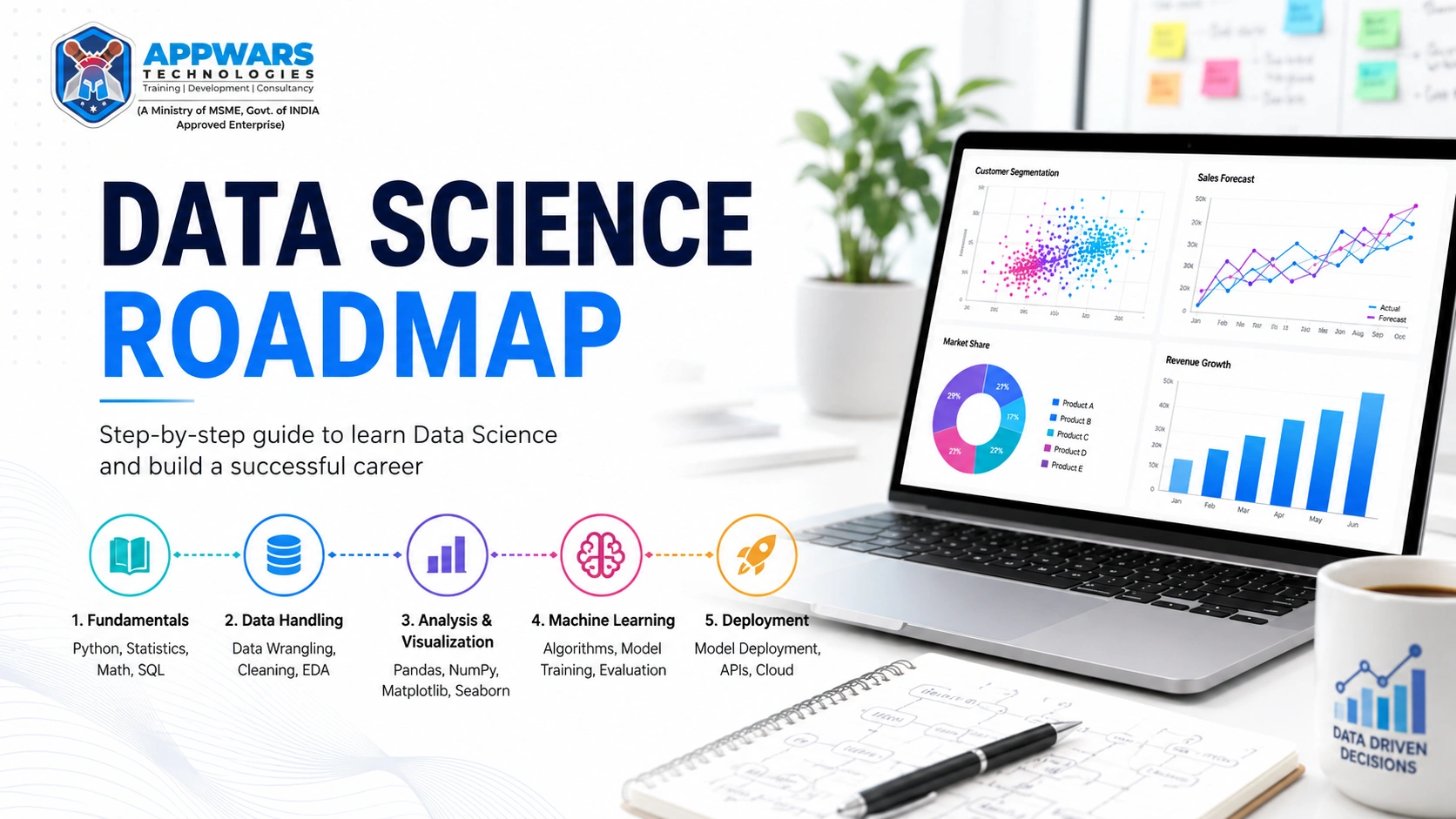
People get lost trying to learn data science. They see a mountain of math and code. A clear data science roadmap fixes that confusion. It gives you a strict sequence to follow. Whether you are a college student or a working professional, you need a plan. You need a data science learning roadmap that points toward a real job.
Most tutorials skip the boring stuff. They jump straight to artificial intelligence. We are going to build a realistic roadmap to learn data science. A solid data science career roadmap starts with the absolute basics. You build upward layer by layer.
Phase 1: The Spreadsheet Foundation
I always tell beginners to start with spreadsheets. You probably think you need to write complex code on day 1. You actually need to understand rows and columns first. Data lives in tables. Excel forces you to look at that data manually. Learn how to filter data. Learn how to write a simple VLOOKUP function. You also need to master pivot tables. They help you summarize millions of rows in seconds.
A good Advance Excel course will cover exactly how to clean messy data before you ever touch a programming language. This is the quiet foundation of any effective data science roadmap.
Phase 2: Database Communication
Your company will store data in a database. You have to extract it yourself. This brings us to SQL. Structured Query Language is mandatory. It is the most requested skill in a data science career roadmap. Start with basic SELECT statements. Learn how to filter with WHERE clauses. Then move to joins. You need to know how to connect table A to table B using an INNER JOIN or LEFT JOIN. Group By clauses are your next target. You will use them every single day to aggregate numbers.
If you want proof of your skills, an SQL certification shows employers you can actually pull your own data. SQL is a massive chunk of your data science learning roadmap.
Phase 3: Learning to Code
Now you pick up a programming language. Python is the industry standard. You use Python to automate the things Excel cannot handle. It handles massive datasets without crashing your computer. Start with basic syntax. Learn how to assign variables. Learn how to write a simple for-loop.
You need to understand lists and dictionaries. These are the basic data structures you will use constantly. Taking a structured Python course keeps you focused on the syntax that actually matters for data analysis. This programming phase sits right in the middle of your roadmap to learn data science.
Phase 4: The Math You Actually Need
People panic about the math requirement. You only need a specific subset of mathematics. Your data science roadmap requires a solid grasp of statistics. You need to understand mean, median, and mode. Learn about standard deviation. It tells you how spread out your data is. Probability is another core concept. You need to know the odds of an event happening.
A complete roadmap of data science also includes basic linear algebra. You just need to understand matrices because algorithms run on them under the hood.
Phase 5: Python Data Libraries
Pure Python is not enough. You need the specific libraries built for data. Pandas is your primary tool here. It is essentially Excel on steroids. You will use Pandas to import CSV files. You will use it to drop missing values. NumPy is the second library you need. It handles heavy mathematical operations quickly. Every good data science learning roadmap dedicates weeks entirely to Pandas and NumPy.
Phase 6: Making Data Look Good
Nobody wants to look at a massive spreadsheet. Stakeholders want pictures. Data visualization is how you communicate your findings. You have to turn numbers into bar charts and line graphs. You can use Python libraries like Matplotlib or Seaborn. They require writing code for every graph. Business intelligence tools are much faster. A tool like Power BI lets you drag and drop columns to create interactive dashboards.
I recommend taking a Power BI course to learn how to build automated reports. Visualization is a highly visible part of your data science career roadmap. It is what the executives actually see.
Phase 7: Introduction to Machine Learning
This is the part everyone waits for. Machine learning is simply using algorithms to find patterns. Your roadmap to learn data science enters a new phase here. You move from analyzing the past to predicting the future. Scikit-Learn is the library you will use. It contains all the standard algorithms. Start with linear regression. It helps you predict a continuous number (like a house price).
Then learn logistic regression. You use this to predict a category (like whether a customer will cancel their subscription). These 2 algorithms make up a massive portion of any practical data science roadmap.
Phase 8: Advanced Machine Learning
Once you understand regression, you move to tree-based models. Decision trees split your data based on simple questions. Random Forests combine hundreds of decision trees to get a better answer. You also need to learn clustering. K-Means clustering helps you group similar customers together without knowing the groups in advance.
This section of the roadmap of data science requires heavy practice. You need to train these models on real datasets from Kaggle. You also have to evaluate your models. Learn about accuracy, precision, and recall. A model is useless if you cannot prove it works.
Phase 9: Version Control and Git
You will write code alongside other people. You need a system to manage those changes. Git is the standard version control system. It tracks every edit you make to a file. Learn how to commit your code. Learn how to push it to GitHub. This is a non-negotiable part of the data science career roadmap. Hiring managers want to see your GitHub profile. It proves you know how to work in a modern engineering environment.
Phase 10: Building Real Projects
Tutorials are safe. Real data is messy. Your data science learning roadmap must transition from guided lessons to independent projects. Find a messy dataset on the internet. Clean it up using Pandas. Build a predictive model. Create a dashboard to show the results. Write a clear README file on GitHub explaining what your project does. A strong portfolio is the single best way to prove you followed a rigorous roadmap to learn data science.
Structuring Your Learning Timeline
A realistic data science roadmap takes about 6 to 12 months. You might spend the first 2 months on Excel and SQL. Months 3 and 4 belong to Python and statistics. Months 5 and 6 focus on machine learning and building projects. Working professionals often have to stretch this timeline. Consistency matters more than speed. Every roadmap of data science looks slightly different based on your background.
The Role of Formal Education
You can piece all this together using free YouTube videos. It just takes longer. Many people prefer a structured environment. A complete data science course packages all these steps into a single curriculum. It prevents you from getting stuck on minor configuration errors. It provides a straight path. You still have to do the work. The course just acts as your guide through the data science roadmap.
Specializing Your Skills
Data science is a broad field. You will eventually have to pick a lane. Some people lean heavily into the database side. They become data engineers. Others focus entirely on dashboards and business metrics. They become data analysts. The pure machine learning engineers spend their time optimizing algorithms. Your data science career roadmap branches out after you master the fundamentals. You get to choose the direction.
Dealing with Imposter Syndrome
Everyone feels overwhelmed in the beginning. The roadmap to learn data science is steep. You will look at Python documentation and feel completely lost. That is a normal part of the process. Just focus on the next immediate step. If you are learning SQL joins, ignore neural networks completely. A good data science roadmap limits your focus. It keeps you executing one task at a time.
Networking and Job Hunting
Your skills do not matter if no one knows you have them. Update your LinkedIn profile. List the specific tools you learned (SQL, Python, Power BI). Connect with recruiters in your industry. Message people who hold the job titles you want. Share your projects publicly. Write a short post explaining a data problem you solved. This active networking finalizes your data science learning roadmap. It connects your technical skills to an actual paycheck.
The Myth of Perfect Code
Beginners obsess over writing elegant code. Businesses just want answers. Your Python scripts will probably be messy at first. Your SQL queries might be a bit slow. Focus on getting the right answer first. You can always optimize the code later. A practical roadmap of data science prioritizes business value over technical perfection.
Deep Learning and the Future
You will eventually hear about neural networks and deep learning. These are the technologies powering modern language models and image generators. They sit at the very end of the data science roadmap. You should only touch them after mastering the basics. Libraries like TensorFlow and PyTorch handle this heavy computing. Most beginner projects do not need deep learning.
Cloud Computing Basics
Your laptop has limits. Real companies run their data operations in the cloud. Familiarize yourself with AWS, Google Cloud, or Microsoft Azure. You do not need to be a cloud architect. You just need to know how to spin up a virtual machine. Learn how to query a cloud database like BigQuery or Snowflake. This knowledge is a massive boost to any data science career roadmap.
Communication Skills
You have to explain your complex models to people who hate math. Communication is a critical technical skill. It determines whether your model actually gets used. Practice explaining your projects in plain English. Avoid using statistical jargon when talking to the marketing team. A successful data science learning roadmap forces you to present your findings regularly.
Continuous Learning
The tools change rapidly. The core concepts stay the same. A solid roadmap to learn data science focuses heavily on the fundamentals. A SQL join works the same way it did 20 years ago. Python is constantly updating. New visualization tools appear every year. You will spend your entire career learning new libraries. Accept that fact early. Your data science roadmap is just the entry point into a lifelong habit of studying.
Building Your First Excel Project
Let us look at a specific project for the start of your data science roadmap. Download a personal finance dataset from Kaggle. Open it in Excel. Use the SUMIFS function to calculate total spending by category. Create a pivot table to show spending trends over 12 months. This simple exercise proves you can handle raw data. Save this spreadsheet. It is the first entry in your portfolio.
Deep Dive into SQL Functions
Your roadmap of data science needs to go beyond basic SQL. You have to learn window functions. Functions like ROW_NUMBER() and RANK() are incredibly powerful. They let you calculate running totals without collapsing your data rows. You also need to understand Common Table Expressions (CTEs). They make complex queries readable.
Interviewers love testing candidates on CTEs and window functions. Mastering these specific functions accelerates your data science learning roadmap.
Essential Pandas Techniques
Your Python skills will rely heavily on Pandas. You need muscle memory for specific commands. Learn how to use the .groupby() function. It is the Python equivalent of a pivot table. You need to know how to merge two dataframes. The pd.merge() function is essentially a SQL join written in Python. Handling dates is notoriously difficult. Learn how to use pd.to_datetime() to convert text strings into actual dates.
These tiny technical details make up the bulk of your daily work. They are the granular steps within your broader data science roadmap.
Understanding API Connections
Data does not always live in a clean CSV file. Often, it lives on a web server. You need to learn how to pull data using an application programming interface (API). The Python requests library handles this perfectly. This allows you to pull live weather data, stock prices, or social media stats. Adding API extraction to your data science career roadmap gives you access to infinite project ideas.
A Specific Machine Learning Project
Let us outline a proper machine learning project. Find a dataset containing customer churn information. This data shows which customers canceled their service. Your goal is to predict which current customers are likely to leave next month. Load the data with Pandas. Clean the missing values. Train a Random Forest classifier using Scikit-Learn. Calculate the precision of your model. Identify the top 3 reasons customers are leaving.
This exact project proves you understand the core purpose of a data science roadmap. You are solving a measurable business problem.
Creating an Interactive Dashboard
Predictions are useless if they stay hidden in a Jupyter notebook. Export your customer churn predictions. Load them into a visualization tool. Create a bar chart showing churn risk by geographic region. Add a slicer so users can filter by customer age. Publish this dashboard online. Now you have a link you can send to recruiters. This interactive element is a massive differentiator in your roadmap to learn data science.
Preparing for Technical Interviews
The interview process requires its own specific preparation.
You will face live coding tests. Expect to write SQL queries on a whiteboard.
Practice LeetCode problems specifically focused on database querying.
You will also face statistical questions. Review probability and A/B testing concepts.
Your data science roadmap must include dedicated time for interview prep.
The Importance of A/B Testing
Companies run experiments constantly. They want to know if a blue button generates more clicks than a red button. This is A/B testing. It is applied statistics. You need to understand p-values. You need to know how to calculate statistical significance. If you tell a business their test was successful when it was actually random noise, you cost them money. This practical application of math is a cornerstone of the roadmap of data science.
Writing Clean Code
Your scripts need to be readable. Other people will have to maintain your work. Follow the PEP 8 style guide for Python. Use descriptive variable names. Name your variables customer_revenue instead of x. Add comments to explain complex logic. Writing clean code is a quiet superpower in a data science career roadmap. It makes senior developers want to work with you.
Understanding Data Ethics
You will have access to sensitive information. You will handle customer addresses and purchasing histories. You must respect privacy laws like GDPR. You must anonymize data before sharing it. You also have to watch for bias in your machine learning models. If your training data is biased, your predictions will be biased.
A mature data science learning roadmap includes a serious look at ethical responsibilities.
Navigating the Job Market
The entry-level job market is competitive. You have to stand out. Reach out directly to hiring managers on LinkedIn. Send them a link to your portfolio. Tailor your resume for every single application. Highlight the specific tools mentioned in the job description. This aggressive networking strategy is the final phase of your roadmap to learn data science.
Specializing in Natural Language Processing
Maybe you want to work with text data. This is Natural Language Processing (NLP). You will learn to analyze customer reviews to determine sentiment. You will use libraries like NLTK or SpaCy in Python. You have to learn how to tokenize words and remove stop words. NLP is an exciting offshoot of the main data science roadmap. It requires a specific set of text-processing skills.
Time Series Forecasting
Many businesses want to predict future sales based on historical data. This is time series forecasting. It requires different techniques than standard machine learning. You have to account for seasonality. People buy more winter coats in December. You will use models like ARIMA or Prophet. Adding time series analysis to your roadmap of data science makes you incredibly valuable to retail companies.
The Reality of Data Cleaning
I need to be honest about the day-to-day work. You will spend 80% of your time cleaning data. You will spend 20% of your time building models. You will fix typos in databases. You will track down missing records. You have to learn to love the cleaning process. It is where you actually learn the nuances of the business. Every successful data science career roadmap is built on thousands of hours of data janitor work.
Documentation and Reporting
You finish a project. You are not done yet. You have to write documentation. You have to explain exactly how your model works. You need to document where the data came from. You need to list the assumptions you made. Good documentation ensures your work survives after you leave the company. It is a tedious but mandatory part of your data science learning roadmap.
The Power of Community
You do not have to learn alone. Join a local tech meetup. Participate in online forums like Reddit or Stack Overflow. Ask questions when you get stuck. Help others when you know the answer. Building a network provides emotional support during the hardest parts of your roadmap to learn data science.
Reviewing Your Progress
Set milestones. Check your progress every month. If you planned to master SQL in 4 weeks but it took 6, that is fine. Adjust the schedule. Your data science roadmap is a living document. It should adapt to your learning speed. Keep pushing forward. Consistency always beats intensity.
Handling Large Datasets
Eventually, Pandas will run out of memory. Your computer will freeze trying to load a 10-gigabyte file. This is where your data science roadmap expands into big data tools. You will need to learn PySpark. It distributes the data processing across multiple computers. It uses syntax very similar to Pandas and SQL. Knowing how to handle massive datasets is a major milestone in your data science career roadmap.
The Role of Domain Knowledge
Coding and math are just tools. You need to understand the business you work for. If you work in healthcare, you need to understand medical billing codes. If you work in finance, you need to understand interest rates and risk metrics. Domain knowledge tells you which questions are actually worth asking. A technical data science roadmap is useless if you do not understand the industry context.
Choosing an IDE
You need a place to write your Python code. This is called an Integrated Development Environment (IDE). Most beginners start with Jupyter Notebooks. They allow you to run code one block at a time. As your projects get larger, you will likely switch to VS Code or PyCharm.
These tools help you catch syntax errors before you run the script. Setting up a professional coding environment early accelerates your data science learning roadmap.
Staying Updated
The tech industry moves aggressively fast. New algorithms are published weekly. Software gets updated constantly. Subscribe to industry newsletters. Read engineering blogs from companies like Netflix or Uber. Your roadmap of data science does not end when you get hired. The learning requirement is permanent. You have to dedicate a few hours every week to studying new concepts.
Overcoming the Plateau
You will hit a wall around month 4. You will understand the syntax, but you will struggle to build projects from scratch. This is the hardest part of the roadmap to learn data science. Push through it. Start with tiny scripts. Automate one small task on your computer. Momentum builds slowly. Trust the structure of your data science roadmap.
The Final Review of the Roadmap
Let us summarize the core progression. Start with the spreadsheet basics. Master database extraction with SQL. Learn Python to automate tasks and manipulate data frames. Apply statistics to understand the numbers. Build machine learning models to make predictions. Visualize the results for stakeholders. This sequence creates a predictable, reliable data science roadmap.
Conclusion
The path is long. The work is difficult. But a career in data is incredibly rewarding. You get to solve complex puzzles every day. Stick to your data science career roadmap. Build a portfolio that proves your competence. The jobs are out there waiting for people who can actually execute these skills. Start building today.
Learn more:- Your comprehensive guide to mastering data science