Companies don’t guess anymore. They pull numbers, run models, and make calls based on what the data actually says. That shift, from gut instinct to evidence, is why data science has become one of the most talked about careers on the planet.
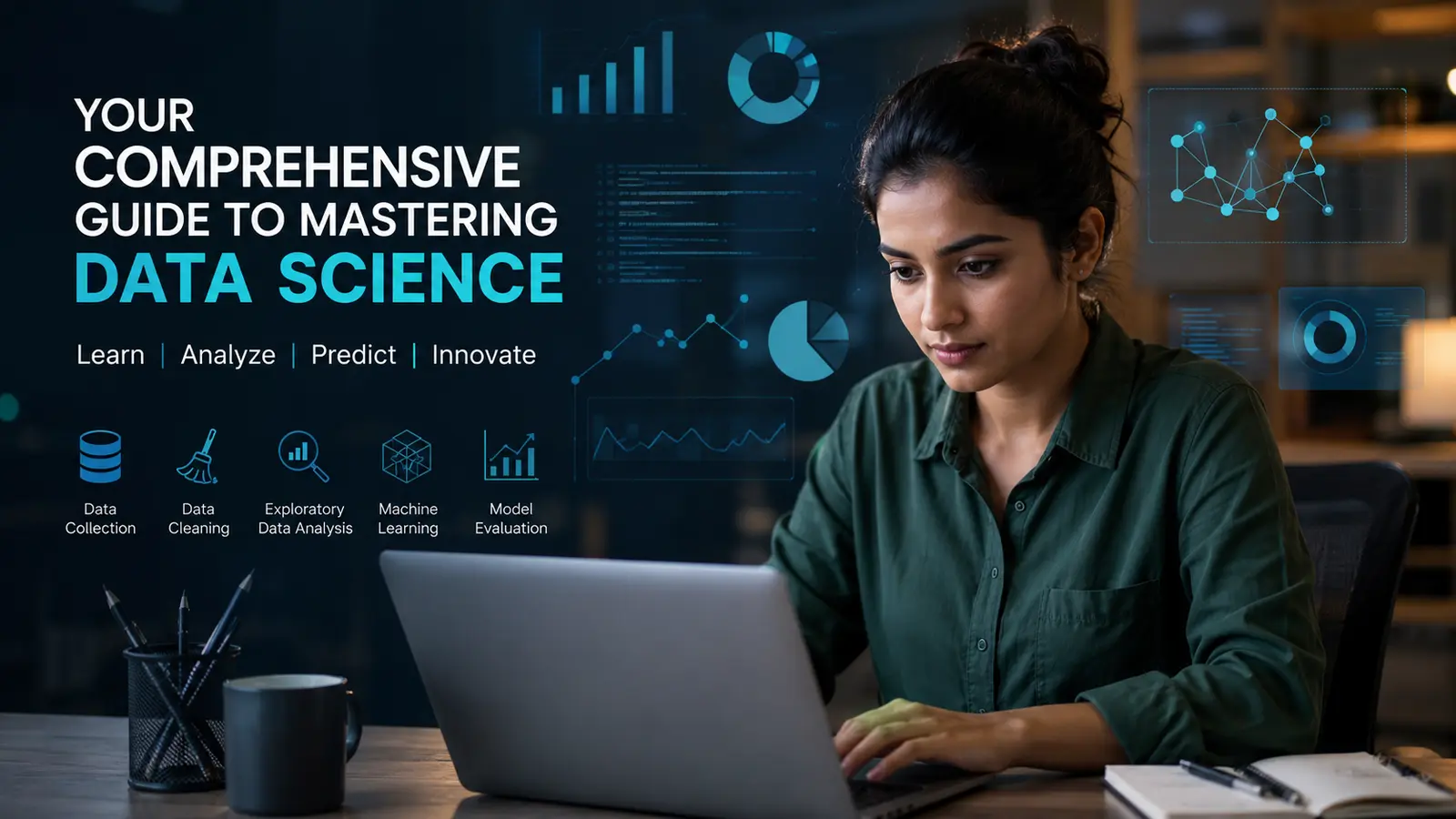
If you’ve been thinking about taking a data science course but aren’t sure where to start, this guide is for you. In this comprehensive guide to mastering data science, you’ll learn what data science is, why it has become one of the most sought-after career options, the essential skills you need, and a step-by-step roadmap to start and become proficient in data science. Whether you’re a student, working professional, or career changer, this guide will help you make informed career decisions with clear, practical insights.
By the end, you’ll have a clear roadmap: the tools worth learning, the projects worth building, and the career paths worth chasing. Let’s get into it.
What is data science?
At its core, data science is the practice of extracting useful insight from raw data. That’s it. You take messy numbers, text, images, or logs, and you turn them into something a business can act on.
It’s not one skill. It’s a mix. A good data scientist understands statistics well enough to trust (or question) a result. They can code well enough to clean and process data at scale. They know enough about machine learning to build predictive models. And they understand the business well enough to know which question is even worth asking.
Think about Netflix recommending your next show, or a bank flagging a fraudulent transaction in half a second. Both are data science in motion: pattern recognition applied to millions of data points, running quietly in the background of products you use every day.
Before you start following a data science roadmap, it’s important to understand how data science differs from closely related fields. Many beginners confuse data science, data analytics, machine learning, and AI, so let’s clear that up first.
Data science vs data analytics vs AI vs machine learning
Data analytics looks backward. It answers “what happened and why,” usually through dashboards, reports, and SQL queries. Data science looks forward too. It builds models that predict what’s likely to happen next.
Machine learning is a tool inside the data science toolbox: algorithms that learn patterns from data instead of following hardcoded rules. Artificial intelligence is the broader umbrella, covering everything from machine learning to robotics to natural language systems like the one you might be using to draft an email right now.
So a data analyst might tell you sales dropped 12% last quarter. A data scientist builds the model that predicts next quarter’s sales and flags which customers are about to churn. Different jobs, overlapping skills, and honestly, a lot of companies blur the titles anyway.
Why data science matters for businesses
Every industry runs on decisions, and decisions built on data tend to beat decisions built on hunches. Retailers use it to forecast demand before shelves go empty. Hospitals use it to predict patient readmission risk. Insurance firms use it to price policies more accurately.
Automation is a big piece of this too. A model that flags fraudulent credit card charges in real time saves banks millions and protects customers before they even notice something’s wrong. Predictive analytics does something similar for manufacturing, catching equipment failures before a machine actually breaks down.
None of this happens without people who know how to build, test, and deploy these models responsibly. That’s the demand driving data science career growth right now, and it’s not slowing down anytime soon.
Is data science a good career in 2026 and beyond?
Short answer: yes, and it’s not close. Every sector, healthcare, finance, logistics, retail, entertainment, needs people who can turn data into decisions. Salaries reflect that demand, and the roles keep multiplying as companies build out AI products.
That said, the field is maturing. Five years ago, knowing basic Python and a bit of statistics could land you a job. Now employers expect real projects, a working knowledge of deployment, and comfort with tools beyond a Jupyter notebook. The bar is higher, but so is the payoff for people who put in the work.
If you’re weighing a data science career against other tech paths, the honest pitch is this: it rewards curiosity and persistence more than raw genius. You don’t need a PhD to get started. You need consistency.
What skills are required to become a data scientist?
You need a working combination of programming, statistics, and communication. Python is the backbone for most data science work. SQL lets you pull data out of the databases where it actually lives. Statistics tells you whether a pattern is real or just noise.
Beyond the technical side, you need to explain your findings to people who don’t care about your code. A model is worthless if the marketing team can’t understand why it recommends what it recommends. That communication piece trips up more beginners than any algorithm does.
Curiosity matters more than people admit. The best data scientists I’ve worked with poke at data the way a mechanic pokes at an engine, just to see what happens when they change one thing.
Popular data science tools you should know
Python is the most widely used language in the field, thanks to libraries built specifically for data work. R remains popular in academic and statistical circles, especially for heavy-duty statistical modeling.
Jupyter Notebook is where most data scientists write and test code interactively, mixing code, notes, and charts in one file. Google Colab does something similar but runs in the cloud, free of charge, which makes it a favorite for beginners without a powerful laptop. VS Code is the editor many professionals switch to once projects grow past a single notebook.
For visualizing results, Power BI and Tableau turn raw numbers into dashboards that non-technical stakeholders can actually read. MySQL and PostgreSQL are the databases where most business data sits, so knowing how to query them is non-negotiable.
On the machine learning side, Scikit-learn handles most classic algorithms, while TensorFlow powers deep learning projects like image recognition and natural language models. Apache Spark and Hadoop step in when datasets get too large for a single machine to handle. And GitHub is where you’ll store, version, and share your code, something every employer expects to see.
Knowing the names isn’t enough. You learn these tools by breaking things in them, which brings us to the roadmap.
A step-by-step roadmap to mastering data science
Start with Python. Not “read a book about Python,” actually write code every day until basic syntax stops feeling foreign. From there, statistics: distributions, hypothesis testing, correlation versus causation. Skip this step and every model you build later becomes a black box you don’t trust.
Next comes SQL, because real data doesn’t live in a clean CSV file waiting for you. It’s sitting in databases, and you need to know how to pull it out. Once you can gather and query data, move into data analysis and visualization: cleaning messy datasets, spotting outliers, and building charts that tell a clear story.
Machine learning comes after that foundation, not before it. Learn regression and classification first, then move into more advanced models. Build real projects along the way instead of waiting until you “feel ready.” You’ll never feel ready. Build anyway.
Deep learning basics round things out for anyone interested in image or language work. Then it’s about packaging everything: a portfolio on GitHub, practice with interview-style problems, maybe a certification if it fits your goals, and finally, applying for roles. This whole data science learning path usually takes 8 to 14 months for someone studying seriously alongside a job or school, though some people move faster.
Data science projects beginners should try
House price prediction teaches regression: how different features combine to predict a number. A movie recommendation system introduces you to similarity metrics and collaborative filtering, the same logic behind Netflix and Spotify suggestions.
Customer churn prediction is a favourite among hiring managers because it mirrors real business problems: which customers are about to leave, and why. Sales forecasting teaches time series analysis, a skill that shows up constantly in retail and finance roles.
Spam email detection and sentiment analysis both dip into natural language processing, teaching you how to work with text instead of numbers. Credit card fraud detection introduces you to imbalanced datasets, where the thing you’re trying to catch is rare and easy to miss. Employee attrition prediction rounds things out with HR analytics, a field a lot of beginners overlook.
Each of these projects, on its own, isn’t impressive. What matters is that you build five or six of them, document your process, and put them somewhere a recruiter can actually see your thinking.
Career opportunities in data science
A data scientist builds models and extracts insight from complex datasets. A data analyst focuses more on reporting, dashboards, and answering specific business questions. A machine learning engineer takes models from research into production, making sure they run reliably at scale.
An AI engineer builds broader intelligent systems, often combining machine learning with software engineering. A business intelligence analyst turns data into dashboards executives actually use to make decisions. A data engineer builds and maintains the pipelines that move data from one system to another, work that’s less visible but absolutely essential.
Research scientists push the boundaries of what’s algorithmically possible, often inside universities or R&D labs. NLP engineers specialize in language, powering chatbots and translation tools. Computer vision engineers work on image and video recognition. Analytics consultants bounce between companies, solving data problems on a project basis.
Demand across nearly all of these roles has grown steadily for years, and companies building AI products aren’t slowing their hiring anytime soon.
Common challenges beginners face and how to beat them
Learning to code from zero is genuinely hard for a lot of people, and it’s fine to admit that. The fix isn’t a better tutorial. It’s writing code daily, even fifteen minutes, until your brain stops treating it like a foreign language.
Statistics trips people up because it’s abstract until you apply it to something real. Work through problems using actual datasets instead of textbook examples, and the concepts click faster. Real-world data is messy in ways no course fully prepares you for: missing values, inconsistent formatting, duplicate entries. You get better at handling it by handling it, repeatedly, on different datasets.
Building your first project feels intimidating because you’re staring at a blank notebook with no instructions. Pick something small and finish it badly before you try to build something impressive. Staying consistent is probably the hardest part of any data science learning path, and the honest fix is scheduling study time like you’d schedule a meeting you can’t skip.
Choosing resources is its own trap, since there are thousands of courses promising the same outcome. Pick one structured path, finish it, and resist the urge to restart with a shinier course every few weeks.
Tips to become a successful data scientist
Practice daily, even in small doses. Thirty focused minutes beats three scattered hours on a weekend. Build projects instead of just watching tutorials, because building is where the actual learning happens.
Work with real datasets from places like Kaggle, government data portals, or open APIs. Join competitions occasionally, not to win, but because the deadline pressure forces you to finish things instead of endlessly tweaking them. Read research blogs from companies like Google AI or industry practitioners to stay current on how techniques are actually used, not just how they’re taught.
Improve how you explain your work, out loud, to someone who isn’t technical. That skill alone separates a lot of average data scientists from great ones. And keep learning. The tools shift every couple of years, and staying static is the fastest way to fall behind in a field built on constant change.
Why choose professional data science training
Self-study works, plenty of people have done it. But structured programs solve a specific problem: they give you a sequence, a set of expert mentors, and deadlines you didn’t create yourself.
A solid program pairs an industry-relevant curriculum with hands-on projects instead of pure theory. Capstone projects push you to apply everything you’ve learned to something that resembles a real business problem, often the strongest portfolio piece a beginner walks away with.
Career guidance, resume building, and interview preparation matter more than people expect going in. Knowing the material and knowing how to present it in an interview are two separate skills, and most beginners underestimate the second one. Some programs also offer placement support and certification, which can help when you’re trying to get noticed in a crowded job market, though a certificate alone won’t replace a strong portfolio.
Frequently asked questions
1. Is data science difficult?
It’s demanding, not impossible. Math and coding take real effort, but thousands of people with no technical background have learned it through consistent practice.
2. Can beginners learn data science?
Yes. Most working data scientists started with zero coding experience. What matters is a structured data science learning path and the discipline to stick with it.
3. Do I need coding experience to start?
No prior experience is required. You’ll build coding skills as part of learning data science itself, usually starting with Python.
4. Which language should I learn first?
Python, for most people. It’s the most widely used language in the field and has the largest ecosystem of data science libraries.
5. Is Python enough on its own?
Python covers most of what you need, but pairing it with SQL for querying databases makes you far more employable.
6. Is data science a good career choice?
Yes. Demand spans nearly every industry, and salaries reflect that demand, though like any field, results depend on the effort you put in.
7. How long does it take to become job-ready?
Most people studying seriously take 8 to 14 months, depending on prior experience and how much time they can dedicate weekly.
8. Which certification is best?
No single certification dominates the field. What matters more to employers is a portfolio of real projects backed by clear thinking.
9. Can non-IT students learn data science?
Absolutely. Students from commerce, biology, economics, even the humanities, have transitioned into data science successfully by focusing on Python, statistics, and consistent project work.
10. Is data science future-proof?
No field is fully future-proof, but data science sits at the center of how AI and automation are being built, which makes it one of the safer long-term bets in tech right now.
Conclusion
Mastering data science isn’t about memorizing every tool on this list or finishing every course available. It’s about picking a path, Python, statistics, SQL, a few solid projects, and working through it consistently until the pieces start connecting on their own.
The demand is real. The career paths are wide open, from data analyst to machine learning engineer to research scientist. And the skills you build along the way, working with real data, explaining findings clearly, thinking in probabilities, carry over into almost any modern job.
You don’t need permission to start. Open a notebook, pull a dataset, and write your first ten lines of Python today. That’s how every data scientist you admire actually began.