You’ve probably typed “Python Full Stack vs MERN Stack” into Google at 1am, half-convinced you’re behind on something everyone else already figured out. You’re not. Both stacks are still wide open in 2026, and the “right” answer depends less on what’s trendy and more on what kind of developer you want to become.
Full stack development means you can build the part users click on and the part that actually does the work behind it. The frontend, the backend, the database, all of it. A full stack developer doesn’t need a teammate to ship a working product end to end.
Why does this matter so much right now? Companies are hiring smaller teams and expecting more from each hire. A startup with 8 engineers can’t afford to keep frontend and backend specialists in separate silos anymore. They want someone who can take a feature from a Figma file to a deployed API in the same sprint. That’s the gap full stack skills fill.
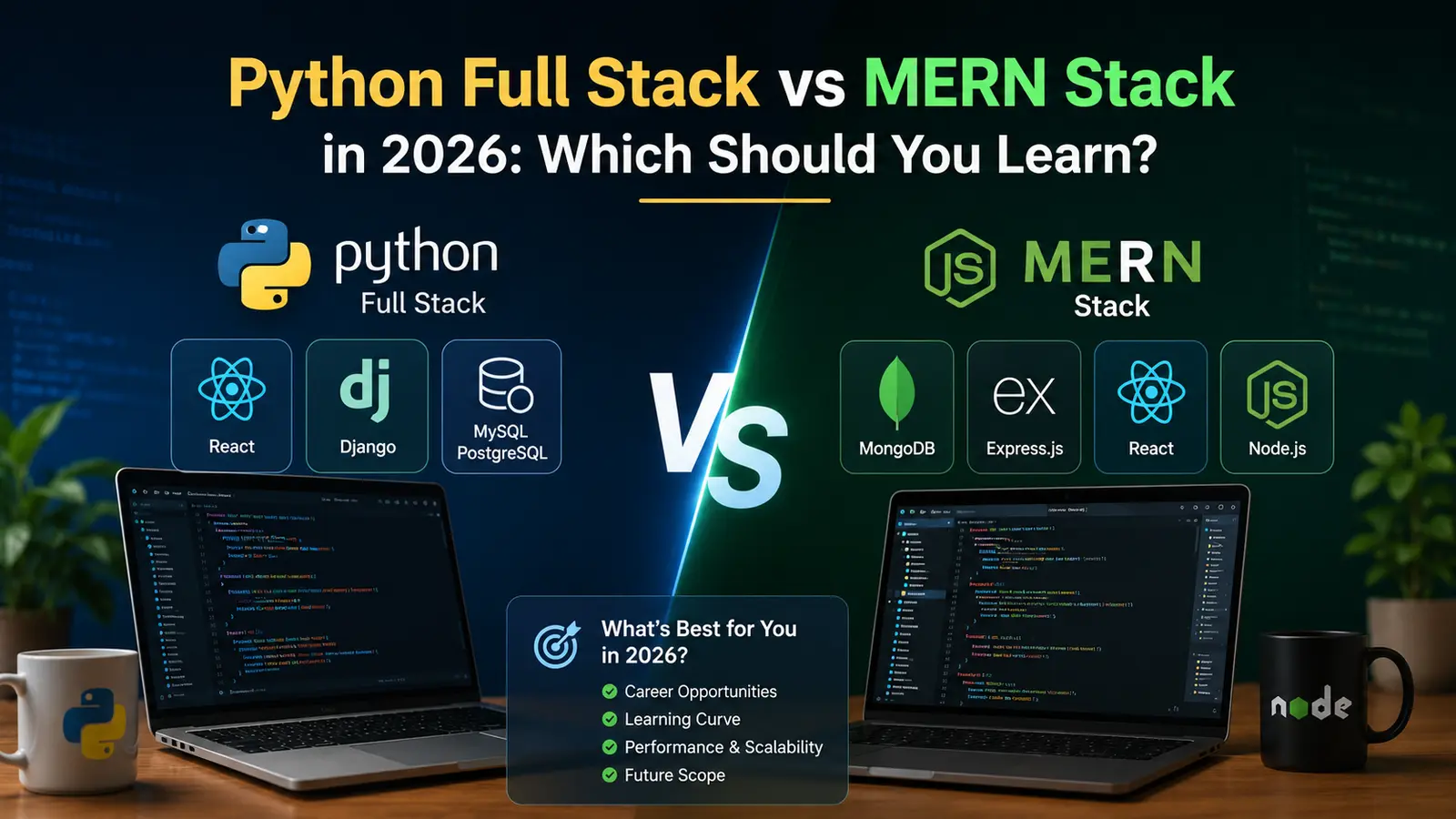
Two stacks dominate this conversation: Python Full Stack and MERN Stack. Python Full Stack pairs a Python backend (usually Django or Flask) with a frontend layer like React, plus SQL for data. MERN Stack is JavaScript end to end: MongoDB, Express.js, React, and Node.js, no language switching required.
This blog breaks down both stacks piece by piece, so by the end you’ll know exactly which one fits your goals, not just which one has more YouTube tutorials.
What is Python Full Stack Development?
Python Full Stack means using Python to handle your backend logic while pairing it with frontend tools to build the interface users actually see. It’s not a single framework with a fixed name like MERN. It’s a combination: Python does the heavy lifting on the server, and HTML, CSS, and JavaScript (often through React) handle what happens in the browser.
The frontend layer is where users click buttons, fill forms, and scroll feeds. The backend is where that data gets validated, processed, and stored. The database sits underneath both, holding everything from user accounts to product inventories. In a Python Full Stack setup, these three layers talk to each other through APIs, with Python doing the server-side thinking.
On the frontend side, you’re working with HTML for structure, CSS for styling, and JavaScript for interactivity. Most Python Full Stack developers now pair this with React, because building a Python backend without a modern frontend framework feels like driving a sports car with bicycle wheels.
The backend is where Python actually flexes. Django gives you a batteries-included framework: authentication, admin panels, ORM, all baked in. Flask is the lighter option, built for developers who want control over every piece instead of accepting Django’s opinions. Both connect to SQL databases like PostgreSQL or MySQL, where your data lives in structured tables with defined relationships.
I’d say Django suits people building something with users, permissions, and admin needs from day one. Flask suits people who want to understand every line of their backend before adding complexity.
What is MERN Stack Development?
MERN Stack stands for MongoDB, Express.js, React, and Node.js. Four tools, one language. Every layer of your application, from database queries to server logic to the UI, runs on JavaScript.
That single-language setup is exactly why MERN exploded in popularity. Before Node.js, JavaScript lived only in browsers. Backend work meant learning a second language like Python, Ruby, or PHP. Node.js changed that by letting JavaScript run on servers too. Suddenly, one language could cover your entire application, and developers didn’t need to mentally switch gears between frontend and backend code.
MongoDB is the database layer, and it’s not built like traditional SQL databases. Instead of rows and tables, MongoDB stores data as JSON-like documents. If your app’s data structure changes often (and in fast-moving startups, it usually does), MongoDB lets you adapt without rewriting your schema every time.
Express.js sits on top of Node.js and handles your server logic: routing, middleware, API endpoints. It’s minimal by design, which means you write more of the structure yourself compared to Django, but you also get more flexibility.
React.js, the same library Python Full Stack developers often use, builds the interface. Components, state, props, the works.
Node.js is what makes all of this run on the server. It’s fast for I/O-heavy tasks like handling lots of simultaneous API requests, which is part of why companies running real-time apps (think chat platforms, live dashboards) lean toward Node.
Python Full Stack vs MERN Stack: Key Differences
When people search “mern stack vs python full stack,” they usually want a direct comparison, not a philosophy lecture. So here it is, side by side.
Programming language is the first fork in the road. Python Full Stack means you’re switching between Python on the backend and JavaScript on the frontend. MERN keeps you in JavaScript the entire time. If context-switching between languages slows you down, that’s a real consideration, not a minor one.
Frontend technology is actually a tie. Both stacks commonly use React for the UI layer, so this isn’t where they differ much.
Backend technology is where the two stacks differ the most. A Python Full Stack course typically uses Django or Flask, both Python-based frameworks known for their clean and readable syntax. MERN uses Express.js running on Node.js, which is fast but requires more manual setup for things Django gives you for free.
Database choice diverges too. Python Full Stack typically pairs with SQL databases like PostgreSQL, great for structured data with clear relationships (think banking records, inventory systems). MERN uses MongoDB, a NoSQL database that handles flexible, document-based data well (think user-generated content, rapidly evolving app features).
Performance is close, but they shine in different scenarios. Node.js (and by extension MERN) handles high-concurrency, I/O-heavy workloads efficiently, like real-time messaging or live notifications. Python’s strength shows in compute-heavy tasks, especially anything touching machine learning or data processing.
Learning difficulty leans slightly in Python’s favor for absolute beginners. Python’s syntax reads close to plain English, which softens the learning curve. MERN asks you to get comfortable with JavaScript’s quirks (callbacks, promises, async patterns) a bit earlier in the journey.
Career opportunities are strong on both sides, but they skew differently. Python Full Stack opens doors in AI, data science, and backend-heavy roles. MERN Stack is dominant in startups and companies building fast, JavaScript-first web products.
And since “mern stack vs django” comes up constantly in search: Django is the framework, MERN is the full stack. Comparing them directly is a bit like comparing an engine to a car, but the short version is Django wins on built-in structure, MERN wins on language consistency.
Advantages of Python Full Stack
Python’s syntax is genuinely beginner-friendly. You’re not fighting semicolons, curly braces, or confusing scoping rules early on. You write something close to pseudocode, and it runs. That lower barrier to entry is a real reason so many people choose Python Full Stack as their first serious stack.
Django and Flask are backend frameworks with serious staying power. Django alone powers parts of Instagram, Pinterest, and Spotify’s backend tooling. These aren’t toy frameworks. They’re built for production at scale, with security patches, active communities, and mature documentation behind them.
Here’s where Python pulls ahead of MERN in a way that’s hard to ignore: AI and machine learning support. Python is the default language for TensorFlow, PyTorch, scikit-learn, and basically every major ML library in active use. If you’re building a Python Full Stack app today, adding a recommendation engine or a predictive feature tomorrow doesn’t require learning a new language. You just import the library.
Security and scalability are baked into Django specifically. Built-in protection against SQL injection, cross-site scripting, and clickjacking comes standard, not bolted on. For teams that don’t want to think about security from scratch, that’s a meaningful head start.
Career-wise, Python Full Stack developers aren’t limited to web development. The same Python skills transfer to data analysis, automation, and AI roles, which means more flexibility if you decide web dev isn’t your final destination.
Advantages of MERN Stack
The single biggest draw of MERN is obvious: one language, JavaScript, covers your entire app. No mental gear-shifting between Python syntax and JavaScript syntax. You write JavaScript in the morning for your React components and JavaScript in the afternoon for your Express routes. That consistency speeds up how fast you can actually build things.
Faster development is a direct result of that consistency. Shared logic, shared mental models, shared debugging patterns across frontend and backend. Teams report shipping MVPs faster with MERN specifically because there’s less friction moving between layers.
The ecosystem around MERN is enormous and flexible. npm hosts more packages than almost any other package registry, which means whatever niche problem you’re solving, someone’s probably already built a library for it.
Popularity among companies is hard to overstate. Netflix, Uber, and countless startups run Node.js in production. JavaScript’s dominance in web development isn’t slowing down, and MERN rides that wave directly.
Career opportunities lean heavily toward startup and product-focused roles. If you want to work somewhere shipping fast, iterating constantly, and building consumer-facing products, MERN Stack experience tends to map directly onto what those companies are hiring for.
Python Full Stack vs MERN Stack: Which Should You Learn in 2026?
I won’t pretend there’s one universal answer here, because there isn’t. But there are clear signals for which way you should lean.
Choose Python Full Stack if you’re drawn to Python itself, or if AI and data science sound more interesting to you than pure web development. If “I want to eventually build machine learning features” is somewhere in your head, even vaguely, Python Full Stack sets you up for that pivot without starting over. It’s also the stronger pick if you want backend skills that go deep: complex business logic, data pipelines, systems that need to scale carefully.
Choose MERN Stack if JavaScript already feels comfortable, or if you want to move fast on modern, interactive web products. If your goal is building polished, fast UIs and shipping features quickly at a startup, MERN’s single-language workflow removes a lot of friction. It’s also the better pick if you’re aiming for roles at companies building real-time features: chat apps, live dashboards, collaborative tools.
If you’re still torn, ask yourself one question: in five years, do you want to be the person companies call for AI integration, or the person companies call to build their product fast? That answer points you toward your stack.
Career Opportunities After Learning These Stacks
Both stacks open the door to genuinely overlapping roles, with some differences in emphasis depending on which path you took.
A Full Stack Developer title is the most direct outcome either way, someone who builds and maintains both the user-facing and server-side parts of an application. Software Developer is broader, often covering work beyond just web apps, including tools, internal systems, and automation, especially common for Python Full Stack graduates.
Web Developer roles tend to focus specifically on building and maintaining websites and web applications, a strong fit for MERN Stack skills given the heavy frontend and JavaScript overlap. Backend Developer roles concentrate on server logic, APIs, and databases, places where deep Python (Django/Flask) or Node.js (Express) knowledge directly applies.
Frontend Developer roles focus purely on the user interface and experience layer, and since both stacks commonly use React, this path is open regardless of which backend you learned. Companies hiring for any of these titles in 2026 are less concerned with which exact stack you used in a course and more concerned with whether you can demonstrate real, working projects.
Skills Required to Become a Full Stack Developer
Regardless of which stack pulls you in, certain skills sit underneath both paths, non-negotiable groundwork that every full stack developer needs.
HTML and CSS come first. They’re the skeleton and skin of every web page you’ll ever build, and skipping them to jump straight into frameworks usually backfires later when something breaks and you don’t understand why.
JavaScript is essential even if you go the Python Full Stack route, since your frontend (React or otherwise) runs on it regardless of your backend choice. Programming concepts like loops, conditionals, functions, and data structures transfer across every language you’ll touch, so understanding them deeply matters more than memorizing syntax in any one language.
APIs are how your frontend and backend actually talk to each other. Understanding REST principles, HTTP methods, and how to structure requests and responses isn’t optional, it’s the connective tissue of full stack work.
Databases, whether SQL or NoSQL, need to make sense to you conceptually: how data gets structured, queried, and related. Git is how you track changes and collaborate without overwriting your teammate’s work at 2pm on a deadline day.
And honestly, problem-solving skills matter more than any single technology on this list. Stacks change. Frameworks get replaced. The ability to break down a messy problem into solvable pieces is what actually makes someone hireable long after the specific tools they learned have shifted.
Conclusion
Picking between Python Full Stack and MERN Stack isn’t really about which one is objectively better, because neither is. It comes down to your interests and where you want your career to head. If Python, AI, and strong backend systems pull at you, go that route. If JavaScript already feels like home and you want to build fast, modern web products, MERN makes more sense.
Both paths have genuine staying power heading through 2026 and beyond. Companies need developers who understand Python Full Stack development for AI-adjacent and data-heavy products, and they need MERN Stack developers for fast, JavaScript-native web applications. Pick the one that excites you enough to actually finish the projects, because that’s ultimately what gets you hired, not which stack technically has more job postings this month.
Also read this article- Python Full Stack Development Roadmap