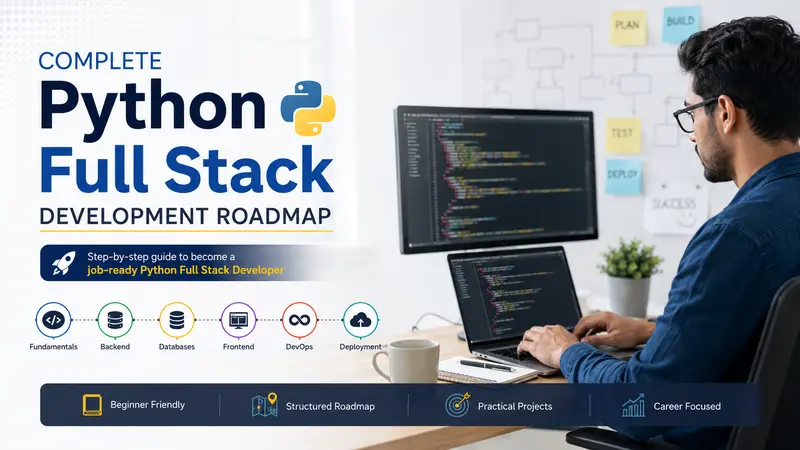
Python remains one of the most popular programming languages for web development, automation, artificial intelligence, and enterprise applications. Its simple syntax and extensive ecosystem make it an excellent choice for beginners and experienced developers alike. For anyone planning to become a full stack developer, following a structured Python Full Stack Development Roadmap can help you build the right skills in the correct order and avoid wasting time on unnecessary technologies.
A full stack developer is expected to handle both the front-end and back-end aspects of a web application. That means understanding user interfaces, databases, APIs, server-side programming, deployment, and cloud platforms. This guide walks through a complete Python full stack training development roadmap that can help you become job-ready in 2026.
Understanding the role of a Python full stack developer
A Python full stack developer works on every layer of a web application. They create user-facing interfaces, build server-side logic, manage databases, develop APIs, and deploy applications to production environments.
The demand for developers who follow a complete Python full stack developer roadmap continues to grow because businesses prefer professionals who can contribute across multiple stages of software development. Whether you join a startup or a large organization, full stack development skills make you a more versatile and valuable developer.
Start with Python fundamentals
Every successful Python full stack roadmap begins with strong programming fundamentals. Before learning frameworks or web technologies, you need a solid understanding of Python itself.
Focus on variables, data types, operators, loops, conditional statements, functions, and exception handling. Spend time learning object-oriented programming because most modern Python frameworks rely heavily on classes and objects. Understanding data structures such as lists, tuples, dictionaries, and sets will also make development much easier later.
Many beginners rush through this stage. Taking time to build a strong foundation will make every future step in the roadmap for python full stack developer significantly easier.
Learn HTML for web page structure
HTML is the backbone of every website. It defines the structure and content displayed in a browser.
You should learn semantic HTML elements, forms, tables, links, images, and page layouts. Understanding how web pages are structured helps developers create websites that are easier to maintain and more accessible to users and search engines. HTML may seem simple at first, but it remains an essential part of the Python Full Stack Learning Path.
Master CSS for responsive design
Once you understand HTML, the next step in the Python full stack roadmap is CSS. CSS controls the visual appearance of websites and applications.
Learn the box model, positioning, Flexbox, CSS Grid, responsive design techniques, animations, and media queries. Modern users access websites from smartphones, tablets, laptops, and desktops, so creating responsive layouts is a necessary skill. Strong CSS knowledge allows developers to build interfaces that look professional across all screen sizes.
Learn JavaScript to add interactivity
JavaScript brings websites to life. Without it, web pages remain static and limited in functionality.
Start by learning variables, functions, arrays, objects, loops, events, and DOM manipulation. Then move into asynchronous programming concepts such as promises and async/await. JavaScript is a major part of every modern Python full stack development roadmap because it enables developers to create interactive user experiences and communicate with APIs effectively.
Understand version control with Git and GitHub
Professional software development depends on version control. Git allows developers to track changes, collaborate with teams, and maintain project history.
Learning Git commands, repositories, branches, merges, and pull requests should become part of your daily workflow. GitHub serves as a platform where developers store code, contribute to projects, and showcase their work to potential employers. Any serious full stack python developer roadmap includes Git because it is used in almost every software company.
Learn database management
Databases store and organize application data. Without databases, modern web applications cannot function effectively.
Start by learning SQL concepts such as tables, relationships, joins, normalization, indexing, and query writing. PostgreSQL and MySQL are excellent choices for beginners. After understanding relational databases, explore MongoDB to learn NoSQL concepts. Database knowledge is a critical stage in any roadmap for python full stack developer because applications constantly interact with stored information.
Learn Django framework
Django is one of the most widely used Python web frameworks. It provides many built-in features that help developers create web applications quickly.
The framework includes authentication systems, database management through ORM, form handling, routing, security protections, and an administrative dashboard. Learning Django gives developers the ability to build large-scale web applications efficiently. It remains one of the most important technologies in the Python full stack developer roadmap.
Learn Flask for lightweight application development
Flask is another popular Python framework. Unlike Django, Flask provides greater flexibility and allows developers to build applications with a more customized structure.
Learning Flask helps you understand web development concepts at a deeper level because many components must be configured manually. Flask is widely used for APIs, microservices, and lightweight web applications. Knowing both Flask and Django strengthens your overall Python full stack roadmap and expands your career opportunities.
Learn REST API development
Modern applications communicate through APIs. Mobile apps, websites, payment gateways, and third-party services rely on APIs to exchange information.
Understanding HTTP methods, status codes, authentication, request handling, and data serialization is essential. Django REST Framework and Flask-based API libraries help developers build production-ready APIs. API development is a core requirement in every modern Python full stack development roadmap because businesses increasingly depend on interconnected systems.
Learn React for modern front-end development
React has become one of the most popular JavaScript libraries for building user interfaces. Many organizations combine React with Python frameworks to create high-performance applications.
Learning React involves understanding components, props, state management, hooks, routing, and API integration. React skills significantly improve employability because companies actively seek developers who can work across both front-end and back-end technologies. For this reason, React has become a standard part of the Python Full Stack Learning Path.
Understand authentication and application security
Security is a major responsibility for full stack developers. Applications often handle user accounts, passwords, payments, and personal information.
Learn password hashing, session management, JSON Web Tokens, role-based permissions, and common security vulnerabilities. Understanding protection against SQL injection, cross-site scripting, and cross-site request forgery helps developers create safer applications. Security knowledge strengthens any full stack python developer roadmap and increases employer confidence in your skills.
Learn deployment and hosting
Building an application is only part of the job. Developers must also know how to make applications available to users.
Learn Linux basics, web servers, environment variables, domain management, SSL certificates, and deployment workflows. Platforms such as AWS, Azure, Google Cloud, Render, and DigitalOcean are commonly used for hosting applications. Deployment skills separate beginners from professionals and form an important section of a complete Python full stack roadmap.
Learn Docker and containerization
Docker helps developers package applications along with their dependencies. This ensures applications run consistently across development, testing, and production environments.
Containerization has become common across software development teams because it simplifies deployment and reduces environment-related issues. Learning Docker improves your ability to work on professional projects and complements the overall Python full stack development roadmap.
Understand cloud computing fundamentals
Cloud platforms have become the standard infrastructure for modern applications. Developers who understand cloud services often have an advantage during hiring.
Focus on virtual machines, storage systems, networking, monitoring, security concepts, and cloud deployment processes. AWS remains the most popular cloud platform, though Azure and Google Cloud also have significant market share. Cloud knowledge strengthens your Python full stack developer roadmap and prepares you for real-world development environments.
Build real-world projects
Projects are where learning becomes practical. Employers care more about what you can build than how many courses you have completed.
Develop applications such as e-commerce websites, social media platforms, learning management systems, inventory management software, and task management tools. Each project should include authentication, database integration, APIs, responsive design, and deployment. Building projects is one of the fastest ways to progress through the Python Full Stack Learning Path and gain confidence as a developer.
Create a professional portfolio
A portfolio website demonstrates your skills and experience. It gives recruiters and hiring managers a place to evaluate your work.
Include project descriptions, GitHub repositories, technologies used, deployment links, and contact information. A strong portfolio often creates a better impression than a resume alone. As you advance through the roadmap for python full stack developer, your portfolio becomes one of your most powerful career assets.
Gain practical experience through internships and freelance work
Real-world experience teaches lessons that tutorials cannot. Internships and freelance projects expose developers to deadlines, client requirements, debugging challenges, and collaboration.
Even small projects can improve your understanding of software development processes. Practical experience helps bridge the gap between learning concepts and applying them professionally. It is an important milestone in every successful Python full stack roadmap.
Learn continuously and stay updated
Technology changes constantly. New frameworks, tools, and development practices appear every year.
Following developer communities, reading technical blogs, contributing to open-source projects, and building new applications help keep your skills relevant. Continuous learning ensures that your Python full stack development roadmap remains effective even as industry requirements evolve.
Conclusion
The journey from beginner to professional developer requires consistency, practice, and project-building experience. Following a structured Python full stack roadmap helps you learn technologies in the right sequence while avoiding common mistakes. Start with Python fundamentals, move into front-end development, learn databases and frameworks, build APIs, master deployment, and create real-world projects. With dedicated effort and continuous practice, you can build a successful career as a Python full stack developer in 2026 and beyond.
Read more:- Top 10 Cloud Computing Institutes in Noida