
Every app you touch is quietly run by a machine learning algorithm. Netflix guessing your next binge, Gmail catching spam before you see it, your bank flagging a weird transaction at 2 a.m. None of that happens by magic. It happens because someone taught a machine to spot patterns in data, and that “teaching” is exactly what a machine learning algorithm does.
If you’re trying to break into data science, AI, or even just want to sound sharp in a job interview, you can’t skip this part. Frameworks change every year. Tools come and go. But the core machine learning algorithms? They’ve stayed relevant for decades because they solve real problems, not because they’re trendy.
In this piece, I’ll walk you through the 5 algorithms every beginner should actually learn, how they work in plain English, where they show up in real products, and which one to start with if you’re overwhelmed (you probably are, that’s normal). By the end, you’ll know the difference between a decision tree and a random forest without googling it mid-interview.
What are machine learning algorithms?
A machine learning algorithm is a set of rules a computer follows to find patterns in data and make predictions from it. Instead of you writing “if X then Y” for every single case, you feed the algorithm examples, and it figures out the rules itself.
Think of teaching a kid to recognize dogs. You don’t hand them a rulebook with 500 conditions about ear shape and tail length. You just show them 200 photos of dogs and cats and say “this one’s a dog, this one’s not.” Eventually they get it. That’s basically what happens when you train a machine learning model, except the “kid” is code, and the photos are your dataset.
There are different types of machine learning algorithms depending on how they learn. Supervised learning algorithms learn from labeled data (you tell them the right answer during training). Unsupervised learning algorithms find patterns in data that has no labels at all. There’s also reinforcement learning, where an algorithm learns by trial and error, like a robot learning to walk by falling over a thousand times first.
Why is it important to learn machine learning algorithms?
Because tools change, but logic doesn’t. You can learn 10 new Python libraries this year and 10 more next year. But if you understand how a decision tree actually splits data, you’ll understand every tree-based model built on top of it for the rest of your career.
Companies aren’t just hiring people who can call .fit() on a model. They want people who know why a model failed, why accuracy dropped after adding a new feature, or why a random forest algorithm is overfitting on a small dataset. That knowledge comes from understanding the algorithm, not just the library.
There’s also a career angle here. Machine learning models sit behind hiring software, credit scoring, fraud detection, medical diagnosis tools, and pricing engines. If you’re a software developer, an AI enthusiast, or someone planning a career switch into data science, this is the one skill that shows up in almost every job description, whether the role is titled “ML engineer,” “data analyst,” or “AI researcher.”
Most popular machine learning algorithms 2026
Right now, the algorithms getting the most attention split into two camps: the classic ones that never left, and the ones riding the generative AI wave.
On the classic side, you’ve still got linear regression, decision trees, random forest, and gradient boosting methods like XGBoost and LightGBM doing heavy lifting in finance, healthcare, and retail. These aren’t flashy, but they’re fast, explainable, and cheap to run, which is exactly why banks still use them for credit risk models.
On the newer side, transformer-based architectures (the backbone of large language models) dominate the conversation. But here’s the thing nobody skips past fast enough to notice: transformers are built on the same statistical foundations as the “boring” algorithms. If you don’t understand gradient descent, loss functions, or how a simple linear model gets fitted, the deep learning side will feel like a black box forever.
Latest machine learning algorithms
A few newer approaches are picking up traction in 2026. Graph neural networks are being used to model relationships, think fraud rings, drug molecules, or social networks, where data isn’t just rows and columns but connected nodes.
Federated learning is another one worth knowing. Instead of sending your data to a central server, the model trains locally on your device (your phone, for instance) and only shares the learned updates. Apple and Google both use versions of this for predictive keyboards, so your typing habits improve the model without your actual messages ever leaving your phone.
And self-supervised learning, where a model generates its own labels from raw data, is what powers most modern large language models before they ever see human-labeled examples. It’s a big reason training has scaled the way it has over the last few years.
Different algorithms used in machine learning
Machine learning algorithms broadly fall into 3 buckets based on how they learn.
Supervised learning algorithms train on labeled data, meaning every example comes with a known answer. Linear regression, decision trees, random forest, KNN, and support vector machines all fall here. You use these when you already know what you’re trying to predict, like house prices or whether an email is spam.
Unsupervised learning algorithms work with unlabeled data. There’s no “right answer” given during training. K-means clustering is the classic example here, grouping customers by behavior without anyone telling the algorithm what the groups should be ahead of time.
Reinforcement learning sits in its own category. An agent takes actions in an environment and gets rewarded or penalized based on outcomes. Game-playing AI (like the systems that beat human champions at Go) and robotics both rely heavily on this approach.
Most used algorithms in machine learning
If you looked at actual production systems across companies today, a handful of algorithms show up again and again: linear and logistic regression for straightforward predictions, decision trees and random forest for tabular data, gradient boosting (XGBoost, LightGBM) for competition-winning accuracy, KNN for recommendation-style tasks, and K-means for customer segmentation.
Deep learning models get the headlines, but plenty of real-world systems, especially in fraud detection, insurance, and banking, still run on these simpler machine learning models because they’re easier to explain to regulators and faster to retrain.
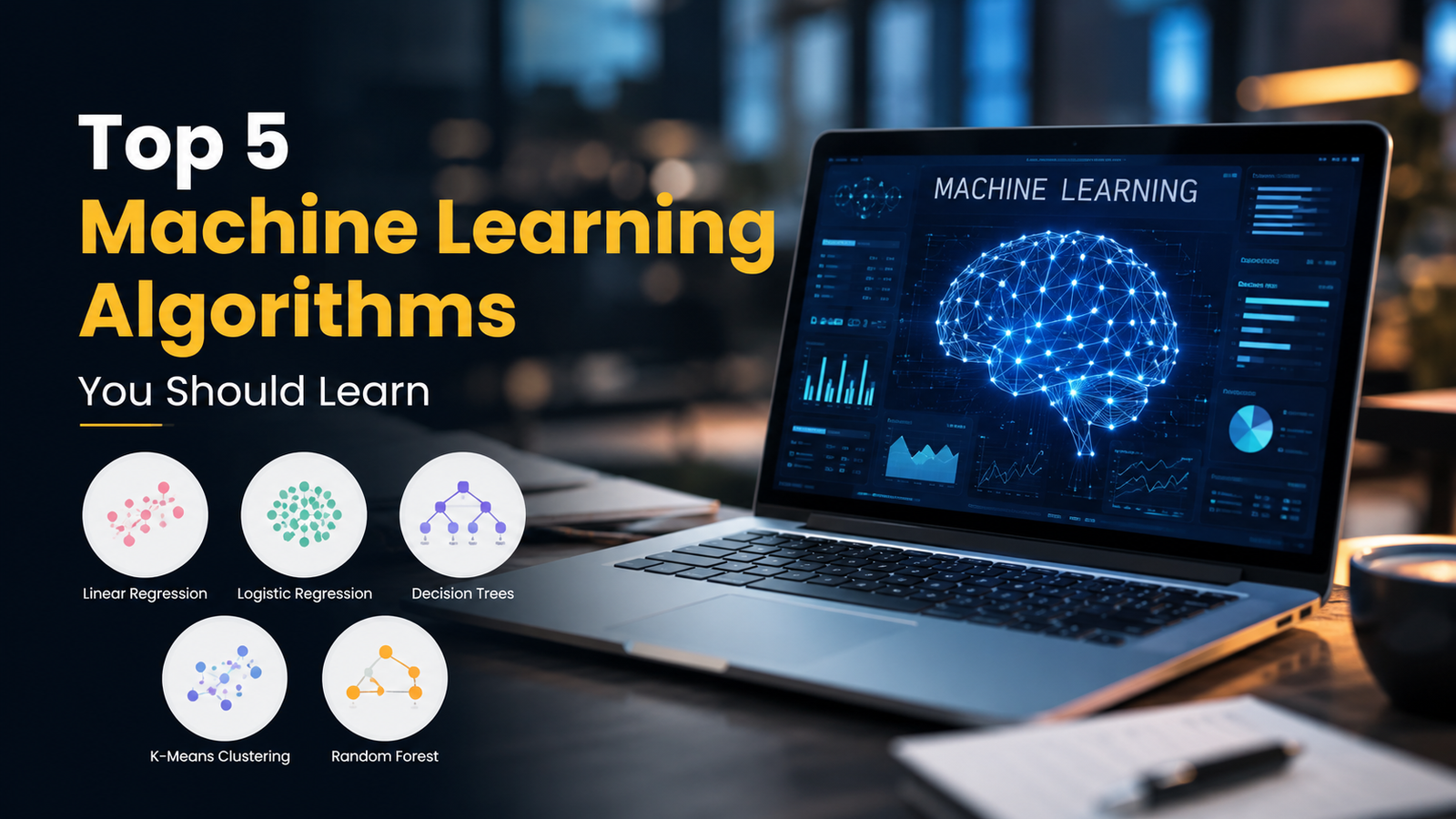
Top 5 Machine Learning Algorithms
These 5 cover roughly 80% of what you’ll encounter in your first year learning machine learning. Master these before you touch anything fancier.
Linear regression
Linear regression predicts a number based on other numbers. Given enough examples, it draws the best-fitting straight line through your data and uses that line to guess future values.
Here’s how it works: say you have data on house size and price. Linear regression looks at that relationship and calculates a formula like price = (size × 150) + 20000. Feed it a new house size, and it spits out a predicted price using that same formula.
Real-world use: real estate pricing tools, predicting sales based on ad spend, estimating delivery times based on distance. Netflix even used a variant of this early on to predict user ratings.
Advantages: it’s fast, simple to explain to non-technical people, and doesn’t need a ton of data to work reasonably well. Limitations: it assumes a straight-line relationship, which real life rarely gives you cleanly. It also struggles when your data has outliers or complex, curved patterns.
When to use it: when your target variable is a continuous number and the relationship with your inputs looks roughly linear. Beginner example: predicting a student’s exam score based on hours studied. Plot the dots, draw the line, and you’ve basically built your first machine learning model.
Decision tree algorithm
A decision tree algorithm makes predictions by asking a series of yes/no questions, branching down until it reaches an answer. Picture a flowchart: “Is age over 30?” then “Is income above 50k?” then a final decision at the bottom.
It works by splitting your dataset at each step based on whichever question separates the data most cleanly. The algorithm keeps splitting until it reaches a “leaf,” which is the final prediction.
Real-world use: loan approval systems, medical diagnosis support tools, customer churn prediction. Doctors actually like decision trees because you can literally show them the chart and explain the reasoning step by step.
Advantages: easy to visualize, easy to explain to a non-technical stakeholder, handles both numbers and categories well. Limitations: a single decision tree overfits easily, meaning it memorizes training data instead of learning general patterns, which hurts it on new, unseen data.
When to use it: when you need a model you can explain in a single meeting, or as a stepping stone before building a random forest. Beginner example: predicting whether someone will buy a product based on age, income, and browsing time. Draw the tree on paper first. It genuinely helps.
Random forest algorithm
A random forest algorithm builds hundreds of decision trees and combines their answers. Instead of trusting one tree’s opinion, it takes a vote across many trees and goes with the majority.
Each tree in the forest sees a slightly different, randomly selected slice of the data and features. That randomness is the whole point, because it stops all the trees from making the exact same mistakes, and averaging their votes cancels out individual errors.
Real-world use: fraud detection systems, stock market trend prediction, e-commerce recommendation engines, and diagnostic tools in healthcare. It’s one of the most reliable machine learning models for structured, tabular data.
Advantages: much less prone to overfitting than a single tree, handles missing data reasonably well, and performs strongly with little tuning. Limitations: harder to interpret than a single tree (good luck explaining 300 trees to your manager), and slower to run since it’s building many models instead of one.
When to use it: when accuracy matters more than perfect explainability, and your dataset is tabular with a mix of numeric and categorical columns. Beginner example: predicting loan default risk using income, credit history, and employment status across thousands of applicants.
K-Nearest Neighbors (KNN)
KNN predicts by looking at the closest data points to whatever you’re trying to classify, then going with whatever the majority of those neighbors are. No formula, no tree, just “who’s nearby.”
Say you want to predict if someone will like a movie. KNN looks at the 5 people (K=5) most similar to that person based on past ratings, checks what those 5 people thought, and predicts accordingly. Change K to 10, and it checks 10 neighbors instead.
Real-world use: recommendation systems, credit scoring, pattern recognition in handwriting, and even medical diagnosis based on symptom similarity to past patients.
Advantages: dead simple to understand, no training phase required, works well on smaller datasets. Limitations: gets painfully slow on large datasets since it has to compare against every existing point, and it’s sensitive to irrelevant features throwing off the “distance” calculation.
When to use it: smaller datasets where you need quick results and don’t want to deal with model tuning. Beginner example: classifying a fruit as an apple or orange based on weight and color, by checking which labeled fruits it’s closest to.
K-Means clustering
K-means clustering groups similar data points together without being told what the groups are ahead of time. You pick a number, K, for how many groups you want, and the algorithm sorts your data into that many clusters based on similarity.
It works by placing K random center points, assigning each data point to its nearest center, then recalculating the centers based on the new groupings. It repeats this cycle until the groups stop shifting.
Real-world use: customer segmentation for marketing campaigns, grouping similar news articles, organizing image galleries by similarity, and identifying regions of a city with similar traffic patterns.
Advantages: fast, scales reasonably well, and needs no labeled data at all. Limitations: you have to guess K ahead of time, and it struggles with clusters that aren’t roughly round or evenly sized.
When to use it: when you want to discover natural groupings in your data without any predefined categories. Beginner example: grouping shoppers into “budget,” “mid-range,” and “premium” buyers based purely on purchase amount and frequency, with no one manually labeling those categories first.
Comparison table of the top 5 machine learning algorithms
| Algorithm | Learning type | Best use case | Difficulty level | Speed | Accuracy (general) |
| Linear regression | Supervised | Predicting continuous numbers | Easy | Very fast | Moderate |
| Decision tree | Supervised | Explainable classification/regression | Easy | Fast | Moderate |
| Random forest | Supervised | High-accuracy tabular predictions | Moderate | Moderate | High |
| KNN | Supervised | Similarity-based classification | Easy | Slow on large data | Moderate to high |
| K-means clustering | Unsupervised | Grouping/segmentation | Moderate | Fast | Depends on K choice |
Which machine learning algorithm should beginners learn first?
Start with linear regression. Not because it’s the most powerful, but because it teaches you the core idea behind every machine learning model: fitting a function to data and measuring error.
Once that clicks, move to decision trees. They introduce classification, splitting logic, and the concept of overfitting, all things you’ll run into again and again down the line. Random forest is the natural next step after that, since it’s literally built from decision trees you already understand.
Save K-means and KNN for after you’re comfortable with supervised learning basics. They’re not harder exactly, they just think differently (no “correct answer” to check against during training), and that mental shift is easier once supervised learning already feels familiar.
Common mistakes beginners make while learning machine learning algorithms
The biggest one: jumping straight to deep learning and neural networks before understanding basic statistics. You’ll end up copy-pasting code you don’t actually understand, and the moment something breaks, you’re stuck.
Another one: skipping the math entirely. You don’t need a PhD in linear algebra, but if you don’t understand what a loss function or a gradient is, you’ll never know why your model is behaving strangely. Even 20 minutes a day on the fundamentals compounds fast.
A lot of beginners also train a model once, see a good accuracy score, and stop there. They never check for overfitting, never split their data properly into training and test sets, and end up with a model that performs great in a notebook and terribly in production.
Last one, and it’s sneaky: treating every project as an excuse to use the fanciest algorithm available. Sometimes linear regression beats a neural network on a small, simple dataset. Pick the tool that fits the problem, not the one that sounds impressive on a resume.
Tips to learn machine learning faster
Practice with real datasets early. Kaggle, UCI Machine Learning Repository, and Google’s dataset search all have free, messy, real data you can use instead of clean toy examples that don’t prepare you for actual work.
Build small projects instead of just watching tutorials. Predict house prices, classify emails, cluster customers, anything that forces you to write code and debug it yourself rather than following along passively.
Get comfortable with Python basics first. Pandas for handling data, NumPy for math operations, and Matplotlib for visualizing what’s actually happening in your dataset. You’ll use all three constantly.
Learn Scikit-learn early. It has clean, consistent implementations of nearly every algorithm covered here, which means you can focus on understanding concepts instead of writing algorithms from scratch on day one.
Join a Kaggle competition, even a beginner one. Reading other people’s solutions after a competition ends teaches you more in an afternoon than a week of tutorials.
Read the documentation. Scikit-learn’s docs are genuinely well-written, and half the confusion beginners have gets solved just by reading the parameter descriptions instead of guessing.
Revisit math fundamentals as you go, not all upfront. Statistics, probability, and a bit of linear algebra will make way more sense once you’ve seen where they actually get used inside an algorithm.
Conclusion
Machine learning algorithms aren’t going anywhere, no matter how many new frameworks show up next year. Linear regression, decision trees, random forest, KNN, and K-means cover the fundamentals you’ll keep using no matter which direction your career takes, whether that’s data science, AI research, or software engineering with an ML twist.
Start with one. Build something small and messy with it. Then move to the next. That’s genuinely how most working data scientists learned this stuff, one dataset and one broken model at a time.
Frequently asked questions (FAQs)
1. What is the easiest machine learning algorithm to learn first?
Linear regression. It’s the simplest starting point and teaches the core logic behind almost every other algorithm you’ll learn later.
2. What are the main types of machine learning algorithms?
Supervised learning, unsupervised learning, and reinforcement learning. Supervised uses labeled data, unsupervised finds patterns without labels, and reinforcement learns through trial and reward.
3. Is Python necessary to learn machine learning algorithms?
Not strictly, but practically, yes. Almost every tutorial, library, and job posting assumes Python, and tools like Scikit-learn make implementing these algorithms far easier.
4. What’s the difference between a decision tree and a random forest?
A decision tree is a single model making one set of splits. A random forest builds hundreds of decision trees and combines their votes, which usually gives better accuracy and less overfitting.
5. Can beginners learn machine learning without a strong math background?
Yes, you can start with basic statistics and pick up more math as concepts require it. You don’t need advanced math to build your first working model, just enough to understand what it’s doing.
6. Which machine learning algorithm is best for beginners working with small datasets?
KNN and decision trees both work well on smaller datasets since they don’t require huge amounts of data to produce reasonable results.
7. How long does it take to learn the top machine learning algorithms?
With consistent daily practice, most beginners get a working understanding of these 5 algorithms within 4 to 8 weeks, faster if you’re already comfortable with basic Python and statistics.
8. Are these algorithms still relevant with the rise of deep learning and AI?
Yes. Deep learning solves specific problems well (images, text, audio), but these classic algorithms remain faster, cheaper, and more explainable for structured, tabular data, which is still most of what businesses actually work with.
9. What is the difference between supervised and unsupervised learning algorithms?
Supervised learning algorithms train on labeled data with known answers. Unsupervised learning algorithms find patterns or groupings in data that has no labels at all.
Read also more:- Importance of Machine Learning,