
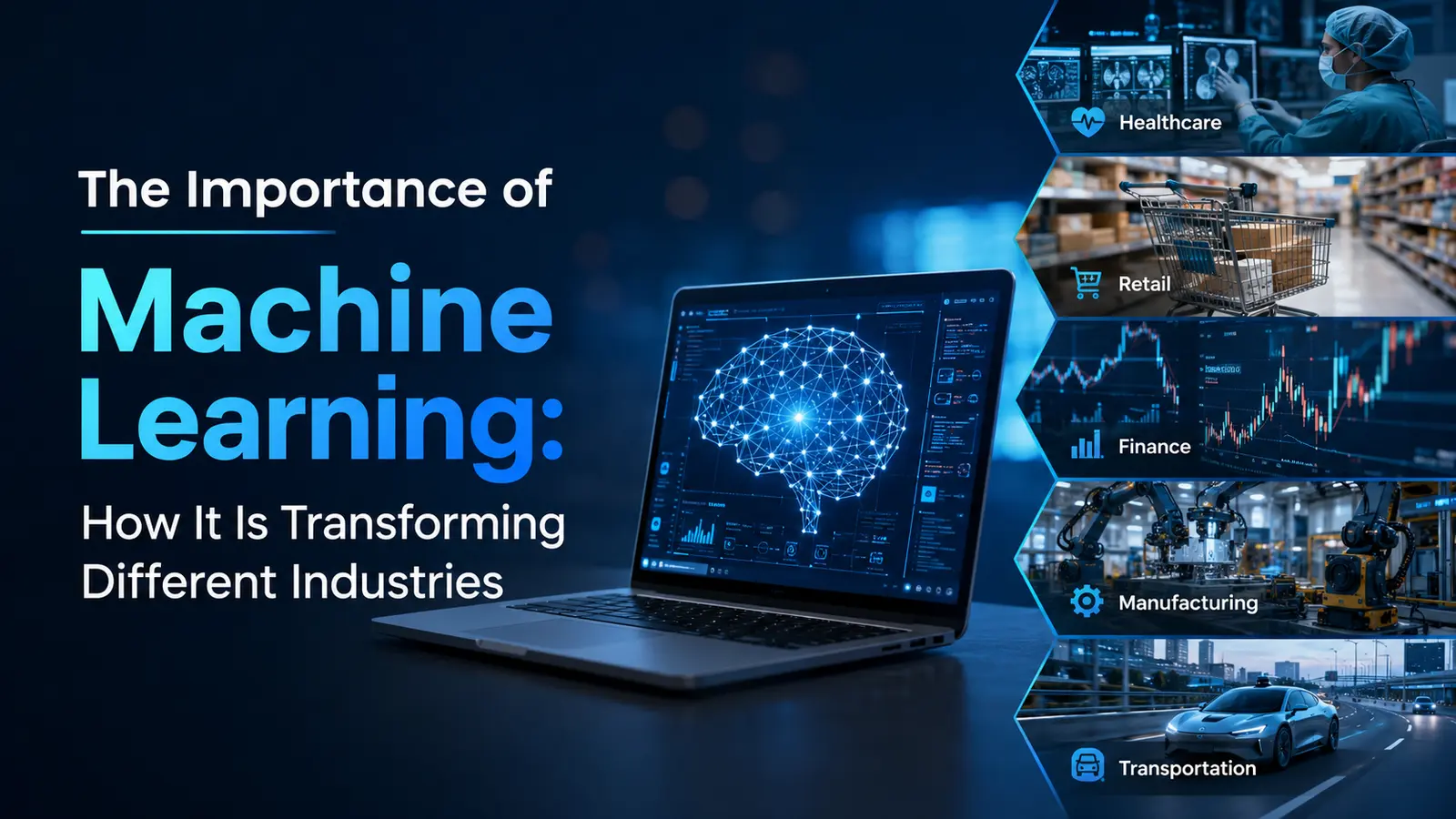
Machine learning runs your Netflix queue, flags fraud on your credit card, and decides which ad follows you around the internet. Most people interact with it 50 times before breakfast and never notice. That’s the real story here: not some distant tech trend, but software that’s already embedded in how hospitals diagnose patients, how banks catch thieves, and how factories keep machines from breaking down.
The importance of machine learning isn’t theoretical anymore. Companies that ignore it are losing ground to competitors who don’t. And for anyone weighing a career move, the demand for people who understand this stuff is only growing. Let’s get into what it actually is, why it matters, and where it’s headed.
What is machine learning?
Machine learning is a branch of artificial intelligence where systems learn patterns from data instead of following rules a programmer wrote line by line. Feed a model thousands of labeled photos of cats and dogs, and it figures out the distinguishing features on its own. No one tells it “look for pointy ears.” It works that out from examples.
People mix up AI, machine learning, and deep learning constantly. Artificial intelligence is the umbrella term: any system that mimics human-like decision-making. Machine learning is one way to build AI, using statistics and data instead of hardcoded logic. Deep learning is a subset of machine learning that uses layered neural networks, the kind of architecture behind image recognition and large language models. So deep learning sits inside machine learning, which sits inside AI. Nested, not interchangeable.
Here’s how it actually works in practice. You collect data, clean it up (this part is tedious and unglamorous, but skip it and your model is garbage), choose an algorithm, train the model on a chunk of that data, then test it on data it hasn’t seen before. If it performs well, you deploy it. If not, back to tuning.
There are three main types of machine learning, and each handles a different kind of problem.
Supervised learning
The model trains on labeled data: input paired with the correct output. Show it 10,000 emails marked “spam” or “not spam,” and it learns to classify new emails on its own. This is the most common type you’ll encounter, used for everything from credit scoring to medical diagnosis.
Unsupervised learning
No labels here. The model hunts for structure in raw data by itself. Retailers use this to group customers into segments based on buying behavior, without ever telling the algorithm what those segments should look like.
Reinforcement learning
The model learns by trial and error, getting rewarded for good decisions and penalized for bad ones. This is how AI beats humans at Go, and it’s also how warehouse robots learn to navigate without bumping into shelves.
Why is machine learning important?
Ask any CTO why their company invested in this stuff, and you’ll get a version of the same answer: speed and money. Machine learning importance comes down to a handful of concrete advantages that businesses can’t easily replicate with human labor alone.
Automation is the obvious one. Tasks that used to take a team of analysts a week, sorting through spreadsheets, flagging anomalies, now run in minutes. That frees people up for work that actually needs human judgment.
Then there’s decision-making speed. A fraud detection model can flag a suspicious transaction in milliseconds, before the money even clears. A human reviewer would take hours, by which point the damage is done.
Predictive analytics is where things get genuinely useful. Models trained on historical data can forecast demand, predict equipment failure, or estimate customer churn before it happens. Knowing what’s coming beats reacting to it after the fact, every time.
Customer experience improves too. Recommendation engines, chatbots, personalized search results: these aren’t add-ons anymore, they’re expected. A retail site without personalization feels broken to a modern shopper.
Cost reduction follows naturally from all of this. Fewer manual reviews, less downtime, fewer returns from bad inventory forecasting. The need of machine learning in business strategy isn’t about chasing a trend. It’s about staying solvent against competitors who’ve already automated the boring parts.
And underneath all of it: data-driven insight. Companies sitting on years of customer data finally have a way to extract value from it instead of letting it rot in a warehouse somewhere.
How machine learning is transforming different industries
This is where the impact of machine learning on industries gets specific. Every sector is using it differently, shaped by what problems actually matter to them.
Healthcare
Radiologists now use ML models to scan X-rays and MRIs for early signs of cancer, often catching things a tired human eye might miss at 4pm on a Friday. Hospitals use predictive models to flag patients at risk of sepsis hours before symptoms become obvious. Drug discovery, which used to take a decade per compound, is being compressed by models that simulate molecular interactions instead of testing them all in a lab.
The benefit is measurable: earlier diagnosis, fewer missed cases, faster drug pipelines. The future here points toward personalized medicine, where treatment plans are built around your specific genetic data instead of population averages.
Banking and finance
Every major bank runs fraud detection models that watch transaction patterns in real time. Something looks off, a purchase in a country you’ve never visited, a sudden spike in spending, and the system flags it before you even notice your card was compromised. Credit scoring has shifted too, with lenders using broader behavioral data instead of relying purely on a single credit number.
Algorithmic trading, robo-advisors, risk assessment models: finance was one of the earliest industries to go all-in on this technology, mostly because the payoff (catching fraud, optimizing trades) is so directly tied to money.
Retail and e-commerce
Amazon’s “customers also bought” feature is a machine learning model, full stop. Recommendation engines analyze your browsing and purchase history to surface products you’re more likely to buy, and they work well enough that a huge share of e-commerce revenue now comes directly from these suggestions.
Inventory forecasting has gotten smarter too. Retailers used to guess at demand based on last year’s sales. Now models factor in weather, local events, social trends, and seasonal shifts to predict what’ll sell where. Dynamic pricing, the kind that adjusts airline ticket prices by the hour, runs on the same logic.
Manufacturing
Predictive maintenance is the headline application here. Sensors on factory equipment feed data into models that predict when a machine is likely to fail, so technicians can fix it during scheduled downtime instead of after a costly breakdown on the floor. Quality control cameras now catch defects on assembly lines faster and more consistently than a human inspector glancing at parts all shift.
The role of machine learning in industries like manufacturing keeps expanding into supply chain optimization too, predicting delays before they cascade into missed shipments.
Education
Adaptive learning platforms adjust the difficulty of lessons based on how a student is performing in real time. Struggling with fractions? The system slows down and offers more practice. Acing everything? It moves you ahead. Automated grading for essays and assignments saves teachers hours each week, and dropout prediction models help schools intervene with at-risk students before it’s too late.
Cybersecurity
Threats evolve daily, and rule-based security systems can’t keep up. Machine learning models analyze network traffic patterns to spot anomalies that suggest a breach, often catching attacks that don’t match any known signature. Spam filters, malware detection, and behavioral biometrics (the way you type or move your mouse) all lean on this technology now.
Transportation and logistics
Self-driving car research is the most visible example, but the bigger near-term impact is in logistics. Route optimization models cut delivery times and fuel costs for companies running thousands of vehicles. Ride-sharing apps price rides and match drivers using real-time demand models. Predictive maintenance shows up here too, keeping fleets running instead of stranded.
Agriculture
Precision farming uses satellite imagery and sensor data to tell farmers exactly which patches of a field need water, fertilizer, or pest control, instead of treating the whole field the same way. Crop yield prediction models help with planning, and computer vision systems can spot disease in crops before it spreads across an entire farm.
Entertainment and streaming
Spotify’s Discover Weekly, Netflix’s homepage, YouTube’s “up next” queue: all machine learning, all built to keep you watching or listening longer. These platforms have entire teams dedicated to refining recommendation models because even a small improvement in accuracy translates into massive engagement gains.
Digital marketing and advertising
Ad targeting has gone from broad demographic buckets to models that predict individual purchase intent based on browsing behavior. Customer segmentation, churn prediction, and chatbot-driven customer service all sit under this umbrella too. Marketers who understand machine learning applications in their campaigns are running circles around teams still guessing at what works.
Top benefits of machine learning
Pulling the industry examples together, a few benefits show up again and again. Productivity climbs because repetitive analysis gets automated. Accuracy improves, since models don’t get tired or distracted the way humans do at hour eight of a shift. Personalization at scale becomes possible, something that would require an army of analysts to do manually. Fraud detection catches what rule-based systems miss. Predictive maintenance saves real money by preventing breakdowns instead of reacting to them. And business growth follows from all of it: companies making faster, better-informed decisions tend to outpace those still relying on gut instinct and quarterly reports.
Challenges of machine learning
None of this is free of friction, though.
Data quality is the biggest practical headache. A model trained on messy, incomplete, or biased data will produce messy, biased results. Garbage in, garbage out, no exceptions.
Privacy concerns are real and growing. Models need data to learn, and that data often includes sensitive personal information. Regulations like GDPR exist precisely because companies weren’t always careful about this.
Bias in AI models is a documented problem, not a hypothetical one. If historical hiring data reflects discrimination, a model trained on it will learn to discriminate too, just faster and at scale.
Implementation costs run high. Building infrastructure, hiring talent, and maintaining models isn’t cheap, and smaller companies sometimes struggle to justify the investment upfront even when the long-term payoff is clear.
There’s also a serious shortage of skilled professionals who can build, deploy, and maintain these systems responsibly. And ethical questions, around accountability when a model makes a harmful decision, around transparency in how decisions get made, don’t have settled answers yet.
Future of machine learning in 2026 and beyond
Generative AI has dominated headlines for the past couple of years, and that’s not slowing down. Tools that write, design, and code are becoming standard parts of workflows across industries.
AI automation is pushing further into white-collar work too, not just factory floors. Autonomous vehicles are inching closer to wider deployment, particularly in logistics and trucking where the economics make sense sooner than consumer cars.
Smart healthcare keeps expanding, with wearable devices feeding real-time data into predictive models that can flag health issues before a person even notices symptoms. Robotics is getting smarter and cheaper, opening up use cases beyond big manufacturers. Edge AI, running models directly on devices instead of in the cloud, matters more as privacy concerns grow and latency becomes a bigger deal for real-time applications.
One trend worth watching closely: explainable AI, or XAI. As models get more complex, the demand for understanding why a model made a decision, not just what it decided, is becoming a regulatory and ethical requirement, not a nice-to-have.
Career opportunities in machine learning
If you’re weighing whether machine learning is a good career in 2026, the short answer is yes, with a caveat: the field is competitive, and basic familiarity isn’t enough anymore. Employers want people who can build, deploy, and maintain real systems.
A machine learning engineer builds and deploys models into production, the actual software systems companies run on. An AI engineer works more broadly across AI systems, sometimes combining ML with other AI techniques. A data scientist focuses on extracting insight from data, often using ML as one tool among several. A data analyst works closer to the business side, turning data into reports and recommendations.
More specialized roles exist too. An NLP engineer works on language-based systems, chatbots, translation, sentiment analysis. A computer vision engineer focuses on image and video recognition. A robotics engineer combines ML with physical systems. An AI research scientist pushes the boundaries of what’s algorithmically possible, usually with a strong academic or research background.
Required skills overlap heavily across these roles: Python, statistics, an understanding of algorithms, and increasingly, the ability to work with cloud platforms and deployment pipelines. Salary ranges vary a lot by region, experience, and company size, but generally trend well above average tech salaries given how scarce qualified candidates still are. Industry demand isn’t slowing down either, with postings for ML-related roles climbing year over year across nearly every sector covered above.
Skills required to learn machine learning
Python is the starting point for almost everyone in this field, mostly because the ecosystem around it (NumPy for numerical computing, Pandas for data manipulation, Scikit-learn for classical ML algorithms) is so mature. TensorFlow and PyTorch are the two dominant frameworks for deep learning, and most jobs expect familiarity with at least one.
SQL matters more than beginners expect, since real-world data lives in databases, not clean CSV files. A solid grounding in statistics and mathematics, particularly linear algebra and probability, makes the difference between someone who can copy-paste model code and someone who actually understands what it’s doing. Data visualization skills help you communicate findings to people who don’t care about your model’s internals, just its conclusions. And Git and GitHub are non-negotiable for working on any real team or building a portfolio employers can actually look at.
How to start learning machine learning
Start with Python. Don’t skip this step or rush it, since everything downstream depends on being comfortable with the language.
From there, build up your math and statistics foundation, focusing on the concepts that show up constantly in ML: probability, linear algebra, and basic calculus. Spend real time on data analysis next, learning to clean and explore datasets before you ever touch a model, because that’s most of the actual job.
Once you’ve got that base, move into machine learning algorithms themselves: regression, classification, clustering, decision trees. Build projects as you go, not after. A model sitting in a Jupyter notebook that never gets deployed doesn’t teach you what actually matters in production.
Kaggle competitions are a good way to test yourself against real problems and see how other people approach the same data. Put your work on GitHub so it’s visible, not buried on your laptop. Certifications can help signal competence, particularly early in your career when you don’t have work experience to point to yet. And internships, even unpaid or low-paid ones, often matter more than another certificate when it comes to actually landing your first role.
FAQs
1. What is machine learning?
It’s a branch of AI where systems learn patterns from data instead of following manually coded rules, improving their performance as they’re exposed to more examples.
2. Why is machine learning important?
It lets businesses automate decisions, predict outcomes, and personalize experiences at a speed and scale humans can’t match alone, which translates directly into cost savings and competitive advantage.
3. Which industries use machine learning the most?
Finance, healthcare, retail, and manufacturing are among the heaviest adopters, though virtually every industry covered here, from agriculture to entertainment, now relies on it in some form.
4. Is machine learning a good career in 2026?
Yes. Demand for skilled practitioners keeps growing across sectors, though the field has gotten more competitive, so practical project experience matters as much as theoretical knowledge.
5. What skills are required for machine learning?
Python, statistics, linear algebra, SQL, and familiarity with frameworks like Scikit-learn, TensorFlow, or PyTorch form the core skill set most employers look for.
6. Can beginners learn machine learning?
Yes, with consistent effort. Starting with Python fundamentals and basic statistics before moving into algorithms and projects works well for most newcomers.
7. What programming language is best for machine learning?
Python, by a wide margin, mainly because of its mature ecosystem of libraries built specifically for data science and model development.
8. What are the biggest challenges of machine learning?
Poor data quality, privacy concerns, bias in trained models, high implementation costs, and a shortage of skilled professionals are the most common obstacles companies run into.
9. Which machine learning course is best for beginners?
Look for a course that balances theory with hands-on projects, ideally one that has you building and deploying a real model rather than just watching lectures. If you’re serious about a career shift, pairing a structured course with personal projects and a GitHub portfolio will get you job-ready faster than either alone.
10. Where can I learn Machine Learning in Noida?
If you are looking for a practical Machine Learning course in Noida, choose a training institute that offers live projects, industry-relevant tools, experienced trainers, and placement support. Appwars Technologies provides comprehensive Machine Learning training covering Python, data science fundamentals, machine learning algorithms, TensorFlow, real-world projects, certification, and career assistance to help learners become industry-ready.
Conclusion
The importance of machine learning isn’t a marketing line anymore. It’s baked into how hospitals catch disease early, how banks stop fraud before it happens, how factories avoid costly breakdowns, and how every major retailer decides what to show you next. Industries that adopted it early are pulling ahead of the ones still debating whether it’s worth the investment.
For anyone reading this and wondering whether to learn it: the barrier to entry has never been lower, and the demand has never been higher. Pick a project, get your hands on real data, and start building. The theory matters, but nothing teaches you faster than a model that breaks and forces you to figure out why.
Learn more:- AI vs Data Science vs Machine Learning