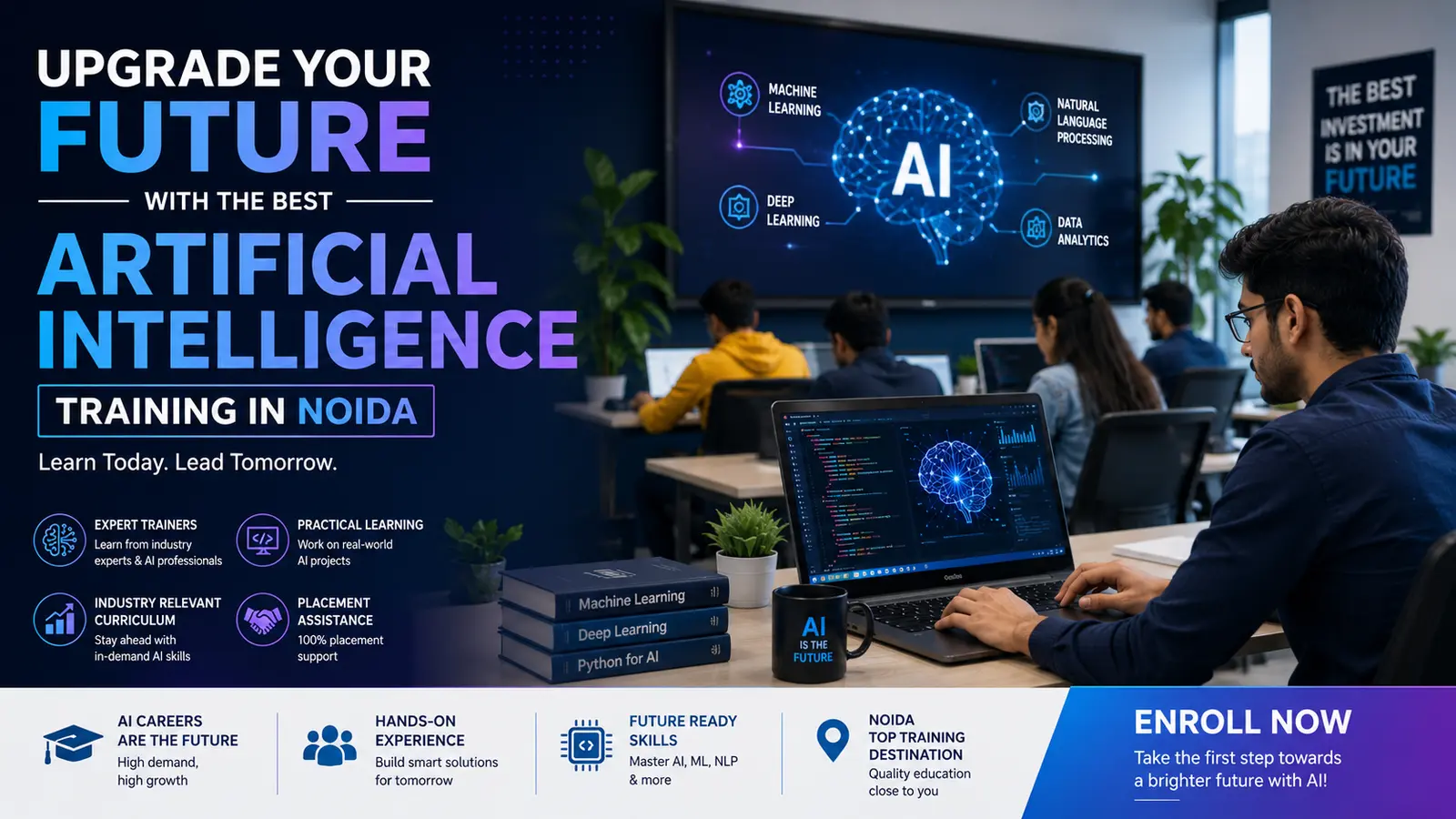
AI isn’t a buzzword anymore. It’s running hospital diagnostics, writing code, pricing insurance policies, and deciding what video autoplays next on your phone. Five years ago, “AI skills” meant a niche research background. Now it means a job.
That shift has made Artificial Intelligence training program in Noida one of the most searched terms in Indian tech education, and Noida has quietly turned into one of the better places to get that training. It’s got the IT parks, the startup density, and institutes that actually run live projects instead of just PowerPoint decks. If you’re comparing artificial intelligence training in Noida against options in Delhi or Gurugram, this guide walks through what actually matters: the curriculum, the projects, the certifications, and the mistakes that trip up almost every beginner.
What is ArtificiaI Intelligence?
Artificial intelligence is the umbrella term for machines performing tasks that normally need human judgment: recognizing a face, translating a sentence, predicting which customer is about to cancel a subscription. Machine learning is a subset of AI, the part where a system learns patterns from data instead of following hardcoded rules. Deep learning is a subset of machine learning that uses layered neural networks, the technique behind most of the AI breakthroughs you’ve read about since 2020.
You’ve already used AI today, probably more than once. ChatGPT drafting your email. Google Assistant setting a reminder. Netflix guessing you’ll like a Korean thriller because you watched three of them last month. Face recognition unlocking your phone. Your bank’s fraud detection system flagging a card swipe from a city you’ve never visited. Self-driving features in newer cars reading lane markings in real time. None of that is science fiction. It’s Tuesday.
Why learn artificial intelligence in 2026?
Demand for AI professionals hasn’t slowed down, it’s compounded. Every sector, from banking to agriculture to logistics, has started hiring for roles that didn’t exist five years ago: prompt engineers, ML ops specialists, AI product managers. A company that ignored AI in 2022 is now scrambling to catch up, and scrambling companies pay well for people who can move fast.
Salaries reflect that scramble. Freshers with a solid AI or ML portfolio in India are landing offers well above the average IT starting salary, and experienced engineers with 3 to 5 years of specialization routinely cross into senior compensation brackets faster than traditional software roles allow. The work is also unusually portable. A machine learning engineer in Noida can work for a startup in Bengaluru, a fintech in Singapore, or a research lab in Berlin, often without relocating. Remote and hybrid AI roles are common because the output (models, code, dashboards) ships over the internet just fine.
None of this means the field is easy money. It means the field rewards people who actually build things, not just people who watch tutorials.
Why choose Artificial Intelligence training in Noida?
Noida’s IT ecosystem has grown past its outsourcing-hub reputation. Sector 62, Sector 63, and Noida’s tech corridors now host a mix of established IT companies, product startups, and R&D units, which means training institutes here are training people for jobs that exist a few kilometers away, not jobs in an abstract “industry.”
Cost is a real factor too. Training fees in Noida tend to run lower than equivalent programs in Delhi or Mumbai, without a drop in quality, since many trainers commute between NCR cities anyway. Institutes with strong local placement networks can plug students into internships at nearby startups, which matters more than people realize: a 3-month internship with real deliverables beats a 6-month course with none.
Good institutes in the region also build in placement assistance, alumni networks, and access to trainers who’ve actually shipped ML systems in production, not just people reading from a slide deck they inherited. That combination, affordability plus proximity to real employers, is why “artificial intelligence training in Noida” has become such a common search for people planning a career switch.
What should you learn in an AI course?
A curriculum that skips the fundamentals to rush into flashy generative AI demos will leave you stuck the moment an interviewer asks you to explain your own model. Here’s what a serious course actually needs to cover.
Python programming
Python is the language almost every AI library is built around: TensorFlow, PyTorch, scikit-learn, pandas. You don’t need to master every corner of the language, but you do need to be fluent enough that syntax never slows down your thinking.
Mathematics for AI
Linear algebra shows up in every neural network layer. Calculus shows up in how models learn (gradient descent). You don’t need a PhD in math, but you need enough intuition to understand why a model is doing what it’s doing, instead of treating it as a black box.
Statistics
Probability distributions, hypothesis testing, and correlation versus causation come up constantly in data science work. Skip this and you’ll misread your own results.
Machine learning
Regression, classification, clustering, decision trees, random forests: this is the backbone. Most real-world business problems (churn prediction, fraud detection, demand forecasting) get solved with these classical methods, not with the flashiest deep learning model available.
Deep learning
Once you understand the basics, deep learning opens up image recognition, speech processing, and the architectures behind large language models.
Neural networks
The building blocks of deep learning: neurons, weights, activation functions, backpropagation. Understanding this from first principles makes every advanced topic afterward click faster.
Natural language processing
NLP is how machines read and generate text: tokenization, sentiment analysis, named entity recognition, and the transformer architecture that powers tools like ChatGPT.
Computer vision
Image classification, object detection, and facial recognition all fall under computer vision. It’s one of the more visual, satisfying parts of AI to learn because you can literally see your model improve.
Generative AI
This is where things get current: text generation, image generation, and the diffusion models behind tools like Midjourney. Generative AI courses offered by institutes in Noida have expanded rapidly over the last two years due to growing industry demand.
Prompt engineering
Writing effective prompts for large language models is now its own skill. It’s not complicated, but it’s learnable, and it’s become a genuine job title.
ChatGPT applications
Beyond prompting, understanding how to integrate ChatGPT-style APIs into actual applications (customer support bots, internal tools, content pipelines) is a practical, hireable skill.
AI model deployment
A model sitting in a Jupyter notebook helps nobody. Deployment covers packaging a model, serving it through an API, and monitoring it in production. This is the step that separates hobbyists from hires.
Data visualization
Matplotlib, Seaborn, or Power BI: being able to show what your model found, clearly, to someone who isn’t technical, is half the job.
AI ethics
Bias in training data, privacy concerns, and the responsibility that comes with deploying models at scale. Employers increasingly ask about this in interviews, not as a formality but because a biased hiring algorithm or a leaky facial recognition system is a real legal liability.
Git and GitHub
Version control isn’t optional. Every AI job, whether it’s a startup or an MNC, expects you to work with Git daily.
Hands-on projects you should build
Reading about neural networks and building one are different skills entirely. A chatbot project forces you to work with NLP and conversation flow at the same time. A movie recommendation system teaches you collaborative filtering, the same logic Netflix runs at scale. A resume screening system pushes you into text classification with real, messy data. A face recognition system gets you working with computer vision pipelines end to end.
A spam email detector is a classic starter project, but don’t skip it just because it’s common: it teaches you the full pipeline from raw text to a working classifier. Sales prediction work builds your regression and time-series intuition. Image classification projects (say, distinguishing dog breeds or plant diseases from photos) get you comfortable with convolutional neural networks. An AI voice assistant combines speech recognition with NLP. Sentiment analysis on product reviews or tweets is one of the most requested skills in job postings. Customer churn prediction, meanwhile, is exactly the kind of business problem you’ll be asked to solve in an actual interview.
Each of these projects, done properly and pushed to GitHub with a clear README, does more for your job search than another certificate. Recruiters skim resumes. A working demo link stops the skim.
Skills you will gain
On the technical side, expect to walk away fluent in Python, machine learning, deep learning, and NLP, comfortable with TensorFlow and PyTorch, capable of writing SQL queries for data extraction, skilled at data analysis and cleaning, able to integrate APIs into your applications, and confident deploying a trained model rather than leaving it in a notebook.
The soft skills matter just as much, even if they get less attention. Problem solving, because every AI project is really a series of small, stubborn bugs. Critical thinking, because a model that performs well on paper can still be wrong in ways that matter. Communication, because you’ll eventually need to explain a model’s output to someone who’s never heard of a confusion matrix. And team collaboration, because production AI systems are never a one-person job.
Career opportunities after AI training
| Job role | Average salary (India, per year) | Skills required |
| AI Engineer | ₹8-18 LPA | Python, ML/DL frameworks, model deployment |
| Machine Learning Engineer | ₹9-20 LPA | ML algorithms, TensorFlow/PyTorch, MLOps |
| Data Scientist | ₹7-16 LPA | Statistics, Python, SQL, data visualization |
| NLP Engineer | ₹9-19 LPA | NLP, transformers, Python, linguistics basics |
| Computer Vision Engineer | ₹9-20 LPA | OpenCV, CNNs, image processing |
| AI Research Assistant | ₹5-10 LPA | Research methodology, math, ML fundamentals |
| Prompt Engineer | ₹6-14 LPA | LLMs, prompt design, API integration |
| AI Consultant | ₹10-22 LPA | Business analysis, ML strategy, communication |
| Robotics Engineer | ₹8-18 LPA | Python/C++, control systems, ML for robotics |
These figures move around depending on the city, the company, and how strong your project portfolio is. A fresher with three solid deployed projects will often out-negotiate a fresher with a certificate and no code to show for it.
How to choose the best Artificial Intelligence training institute in Noida
Start with the curriculum date. AI moves fast, so a syllabus that hasn’t been updated in two years is already behind on generative AI and LLM tooling. Ask whether the course includes live projects with real datasets, not toy examples copied from a textbook.
Check who’s actually teaching. Industry-experienced trainers, people who’ve worked on production ML systems, teach differently than people who only know the theory. Ask about internship tie-ups and placement support specifically, not just “we help with placements” as a vague line in a brochure.
Look at batch size. A 60-person batch means you’ll get maybe two minutes of a trainer’s attention per session. Smaller batches mean actual doubt-clearing. Flexible schedules matter if you’re working while you study, which a lot of career-switchers are. Read student reviews, but read the critical ones too, not just the five-star testimonials on the homepage.
Sit in on a demo class before paying anything. It tells you more about teaching quality than any brochure will. Compare fees against what’s included: some institutes bundle lifetime doubt-support and course updates, others charge extra for every add-on. And check certification credibility: does the certificate carry weight with local employers, or is it just a PDF with a logo on it?
Classroom versus online AI training
Classroom training in Noida gives you direct access to trainers, in-person networking with classmates who might become your first professional contacts, and a fixed schedule that keeps you accountable. It also tends to give richer hands-on lab time, since trainers can walk over and debug your screen directly.
Online training wins on flexibility. If you’re working a full-time job or living outside Noida, online lets you learn at your own pace and revisit recorded sessions. It’s usually cheaper too, since institutes save on physical infrastructure. What it costs you is spontaneous networking and the kind of instant, over-the-shoulder help a classroom offers.
If you’re a student with time and you want the internship and networking upside, classroom training in Noida is probably the better call. If you’re a working professional squeezing in study time around a job, online training with recorded backup sessions makes more practical sense.
Certifications that add value
A certificate alone won’t get you hired. But a certificate attached to a strong project portfolio tells a recruiter you didn’t just wing it, you followed a structured curriculum and someone verified you completed it. Certifications from recognized providers (Google, IBM, Microsoft, or well-established Indian training institutes with industry tie-ups) carry more weight than generic ones, mostly because recruiters recognize the name and trust the rigor behind it.
Don’t chase certificates as a substitute for building things. Treat them as a supporting document, not the main pitch. The main pitch is always your project portfolio and how well you can explain your own work in an interview.
Common mistakes beginners should avoid
Skipping Python basics to jump straight into deep learning is one of the most common traps. You’ll hit a wall the first time you need to debug your own code instead of copying a tutorial. Fix it by spending genuine time on Python fundamentals before touching a neural network.
Skipping mathematics is another. You can copy-paste a working model without understanding the math, but you won’t be able to explain why it failed, and interviewers will notice. Spend a few weeks on linear algebra, calculus, and probability before diving deep into ML theory.
Not building projects is probably the biggest one. Watching 40 hours of tutorial videos without writing your own code teaches you almost nothing that survives contact with a real dataset. Build small, build often, and build things that are slightly harder than what you’re comfortable with.
Depending only on theory has the same root problem. Pair every concept you learn with a mini-project the same week. Avoiding GitHub is a mistake too, since it’s the first thing a recruiter checks after your resume. Push code regularly, even messy code, and write clear commit messages.
Not practicing consistently kills momentum. AI skills, like a language, decay if you don’t use them. Set a weekly rhythm rather than cramming in bursts. And ignoring interview preparation until the last week is a mistake almost everyone makes once. Practice explaining your projects out loud, not just coding them, because interviews test communication as much as correctness.
Conclusion
AI is one of the rare career paths right now where demand is outpacing supply of genuinely skilled people. Not people with a certificate, people who can actually build, debug, and deploy something that works.
A quality training program in Noida gives you the curriculum, the trainers, and the local job market access to make that transition realistically. But the training only works if you treat it as a starting point, not a finish line: build the projects, push the code, keep learning after the course ends.
Compare institutes carefully. Sit in on a demo class. Ask hard questions about placement records and trainer experience. Then pick the program that actually matches where you want to be in two years, not just the one with the flashiest ad.
Frequently asked questions
1. What is the eligibility for Artificial Intelligence training in Noida?
Most institutes accept students from any background, though a basic comfort with logic or math helps. Graduates, final-year students, and working professionals from IT or non-IT backgrounds all commonly enroll.
2. Do I need coding experience to learn AI?
No prior coding experience is required to start, but you will need to pick up Python early in the course. Beginner-friendly programs usually start from Python basics before moving into AI concepts.
3. How long does an AI course take?
Most comprehensive programs run 4 to 9 months, depending on depth and whether you’re attending part-time or full-time. Shorter certification-only courses can run 6 to 8 weeks but cover far less ground.
4. Is Python mandatory for AI?
Effectively, yes. Nearly every major AI library and framework is Python-based, and almost every job posting lists it as a requirement.
5. What projects will I build?
A solid course should have you build at least 4 to 6 real projects across machine learning, NLP, and computer vision, ideally with a couple involving deployment, not just training a model in a notebook.
6. Will I receive a certificate?
Yes, most institutes issue a completion certificate, and some offer additional certifications tied to specific tools or partner organizations.
7. Does AI training include placement assistance?
Many Noida-based institutes offer placement support, resume reviews, and interview preparation, though the strength of this support varies a lot between institutes, so verify actual placement records rather than marketing claims.
8. What salary can freshers expect after AI training?
Freshers with a strong project portfolio typically start somewhere between ₹4-8 LPA in India, with higher offers going to those who’ve built and deployed real, demonstrable projects.
9. Can working professionals learn AI?
Yes, and many do. Evening batches, weekend batches, and online formats exist specifically to accommodate working professionals transitioning into AI roles.
10. Which industries hire AI professionals?
Banking and finance, healthcare, e-commerce, logistics, manufacturing, and IT services all actively hire AI talent now. It’s no longer confined to tech companies alone.
Read this article- Why Appwars Technologies Is the Best Institute for AI Training in Noida