AI isn’t a buzzword anymore. It’s in your hospital’s diagnostic tools, your bank’s fraud alerts, the recommendation engine on your phone, and the hiring software that screened your last job application. Companies across every sector want people who can build, train, and deploy these systems, and they’re struggling to find enough of them.
That gap is exactly why Noida has turned into one of the busiest hubs for AI education in North India. The city already has a dense IT and startup base, and that base is now hungry for AI talent. Walk into any tech park in Sector 62 or Sector 135 and you’ll find teams actively trying to staff AI roles they can’t fill fast enough. Naturally, the number of institutes offering an AI Training Program in Noida has shot up too. Some are genuinely good. Some are just riding the trend with a recycled syllabus and a fancy brochure.
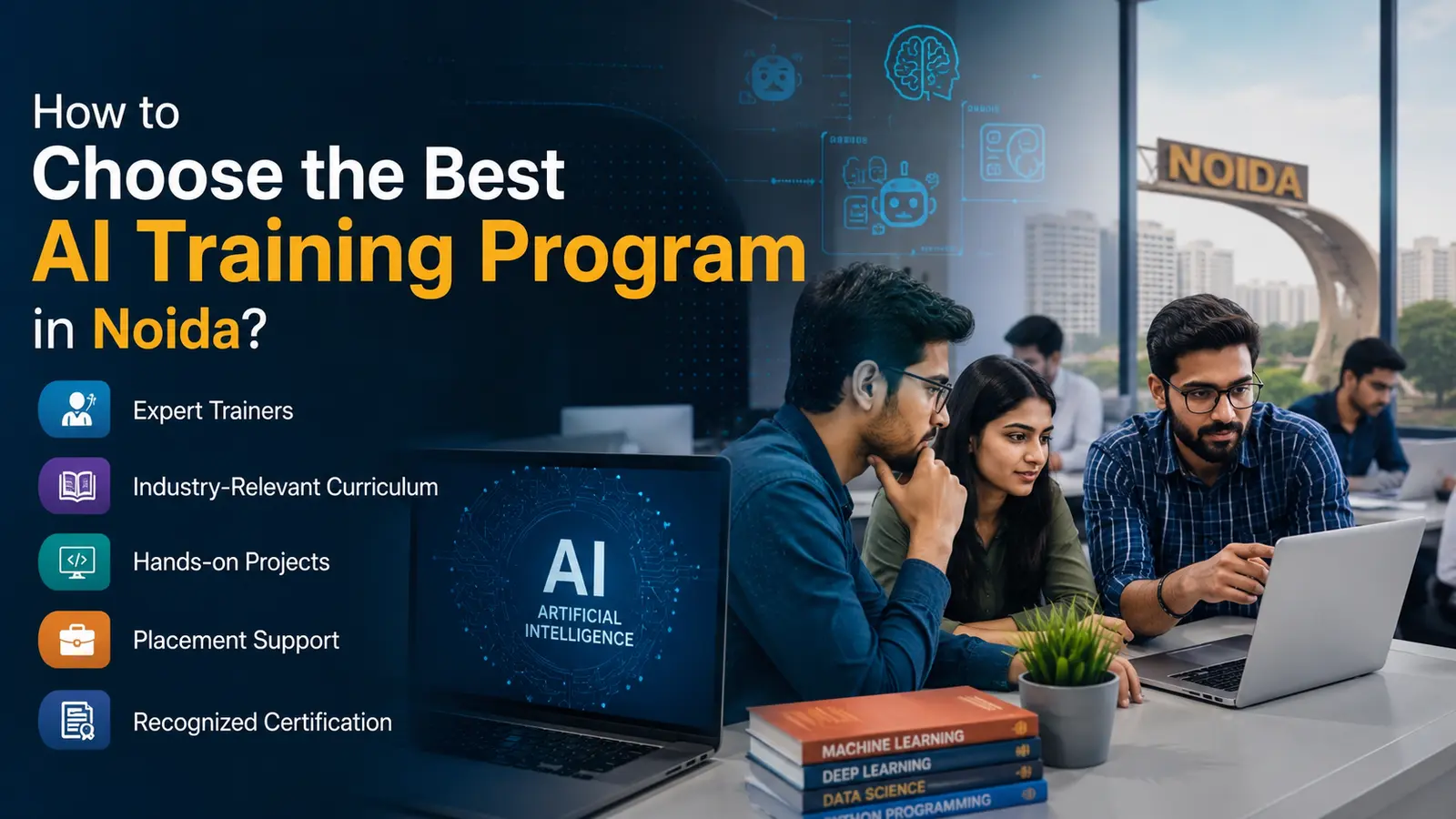
Picking the wrong one costs you months and money you won’t get back. Picking the right one can set up your entire career. So let’s look at what actually separates solid AI Training in Noida from the rest, and why so many learners are searching for AI Training in Noida right now instead of settling for generic online courses.
Why choose AI training in Noida?
Noida isn’t just another satellite city near Delhi. It’s home to IT parks, GCCs, and a growing list of startups working on automation, analytics, and machine learning products. That concentration matters. When you train in a city where companies are actively hiring for AI roles, you’re closer to internships, meetups, and recruiters who show up at institute placement drives.
Job openings for AI and ML talent in the NCR region have grown steadily over the past few years, and Noida gets a fair share of that demand because of its proximity to Delhi and Gurugram’s tech corridors. This is one of the biggest reasons people specifically search for AI Training in Noida rather than a generic city-agnostic course online. Training here also means you’re more likely to sit in a classroom with working professionals who bring real industry context to discussions, not just textbook theory.
The better institutes built around an AI Institute in Noida model also lean heavily on project-based learning. You’re not just watching slides. You’re writing code, breaking it, fixing it, and building something you can show in an interview. That hands-on grind is what separates a person who “knows about AI” from one who can actually do the job.
Networking matters more here than people give it credit for. Good institutes run guest sessions with working data scientists, organize hackathons, and connect students with alumni already placed in AI roles. That kind of access is hard to replicate through self-paced online courses alone. You learn faster when you’re surrounded by people solving similar problems, and you hear about openings before they hit job portals.
Factors to consider before choosing an AI training program in Noida
This is where most people rush. Don’t. Slow down and actually dig into these six things before you pay a rupee.
Check the course curriculum
A good AI Training Program in Noida should cover the full stack, not just the trendy parts. Look for Python programming as the foundation, since almost every AI workflow runs through it. Then check whether they go deep into machine learning algorithms (not just a two-week overview), deep learning with neural networks, and data science fundamentals like data cleaning, visualization, and statistics.
Natural Language Processing matters more now than it did three years ago, thanks to the explosion of chatbots and text-based AI tools. So does Generative AI. If a curriculum doesn’t mention GenAI tools and applications at all, that’s a curriculum stuck in 2021. Ask for the actual syllabus document, not a verbal summary. If they hesitate to share it, walk away.
Pay attention to how the modules connect too. A scattered syllabus that jumps from Python basics straight to advanced neural networks, skipping statistics and data handling in between, will leave gaps you only discover during a job interview. The sequence should build, with each topic giving you the foundation for the next one.
Check the trainer’s experience
I’ve seen institutes hire trainers straight out of a 6-month certification with zero industry background. They can recite definitions. They can’t tell you why a model overfits on real production data, because they’ve never seen production data.
Ask how many years the trainer has spent actually working on AI or ML projects, not teaching about them. Ask if they can share examples of real-world projects they built or contributed to. A trainer who mentors instead of just lectures, who answers “why didn’t this work” questions with actual debugging logic, is worth far more than one with a polished slide deck and nothing behind it.
Practical projects and hands-on training
Theory gets you through a quiz. Projects get you through an interview. Any serious Artificial Intelligence Course in Noida needs to include live projects where you handle messy, real datasets, not the clean, pre-processed kind that make every model look perfect.
Look for real-world case studies pulled from industries like healthcare, retail, or finance. These force you to think about constraints, not just accuracy scores. And push for portfolio building specifically. By the end of the program, you should have 3 to 5 projects you can put on GitHub and talk through confidently. That portfolio is what gets you shortlisted, not your certificate.
Certification value
Not all certificates carry weight. A printed PDF with a logo on it means nothing if the issuing body has no recognition in the industry. Before enrolling, find out if the AI Certification Course in Noida you’re looking at is recognized by employers or affiliated with a known tech platform. Some institutes partner with global tech companies for co-branded certificates, and those tend to carry more weight on a resume than a standalone, in-house badge nobody’s heard of.
A solid certification can speed up your resume screening and give you a talking point in interviews. Recruiters scanning hundreds of applications often use certification names as a quick filter, so having one that’s actually recognized can be the difference between getting a callback and getting skipped. But it’s a supporting piece, not the whole package. Don’t pick a program because the certificate looks good on paper while the actual learning is thin. An interviewer will see through a certificate-only candidate within the first technical question.
Placement and career support
This is where a lot of institutes quietly cut corners. They’ll show last year’s “100+ placements” banner without telling you what kind of roles or salaries those numbers represent.
Ask specific questions. Do they help with resume building tailored to AI and ML roles? Do they run mock interviews and prepare you for the kind of technical rounds companies in Noida and Gurugram actually run? Is there a dedicated career guidance counselor, or are you on your own after the last class? A Best AI Training Institute in Noida should treat placement support as part of the curriculum, not an afterthought tacked on at the end.
Compare course duration and fees
Beginner programs and advanced ones aren’t priced the same, and they shouldn’t be. A 2-month foundation course covering Python and basic ML concepts should cost less than a 6-month Artificial Intelligence Machine Learning Course in Noida that goes into deep learning, NLP, and GenAI tools.
Compare durations across at least 3 institutes before deciding. Then compare fees against what’s actually included, projects, mentorship hours, doubt-clearing sessions, placement support. A cheaper course that skips half of this isn’t a deal. It’s a shortcut that costs you later when you’re unprepared for interviews.
What should a good AI course in Noida include?
If you want a quick checklist to hold any institute against, here’s what a strong AI Machine Learning Course in Noida should cover at minimum. Whether you call it an AI ML Course in Noida or a full Artificial Intelligence Machine Learning Course in Noida, the substance matters more than the label.
Python programming fundamentals, since it’s the backbone of nearly every AI tool and library you’ll touch. Machine learning algorithms including regression, classification, clustering, and ensemble methods. Deep learning concepts covering neural networks, CNNs, and RNNs at a level where you understand the math, not just the API calls.
ChatGPT and Generative AI skills, because prompt engineering and working with large language models is now a real, billable skill on its own. AI automation tools that show you how businesses are actually deploying these models, not just researching them. And real-world industry projects that simulate what you’d face in an actual job, with deadlines, messy data, and stakeholders asking for results.
If a program checks all of these boxes, it’s worth serious consideration. If it’s missing 2 or more, keep looking.
Who should join an AI training program?
AI training isn’t reserved for computer science graduates anymore. Students still in college benefit from getting a head start before they hit the job market. Freshers who graduated without a strong tech foundation use these programs to build one from scratch.
Working professionals already in IT, especially developers and analysts, join to stay relevant as their companies start integrating AI into existing products. Software developers specifically often pivot into AI Developer or ML Engineer roles because their coding foundation gives them a faster path in. Data analysts who already work with numbers and spreadsheets find the jump into machine learning surprisingly natural once they pick up Python and ML algorithms.
And then there are career switchers, people from non-tech backgrounds who see where the job market is heading and decide to make the leap. With the right Best AI Training Program in Noida, that switch is realistic, not just wishful thinking.
Career opportunities after AI training
Completing a strong program opens up several real, hiring-active roles. AI Engineer positions focus on building and deploying models into actual products, working closely with product teams to ship features that customers actually touch. Machine Learning Engineer roles lean more into the technical pipeline, training models, tuning hyperparameters, and getting them production-ready on infrastructure that can handle real traffic.
Data Scientist remains one of the most in-demand titles, combining statistics, programming, and business insight to turn raw numbers into decisions executives can act on. AI Developer roles focus on integrating AI features into applications and software, often working at the intersection of backend engineering and model deployment. Automation Specialist positions are growing fast as companies look to cut manual work using AI-driven tools across HR, finance, and customer support functions. And AI Research Associate roles, while fewer in number, exist for people who want to dig into the research side rather than pure application, often working alongside academic institutions or R&D teams inside larger firms.
Salaries and exact titles vary by company and experience level, but all six of these roles are actively hiring in the NCR region right now, and a well-built AI Institute in Noida program is designed to prepare you for exactly these positions.
Common mistakes while choosing an AI course
I’ve watched people make the same errors over and over. Choosing a course purely because it’s the cheapest option in the city, without checking what’s actually taught, almost always backfires. You save 10,000 rupees upfront and lose months relearning fundamentals later.
Ignoring practical training is another big one. If a program is 80% lecture and 20% hands-on coding, you’ll struggle the moment an interviewer asks you to write actual code. Selecting a course with an outdated syllabus, one that skips Generative AI or modern NLP techniques entirely, leaves you behind candidates trained on current tools.
Not checking student reviews before enrolling is a mistake that’s entirely avoidable. A quick search on Google or LinkedIn tells you a lot about real student experiences versus marketed promises. And avoiding programs with weak or non-existent placement support means you’re left to navigate the job hunt completely alone, right when you need guidance the most.
Conclusion
Choosing the right AI training program is a career investment, not just another course fee. A program built around a strong curriculum, experienced trainers, hands-on projects, recognized certification, and real placement support gives you what you actually need to succeed in this field; not just a piece of paper, but skills you can prove. Take your time comparing options, ask the hard questions about trainers and placements, and pick a Best AI Training in Noida program that’s built for where the industry is headed, not where it used to be.