AI models are only as good as the person asking the questions. That’s the whole idea behind prompt engineering, and it’s why a clear prompt engineering roadmap matters more in 2026 than it did even a year ago.
If you’re a student picking a first tech skill, or a working professional trying to stay relevant while your industry gets rewired by AI, this prompt engineering roadmap walks you through what to learn, in what order, and how long each stage actually takes.
By the end, you won’t just know what prompt engineering is. You’ll have a working prompt engineering roadmap you can follow week by week, whether you’re starting from zero or already messing around with ChatGPT every day.
What is prompt engineering, really?
Prompt engineering is the practice of writing instructions that get a large language model (LLM) to produce the output you actually want. Not a vague answer. The specific thing you need is in the format you need it.
Think of an LLM like a capable new employee on their first day. They know a lot, but they don’t know your context, your tone, or what “good” looks like for your task. A prompt is the briefing you give them. A well-engineered prompt does in one shot what three rounds of back and forth used to take.
That’s why prompt engineering skills show up in job descriptions now, not just for AI researchers, but for content writers, marketers, analysts, and developers. And it’s why a proper prompt engineering roadmap has become worth following instead of picking up tips from scattered YouTube videos.
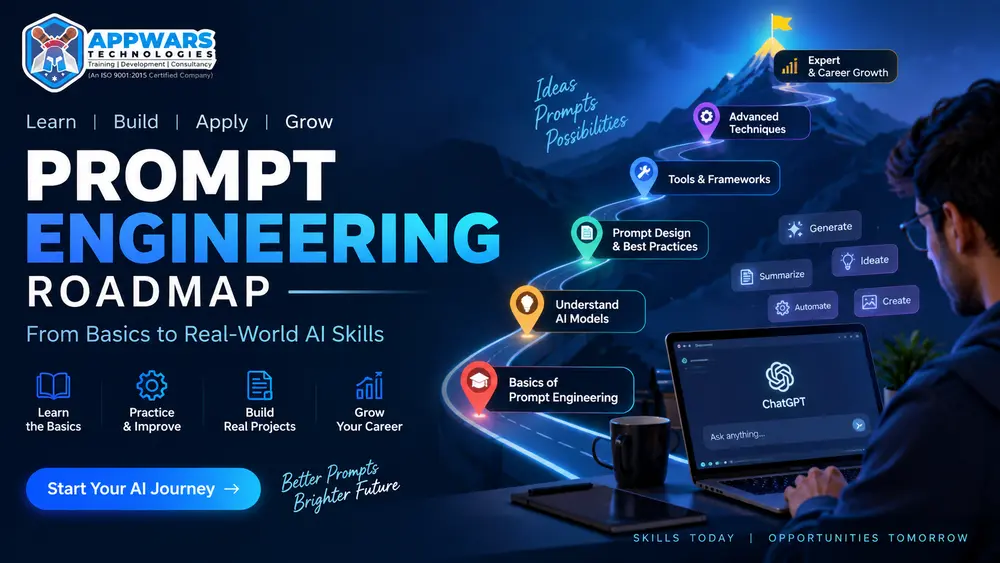
The rest of this prompt engineering roadmap breaks that skill into six phases you can actually schedule around a semester or a job.
Get Free Career Counseling ➔Why 2026 is a different year for this skill
Two years ago, prompt engineering was treated like a novelty job title. That’s changed.
Companies now expect employees to already know how to prompt well, the same way they expect basic Excel skills. Job postings for content, marketing, support, and even HR roles now list “AI prompting” or “generative AI tools” as a requirement, not a bonus.
This is exactly why a structured prompt engineering roadmap matters more now than a year ago. Learning by trial and error still works, but it’s slower, and it leaves gaps that show up in interviews or on the job.
Who this roadmap is for
- Students who want an AI-adjacent skill without a computer science degree
- Working professionals in marketing, content, HR, or operations who already use ChatGPT or Claude but want sharper, more consistent results
- Developers moving from basic API calls to structured, reliable prompt systems
- Freelancers who want to add AI prompt engineering or AI workflow consulting to their service list
If you fall into any of these buckets, the roadmap below is built for you.
Prompt engineering roadmap 2026: the full overview
Here’s the entire prompt engineering roadmap at a glance. Each phase builds on the last, so don’t skip ahead.
| Phase | Duration | Focus | What you’ll be able to do |
|---|---|---|---|
| 1. AI foundations | 1 to 2 Weeks | How LLMs work, tokens, context windows | Explain how a model reads and responds to text. |
| 2. Core prompting techniques | 3 to 5 Weeks | Zero-shot, few-shot, chain-of-thought, role prompting | Write prompts that consistently return usable output. |
| 3. Tools and platforms | 6 to 7 Weeks | ChatGPT, Claude, Gemini, LangChain | Pick the right tool for the right job. |
| 4. Specialization | 8-10 Weeks | Content, code, data, marketing, agents | Apply prompting to your actual field |
| 5. Portfolio building | 11-12 Weeks | Prompt libraries, case studies | Show proof of skill to employers or clients. |
| 6. Job and freelance prep | Week 13 | Resume, interviews, platforms | Land a role or your first paid project. |
Total time on this prompt engineering roadmap: about 3 months if you put in 5 to 7 hours a week. Faster if you already work with AI tools daily.
Step 1: Build your AI foundations first.
This is where every good prompt engineering roadmap should start and where most beginners try to skip ahead. Don’t. You don’t need to train a model. You need to understand how one thinks.
Learn these basics:
- What a large language model actually is: a system predicting the next most likely word, not a database storing facts
- Tokens: models read text in chunks, not whole words, and that affects prompt length and cost
- Context window: the amount of text a model can hold in mind at once, and why a 10-page document might get cut off mid-thought
- Temperature and sampling: why the same prompt can return different answers each time
- The difference between a base model and an instruction-tuned model (ChatGPT, Claude, and Gemini are all instruction-tuned)
Spend two weeks here. Read documentation from OpenAI, Anthropic, and Google. Watch a few technical explainer videos. This part is reading-heavy, not writing-heavy, but it’s the part that makes step 2 click faster.
Get Free Demo Class ➔Step 2: Learn the core prompting techniques.
This is the heart of any prompt engineering roadmap. Once you know these techniques, you can mix and match them for almost any task, from a one-line social post to a multi-step research brief.
| Technique | What it does | Example use case |
|---|---|---|
| Zero-shot prompting | Ask directly; no examples given. | “Summarize this article in 3 bullet points.” |
| Few-shot prompting | Give 2-3 examples before the real task. | Show 3 sample product descriptions, then ask for a 4th. |
| Chain-of-thought (CoT) | Ask the model to reason step by step | “Walk through your logic before giving the final answer.” |
| Role prompting | Assign the model a persona. | “You are a senior SEO auditor reviewing this page.” |
| Self-consistency | Generate multiple answers, and pick the best one. | Run the same prompt 3 times, and compare outputs. |
| ReAct prompting | Combine reasoning with tool use | Used in AI agents that search and then answer |
Practice each technique on the same task. Ask a model to write a product description with zero-shot, then few-shot, then role prompting. You’ll see the quality gap immediately, and that gap is what employers are paying for.
This is also the stage where prompt design starts to feel less like guesswork and more like a skill you can repeat on demand.
Step 3: Get hands-on with the right tools
Reading about prompting only gets you so far. By week 6 of this prompt engineering roadmap, you should be prompting daily inside real tools, not just reading about them.
- ChatGPT: general-purpose prompting practice and plugin-based workflows
- Claude: long documents, careful reasoning, and coding tasks
- Gemini: useful if you’re already inside Google Workspace
- Perplexity: prompts that need live web results
- LangChain or Flowise: chaining multiple prompts into a workflow, useful once you move toward automation
- PromptLayer or similar: tracking and versioning prompts once you’re managing more than a handful
If you’re aiming for roles that touch AI agents and automation, this is also where Appwars Technologies’ AI course in Noida fits in. It covers this tool stack through hands-on projects instead of theory alone, which shortens this part of the prompt engineering roadmap considerably if you’re learning with a group.
Step 4: Specialize in one direction
Generic prompting skills get you an interview. Specialized prompting skills get you hired. Pick one lane based on your background.
Content and copywriting Learn prompts for SEO briefs, blog outlines, ad copy variations, and tone matching. Pair this with basic keyword research so your AI prompt writing produces content that’s built to rank, not just readable.
Coding and development Prompts for debugging, code review, test generation, and documentation. Claude and GitHub Copilot are the common tools here.
Data and analytics Prompts that turn messy data into summaries, generate SQL queries from plain English, or explain a dataset’s patterns in plain language.
Marketing and growth Prompts for ad targeting ideas, campaign copy, and customer segment analysis. If this is your track, pairing prompt skills with a data science course in Noida gives you the analytical backbone to prompt with real numbers, not guesses.
AI agents and automation This is where prompting meets orchestration tools like n8n or LangChain, and where a basic prompt engineering roadmap starts overlapping with agent design. Our Agentic AI roadmap breaks down the next layer once you’re comfortable prompting on your own, and generative AI vs agentic AI explains where prompting stops and autonomous agent behavior begins.
Step 5: Build a portfolio that proves it
Nobody hires a prompt engineer off a resume line. They want to see the work.
Build these 3 things by week 12:
- A prompt library: 15-20 prompts you’ve written and refined for a specific use case, with notes on what changed between versions
- Two or three case studies: the problem, the prompt, the before-and-after output
- A short write-up on one failed prompt and how you fixed it. This shows judgment, not just output.
Post this on a personal site, a Notion page, or GitHub. Recruiters and clients check this before they check your resume. This step is what separates people who finished a prompt engineering course from people who can actually do the job, and it’s the part of the prompt engineering roadmap most beginners skip.
Step 6: Prepare for jobs and freelance work
By this stage, you’re not learning anymore. You’re positioning.
- Update your resume with specific, measurable outcomes: “reduced content revision cycles by 40% using structured prompt templates,” not “skilled in AI prompting.”
- Practice explaining your prompt choices out loud. Interviewers often ask why you picked one technique over another
- If freelancing, list your services clearly: prompt audits, prompt library builds, AI workflow setup
On pay: prompt engineering rarely stands alone as a job title in India yet. It shows up bundled into roles like AI content strategist, GenAI associate, or automation specialist. Entry to mid-level pay for these roles runs roughly in the 4 to 12 LPA range, higher when paired with a technical skill like Python or SQL. A prompt engineer salary this early in the field’s life depends a lot on what other skills you’re stacking it with.
Common mistakes beginners make on their prompt engineering roadmap
- Treating prompting as one-shot magic instead of an iterative process. Your first prompt is a draft, not a final answer.
- Writing prompts that are too vague (“write something about marketing”) instead of specific (“write a 150-word LinkedIn post for a B2B SaaS founder announcing a product update”)
- Ignoring a tool’s quirks. What works in ChatGPT doesn’t always transfer directly to Claude or Gemini.
- Skipping the foundations step. You can copy prompt templates off the internet forever and still not know why they work or fail.
- Rushing past step 2 to jump straight into automation. Solid prompting technique is what makes agent workflows reliable later.
How to adjust this roadmap for your pace
Not everyone needs all 6 phases at the same speed. If you’re a working professional already comfortable with ChatGPT, you can compress steps 1 and 2 into a single week and spend the saved time on step 4, where the actual job-relevant skill lives.
Students with more free hours can slow down step 2 instead. Rushing the core prompting techniques is the most common reason people finish a prompt engineering roadmap and still write mediocre prompts six months later.
There’s no single correct pace for a prompt engineering roadmap. There’s only the pace that gets you through step 5 with a portfolio you’re not embarrassed to share.
Explore Trending Courses ➔FAQs
Is prompt engineering still relevant in 2026?
Yes, though the job title itself is shifting. The skill is getting folded into broader roles rather than disappearing. Every AI-adjacent job now expects some level of prompting competence.
Do I need to know how to code for prompt engineering?
No, not for the basics. Coding helps once you move into automation, API-based prompting, or agent workflows.
How long does a prompt engineering roadmap for beginners actually take?
About 3 months of consistent practice, following the roadmap above, gets you to a job-ready level. Basic competence takes 2 to 3 weeks.
Which AI tool is best to practice prompting on?
Start with ChatGPT for general practice, then move to Claude for longer, reasoning-heavy tasks. Using both shows you how the same prompt behaves differently across models.
Can I learn prompt engineering alongside a full-time job?
Yes. Most people following this roadmap study 5 to 7 hours a week. Weeknights plus one weekend session cover it.
Where to go from here
Prompting is a skill you build through repetition, not theory. Pick one real task from your work or coursework this week and rewrite the prompt for it three different ways using the techniques from step 2 of this prompt engineering roadmap.
If you’d rather learn this with a structured curriculum, live projects, and instructor feedback, Appwars Technologies’ AI course in Noida covers this full prompt engineering roadmap hands-on and pairs well with the data science course in Noida if you want the analytical side too.