
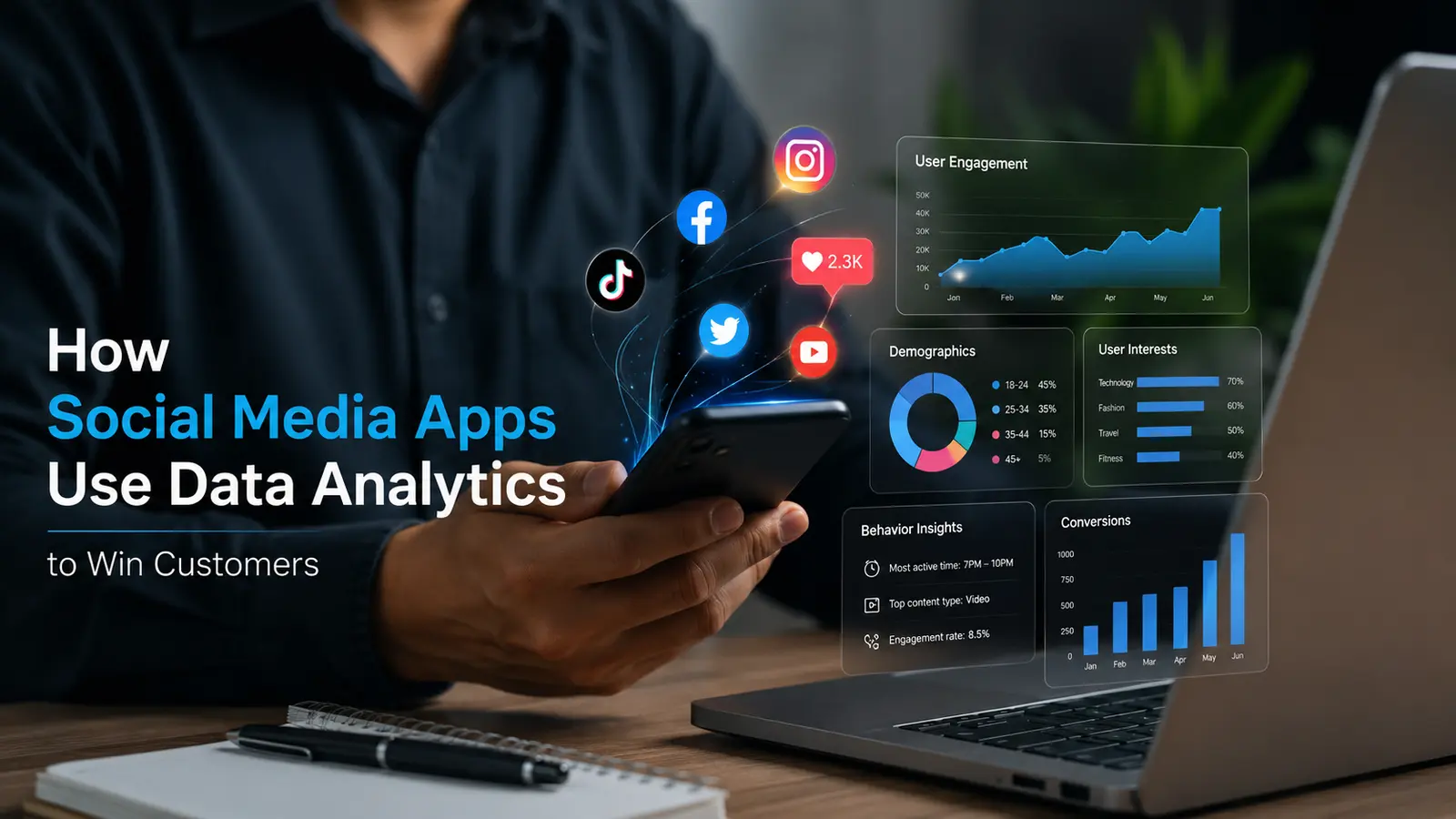
Open Instagram right now and count how many posts feel like they were made for you specifically. That’s not luck. That’s data analytics in social media working in the background, every scroll, every pause, every double tap feeding a system that’s learning who you are.
Ten years ago, social platforms guessed what users wanted. Now they know. A single TikTok session generates hundreds of data points: how long you watched, where you stopped, whether you rewatched a section, whether you skipped after two seconds. Multiply that by a billion users and you get a machine that understands human attention better than most humans do.
This shift matters for anyone building an audience online, whether you’re a student learning the ropes, a marketer running campaigns, or a business owner trying to figure out why your last three posts flopped. Data analytics in social media isn’t a backend detail anymore. It’s the reason some apps keep users for hours and others get deleted within a week. This piece walks through how it actually works, who’s doing it well, and what it means for the future of social media marketing analytics.
As businesses increasingly depend on social media insights to improve marketing performance, the need for professionals who can analyze and interpret data is growing rapidly. Whether you’re a student, marketer, or business owner, understanding social media analytics can give you a valuable competitive advantage. Structured Data Analytics Training can help you build practical skills in data analysis, visualization, and business intelligence, enabling you to make smarter, data-driven decisions.
What is social media data analytics?
Social media data analytics is the process of collecting, measuring, and interpreting data generated by user activity on platforms like Instagram, YouTube, or LinkedIn. That includes obvious things like likes and shares, but also quieter signals: scroll speed, time spent on a video, the exact moment someone closes the app.
Platforms care about this because attention is their product. Every extra minute you spend scrolling is a minute of ad inventory sold. So the more accurately an app can predict what keeps you engaged, the more money it makes. That’s the blunt version, and it’s the honest one.
The types of user data collected generally fall into a few buckets: who you are (profile data), what you do (behavioral data), where you are (location and device data), and what you’re interested in (search and interaction history). Combined, these create what’s often called app demographic and interest analytics, a profile detailed enough to predict your next move with uncomfortable accuracy.
Types of data social media apps collect
User profile data
This is the information you hand over willingly: age, gender, location, job title, relationship status, listed interests. LinkedIn uses this heavily to power its “People you may know” suggestions, while Facebook has built entire ad categories around profile fields users filled in years ago and forgot about.
Engagement data
Likes, comments, shares, saves, watch time. This is the clearest signal a platform has about what content actually works. A post that gets saved is worth more to the algorithm than one that just gets liked, because a save signals real intent to return to it.
Behavioral data
Scroll patterns, session length, time of day you’re active, what you skip versus what you linger on. Netflix famously does this with viewing data, and social apps borrowed the same playbook. TikTok’s For You page is basically one giant behavioral data experiment running continuously.
Device and location data
What phone you use, your operating system, your general location, even your connection speed. This helps platforms optimize load times and also feeds hyperlocal advertising, like a restaurant ad that only shows up when you’re within two miles of the place.
Search history
What you type into the search bar tells a platform what you’re curious about before you’ve even engaged with related content. Pinterest and YouTube both lean on search data to shape recommendations days or weeks in advance.
Purchase and ad interaction data
Which ads you clicked, which you scrolled past instantly, what you bought after clicking. This closes the loop between advertising spend and actual revenue, and it’s the single most valuable dataset for advertisers because it ties behavior directly to dollars.
How social media apps use data analytics to win customers
Personalized content recommendations
Every major platform now runs on a recommendation engine rather than a chronological feed. Instagram’s Explore page, YouTube’s homepage, TikTok’s For You feed: none of these show the same thing to any two users. The system takes your engagement data and behavioral data and constantly recalculates what’s most likely to keep you watching.
Targeted advertising
This is where social media marketing analytics earns its keep for businesses. Instead of buying a billboard and hoping the right people drive past, a company can target 28-to-35-year-old graphic designers in Mumbai who recently searched for design software. Facebook’s Ads Manager built its entire business model on this kind of precision targeting.
Customer segmentation
Businesses don’t market to “everyone.” They split audiences into segments: new followers, loyal customers, cart abandoners, high spenders. A skincare brand might run one ad for people who’ve never bought from them and a completely different one for repeat customers, using data to decide who sees what.
User behavior analysis
This looks at patterns over time rather than single actions. Does a user always open the app in the morning? Do they respond better to video than static images? Customer behavior analytics answers questions like these, and the answers shape everything from posting schedules to content format decisions.
Push notifications and customer retention
Notifications aren’t random either. Apps test which message, which time of day, and which emoji gets the highest open rate, then apply that formula at scale. A well-timed “Someone commented on your photo” notification exists because a data team found it brings people back to the app more reliably than a generic reminder.
Trend detection
Platforms track spikes in hashtag usage, sound usage, or search terms in near real time. TikTok’s trend detection is fast enough that a sound can go from unknown to inescapable within 48 hours, and the platform’s own analytics dashboards are what let creators and brands catch that wave early.
A/B testing
Nothing gets rolled out to everyone at once anymore. A new button color, a different feed layout, a tweaked notification copy: these get tested on small user groups first, measured against engagement metrics, and only scaled up if the numbers hold.
Real-world examples
Instagram’s Explore page and Reels feed run on engagement prediction models that weigh watch time, likes, and shares within the first few seconds of a post going live. The platform also gives business accounts detailed audience insights, breaking down follower demographics by age, location, and active hours.
Facebook’s ad platform remains one of the most detailed targeting systems in advertising, letting businesses filter audiences by interests, behaviors, and even life events like a recent move or new job. Its Lookalike Audience tool builds new target lists based on the data profile of existing customers.
YouTube
YouTube’s recommendation engine drives a huge share of total watch time on the platform, and it does this by analyzing session data, not just single-video performance. It’s less interested in whether you liked one video and more interested in whether that video kept you watching the next one.
TikTok
TikTok’s algorithm is famously fast at learning individual preference, sometimes within the first 20 to 30 videos a new user watches. It relies less on who you follow and more on raw behavioral signals: watch time, rewatches, and completion rate.
LinkedIn uses profile and behavioral data to power both its feed and its “People you may know” suggestions, but its real analytics strength shows up for businesses through LinkedIn Analytics, which tracks post reach, follower demographics by industry and seniority, and engagement by content type.
Snapchat
Snapchat leans on its Snap Map and Discover data to understand where and when users are most active, and it uses purchase and ad interaction data heavily for its AR-based shopping ads, where users can try on products through the camera before buying.
Comparison: how top platforms use data analytics
| Platform | Primary data focus | Key analytics use |
| Engagement + demographics | Explore page personalization, business audience insights | |
| Interests + behavior | Targeted ads, Lookalike Audiences | |
| YouTube | Session-level watch time | Recommendation engine, retention modeling |
| TikTok | Behavioral micro-signals | Fast-learning For You algorithm |
| Professional profile data | B2B targeting, content performance by industry | |
| Snapchat | Location + AR interaction | Snap Map targeting, AR shopping ads |
Benefits of data analytics for businesses
Better audience targeting means less money wasted on people who were never going to buy anyway. Improved customer experience comes from showing people content and offers that actually match their interests instead of generic blasts. Higher ROI follows naturally once targeting and content both improve, since every dollar spent works harder.
Better decision-making replaces gut instinct with actual numbers, which matters when a campaign budget is on the line. And campaign optimization lets businesses fix underperforming ads mid-flight instead of waiting until the whole budget is spent to find out something didn’t work.
Challenges and privacy concerns
Data privacy sits at the center of most of this. Users generate huge amounts of personal information just by using an app normally, and not everyone is comfortable with how much of it gets used for advertising.
User consent has become a legal requirement in many regions, not just a nice gesture. GDPR in Europe and similar laws elsewhere now require platforms to explain what they collect and let users opt out, which has forced real changes in how apps design their onboarding flows.
Algorithm bias is a quieter problem but a real one. If training data skews toward certain demographics or behaviors, recommendations can end up reinforcing narrow content bubbles rather than broadening what users see. Data security matters just as much: a breach exposing millions of user profiles isn’t hypothetical, it’s happened to several major platforms already. And the ethical questions (how much influence should an algorithm have over what a teenager sees at 2am) don’t have clean answers yet.
Future of social media data analytics
Artificial intelligence is moving from a background tool to the main engine behind content ranking, ad targeting, and even content creation suggestions for creators. Predictive analytics is getting good enough to flag which posts will perform well before they’re even published, based on early engagement patterns from similar content.
Real-time analytics is becoming standard rather than a premium feature, letting brands adjust a live campaign within minutes instead of waiting for next-day reports. First-party data is growing in importance as third-party cookies get phased out, pushing platforms and businesses to collect information directly rather than buying it from data brokers.
Privacy-first marketing is no longer a niche approach, it’s becoming the default expectation from regulators and users alike. Generative AI is starting to combine with analytics directly, suggesting ad copy or content ideas based on what a specific audience segment has responded to in the past.
Best practices for businesses using social media analytics
Start with a clear goal before pulling any report. Knowing whether you’re optimizing for reach, engagement, or conversions changes which metrics actually matter, and chasing vanity numbers like follower count rarely translates into revenue.
Track the right metrics for the platform you’re on. Watch time matters more on YouTube and TikTok, while click-through rate and conversion rate matter more for Facebook and LinkedIn ad campaigns. Test consistently rather than occasionally, since a single A/B test tells you little compared to a pattern built over several campaigns.
Respect user privacy proactively rather than reactively. Businesses that are upfront about data use tend to build more trust with their audience than ones that only mention it in a buried terms page. And review your analytics dashboard weekly at minimum, since social media algorithms shift often enough that a strategy from three months ago may already be outdated.
FAQs
1. What is data analytics in social media?
It’s the practice of collecting and analyzing user data, like engagement, behavior, and demographics, to understand audiences and improve content, ads, and platform features.
2. How do social media algorithms decide what I see?
They rank content based on signals like watch time, likes, shares, and how similar the content is to things you’ve engaged with before, updating in near real time.
3. What is app demographic and interest analytics?
It’s data broken down by who your audience is (age, location, gender) and what they’re interested in, used by businesses to target ads and tailor content.
4. Why do businesses use customer segmentation on social media?
Because different customer groups respond to different messaging, and segmentation lets a business show the right offer to the right group instead of one message to everyone.
5. Is social media data analytics only useful for large companies?
No. Small businesses use the same free analytics tools built into Instagram, Facebook, and TikTok to understand their audience without needing an enterprise budget.
6. How does TikTok’s algorithm learn preferences so fast?
It relies heavily on behavioral signals like watch time and rewatch rate rather than follower relationships, so it can adjust recommendations within a user’s first few sessions.
7. What’s the difference between engagement data and behavioral data?
Engagement data covers direct actions like likes and comments. Behavioral data covers indirect signals like scroll speed, session length, and time of day spent active.
8. Are social media platforms transparent about the data they collect?
Most provide a data policy and some in-app controls, but the level of detail varies, and laws like GDPR have pushed platforms toward clearer disclosure than a few years ago.
9. How can I use social media analytics if I’m just starting out?
Start with the free native analytics dashboard on whichever platform you use most (Instagram Insights, YouTube Studio, TikTok Analytics) before paying for third-party tools.
10. Will privacy regulations change how social media analytics works?
Yes. Regulations are already pushing platforms toward more first-party data collection and clearer consent flows, and this trend is expected to keep shaping how analytics is done.
Conclusion
Data analytics in social media isn’t some future trend businesses need to prepare for. It’s already running every feed you scroll through today. The platforms that win, Instagram, TikTok, YouTube, and the rest, aren’t winning because they have the flashiest features. They’re winning because they understand their users at a level of detail that would have sounded impossible a decade ago.
If you’re a business owner or marketer reading this, the takeaway is simple: start paying attention to your own analytics dashboards this week, not next quarter. Pick one metric that matters for your goal, track it for a month, and adjust based on what you actually see instead of what you assume. That’s the whole game.
Also read- Role of Data Analytics in E-Commerce