If you’re researching a digital marketing course, you’ve probably noticed every institute lists a different set of modules. Some cram in 20 topics. Others stick to 6. So which one is actually right?
Here’s the short answer: a solid digital marketing course covers SEO, content, social media, paid ads, email, analytics, and a handful of specialized skills like CRO and marketing automation. But the depth, sequencing, and tools matter more than the module count. This guide breaks down exactly what’s inside a modern digital marketing course syllabus, why each module exists, and how to judge if a program is worth your time.
What is a digital marketing course, and who should take one
A digital marketing course teaches you how businesses attract, convert, and retain customers online. That includes search engines, social platforms, email, paid ads, and the data behind all of it.
It’s not one skill. It’s a stack of skills that work together. SEO brings organic traffic. Ads bring paid traffic. Email and automation keep people coming back. Analytics tells you what’s working and what’s burning money.
Who actually needs this? Students who want a career path that doesn’t require a technical degree. Fresh graduates competing in a job market where “marketing experience” is now assumed at entry level. Working professionals in sales, design, or operations who want to add a marketable skill without quitting their job. And career changers, people leaving retail, teaching, or finance, who’ve noticed that marketing roles are everywhere and don’t always demand a marketing degree to start.
A good digital marketing training program is built for all four groups, but the pace and depth of explanation should differ. A fresher needs more hand-holding on basics. A working professional often wants to skip the fluff and get to campaign strategy.
What are the modules in a digital marketing course?
Here’s the direct answer. A comprehensive digital marketing course curriculum typically includes these modules:
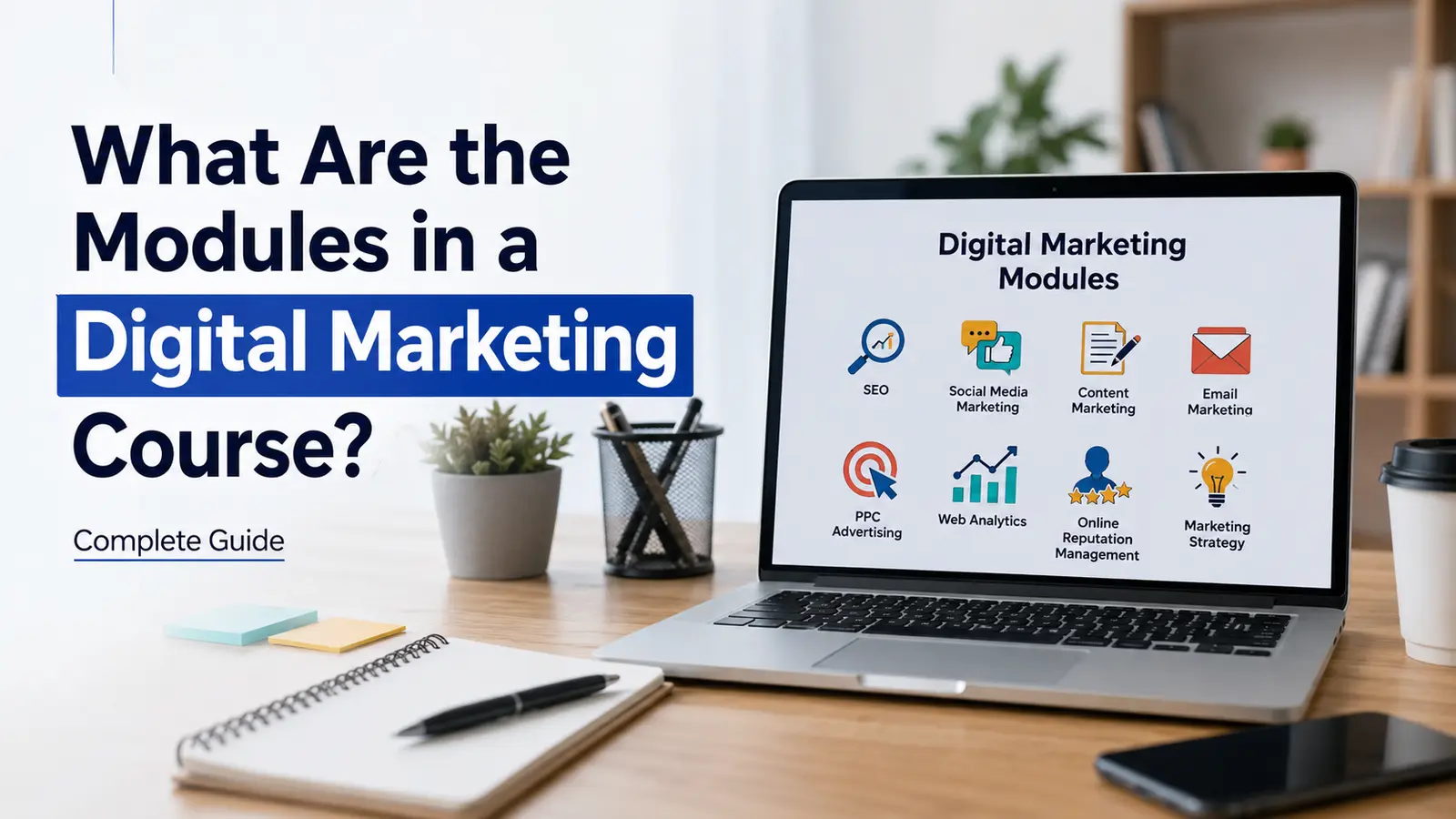
SEO, content marketing, social media marketing, search engine marketing (Google Ads/PPC), Meta Ads, email marketing, performance marketing, web analytics using GA4, conversion rate optimization, affiliate marketing, influencer marketing, e-commerce marketing, local SEO, marketing automation, and AI tools for digital marketing.
That’s 15 modules. Not every course teaches all 15 in equal depth, and that’s fine. A beginner-focused program might spend 3 weeks on SEO and content, then briefly touch affiliate and influencer marketing. An advanced program does the opposite: it assumes you know the basics and spends more time on automation, CRO, and AI-assisted workflows.
Here’s a table showing what each module covers and why it’s included in a digital marketing course syllabus.
| Module | What you learn | Why it matters |
| SEO | Keyword research, on-page optimization, technical audits, link building | Drives free, long-term traffic from Google |
| Content Marketing | Blog writing, content planning, storytelling for brands | Builds trust and supports SEO and social efforts |
| Social Media Marketing | Platform strategy, organic growth, content calendars | Builds audience and brand recall |
| Search Engine Marketing (Google Ads/PPC) | Campaign setup, bidding, keyword match types | Generates fast, measurable traffic |
| Meta Ads | Facebook and Instagram ad campaigns, targeting, creative testing | Reaches audiences by interest and behavior, not just search intent |
| Email Marketing | List building, segmentation, automated sequences | Cheapest channel to retain and convert existing leads |
| Performance Marketing | Multi-channel campaigns tied to ROI | Ties every rupee spent to a measurable outcome |
| Web Analytics (GA4) | Tracking setup, event reporting, funnel analysis | Tells you what’s actually working |
| Conversion Rate Optimization | A/B testing, landing page audits, user behavior analysis | Gets more value from existing traffic |
| Affiliate Marketing | Partner programs, commission models, tracking links | Scales sales through third-party promoters |
| Influencer Marketing | Creator outreach, campaign briefs, ROI tracking | Builds credibility through trusted voices |
| E-commerce Marketing | Product listing ads, marketplace SEO, cart recovery | Drives direct sales for online stores |
| Local SEO | Google Business Profile, local citations, reviews | Critical for shops, clinics, and service businesses |
| Marketing Automation | Workflow tools, lead scoring, CRM integration | Saves time on repetitive campaign tasks |
| AI Tools for Digital Marketing | ChatGPT prompts, AI copywriting, AI-assisted research | Speeds up content, research, and reporting work |
SEO: the module that teaches you to rank without paying for clicks
SEO is usually the first real module in any digital marketing course, and for good reason. It teaches you how Google decides what to show first.
You’ll learn keyword research (finding what people actually type into Google), on-page SEO (titles, meta descriptions, headers, internal links), and technical SEO (site speed, indexing, mobile-friendliness). Most courses also cover backlink building, since links from other sites still influence rankings.
A good instructor will show you a real website audit, not just theory. If your course skips hands-on audits, that’s a gap worth asking about.
Content marketing: writing that earns attention instead of interrupting it
Content marketing sits right next to SEO because good content is what actually ranks. This module covers blog writing, content calendars, brand storytelling, and repurposing one piece of content across formats.
You’ll also learn how to match content to buyer stages. Someone searching “what is SEO” needs a different article than someone searching “SEO agency pricing.” Courses that teach this distinction produce writers who understand strategy, not just grammar.
Social media marketing: building an audience platform by platform
This module covers organic growth on Instagram, LinkedIn, Facebook, and increasingly YouTube Shorts and Reels. You’ll learn content planning, posting cadence, community management, and how each platform’s algorithm rewards different behavior.
A strong social media marketing module also teaches brand voice consistency. Posting daily means nothing if the tone shifts every week.
Search engine marketing (Google Ads/PPC): paying for visibility that converts
Search engine marketing, commonly shortened to SEM or PPC, teaches you how Google Ads auctions work. You’ll set up campaigns, choose keyword match types, write ad copy, and manage budgets.
The real skill here isn’t clicking buttons in Google Ads. It’s understanding quality score, negative keywords, and how to stop wasting spend on clicks that never convert.
Meta Ads: reaching people by interest, not just search intent
Meta Ads (Facebook and Instagram advertising) works differently from search ads. Instead of targeting what someone typed, you target who they are and what they engage with.
This module covers audience targeting, lookalike audiences, creative testing, and the Meta Ads Manager dashboard. You’ll also learn why the same ad creative can perform completely differently across age groups and placements.
Email marketing: the channel with the best return per rupee spent
Email marketing modules cover list building, segmentation, and automated sequences like welcome emails and cart abandonment flows. Tools like Mailchimp are usually taught here.
What separates a good email marketer from a mediocre one is segmentation. Sending the same email to your entire list is a rookie move. A well-taught module shows you how to split lists by behavior and send relevant messages instead.
Performance marketing: connecting every channel to a number
Performance marketing pulls together SEO, ads, email, and social into one accountable system. Every campaign is judged by outcomes: cost per lead, cost per acquisition, return on ad spend.
This module often feels like the “advanced” version of everything you’ve already learned, because it forces you to think in terms of budgets and business goals instead of individual tactics.
Web analytics (GA4): reading the data instead of guessing
Google Analytics 4 replaced Universal Analytics, and most digital marketing course modules now teach GA4 from scratch. You’ll learn event tracking, audience reports, conversion funnels, and how to connect GA4 with Google Ads and Search Console.
If a course still teaches the old Universal Analytics interface, that’s a red flag. GA4 has been the standard since mid-2023.
Conversion rate optimization: getting more from traffic you already have
CRO teaches you to improve what happens after someone lands on your page. That includes A/B testing headlines, simplifying checkout flows, and analyzing heatmaps to see where users drop off.
It’s one of the more underrated modules. A 20% jump in conversion rate can matter more than doubling your ad budget, and it costs nothing to test.
Affiliate marketing: scaling sales through other people’s audiences
This module explains how businesses recruit partners to promote products for a commission. You’ll learn tracking links, commission structures, and how to manage affiliate relationships without losing control of brand messaging.
Influencer marketing: buying trust instead of just impressions
Influencer marketing modules cover creator outreach, campaign briefs, contract basics, and measuring ROI beyond just follower count. You’ll learn why a micro-influencer with 10,000 engaged followers sometimes outperforms a celebrity with a million.
E-commerce marketing: driving direct sales for online stores
This module focuses on product listing ads, marketplace SEO (Amazon, Flipkart), cart recovery emails, and remarketing to people who browsed but didn’t buy. It’s especially relevant if you want to work with D2C brands.
Local SEO: winning the map pack for local businesses
Local SEO teaches Google Business Profile optimization, local citations, and review management. This module matters a lot for clinics, restaurants, salons, and any business that depends on nearby customers finding them on Google Maps.
Marketing automation: doing more without doing it manually
Marketing automation covers tools that trigger emails, score leads, and sync data with a CRM. You’ll learn workflow building, so a new sign-up automatically gets a welcome sequence without anyone manually hitting send.
AI tools for digital marketing: working faster without cutting corners
This is one of the newer digital marketing course topics, and it’s become standard in the last two years. You’ll learn how to use ChatGPT for content briefs, ad copy drafts, and keyword clustering. You’ll also cover AI-assisted research, using tools to summarize competitor strategies or generate first-draft reports.
The important part here is judgment. AI can draft an email in seconds, but you still need to know if the offer, tone, and targeting make sense. Courses that teach AI as a shortcut without teaching the underlying strategy are doing students a disservice.
Tools commonly taught in a digital marketing course
Modules teach concepts. Tools are how you apply them. Here’s what shows up in most digital marketing course subjects today.
Google Analytics 4 (GA4) tracks website behavior and conversions. Google Ads runs paid search campaigns. Google Search Console shows how your site performs in organic search results and flags indexing issues. Meta Ads Manager handles Facebook and Instagram campaigns. Canva is used for quick design work, social posts, banners, and simple graphics. WordPress is the platform most courses use to teach website and blog management. ChatGPT supports content drafting, brainstorming, and research. Semrush and Ahrefs are used for keyword research, competitor analysis, and backlink audits. Mailchimp handles email campaigns and automation sequences.
Knowing these tools by name isn’t enough. A good course has you actually log in, set up a campaign, and pull a real report, not just watch a screen recording.
Practical skills you gain after completing a digital marketing course
By the end of a well-structured program, you should be able to plan a content calendar, set up and optimize a Google Ads campaign, read a GA4 report and explain what it means, write ad copy that doesn’t sound like ad copy, and build a basic email automation flow.
You should also be comfortable explaining marketing decisions with numbers. Not “I think this worked,” but “this campaign had a 3.2% conversion rate against a 1.8% average.”
Projects, assignments, and internships that build real experience
Modules teach theory. Projects prove you can apply it. Look for courses that assign a live website audit, a mock ad campaign with a real (small) budget, or a content calendar for an actual or simulated brand.
Internships add another layer, since you’re working with real deadlines and real client feedback instead of a simulated brief. A portfolio built from these projects, screenshots of campaigns, before-and-after analytics, sample content, matters more to employers than a certificate alone.
How course modules prepare you for different marketing careers
Different modules map to different job titles. Someone strong in SEO and content often moves toward content strategist or SEO executive roles. Someone who enjoys the Google Ads and Meta Ads modules tends to fit paid media specialist positions. Analytics-heavy learners often land in marketing analyst or growth roles. And students who enjoy the automation and CRO modules frequently end up in marketing operations, a role that’s grown a lot in the last few years.
The point is: you don’t need to be equally good at all 15 modules. Most professionals specialize in 2 or 3 within a year or two of starting out.
Beginner, intermediate, and advanced modules compared
| Level | Modules covered | Focus |
| Beginner | SEO basics, content marketing, social media marketing, email marketing | Understanding channels and terminology |
| Intermediate | Google Ads, Meta Ads, GA4, local SEO, e-commerce marketing | Running and measuring real campaigns |
| Advanced | Performance marketing, CRO, marketing automation, affiliate and influencer marketing, AI-assisted workflows | Strategy, optimization, and scaling across channels |
If you’re a complete beginner, don’t jump straight into an advanced-only program. You’ll spend half your time googling terms instead of learning strategy.
What to check before enrolling in a digital marketing course
Here’s a quick checklist to run through before you sign up for any digital marketing training program.
| What to check | Why it matters |
| Updated syllabus (GA4, not old Universal Analytics) | Outdated tools mean outdated skills |
| Live projects, not just recorded lectures | Hands-on work builds a real portfolio |
| Mentors with actual industry experience | Theory without practice doesn’t transfer well |
| Recognized certification | Adds credibility to your resume |
| Coverage of AI tools | Now a standard expectation, not a bonus |
| Internship or practical exposure | Bridges the gap between course and job |
| Placement support (not placement guarantees) | Genuine support helps; guarantees are usually marketing talk |
If a program can’t clearly answer what’s inside each module, that’s worth a second look before you pay.
Where structured learning fits in
Some people can piece together digital marketing skills from YouTube and blog posts. Others prefer structured learning with a set sequence, mentor feedback, and deadlines that keep them accountable. If you’re someone who learns better with structure, a Digital Marketing Course from Appwars Technologies covers all 15 modules above, with live projects and mentor support built into the syllabus. It’s one option among many, so compare it against what you’ve read here before deciding.
Conclusion
So, what are the modules in a digital marketing course? SEO, content, social media, paid ads, email, analytics, CRO, and a set of specialized skills like automation and AI tools. That’s the real answer, but the module list only tells half the story. The depth of teaching, the quality of live projects, and whether the syllabus reflects current tools like GA4 matter just as much as what’s on the topic list.
If you’re a student, fresher, working professional, or career changer weighing whether a digital marketing course is worth your time, use the tables and checklist above as a filter. Ask any institute to walk you through their syllabus module by module. If they can’t explain why a module is there or what tool it uses, that’s your answer.
Frequently asked questions
1. What are the main modules in a digital marketing course?
The core modules are SEO, content marketing, social media marketing, Google Ads, Meta Ads, email marketing, GA4 analytics, and CRO. Advanced courses add automation, affiliate marketing, influencer marketing, and AI tools.
2. How long does a digital marketing course usually take?
Most programs run 3 to 6 months for a full curriculum. Shorter courses of 4 to 6 weeks usually cover only 3 or 4 modules in depth.
3. Do I need a technical background to take a digital marketing course?
No. Most modules are taught from scratch. Basic computer literacy and comfort with spreadsheets helps, but it’s not a prerequisite.
4. Is a digital marketing certification enough to get a job?
A certification helps get past initial resume screening, but employers usually ask for project work or a portfolio during interviews. Combine the certificate with real campaign examples.
5. What’s the difference between a digital marketing course for beginners and an advanced course?
Beginner courses focus on terminology and single-channel basics. Advanced courses assume you know the basics and focus on cross-channel strategy, optimization, and automation.
6. Which module should I focus on first?
SEO and content marketing are usually the best starting point, since they build a foundation that other modules (ads, email, analytics) build on top of.
7. Are AI tools actually part of standard digital marketing course curriculum now?
Yes. Most updated syllabuses added ChatGPT and AI-assisted workflows by 2024 and 2025, since agencies now expect familiarity with AI-assisted content and research work.
Also read this article- Top 20 Digital Marketing Interview Questions