Every business with a website is competing for the same 8 seconds of attention. That’s roughly how long someone scrolls past your post, your ad, or your search result before deciding if you’re worth a click. In 2026, the businesses winning that 8-second war aren’t the ones with the biggest budgets. They’re the ones whose marketers actually know what they’re doing.
I’ve spent over a decade in this industry, and I can tell you the game has shifted faster in the last 2 years than in the previous 8 combined. AI tools write first drafts in seconds. Algorithms rewrite the rules of visibility every quarter. And the marketers who haven’t kept up are getting left behind, not because they’re bad at their jobs, but because the job itself changed underneath them.
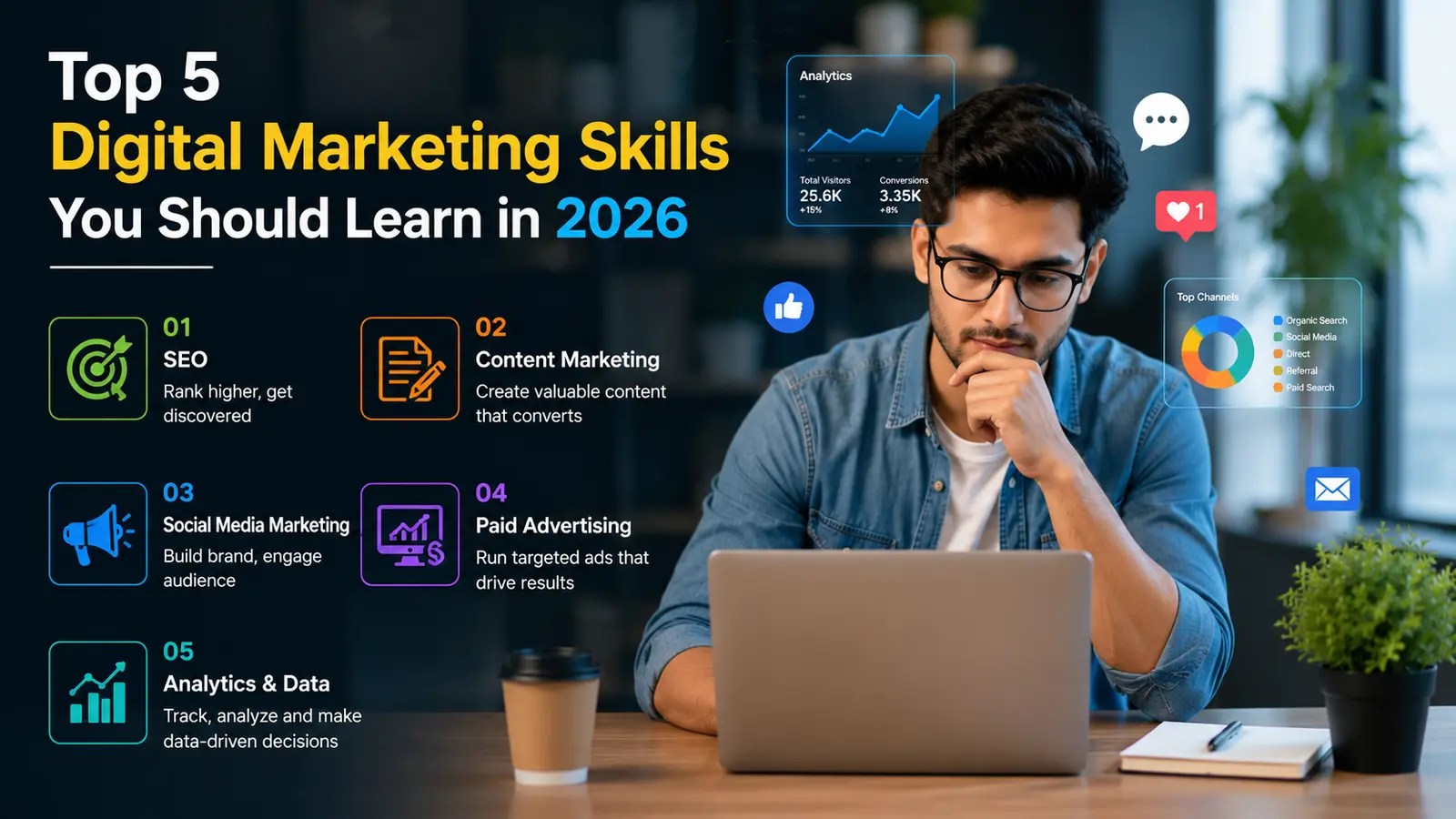
If you’re trying to figure out which digital marketing skills 2026 actually rewards, you’re in the right place. This isn’t a list of buzzwords to put on your resume. It’s a practical breakdown of the 5 skills that are genuinely shaping careers and budgets right now, plus the tools, learning paths, and job titles attached to each one.
Why digital marketing skills are important in 2026?
Online business isn’t a side channel anymore. It’s the main channel. Local shops have e-commerce stores. Service businesses run entirely on inbound leads from Google and social media. Even industries that used to rely on word of mouth, like dentists and lawyers, now spend real money on paid ads and SEO. That shift means more companies need people who can run digital campaigns, and most of them don’t have anyone in-house who actually knows how.
This is why demand for digital marketers keeps climbing. Job boards are flooded with openings for SEO specialists, paid media managers, and content strategists, and a lot of those roles sit open for months because qualified candidates are hard to find. Companies aren’t short on budget. They’re short on skill.
AI and automation changed what “skilled” even means. Five years ago, being good at digital marketing meant knowing how to write a meta description or set up a Facebook ad. Now it means knowing how to use AI tools without becoming dependent on them, how to read data instead of just collecting it, and how to make strategic calls that a chatbot can’t make for you. The repetitive stuff got automated. The thinking didn’t.
That’s exactly why career opportunities in this field are growing instead of shrinking. Automation took over the busywork, which means the people left standing are the ones doing higher-value work, and higher-value work pays better. Companies need strategists, not button-pushers.
Top 5 digital marketing skills to learn in 2026
These are the skills I’d tell my younger self to learn first if I were starting over today. Not because they’re trendy, but because they show up in nearly every job description I’ve seen this year.
1. Search Engine Optimization (SEO)
SEO is the practice of getting your content to show up when people search for something on Google. That’s it. No mystery, no magic, just understanding what people search for and giving Google a reason to trust that your page answers it best.
It’s important because organic search still drives more long-term traffic than almost any other channel, and unlike paid ads, it doesn’t disappear the moment you stop paying. A page ranked well 2 years ago can still bring in traffic today.
Keyword research is where it starts. You’re figuring out what words and phrases your audience actually types into Google, not what you assume they type. Tools like Ahrefs and SEMrush show you search volume, competition, and intent, so you’re not guessing.
On-page SEO covers what you control directly on your page: titles, headers, internal links, image alt text, and how naturally your keywords fit into the content. Technical SEO is the less glamorous half: site speed, mobile usability, crawlability, structured data. Google can’t rank a page it can’t crawl, so this stuff matters more than people think.
AI changed SEO in a real way this year. Google’s AI Overviews now answer simple questions directly in the search results, which means fewer clicks for basic queries. The marketers thriving right now are the ones writing content that goes deeper than AI Overviews can, content with original data, real opinions, and first-hand experience. Among the essential digital marketing skills 2026 demands, SEO is still the foundation everything else builds on.
2. Artificial intelligence and AI marketing
AI marketing means using AI tools to do the work that used to take a team of people, faster and often better. Tools like ChatGPT, Jasper, and Claude can draft blog posts, write ad copy, and generate email sequences in minutes.
AI-powered customer insight tools go further. They analyze purchase history, browsing behavior, and engagement patterns to predict what a customer wants next, before that customer knows it themselves. That’s how brands send you an email about a product you were just thinking about buying.
Marketing automation platforms like HubSpot and ActiveCampaign use AI to trigger emails, score leads, and segment audiences automatically, without a human checking every step. And prompt engineering, knowing how to talk to an AI tool to get a genuinely useful result instead of generic fluff, has become its own skill. The marketers getting the best AI output aren’t the ones with access to better tools. They’re the ones who know how to ask better questions.
This is one of the advanced digital marketing skills 2026 employers specifically screen for now. I’ve seen job postings literally ask candidates to demonstrate their AI workflow in an interview.
3. Content marketing
Content marketing is creating material, blogs, videos, guides, that attracts and keeps an audience without directly pitching them. Done right, it builds trust before you ever ask for a sale.
Blog writing is still the backbone of most content strategies because it feeds SEO and gives you something to link, share, and repurpose. Video content has overtaken blogs in raw engagement though. People would rather watch a 90-second explainer than read 800 words, and platforms know it, which is why video gets pushed harder in every algorithm right now.
Storytelling is what separates content that gets remembered from content that gets scrolled past. Anyone can list product features. Fewer people can make you feel something about a brand. And none of this works without a content strategy tying it together: a plan for what you publish, where, how often, and why, instead of posting whatever feels good that week.
4. Social media marketing
Social platforms aren’t just where brands post updates anymore. They’re where discovery happens, where customer service happens, and increasingly where purchases happen too.
A solid social media strategy means knowing which platform fits your audience instead of trying to be everywhere at once. Short-form video, TikTok, Reels, YouTube Shorts, dominates attention right now, and brands that ignore it are leaving reach on the table. Audience engagement (actually replying to comments, running polls, showing up in DMs) builds the kind of loyalty that ads can’t buy.
Paid social ads through Meta Ads Manager or TikTok Ads let you put budget behind content that’s already working, which is smarter than starting from zero. And brand building on social media is a slow game: consistent voice, consistent visuals, showing up the same way every single time until people recognize you without seeing your logo.
5. Data analytics and performance marketing
This is the skill that tells you whether everything else is actually working. Data analytics means tracking what’s happening across your campaigns and using that to make better decisions instead of guessing.
Google Analytics is the starting point for almost every marketer, showing you where traffic comes from, what people do on your site, and where they drop off. Tracking campaigns properly means setting up UTM parameters and conversion tracking so you know exactly which ad, email, or post drove a sale, not just that a sale happened.
Understanding customer behaviour goes beyond traffic numbers. It’s noticing patterns: people abandon your cart at the shipping page, or your blog readers convert better than your social followers. Measuring ROI keeps everyone honest, because a campaign that generates clicks but no revenue isn’t a win, no matter how good it looks in a screenshot. And paid advertising optimization, adjusting bids, testing creative, refining targeting, is what turns a mediocre ad campaign into a profitable one.
Among skills required for digital marketing today, this one gets underrated the most. Creativity gets you attention. Data tells you if that attention turned into anything.
Essential tools every digital marketer should learn
Skills mean nothing if you can’t execute them, and execution runs through tools. Google Analytics and Google Search Console are non-negotiable, they show you traffic and search performance straight from the source. Google Ads and Meta Ads Manager run your paid campaigns across the two biggest ad networks on the planet.
Canva makes design accessible to people who can’t open Photoshop, which is most marketers, honestly. ChatGPT has become a daily tool for drafting, brainstorming, and editing. SEMrush and Ahrefs handle the heavy lifting in keyword research and competitor analysis. None of these tools replace skill, they just make skilled people faster. This list covers most of the digital marketing tools and skills you’ll actually touch on the job.
How to improve your digital marketing skills?
Online courses give you structure, and platforms like Google Skillshop, HubSpot Academy, and Coursera offer free or cheap certifications that actually carry weight on a resume. But courses alone won’t get you hired. Practice with real projects, start a blog, run a small ad campaign for a friend’s business, manage a social account for free if you have to. Employers want proof you’ve done the work, not just watched videos about it.
Following industry trends matters more in this field than almost any other, because what worked last year can stop working overnight when a platform changes its algorithm. Creating your own campaigns, even tiny ones with $20 in ad spend, teaches you more in a week than a month of theory. And analyzing successful brands, picking apart why a campaign worked, what hook they used, how they structured the funnel, trains your eye to spot patterns you’ll later apply to your own work.
Career opportunities after learning digital marketing skills
An SEO specialist focuses on ranking websites higher in search results, researching keywords and fixing technical issues. A content marketer plans and creates the blogs, videos, and guides that attract an audience. A social media manager runs brand accounts, plans content calendars, and handles engagement.
A PPC specialist manages paid ad campaigns across Google and Meta, optimizing spend to get the best return. And a digital marketing manager usually oversees all of it, setting strategy and managing the people executing each piece. These roles pay differently depending on experience and location, but all 5 are hiring right now, and most only need a portfolio and a working knowledge of the right digital marketing career skills, not a fancy degree.
Future of digital marketing skills
AI-driven marketing isn’t a future trend anymore, it’s already running quietly behind most campaigns you interact with daily. What’s coming next is deeper personalization: ads, emails, and even website layouts that shift based on individual behavior instead of broad audience segments.
Automation will keep eating the repetitive tasks: scheduling, basic reporting, simple customer responses. That’s not a threat to marketers who adapt, it’s a filter that removes the parts of the job nobody enjoyed anyway. And data-based decision making will only get stricter. Gut feeling still has a place in creative work, but budget decisions are increasingly backed by numbers, and marketers who can’t read a dashboard will struggle to justify their strategy in a room full of people asking why.
FAQs
1. What are the top digital marketing skills in 2026?
SEO, AI marketing, content marketing, social media marketing, and data analytics top the list. Together they cover visibility, creation, distribution, and measurement, which is the full loop of any campaign.
2. Is digital marketing a good career in 2026?
Yes. Demand keeps growing as more businesses move online, and the rise of AI has shifted marketers toward higher-value strategic work instead of replacing them outright.
3. Which digital marketing skill is most in demand?
SEO and AI marketing currently top most job listings, but the strongest candidates combine both with at least one execution skill like content or paid ads.
4. How long does it take to learn digital marketing?
You can learn the basics in 2 to 3 months with consistent practice. Getting genuinely good at one specialization, like SEO or PPC, usually takes 6 months to a year of hands-on work.
5. Can beginners learn digital marketing skills?
Yes, and there’s never been an easier time to start. Free courses, AI tools, and low-cost ad platforms mean you can learn and practice digital marketing for beginners in 2026 without a big upfront investment.
Conclusion
This field doesn’t sit still. Tools change, algorithms shift, and the skills that mattered 3 years ago aren’t the same ones that matter today. SEO, AI marketing, content, social media, and data analytics are the 5 areas where I’ve seen the most career movement this year, and they’re not going anywhere in 2026.
Pick one, get genuinely good at it, then build outward from there. That’s a far more reliable path than trying to learn everything at once and mastering none of it.