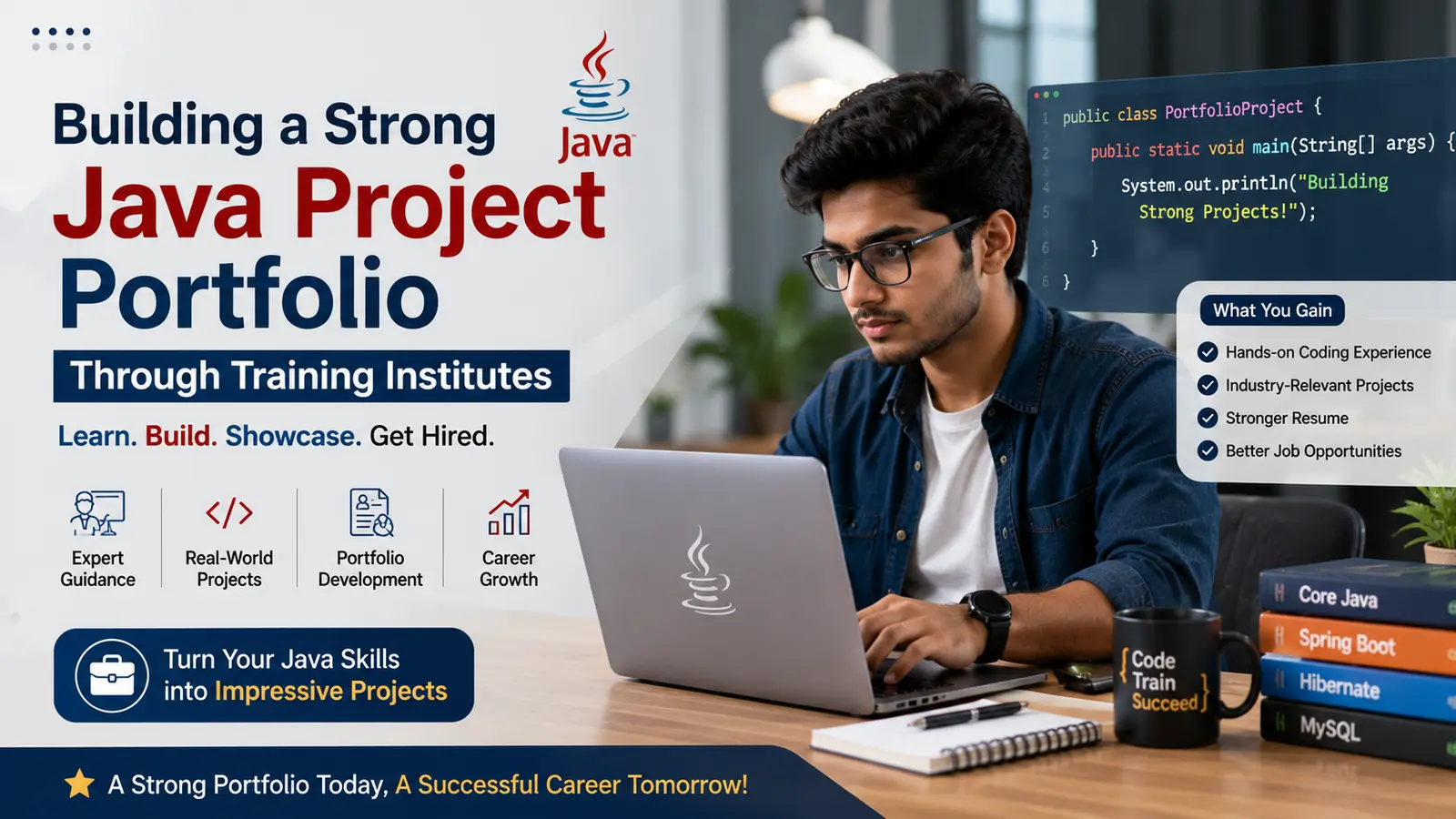
A certificate tells a recruiter you sat through a course. A Java project portfolio tells them you can actually build something. That difference decides who gets called back for an interview and who gets skipped.
I’ve watched this play out over and over. Two candidates apply for the same Java developer role. Both have similar degrees, similar certifications, similar mock test scores. One has a GitHub profile with five working applications, clean commit history, and a README that explains the thinking behind each project. The other has a PDF listing “Core Java, Advanced Java, Spring Boot.” Guess who gets the callback.
Recruiters don’t have time to test everyone’s coding ability in depth during a first screen. They look for proof. A portfolio is proof. And that’s exactly why this guide walks through what a strong Java portfolio looks like, which projects belong in it, and how a good training institute helps you build one that actually gets noticed.
Table of contents
What is a Java project portfolio Why every Java developer needs a strong portfolio Why training institutes play an important role Essential Java projects to include in your portfolio Technologies that strengthen a Java portfolio How to present your Java projects professionally Common mistakes to avoid How training institutes help with placement preparation Tips for continuously improving your Java portfolio Frequently asked questions
What is a Java project portfolio?
A Java project portfolio is a collection of applications you’ve built that demonstrate your ability to write, structure, and ship working code. Not slides. Not theory. Actual programs that run, solve a problem, and were built by you from the ground up.
Think of it as the developer’s version of a resume, except instead of listing skills, it proves them. A portfolio for a Java developer usually lives on GitHub, sometimes paired with a personal site, and includes source code, documentation, and often a live demo link.
The best java portfolio projects don’t just check a syntax box. They show you understand databases, APIs, error handling, and how real applications are structured. A recruiter scanning your repo can tell within two minutes whether you understand object-oriented design or just copied a tutorial.
Why every Java developer needs a strong portfolio
Certifications prove you attended a course. A portfolio proves you can code. That’s the whole argument, and it holds up in every hiring conversation I’ve been part of.
A solid portfolio java developer profile builds credibility fast. When a hiring manager opens your GitHub and sees five or six well-documented projects, they trust your resume claims more. Words on paper are cheap. Working code isn’t.
It also changes how you show up in an interview. Ask a candidate to explain how they built a login system with JWT authentication, and someone who actually built it will talk for ten minutes without blinking. Someone who memorized the theory will stumble on the first follow-up question. Confidence in interviews comes from having done the thing, not from having read about the thing.
Portfolios also open doors before the interview even happens. Many internships and junior roles get filled through recruiters browsing GitHub directly, especially at startups that don’t have the bandwidth for long screening processes. A strong Java developer portfolio can get you noticed without you ever sending a single application.
And for recruiters themselves, a portfolio saves time. Instead of guessing based on a resume, they can look at your code, check your commit history, and get a read on your skill level in minutes. That efficiency works in your favor if your projects are good.
Why training institutes play an important role
Building projects on your own is possible. Building the right projects, in the right order, with proper feedback, is where most self-taught developers get stuck. This is where good Java Training Institutes earn their fee.
A structured program pushes you through projects in a sequence that actually builds skill: starting with console-based applications, moving to database-driven systems, then to full-stack apps with REST APIs and a front end. Left alone, most beginners either build the same “student management system” five times or jump straight into something too advanced and give up halfway.
Mentorship is the other piece people underestimate. A trainer reviewing your code will catch things you won’t notice on your own, like tightly coupled classes, missing exception handling, or SQL queries vulnerable to injection. That kind of feedback loop is hard to replicate by watching YouTube tutorials alone.
Good institutes also force you to debug and test properly. Writing code that works once is easy. Writing code that survives edge cases, bad input, and concurrent requests takes practice most beginners skip until someone makes them do it. A Java Hands-on Training program built around real debugging sessions closes that gap fast.
By the time you finish a well-run Java Full Stack Training program, you’re not just familiar with Java syntax. You’ve shipped multiple projects, taken feedback, fixed your own mistakes, and built the kind of muscle memory that only comes from repetition under guidance.
Essential Java projects to include in your portfolio
Not every project deserves a spot in your portfolio. Here’s what actually moves the needle, and why.
Student management system
This one’s often the first serious project a beginner builds, and for good reason. It covers CRUD operations, JDBC or Hibernate for database connectivity, and basic form validation. Employers don’t get excited about this project alone, but it proves you understand the fundamentals of data persistence.
Library management system
A step up in complexity. You’re now handling relationships between entities (books, members, borrowing records) and dealing with business rules like due dates and fines. It’s a good showcase for understanding database design beyond a single table.
Banking application
This project separates casual learners from serious ones. A banking app needs transaction management, data validation, security considerations, and often multi-threading if you’re simulating concurrent transactions. Get this right and it tells an employer you can handle logic that has real consequences if it breaks.
Inventory management system
Retail and logistics companies love seeing this on a resume because it mirrors real operational software. Stock tracking, supplier management, and reporting features built with Spring Boot and MySQL show you can build something a business would actually use.
Hospital management system
Patient records, appointment scheduling, doctor assignments. This project tests your ability to model complex relationships between multiple user roles (admin, doctor, patient) and manage permissions accordingly.
Employee management system
A practical HR-style application covering payroll calculations, attendance tracking, and role-based access. It’s a strong pick if you’re targeting enterprise software roles, since most large companies run internal tools exactly like this.
E-commerce application
Probably the single most impressive project you can build as a Java developer. Product catalogs, shopping carts, payment gateway integration, order tracking. Building even a simplified version using Spring Boot and REST APIs signals full-stack capability.
Online quiz system
A smaller-scope project, but it’s a great way to demonstrate timer logic, scoring systems, and question randomization. Quick to build, easy to demo in an interview, and good for showing you can ship something end to end without over-engineering it.
Task management application
Think of a basic Trello clone. Task creation, status updates, deadlines, and user assignment. This project is popular because it maps directly to tools companies actually use internally, and it’s a natural fit for adding a React or Angular front end later.
REST API-based Java project
If you build nothing else, build this. A standalone REST API using Spring Boot, documented with Swagger, tested with Postman, shows you understand how modern applications talk to each other. Nearly every Java role today expects API development skills, so this project alone can carry serious weight in an interview.
Technologies that strengthen a Java portfolio
Projects matter, but the technology stack behind them tells recruiters how current your skills are. Core Java and Advanced Java remain the foundation, covering OOP concepts, collections, exception handling, and multi-threading.
From there, Spring Boot and Hibernate are close to non-negotiable for backend roles. Spring Boot handles the application framework and dependency injection, while Hibernate manages the object-relational mapping so you’re not writing raw SQL for every query. Pair these with JDBC for direct database access and MySQL as your storage layer, and you’ve covered the backbone of most Java job postings.
REST APIs deserve their own mention because so much hiring now filters specifically for this skill. If you can design, build, and document a clean API, you’re already ahead of a large chunk of applicants.
Git and GitHub aren’t optional either. Version control isn’t just a tool, it’s evidence of how you work. A messy, single-commit upload tells a very different story than a repo with meaningful commit messages and a visible development history.
Maven simplifies dependency management and build automation, which matters the moment your project grows past a handful of files. JUnit shows you test your code instead of just hoping it works. A little Docker knowledge, even just containerizing a simple app, signals you understand modern deployment basics. And whether you build in IntelliJ IDEA or Eclipse, being comfortable in a proper IDE (not just a text editor) is expected at this point.
How to present your Java projects professionally
A great project buried in a messy repo might as well not exist. Presentation is where a lot of good work quietly gets ignored.
Start with your GitHub profile itself. Pin your best repositories, write a clear bio, and organize things so a recruiter doesn’t have to dig through fifteen half-finished experiments to find your real work. Quality over quantity, every time.
Every project needs a README that actually explains something. What does the app do? What problem does it solve? What tech stack did you use, and why? Skip the generic “This is a student management system” line and write like you’re explaining it to someone who’s never seen your code.
Screenshots and short demo videos go a long way. A recruiter scrolling GitHub at 11pm is far more likely to click into a project with a preview image than one with a wall of text. If you can host a live demo link, even better, since it removes all friction between “interested” and “convinced.”
Talk about the challenges you hit while building each project. Did you struggle with a race condition? Did your first database schema fall apart under testing? Write it down. Employers care more about how you solved problems than about a project that magically had no bugs.
And keep everything updated. A repo that hasn’t been touched in two years, sitting next to outdated dependencies, sends the wrong signal even if the original work was solid.
Common mistakes to avoid
Copying a tutorial project line by line and uploading it as your own is the fastest way to get exposed in an interview. The first follow-up question about your own architecture decisions will reveal whether you actually built it or just typed along.
Uploading incomplete code is almost as bad. Half a project with broken functionality tells a recruiter you don’t finish what you start. If a feature isn’t done, either finish it or clearly label it as in progress.
Skipping documentation is a quieter mistake, but just as costly. No README means the recruiter has to reverse-engineer your intent from raw code, and most won’t bother.
Poor organization, random file names, no folder structure, everything dumped in one directory, makes even good code look sloppy. And if you’re still not using Git properly by this stage of your learning, that’s a gap worth closing immediately.
Sticking to only basic CRUD applications caps how impressive your portfolio can be. At some point you need at least one or two projects that involve APIs, authentication, or business logic complex enough to prove you can handle production-level work.
Finally, letting your portfolio sit untouched for a year or more makes it look abandoned. Even small updates, a new feature, a refactor, a bug fix, keep it looking active.
How training institutes help with placement preparation
The best programs don’t stop at teaching Java. They prepare you for the entire hiring process around it.
Mock interviews are one of the most valuable parts of a good institute’s placement track. Practicing under pressure, with someone asking follow-up questions about your own code, builds a kind of confidence you can’t get from solo study.
Resume building support matters more than people expect. A resume that leads with your GitHub portfolio and specific project outcomes reads completely differently from one that just lists skills alphabetically.
Some institutes go further and actually review your GitHub portfolio directly, pointing out what’s missing, what looks unfinished, and what needs a better README before you start applying anywhere.
Capstone projects, usually built in teams toward the end of a course, simulate real workplace collaboration. You learn to split tasks, merge code without conflicts, and handle disagreements about design decisions, all skills that matter far beyond the classroom.
Placement assistance and direct industry mentoring round things out, connecting learners with companies actively hiring and giving them a realistic sense of what interviewers in their target companies actually ask.
Tips for continuously improving your Java portfolio
A portfolio isn’t something you finish once and forget. Treat it like a living project.
Build something new every few months, even something small. A fresh project shows continued growth, and it keeps your skills from going stale between job searches.
Contributing to open-source projects, even fixing small bugs or improving documentation on an existing repository, adds real-world collaboration experience that solo projects can’t replicate.
Keep learning modern frameworks as they evolve. Spring Boot updates, new Java releases, changes in how REST APIs get built, all of it moves fast enough that staying current is part of the job, not an extra.
Practice coding challenges on platforms like LeetCode or HackerRank alongside your project work. Interviews test both practical building skills and algorithmic thinking, and neglecting either one leaves a gap.
Go back and refactor your older projects once in a while. The code you wrote a year ago probably looks rough compared to what you’d write today, and cleaning it up shows growth rather than hiding it.
Conclusion
Java knowledge on its own gets you in the door. A strong Java Project Portfolio is what actually gets you hired. Recruiters want proof, not promises, and the projects you build (along with how well you present them) are the clearest proof you can offer.
If you’re serious about a career in Java development, start now. Pick a project from this list, build it properly, document it well, and get it on GitHub. And if you want structured guidance, proper mentorship, and a faster path to a job-ready portfolio, a good training program can take you there far quicker than figuring it all out alone.
Frequently asked questions
1. What is a Java project portfolio?
It’s a collection of Java applications you’ve built yourself, usually hosted on GitHub, that demonstrate your practical coding ability beyond what a resume or certificate can show.
2. How many Java projects should I include?
Quality beats quantity. Five to seven well-documented, working projects that cover different skills (database handling, APIs, authentication, front-end integration) make a stronger impression than fifteen rushed ones.
3. Which Java projects impress recruiters the most?
REST API-based projects and full applications like e-commerce platforms or banking systems tend to stand out the most, since they show you can handle real complexity, not just basic CRUD operations.
4. Do beginners need a portfolio?
Yes, arguably more than experienced developers. Beginners don’t have work history to lean on, so a portfolio is often the only proof of skill a recruiter has to go on.
5. Can training institutes help build a portfolio?
Absolutely. Good institutes structure your learning around real projects, provide code reviews, and often help you polish your GitHub presentation before you start applying for jobs.
6. Is GitHub necessary for Java developers?
Practically, yes. It’s become the default place recruiters look for proof of coding ability, and skipping it puts you at a real disadvantage compared to candidates who use it well.
7. How often should I update my portfolio?
Aim for at least one meaningful update every few months, whether that’s a new project, a refactor, or improved documentation on existing work.
8. What technologies should a Java portfolio include?
At minimum, Core Java, Spring Boot, Hibernate or JDBC, MySQL, and REST APIs. Git, Maven, and basic testing with JUnit round out a portfolio that looks current and complete.
Also read this- What Are the Benefits of Learning Java Online?