
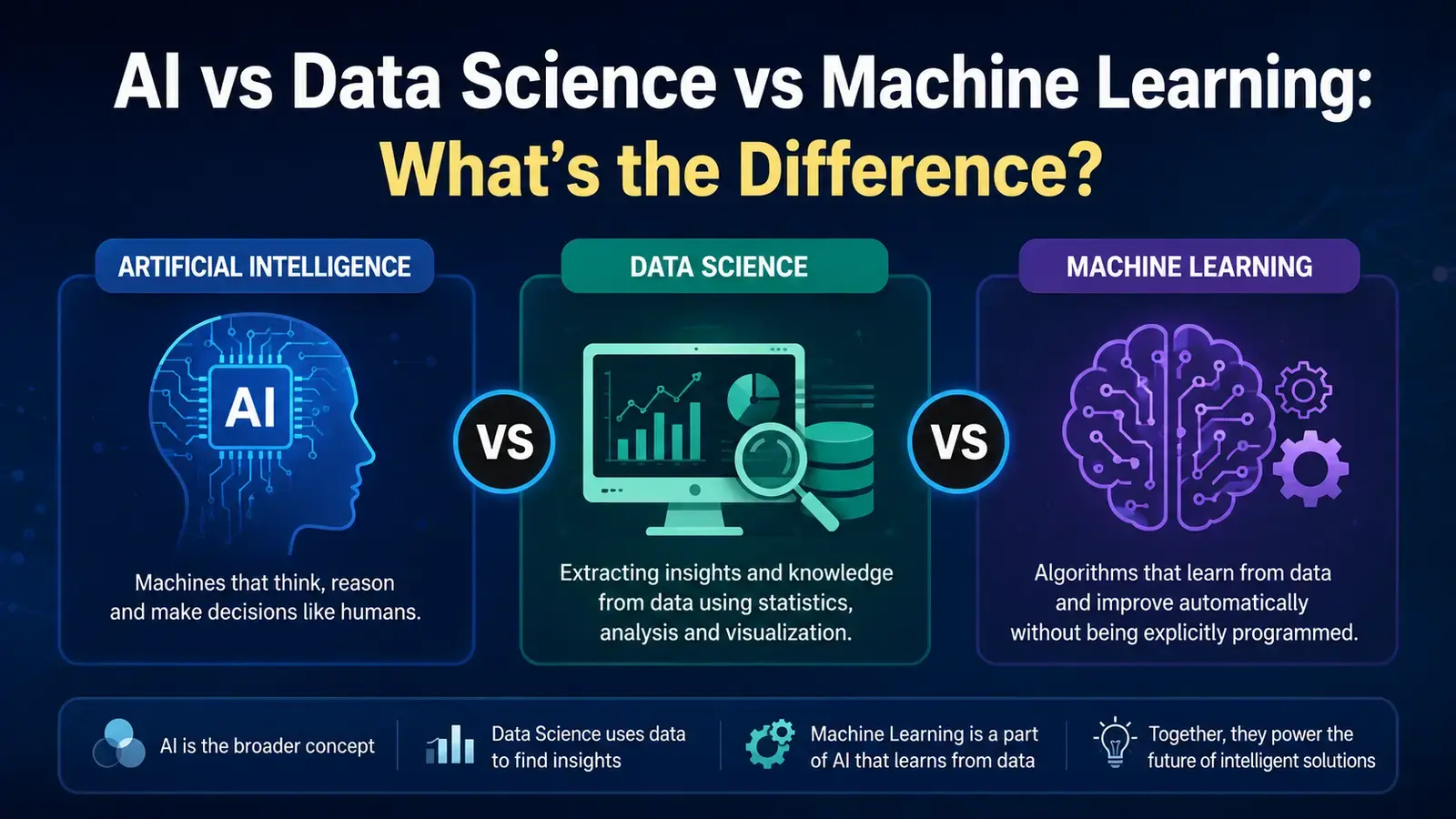
Are you confused about AI vs Data Science vs Machine Learning? You’re not alone. These three buzzwords appear everywhere in job listings, news headlines, university courses, and tech blogs often used interchangeably, even though they mean very different things.
If you’re a student or beginner trying to figure out which path to pursue, this guide is for you. By the end, you’ll clearly understand the difference between AI, ML, and Data Science, how they relate to each other, what careers they offer, and which one you should learn first based on your goals. Let’s break it all down simply and clearly.
1. What is Artificial Intelligence (AI)?
Artificial Intelligence (AI) is the broadest concept of the three. At its core, AI refers to building machines or software that can perform tasks that normally require human intelligence things like understanding language, recognising faces, making decisions, or playing chess. Think of AI as the big idea: creating smart machines.
AI shows up in everyday life more than most people realise. When Siri or Google Assistant understands your voice commands, when Netflix recommends your next favourite show, when a self-driving car navigates traffic, or when a spam filter blocks junk emails that’s all AI at work.
AI has two broad categories. The first is Narrow AI (also called Weak AI), which is designed to do one specific task, like recognising speech or playing a game. This is what exists today. The second is General AI (or Strong AI), a hypothetical form of AI that can think and reason like a human across any domain this does not exist yet. AI is the umbrella under which both Machine Learning and several other technologies like robotics, computer vision, and natural language processing fall.
2. What is Data Science?
Data Science is the field of extracting meaningful insights from large amounts of data. It combines statistics, programming, domain knowledge, and data visualisation to help organisations make better, data-driven decisions. A Data Scientist’s job is to ask the right questions, collect and clean data, analyse it, and communicate findings often through charts, dashboards, or reports.
In practice, a Data Scientist collects and cleans raw datasets, performs exploratory data analysis, builds statistical and predictive models, visualises trends and patterns, and then communicates those insights to business stakeholders. The tools of the trade include Python and R for programming, SQL for querying databases, Pandas and NumPy for data manipulation, Matplotlib, Seaborn, and Tableau for visualisation, and Jupyter Notebook as an interactive coding environment.
It’s important to note that Data Science is not just about machine learning. It also heavily involves statistics, business understanding, and communication. In fact, a data scientist might spend more time cleaning messy data than building models and that unglamorous work is just as critical to the job.
3. What is Machine Learning?
Machine Learning (ML) is a subset of AI. Instead of programming a machine with specific rules, ML lets machines learn from data and improve on their own over time. In simple terms: you feed a machine a lot of examples, and it figures out the patterns by itself.
There are three main types of Machine Learning. Supervised Learning trains a model on labelled data that is, input-output pairs such as predicting house prices based on historical sales data. Unsupervised Learning, by contrast, has the model find hidden patterns in unlabelled data, like grouping customers into segments based on shopping behaviour. Reinforcement Learning takes a different approach entirely, where the model learns by trial and error, receiving rewards or penalties the same technique used to train game-playing AIs like AlphaGo.
Popular ML algorithms include Linear and Logistic Regression, Decision Trees and Random Forests, Support Vector Machines, Neural Networks and Deep Learning, and K-Means Clustering. On the tools side, practitioners commonly use Scikit-learn for classic ML algorithms, TensorFlow and PyTorch for deep learning, Keras as a neural network wrapper, and XGBoost for gradient boosting. Machine learning is, ultimately, the engine that powers most modern AI applications from fraud detection to image recognition to language translation.
4. AI vs Data Science vs Machine Learning – Key Differences
Understanding the difference between AI, ML, and Data Science becomes easy once you see what each one is focused on:
| Dimension | Artificial Intelligence | Data Science | Machine Learning |
| Definition | Building smart systems that simulate human intelligence | Extracting insights and knowledge from data | Teaching machines to learn from data without explicit programming |
| Purpose | To create intelligent machines | To inform decisions through data analysis | To enable systems to improve automatically with experience |
| Scope | Broadest – includes ML, robotics, NLP, vision | Broad – includes stats, ML, visualisation, business analysis | Narrower – a specific technique within AI |
| Primary Tools | TensorFlow, PyTorch, OpenCV, NLP libraries | Python, R, SQL, Tableau, Jupyter, Pandas | Scikit-learn, TensorFlow, Keras, XGBoost |
| Key Skills | Programming, ML, robotics, cognitive science | Statistics, data wrangling, storytelling, SQL | Math (linear algebra, calculus), programming, algorithm design |
| Output | Intelligent products (chatbots, robots, agents) | Dashboards, reports, predictions, business insights | Trained models that make predictions or decisions |
| Career Roles | AI Engineer, AI Researcher, NLP Engineer | Data Scientist, Data Analyst, BI Analyst | ML Engineer, Research Scientist, Deep Learning Engineer |
5. AI, Data Science & ML Comparison Table
Here is a quick-reference comparison table covering the most important aspects:
| Aspect | AI | Data Science | Machine Learning |
| What is it? | Simulation of human intelligence in machines | Science of analysing and interpreting data | A method for machines to learn from data |
| Main Goal | Build smart autonomous systems | Generate actionable insights from data | Create self-improving prediction models |
| Relies On | ML, rules, logic, robotics | Statistics, domain knowledge, ML | Algorithms and training data |
| Typical Input | Text, images, speech, sensor data | Structured and unstructured datasets | Historical labelled or unlabelled data |
| Example Output | Self-driving car, voice assistant | Business report, customer churn prediction | Spam classifier, recommendation engine |
| Entry-Level Salary (India) | ₹6-14 LPA | ₹5-12 LPA | ₹6-15 LPA |
| Entry-Level Salary (USA) | $90K-$130K | $80K-$120K | $95K-$140K |
| Difficulty Level | High | Medium | Medium-High |
| Best For | Those interested in building intelligent systems | Those who enjoy working with data and storytelling | Those who love algorithms and mathematics |
6. Real-Life Applications
Each of these three fields has a distinct footprint in the real world, though they often overlap. Artificial Intelligence powers things like AI-assisted surgeries and diagnostic imaging in healthcare, real-time fraud detection in finance, autonomous checkout systems like Amazon Go in retail, self-driving vehicles from Tesla and Waymo in transportation, and chatbots and virtual assistants like ChatGPT, Alexa, and Siri in customer service.
Data Science, meanwhile, shows up in marketing through customer behaviour analysis that personalises campaigns, in sports through game data used to optimise team strategies, in e-commerce through demand forecasting and inventory management, in public health through disease outbreak tracking, and in finance through stock market forecasting and credit risk scoring.
Machine Learning’s fingerprints are everywhere too in Gmail’s spam filter and Smart Reply feature, in Spotify and Netflix recommendation engines, in banking fraud detection, in Google’s search ranking algorithm, and in the face unlock and object recognition features built into modern smartphones.
7. Career Opportunities & Skills Required
If you’re drawn to AI, the roles you’d be working towards include AI Engineer, NLP Engineer, Computer Vision Engineer, AI Research Scientist, and Robotics Engineer. This path demands strong programming skills in Python and C++, familiarity with deep learning frameworks like TensorFlow and PyTorch, solid mathematical foundations in linear algebra, calculus, and probability, and domain expertise in areas like NLP, vision, or speech.
A career in Data Science leads to roles such as Data Scientist, Data Analyst, Business Intelligence Analyst, Data Engineer, and Product Analyst. You’d need proficiency in Python or R, SQL and database querying, statistics and probability, data visualisation tools like Tableau and Power BI, and crucially the ability to communicate insights clearly to non-technical stakeholders. Business storytelling is as important here as technical skill.
Machine Learning careers centre on roles like ML Engineer, Deep Learning Engineer, ML Research Scientist, MLOps Engineer, and Applied Scientist. The skill set leans heavily mathematical especially statistics and calculus combined with strong Python programming, ML frameworks like Scikit-learn, TensorFlow, Keras, and PyTorch, understanding of model evaluation, cloud platforms such as AWS, GCP, or Azure, and software engineering skills for deploying models into production.
8. Which One Should You Learn First?
This is the most common question beginners ask, and the honest answer is: it depends on your interests and goals.
Data Science course is the right starting point if you enjoy working with numbers, spreadsheets, and discovering stories in data; if you’re more interested in business insights than building complex models; if you have a background in statistics, economics, or business; or if you simply want the most accessible entry point into the tech world. A recommended path would be to learn Python, then Pandas and NumPy, study statistics, practise with real datasets on Kaggle, and pick up SQL along the way.
Machine Learning Course is better suited to you if you love mathematics, especially linear algebra and calculus, enjoy building and experimenting with algorithms, and want to work at the intersection of statistics and software engineering. The path here starts with mastering Python, studying statistics, learning Scikit-learn, building projects, and eventually exploring deep learning with TensorFlow or PyTorch.
AI is the goal if you’re fascinated by robotics, autonomous systems, or building intelligent products from the ground up; if you have (or are willing to build) a strong foundation in ML and software engineering; or if you want to work on cutting-edge research in NLP, computer vision, or reinforcement learning. The recommended approach is to build a solid base in Data Science and ML first, and then specialise in your chosen AI domain.
For most students and career switchers, Data Science is the most accessible starting point. Once you’re comfortable with data analysis and basic ML, transitioning into machine learning or AI becomes much smoother.
9. Future Scope of AI, Data Science & Machine Learning
The future of these three fields is one of the most exciting and consequential stories of our era. Generative AI tools like ChatGPT, Gemini, and Claude have already transformed how people write, code, and create and this technology will continue expanding into healthcare, legal, creative industries, and education.
In healthcare, AI and ML are set to revolutionise medicine through early disease detection and personalised treatment plans. Models that can predict patient outcomes with high accuracy are already in use at leading hospitals. In transportation and logistics, self-driving cars, delivery drones, and automated warehouses are becoming mainstream, with AI-powered robotics reshaping manufacturing and agriculture.
As AI systems are increasingly used to make high-stakes decisions, loan approvals, medical diagnoses, criminal justice there is a growing demand for Explainable AI (XAI): systems that can explain not just what decision they made, but why. Meanwhile, the explosion of IoT devices, social media, and digital transactions means the volume of data being generated is staggering. Data Scientists who can work at scale using tools like Spark, cloud platforms, and real-time pipelines will be in immense demand.
The numbers back up the optimism. The global AI market is projected to surpass $1.8 trillion by 2030. Data Science roles are among the fastest-growing in the world, with millions of positions still unfilled globally. Machine Learning Engineers are among the highest-paid tech professionals anywhere. These fields are not just growing, they are becoming foundational to nearly every industry: healthcare, finance, retail, agriculture, entertainment, and beyond.
Conclusion
Artificial Intelligence is the broadest of the three concepts. It focuses on creating machines and systems that can think, reason, and perform tasks in a way that mimics human intelligence, encompassing technologies like Machine Learning, robotics, Natural Language Processing, computer vision, and expert systems.
Machine Learning is a subset of AI that enables machines to learn from data and improve over time without being explicitly programmed for every task. By identifying patterns and making predictions, it serves as the foundation for many modern AI applications from recommendation systems to voice assistants to predictive analytics.
Data Science is a broader, interdisciplinary field that combines data analysis, statistics, programming, and Machine Learning to extract meaningful insights from data and support business decision-making. While it often uses ML techniques, it goes beyond AI applications to emphasise data visualisation, communication, domain knowledge, and analytical thinking solving real-world business problems and driving strategic decisions.
See more:- Data Science Roadmap for Beginners, Top 10 AI courses in Noida,