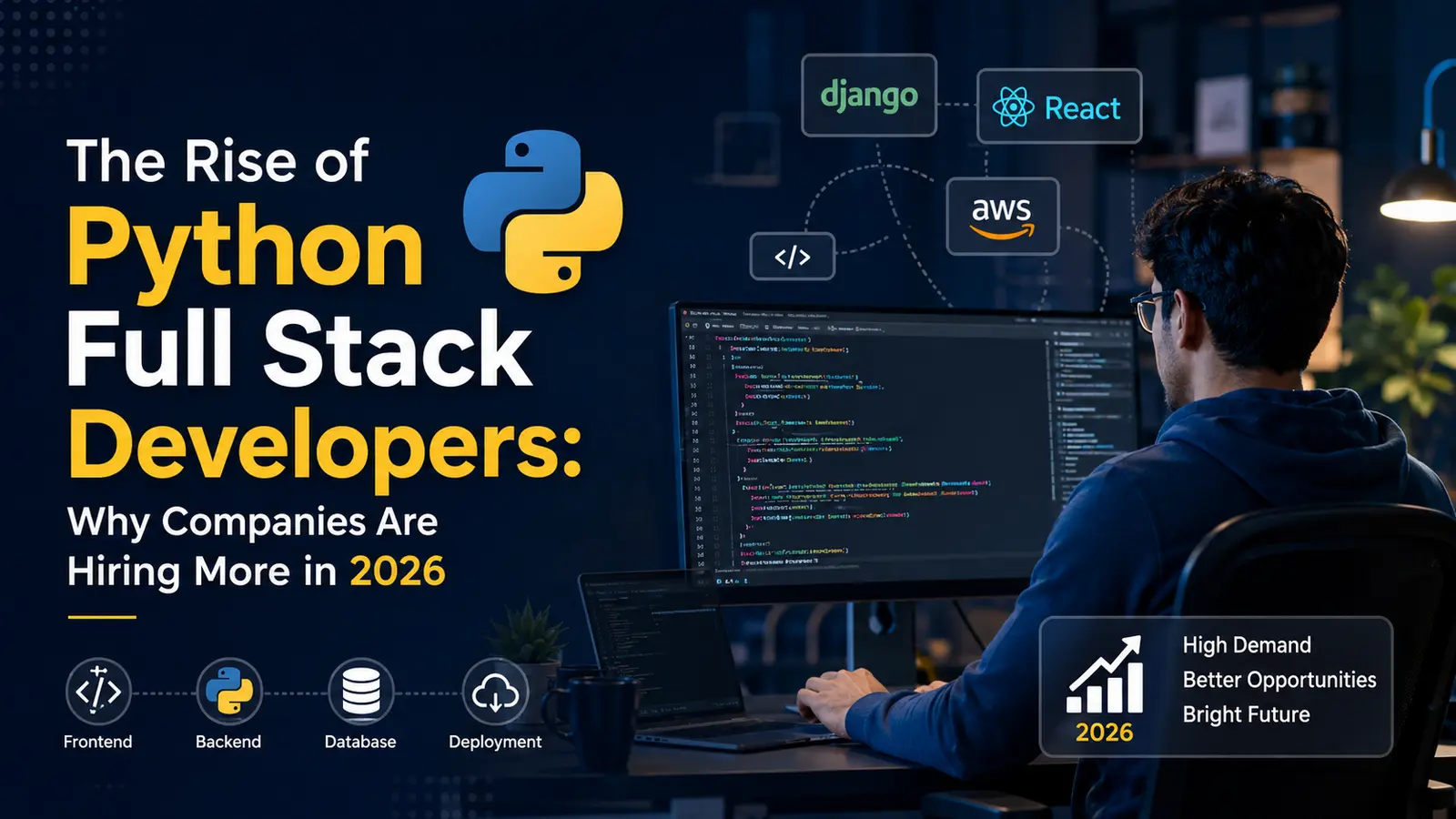
Web development hiring looks different this year. Walk through any tech job board and you’ll see the same line repeated across hundreds of listings: “Python Full Stack Developer wanted.” Not Java. Not .NET. Python.
That’s not a fluke. Companies building AI features, automating workflows, or shipping products fast have settled on Python full stack developers as their default hire. The role used to be a niche choice. Now it’s the obvious one.
This blog walks through why that happened, what skills the job actually demands in 2026, what you can expect to earn, and how to break into the field if you’re starting from zero.
What is a Python Full Stack Developer?
A Python Full Stack Developer builds both sides of a web application. The part users click on, and the part that runs behind the scenes. One person, one skill set, covering frontend, backend, database, and deployment.
On the frontend, that means HTML, CSS, JavaScript, and usually React for building interactive interfaces. On the backend, it’s Python, paired with a framework like Django, Flask, or FastAPI to handle logic, APIs, and server-side work. For data, they’re working with MySQL, PostgreSQL, or MongoDB depending on the project. And for getting code out the door, they’re using Git for version control, Docker for packaging, and basic cloud skills to deploy and scale.
A full stack developer doesn’t just write code in isolation. They take a feature from idea to working product. Design the database schema, build the API, wire up the interface, ship it, and fix it when something breaks at 2am.
This is why comprehensive Python Full Stack Training has become one of the most popular choices among aspiring software developers in 2026.
Why is Python Full Stack Development growing in 2026?
Python’s pitch has always been simple. Clean syntax, readable code, a huge ecosystem of libraries. That hasn’t changed. What’s changed is everything sitting next to it.
AI and machine learning run almost entirely on Python. TensorFlow, PyTorch, scikit-learn, the major LLM frameworks, all Python-first. So when a company wants to bolt an AI feature onto their product, they don’t want two separate teams and two separate languages. They want one developer who can build the web app and plug in the AI model without translation friction. That’s the real driver behind the demand for Python developers right now.
Add to that: Python lets small teams move fast. A startup with three engineers can spin up a working product in weeks using Django or FastAPI, instead of stitching together a heavier, more fragmented stack. And it’s not just startups. Enterprises automating internal tools, building data pipelines, or running data-driven applications lean on Python too, because the same language handles the web layer and the automation layer.
So you’ve got AI growth, automation growth, and startup speed all pulling in the same direction. Python full stack sits right in the middle of that.
Why are companies hiring more Python full stack developers?
Cost is the blunt answer. One Python full stack developer can do the job that used to take a separate frontend dev and backend dev. For a 10-person startup, that’s the difference between hiring 2 people and hiring 4. For a 500-person company, multiply that across a dozen product teams and the savings show up clearly on a budget sheet.
Speed is the second answer. When one person owns the frontend, backend, and database for a feature, there’s no handoff delay between teams, no waiting on the backend team to finish an API before the frontend team can start. Faster product launch cycles, fewer status meetings, less coordination overhead.
Third: AI integration. If a company wants to ship an AI-powered app, whether that’s a chatbot, a recommendation engine, or an automated reporting tool, Python full stack developers are the ones who can build the product layer and connect it to the model layer without a translation team in between.
And fourth, scalability. Modern Python frameworks like FastAPI are built for async, high-throughput APIs. Companies aren’t choosing Python because it’s trendy. They’re choosing it because it holds up under real production load while still being fast to develop in.
Top skills required for Python full stack developers in 2026
Technical skills
Strong Python fundamentals come first. Not just syntax, but data structures, OOP, and writing code that doesn’t fall apart under edge cases.
Framework depth matters next. Most job listings ask for Django, Flask, or FastAPI, and increasingly FastAPI specifically because of its speed and native support for building APIs that AI applications consume.
REST API design is non-negotiable. If you can’t build and consume APIs cleanly, you can’t connect frontend to backend, full stop.
React.js and core JavaScript round out the frontend half. You don’t need to be a frontend specialist, but you need to be comfortable building interfaces, managing state, and handling user interactions.
Database management, both relational (PostgreSQL, MySQL) and NoSQL (MongoDB), because real applications need to model and query data correctly.
Cloud basics: AWS, GCP, or Azure, at least enough to deploy an app and not panic when something needs scaling.
Git and GitHub for version control and collaboration. Testing and debugging skills, because shipping code that breaks in production costs companies real money and real trust.
Soft skills
Problem-solving sits at the core of the job description, but it’s rarely tested the way people expect. Clear communication matters just as much, especially when you’re the one person who understands how the frontend and backend fit together and need to explain that to a product manager who doesn’t code. Team collaboration rounds it out, since full stack work touches design, backend, and ops, and you’re the connective tissue between all three.
Python full stack developer vs other full stack developers
| Skill | Python Full Stack | Other Stacks |
| Backend | Python | Java / Node.js |
| AI Support | High | Depends on stack |
| Learning Curve | Beginner friendly | Varies |
| Career Scope | Growing fast | Growing |
Java stacks still dominate large enterprise systems, banks, insurance, legacy infrastructure. Node.js stacks show up heavily in real-time apps and JavaScript-first teams. Python full stack sits in a different lane: faster to learn, faster to build with, and the default choice when AI is part of the product.
Career opportunities for Python full stack developers
The job title itself, Python Full Stack Developer, is just the entry point. From there, the role branches in a few directions: Backend Developer if you lean toward server-side logic, Software Engineer in broader product teams, Web Developer for client-focused work, or AI Application Developer if you start combining full stack skills with machine learning work.
Industry-wise, the demand spreads wide. FinTech companies need secure, scalable backend systems. Healthcare platforms need compliant, data-heavy applications. E-commerce runs on fast, high-traffic web apps. SaaS companies need full product teams that can ship features weekly. EdTech platforms need scalable systems that handle thousands of concurrent users. Python full stack developers show up in all five.
Salary and future scope in 2026
For freshers in India, starting salaries typically fall between ₹3 LPA and ₹6 LPA, depending on project experience and the strength of your portfolio. Some entry-level offers from larger firms in tech hubs land a bit higher.
Mid-career professionals, roughly 3 to 6 years in, generally see ₹8 LPA to ₹15 LPA, especially if they’ve picked up cloud or AI-adjacent skills along the way. At the senior end, 7 to 10+ years of experience, Python Full Stack Developer salary figures often land between ₹15 LPA and ₹25 LPA, and higher in product companies or specialized AI roles.
Location still matters. Bangalore, Hyderabad, Pune, and Mumbai consistently post the highest packages, partly because that’s where the most IT companies and startups are concentrated.
Remote work has also opened doors that didn’t exist five years ago. Plenty of Python full stack developers in India now work for US or European companies without relocating, often at pay scales well above the local market.
The biggest lever on your future earning potential isn’t years of experience alone. It’s whether you’ve layered AI or data skills on top of your full stack base. That combination is what pushes salaries from “solid” to “well above average.”
How to become a Python full stack developer in 2026 (roadmap)
Start with Python basics. Syntax, data types, loops, functions, OOP. Don’t rush this step. Weak fundamentals show up later as bad habits.
Move to frontend technologies next. HTML and CSS first, then JavaScript, then React once you’re comfortable building static pages and adding interactivity.
Learn a backend framework. Django if you want batteries-included structure, Flask if you want lightweight control, FastAPI if you want speed and modern API design. Most learners pick one and go deep rather than spreading thin across all three.
Practice databases. Set up PostgreSQL or MongoDB locally, write real queries, model real relationships. Tutorials don’t teach you this the way building something does.
Build real projects. A to-do app doesn’t cut it anymore. Build something with user authentication, a real database, and a deployed live link. Three solid projects beat ten half-finished ones.
Learn deployment. Docker, basic CI/CD, and at least one cloud platform. Knowing how to actually ship code is what separates a job-ready developer from someone who can only code in a sandbox.
Apply for internships or junior roles. Don’t wait until you feel “ready.” Apply once you have a working portfolio and the fundamentals down. The rest gets learned on the job.
If you’re weighing a python full stack developer course against self-teaching, the honest answer is it depends on how disciplined you are alone. A structured course gives you a syllabus, deadlines, and project checkpoints. Self-teaching gives you flexibility but demands more self-direction. Either path works if you actually build things along the way instead of just watching tutorials.
Future of Python full stack development
AI integration isn’t slowing down. More companies are building products where the web layer and the AI layer live in the same codebase, and Python is the language that makes that practical.
Cloud-native development is becoming the default, not the exception. New grads entering the field in 2026 are expected to know basic deployment and scaling concepts from day one, not learn them three years into the job.
Automation keeps expanding too. Businesses are replacing manual workflows with Python-driven scripts and applications across finance, healthcare, and operations teams that have nothing to do with traditional “tech.”
Low-code and no-code tools have grown, but they haven’t replaced developers. They’ve replaced some of the repetitive setup work, which actually frees full stack developers to focus on the harder, more valuable parts of a product.
Put all of that together, and the demand for python developers with full stack skills isn’t a short-term spike. It’s tracking the direction the entire industry is moving.
Is python full stack in demand: the short answer
Yes. Job postings, salary growth, and the sheer number of companies pivoting their backend to Python all point the same way. If you’re asking whether to learn python full stack right now versus another stack, the case for Python is strongest when AI, automation, or fast iteration matter to the business you want to work for. And in 2026, that’s most businesses.
FAQs
1. Is Python Full Stack Development a good career in 2026?
Yes. Python Full Stack Development is a promising career choice in 2026. Demand is high across startups and enterprises, the skill set connects well with AI-based roles, and salary growth with experience is strong, especially when combined with cloud computing or machine learning skills.
2. What skills are required for Python Full Stack Developers?
Python Full Stack Developers need skills in Python programming, backend frameworks like Django, Flask, or FastAPI, REST APIs, JavaScript, React, database management (SQL and NoSQL), Git, basic cloud deployment, and strong problem-solving and communication skills.
3. Is Python Full Stack Development easy for beginners?
Yes, Python Full Stack Development is considered beginner-friendly compared to many other technologies. Python’s simple and readable syntax makes learning easier. However, becoming job-ready requires regular practice, coding experience, and building real-world projects.
4. How long does it take to become a Python Full Stack Developer?
With consistent learning and practice, it usually takes around 6 to 12 months to learn Python fundamentals, frontend development, backend frameworks, databases, APIs, and complete practical projects. The timeline may vary depending on your previous programming experience.
5. What is the salary of a Python Full Stack Developer?
In India, freshers typically start around ₹3 LPA to ₹6 LPA. Mid-level developers (3-6 years) often earn ₹8 LPA to ₹15 LPA. Senior developers with 7+ years can reach ₹15 LPA to ₹25 LPA or more, particularly with added AI or cloud expertise.
Conclusion
Python full stack development didn’t become popular by accident. It sits exactly where the industry is headed: AI-integrated products, faster development cycles, and leaner teams that need developers who can own a feature end to end.
If you’re deciding whether to learn python full stack development, the demand data, the salary trends, and the sheer number of companies hiring for this role all point in the same direction. The opportunity is real, and it’s not closing anytime soon. What matters now is building the actual skills and the projects to back them up.
Also read- Python Full Stack vs MERN Stack in 2026