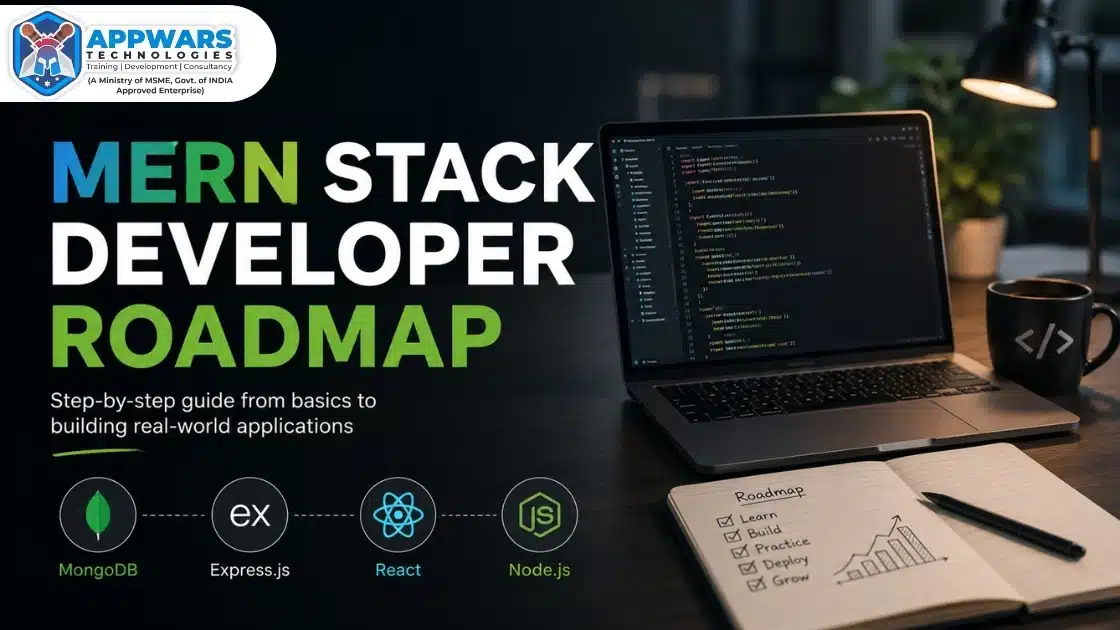
You want to build web applications. The tech industry moves aggressively. But the MERN stack remains the most reliable way to ship a product in 2026. This mern stack developer roadmap gives you a clear path from absolute beginner to hirable engineer.
I stripped this MERN Stack roadmap back to the absolute essentials. We overcomplicate learning. So this mern stack developer roadmap focuses purely on the tools that actually matter right now.
A proper mern stack roadmap demands focus. You will build the frontend, the backend, and the database. You control the entire application.
1. The prerequisites: HTML and CSS
You must start with the raw building blocks. Learn semantic HTML. Understand how to structure a webpage properly.
Then move to CSS. You need to understand Flexbox and CSS Grid. They dictate how elements sit on the screen.
Tailwind CSS dominates styling right now. Learn raw CSS first. Then use Tailwind to speed up your workflow.
2. Git and version control
Git is your safety net. You will break your code. Git lets you undo those mistakes instantly.
Learn the basic commands. Understand commit, push, pull, and merge. Learn how to resolve a merge conflict.
You need a GitHub profile. Employers will look at your commit history. Push your code every single day.
3. JavaScript: The foundation of the mern roadmap
MERN stands for MongoDB, Express, React, and Node. They all run on JavaScript. Your understanding of this language needs to be flawless.
Master ES6+ concepts. Arrow functions, destructuring, and spread operators are daily tools. You will use them constantly.
Asynchronous programming breaks most beginners. Spend a week just studying Promises and async/await. You must know how to fetch data from an API without freezing the browser.
Learn array methods deeply. You will use .map(), .filter(), and .reduce() in almost every React component you write.
4. React: Building the frontend
React rules the frontend ecosystem. This mern stack learning roadmap leans heavily into modern React concepts.
Focus entirely on functional components. You manage state using hooks. Learn useState and useEffect immediately. They handle 90% of your component logic.
React 19 changed how we handle forms and server communication. Learn the newest hooks like useActionState. They reduce the amount of boilerplate code you have to write.
State management gets messy fast in large applications. Learn the native Context API first. Then adopt Zustand or Redux Toolkit for complex global state.
If you feel completely lost, a structured React JS Course often speeds up the learning curve. Sometimes you just need an instructor to explain component lifecycles clearly.
5. Node.js: The backend runtime
Node lets you run JavaScript on the server. This represents the “N” in your MERN full-stack developer roadmap.
Understand the Node event loop. It sounds like academic theory. It actually dictates how your server handles thousands of concurrent users.
Learn the built-in modules. The fs module handles the file system. The http module handles network requests.
I spent weeks wrapping my head around Node streams when I first started. It takes time. A solid Node Js course can save you hours of reading confusing forum threads.
Get Free Demo Class ➔6. Express.js: Routing the server
Node is powerful but clunky. Express makes it manageable. It handles your server routes and logic cleanly.
You will build RESTful APIs. You must understand GET, POST, PUT, and DELETE requests. Learn how to extract data from request bodies and URL parameters.
Middleware sits at the core of Express. It intercepts requests before they hit your main logic. You will use middleware for authentication and error handling.
Security matters at this stage. Learn how to implement rate limiting. Use helmet.js to secure your HTTP headers.
7. MongoDB: Storing the data
MongoDB stores data as JSON-like documents. It pairs perfectly with a JavaScript backend.
Learn basic CRUD operations. You need to create, read, update, and delete documents efficiently.
Understand indexing. A missing index will crash your database when your user base grows.
You will use Mongoose. It acts as an object data modeling library. It bolts a rigid schema onto MongoDB to keep your data perfectly organized.
In 2026, a mern stack developer roadmap has to cover vector search. AI features rely heavily on it. MongoDB handles vector embeddings natively now.
8. TypeScript: The mandatory upgrade
JavaScript allows you to do whatever you want. That flexibility causes severe bugs. TypeScript fixes this by adding strict static typing.
Every modern mern roadmap includes TypeScript. Companies flat out expect you to know it.
Learn how to define interfaces and types. Learn how to type your React props securely. Learn how to type your express request bodies.
It feels incredibly slow at first. Then the compiler catches a typo that would have taken down your production server. You will never go back.
9. Connecting the pieces
This is where the mern stack developer roadmap gets difficult. Connecting a React frontend to a Node backend causes headaches.
Learn about CORS. Cross-Origin Resource Sharing will block your API requests initially. Learn how to configure your Express server to accept requests from your React app.
Authentication is mandatory. Learn how to implement JSON Web Tokens. Store those tokens securely in HTTP-only cookies to prevent cross-site scripting attacks.
Manage your server state cleanly. Use React Query on the frontend. It caches your database requests and keeps your UI feeling instant.
10. Next.js: The industry standard
React is just a library. Next.js is a complete framework built on top of React.
A true roadmap for MERN stack developer in 2026 must include Next.js. The industry largely shifted toward this framework for production apps.
Learn the App Router. It dictates how pages connect.
Understand Server Components. They let you fetch database records directly on the server without shipping bulky JavaScript to the user’s browser.
Next.js blurs the line between frontend and backend. You can write your API routes directly inside the Next.js project folder.
11. Testing your code
Broken code costs companies money. You need to write automated tests.
Learn Jest for your backend logic. Test your Express endpoints to ensure they return the correct JSON data.
Use React Testing Library for the frontend. Test how a user actually interacts with your buttons and forms.
Set up ESLint and Prettier. They format your code automatically. They keep your entire codebase readable and consistent.
12. Deployment and DevOps basics
Your application needs to live on the internet. Localhost means nothing to an employer.
Learn Docker. Containerize your Node backend and your MongoDB instance. This ensures your app runs exactly the same way on any machine.
Deploy your frontend to Vercel or Netlify. They integrate directly with your GitHub repository.
Deploy your backend to Render, Railway, or AWS. Learn how to manage environment variables securely in a production environment.
Set up a basic CI/CD pipeline using GitHub Actions. Automate your testing process so you cannot merge broken code.
13. Building the portfolio
Tutorials only get you so far. A MERN stack developer roadmap requires you to build real, difficult projects.
Build a complete e-commerce store. Handle user authentication, shopping carts, and Stripe payments.
Build a task management application. Add real-time notifications using WebSockets or Socket.io.
A complete MERN stack course usually walks you through a large capstone project. But you must build things without a guide to actually solidify the knowledge.
Write excellent README files for your repositories. Include screenshots and architecture diagrams. Employers skim GitHub profiles quickly. Make yours look incredibly professional.
14. Advanced database concepts
Eventually, basic CRUD operations are not enough. You need to pull complex data sets.
Learn MongoDB aggregation pipelines. You will use operators like $match, $group, and $lookup to join data from different collections.
Understand database transactions. If a user transfers money, the deduction and the deposit must happen together. If one fails, the whole process rolls back.
15. Performance optimization
Fast apps retain users. Slow apps die.
Optimize your React rendering. Learn how to use useMemo and useCallback to prevent components from re-rendering unnecessarily.
Optimize your backend queries. Add caching using Redis. If 1,000 users request the same blog post, your server should not query MongoDB 1,000 times.
Monitor your application. Use tools like Sentry to track frontend errors. Use Datadog to monitor your backend memory usage.
The reality of the job market
Getting hired requires more than just knowing the syntax. You have to prove you can solve business problems.
Contribute to open-source MERN stack projects. It shows you can read and modify code written by other people.
Prepare for technical interviews. Practice LeetCode problems using JavaScript. You will face data structure and algorithm questions.
Understand system design basics. Interviewers will ask how you would scale your MERN app to handle one million users.
Staying updated
The mern stack developer roadmap evolves every single year. You have to adapt.
Read the official documentation for React and Node regularly. They introduce new features constantly.
Follow engineering blogs. See how large companies solve scaling issues with MongoDB and Node.
This mern stack developer roadmap gives you the exact sequence to follow. Put in the hours. Write code every day. Build projects that actually challenge you.