
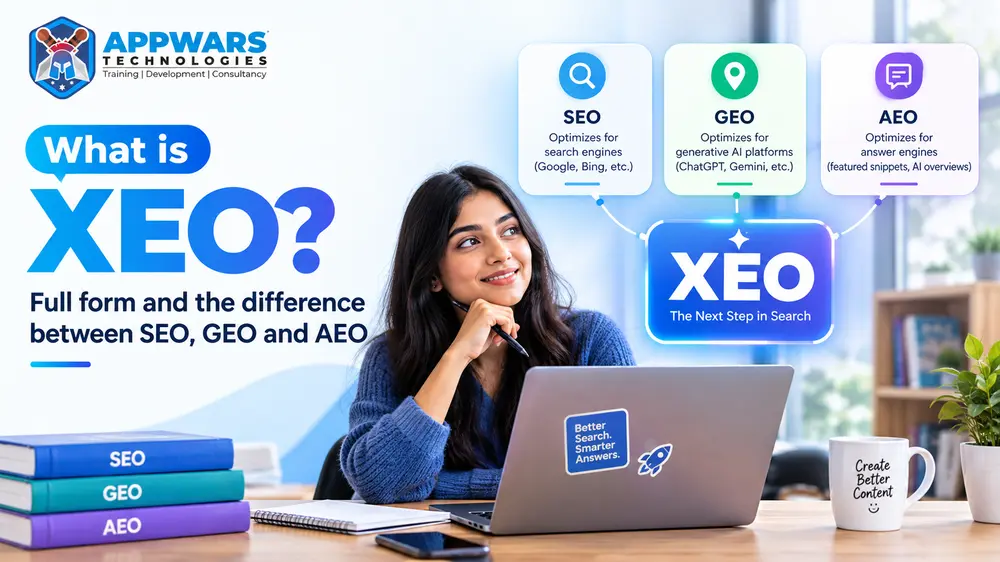
XEO most commonly stands for Experience Optimization. It is the practice of making your content easy to find and good to use across Google, AI answer tools, and social platforms, so a visit ends in trust and action.
There’s one catch. XEO has no official full form. Some writers expand it as Experience and Engine Optimization, others as Cross-Engine Optimization, and a few as X Engine Optimization.
I teach SEO and digital marketing to students and working professionals at Appwars Technologies in Noida. Since AI search arrived, “What is XEO?” has become a regular question in my classes. This guide gives you the plain answer, a clear comparison of XEO with SEO, GEO and AEO, and a checklist you can use this week.
Quick summary
- XEO full form: Experience Optimization (most common). Three other expansions are also in use.
- SEO earns rankings. AEO earns the direct answer. GEO earns citations in AI-generated answers. XEO covers the experience a person has once they find you.
- Google says AEO and GEO are still SEO. So treat XEO as a way of working, and skip the hunt for a new algorithm.
- Start with pages that are indexed and useful. Then add proof, speed and a consistent brand across platforms.
What is XEO?
In most of the writing I’ve seen, XEO means Experience Optimization. We used that meaning in our earlier post on how to use AEO, GEO and XEO to boost SEO. XEO looks at what happens after someone lands on your page, or after your brand shows up in an AI answer. Does the page load fast on a phone? Is the answer clear? Do you look trustworthy? Can the visitor take the next step?
A first-page ranking means little if the visit goes badly. SEO, AEO, and GEO get you seen. XEO decides whether being seen turns into a sign-up, a purchase, or a course inquiry.
Think of XEO as a layer on top of search work. You still need pages that search engines can crawl and index. XEO asks what the person feels and does after that.
Full form of XEO: why there are 4 answers
XEO is a young term and nobody owns it. No standards body defines it, and as far as I can tell, Google hasn’t defined it either. Agencies coined their own expansions, which is why you meet several.
| Expansion | What it focuses on | Where you’ll see it |
|---|---|---|
| Experience Optimization | Page experience, readability, mobile use, engagement, and conversions across the whole customer journey | Digital marketing blogs, including ours |
| Experience and Engine Optimization | One umbrella strategy that groups SEO, AEO, GEO and SXO (search experience optimization) | Agency framework pages |
| Cross-Engine Optimization | Being findable on Google, AI tools, Maps, YouTube, and Instagram, with social proof doing much of the work | Local marketing agencies |
| X Engine Optimization | Visibility in conversations on X and inside Grok | Social and AI search blogs |
For this blog, and for my classroom, I use Experience Optimization as the working meaning and treat Cross-Engine as a description of where you apply it. In an exam or interview, give the common expansion first and mention the others. It shows you know the term is still settling.
Why XEO came up
People no longer start every search in one place. They search Google, ask ChatGPT or Perplexity, watch a YouTube walkthrough, and read Instagram comments before they trust a brand. Google’s AI Overviews and AI Mode now sit on top of the classic results too.
Take a student choosing a course. They might ask an AI tool for 5 options, search Google for reviews, watch a demo class on YouTube, and then call the institute. Each step is a different engine with its own way of judging you. XEO looks at that whole path instead of one search box.
SEO, GEO, AEO and XEO at a glance
| Term | Full form | Where it works | Main goal | What you work on |
|---|---|---|---|---|
| SEO | Search Engine Optimization | Google and Bing results pages | Rank pages and earn organic traffic. | Keywords, content quality, technical health, backlinks |
| AEO | Answer Engine Optimization | Featured snippets, People Also Ask, voice assistants, AI chat | Become the direct answer. | Question headings, short answers, structured data |
| GEO | Generative Engine Optimization | AI Overviews, ChatGPT, Perplexity, Gemini | Get cited or summarized in generated answers. | Original insight, clear facts, authority signals, brand mentions |
| XEO | Experience Optimization (most common) | Every step from search result to sign-up | Turn visibility into trust and action. | Page speed, readability, mobile layout, proof, consistent branding |
A few sites expand GEO as generative experience optimization or tie it to local maps. Most sources, and the original research paper, use generative engine optimization, so that’s what I use here.
SEO vs XEO
SEO is the base. If search engines can’t crawl, index, and understand your page, nothing else matters. The experience layer sits on top of that base.
- SEO asks, “Can a search engine find and rank this page?” XEO asks, “Did the visitor get what they came for?”
- SEO tracks impressions, rankings, and organic clicks. XEO tracks engagement, conversion rate, and repeat visits.
- SEO work happens in keywords, content, links, and technical setup. XEO work happens in page speed, layout, proof, and the follow-up journey.
I see this pattern often in landing page audits: a page ranks well, but it loads slowly on mobile, and the enquiry form sits far below the fold. SEO did its job. The experience didn’t.
GEO vs XEO
GEO is about being used inside answers that AI tools write by pulling from several sources. The term comes from a 2023 research paper. It reported that tested tactics could raise a source’s visibility in generative answers by up to 40% on the authors’ benchmark, with results that varied by topic.
GEO asks, “Will an AI tool quote or cite us?” XEO asks, “When a person clicks that citation, does our page deliver?” You need both. A citation that lands on a slow, vague page wastes the best chance you’ll get.
AEO vs XEO
AEO targets surfaces that give one direct answer: featured snippets, People Also Ask boxes, voice assistants, and AI chat. Practitioners started using the term around 2019 to 2020, when snippets and voice search were growing.
AEO means writing a clear, short answer directly under a question heading. Many practitioners aim for 40 to 60 words. XEO takes over where the snippet ends. Many answers get read without a click, so your brand has to land inside the answer itself: a clear name, an honest claim, and, for those who do click, a page that continues smoothly.
What Google says about AEO, GEO and XEO
In May 2026, Google published a guide for site owners on its generative AI features in Search, including AI Overviews and AI Mode. Search Engine Journal summarized it, and the main points are these:
- Google treats AEO and GEO as part of SEO and sees no separate field.
- You don’t need llms.txt files, special AI markup, special schema, content chunking, or pages rewritten just for AI.
- Google asks for non-commodity content: pages with original insight beyond what everyone already says.
- Pages still need to be indexed and eligible for snippets, with good page experience and little duplicate content.
Two things follow. XEO is a working method that sits on top of normal SEO, and Google hasn’t defined it as a ranking system. And the guide covers Google’s own features only. Other AI tools may weigh signals differently, so a monthly check of ChatGPT and Perplexity answers is still worth the time.
Forrester analyst Nikhil Lai argued in 2025 that AEO and its cousins extend SEO and share its foundations, and that some vendors exaggerate the gap to sell new tools (see the Wikipedia summary). I agree with that. My advice to students is to skip any pitch that sells XEO as a separate secret toolkit.
How to practise XEO: 7 steps
- Fix the SEO base. Check in Google Search Console that your key pages are indexed, free of duplicates, and eligible for snippets. Work on a page nobody can find is wasted.
- Answer first. Put a direct 2 to 3 line answer under each question heading, then add depth. People and AI tools both pull from clear openings.
- Add what only you know. Use real examples, screenshots, numbers from your own work, and first-hand opinions. This is the non-commodity content Google asks for.
- Make pages fast and easy on mobile. Compress images, trim heavy scripts, and test with PageSpeed Insights. Short paragraphs and clear headings help readers on small screens.
- Put proof next to the call to action. Reviews, trainer bios, placement records, or case studies belong near the enquiry button, where the decision happens.
- Keep your brand consistent everywhere. Use the same name, description, and contact details on your website, Google Business Profile, YouTube, LinkedIn, and Instagram.
- Track the whole journey. Read Search Console and GA4 together, and add a “How did you find us?” field to forms, with an option for AI tools.
What to measure
| Layer | What to track | Where to track it |
|---|---|---|
| SEO | Impressions, average position, organic clicks | Google Search Console |
| AEO | Featured snippet wins, People Also Ask appearances | Search Console and a rank tracker |
| GEO | Brand mentions and citations in AI answers, referral visits from AI tools | Manual prompt checks, GA4 referral reports |
| XEO | Page speed, engagement rate, form completions, inquiry source | PageSpeed Insights, GA4, Microsoft Clarity |
For the GEO row, run the same 10 to 15 prompts in ChatGPT, Perplexity, and Google AI Mode once a month and note whether your brand appears. It’s rough, but it shows direction.
XEO and E-E-A-T
E-E-A-T stands for Experience, Expertise, Authoritativeness, and Trustworthiness. Google describes it as a framework its quality raters use and says trust matters most. XEO gives each part a visible job on the page.
| E-E-A-T part | What it means | How to show it |
|---|---|---|
| Experience | First-hand use of the topic | Real project screenshots, class examples, results from your own tests |
| Expertise | Depth and accuracy | Author bio with credentials, claims backed by primary sources |
| Authoritativeness | Recognition from others | Mentions and links from reputable sites, a consistent brand on every platform |
| Trustworthiness | Honest, accurate and safe | Updated dates, clear contact details, correct facts, genuine reviews only |
Common XEO mistakes
- Renaming old work. Calling routine SEO tasks “XEO” adds a label and no results.
- Writing stiffly for AI. Google says you don’t need to rewrite content for AI systems. Write clearly for people.
- Ignoring mobile speed. Most of your visitors are on phones, and a slow page loses them before the answer appears.
- Buying reviews or planted mentions. Google says inauthentic mentions help less than they seem, and spam systems exist to catch them.
- Measuring only rankings. A page can rank well and still bring no enquiries.
- Publishing commodity content. A list of the same 7 tips every other site shares gives AI tools no reason to cite you.
Who should learn XEO
Students in BCA, B.Tech, BBA and MBA programmes can use it to stand out in marketing interviews. Working professionals moving into SEO executive, content strategist, digital marketing executive or growth marketer roles can use it to show they understand AI search as well as classic rankings.
If you want structured, hands-on practice, our SEO course in Noida covers the search foundation XEO sits on. For the wider set of channels, see the digital marketing course in Noida. To understand how AI answers are produced, the generative AI course in Noida is a good companion. And if you’re mapping a career path, read our Best Performance Marketing Roadmap 2026.
FAQs about XEO
What is the full form of XEO?
XEO most commonly stands for Experience Optimization. You’ll also see Experience and Engine Optimization, Cross-Engine Optimization and X Engine Optimization. No official body fixes one meaning, so check how each writer defines it.
Is XEO an official Google term?
No. As far as I can tell, Google hasn’t defined XEO. Its May 2026 guide talks about AEO and GEO and treats both as part of SEO.
What is the difference between SEO and XEO?
SEO works on being found and ranked in search results. XEO works on what the visitor experiences after finding you, across search, AI answers and social platforms.
Is XEO the same as GEO or AEO?
No. AEO targets direct answers. GEO targets citations in AI-generated answers. XEO looks at the experience after discovery. They overlap, and some agencies use XEO as an umbrella term for all of them.
Do I need XEO if I already do SEO?
Most of it is already part of good SEO. What XEO adds is a habit of checking AI answers and social platforms, and judging success by visitor actions as well as rankings.
Can beginners learn XEO?
Yes. Start with SEO basics: keyword research, on-page SEO and Search Console. Then learn to write clear answers and read GA4. It builds on those basics.
Conclusion
XEO is a useful label for a real habit: checking what happens after people find you. The name will keep shifting, and Google already treats AEO and GEO as SEO. The work stays the same: useful pages, honest proof, fast loading and a brand that looks the same wherever someone meets it.
Pick one page this week. Check that it’s indexed, fix its mobile speed, move the proof next to the button, and watch Search Console and GA4 for the next month.
Want to learn this hands-on? Explore the Digital Marketing Course in Noida at Appwars Technologies.