Cloud computing isn’t a side skill anymore. It’s the backbone of how companies build, ship, and scale software. And AWS sits at the center of that shift, running everything from Netflix streams to hospital records to your bank’s mobile app. If you’ve been wondering whether the benefits of AWS training are worth your time and money in 2026, the short answer is yes. The longer answer is what this blog is for.
Companies aren’t just dabbling in cloud anymore, they’re rebuilding entire IT departments around it. That means AWS skills are among the most requested lines on job postings right now, right up there with Python and cybersecurity. Recruiters aren’t asking “do you know cloud.” They’re asking “do you know AWS.” Getting AWS training for career growth is one of the more practical moves a tech professional can make this year, whether you’re starting from zero or pivoting from a legacy IT role.
What Is AWS?
Amazon Web Services is Amazon’s cloud computing platform. It rents out computing power, storage, databases, and dozens of other IT resources over the internet, so companies don’t have to buy and maintain their own servers. Instead of spending months setting up physical data centers, a business can spin up infrastructure on AWS in minutes.
AWS became the world’s leading cloud platform because it got there first and never really slowed down. It launched in 2006, years before Microsoft Azure or Google Cloud had anything comparable, and that head start turned into a massive ecosystem of services, documentation, and third-party integrations that’s hard for competitors to match.
The services that most beginners learn first include EC2 for virtual servers, S3 for object storage, RDS for managed databases, Lambda for serverless computing, VPC for networking, IAM for access control, and CloudFormation for automating infrastructure setup. Master these and you can already hold your own in most entry-level cloud roles.
Industries using AWS span pretty much everything: banking, healthcare, retail, media, gaming, government, manufacturing. If a company runs software, there’s a good chance AWS touches some part of it.
Why Is AWS in High Demand?
Digital transformation isn’t a buzzword companies throw around anymore, it’s a budget line item. Businesses are moving legacy systems to the cloud because on-premise infrastructure is expensive, slow to scale, and a headache to maintain. AWS makes that migration path smoother than most alternatives.
Remote infrastructure needs exploded after 2020 and never really came back down. Teams working from different cities, sometimes different continents, need systems that don’t depend on a physical office network. Cloud platforms solved that problem, and AWS was already positioned to handle it at scale.
Startups love AWS because it removes the upfront capital cost of building infrastructure. Pay for what you use, scale up when you grow, scale down when you don’t. Enterprises like it for the opposite reason: reliability at massive scale, with security and compliance features built in.
AI and machine learning workloads are now a huge part of AWS’s growth story. Services like SageMaker let companies train and deploy models without owning GPU farms. Government agencies and healthcare providers are adopting AWS too, drawn by its compliance certifications and dedicated GovCloud regions. Put all of that together and you get a job market that’s hungry for people who actually know how to work inside AWS, not just talk about it.
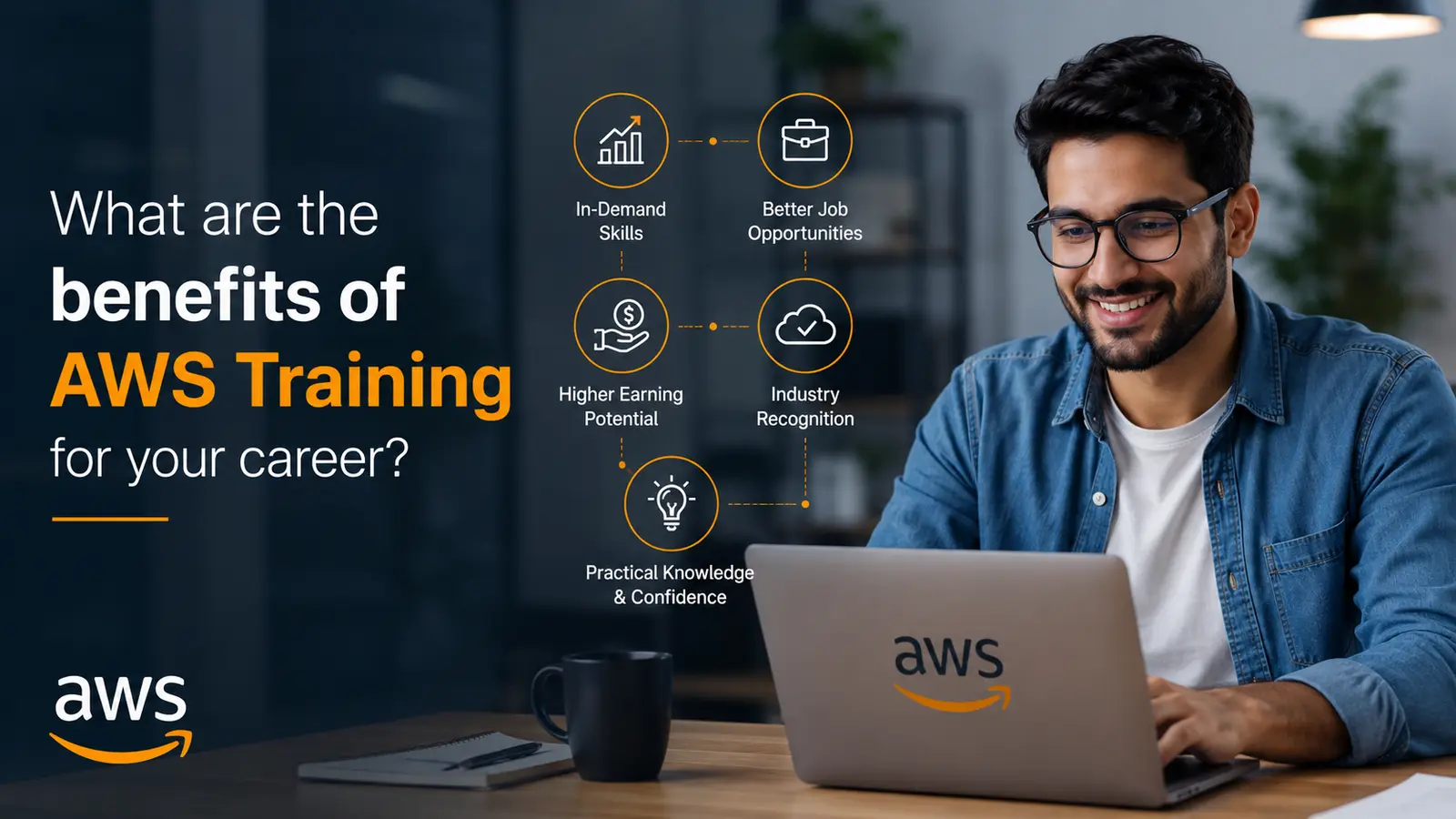
Top Benefits of AWS Training for Your Career
Learn In-Demand Cloud Skills
This is the most obvious one. AWS training for career development gives you hands-on exposure to the exact tools companies are hiring for right now. You’re not learning theory, you’re learning EC2 instances, S3 buckets, and IAM policies the same way professionals use them on the job.
High-Paying Career Opportunities
Cloud roles consistently rank among the higher-paying positions in IT. AWS certification benefits show up directly in salary negotiations, because certified professionals can prove their skills instead of just claiming them on a resume.
Globally Recognized Certification
An AWS certification carries weight whether you’re applying for a job in Delhi, Dubai, or Denver. That’s one of the underrated aws certification benefits: it travels with you, and hiring managers everywhere recognize the badge.
Better Job Security
Companies aren’t walking back their cloud investments. Once infrastructure moves to AWS, it tends to stay there, which means the people who manage it stay employed. That’s a form of job security that’s harder to find in faster-moving tech niches.
Career Growth and Promotions
I’ve seen IT professionals go from support roles to cloud engineering positions within a year of getting certified. AWS training for career advancement isn’t just about landing a new job, it’s about moving up in your current one too.
Hands-On Practical Experience
Good AWS training programs put you inside real labs, building and breaking things in a sandbox environment. That practical exposure matters more than memorizing service names, because interviews and real jobs both test what you can actually do.
Opportunities to Work with Global Companies
AWS skills are portable across industries and borders. A cloud engineer trained on AWS can work for a fintech startup in Bangalore or a logistics company in London without needing to relearn the platform from scratch.
Freelancing and Remote Work Opportunities
Cloud consulting and freelance DevOps work have grown alongside AWS adoption. Once you’re certified and experienced, remote contracts and freelance projects become genuinely accessible, not just a nice idea.
Strong Foundation for DevOps and Cloud Engineering
AWS course benefits extend well beyond the certification itself. The skills you build, automation, infrastructure as code, monitoring, form the foundation for deeper DevOps and cloud engineering careers later on.
Easy Career Transition into Cloud Computing
For professionals stuck in outdated tech stacks, AWS training offers a realistic bridge into cloud computing career paths. You don’t need to start from zero, you need structured training and consistent practice.
AWS Career Opportunities
An AWS Cloud Engineer builds and maintains cloud infrastructure, working daily with EC2, networking, and storage services. A Cloud Architect designs the overall system, deciding how services connect and scale, and usually needs a mix of technical depth and big-picture thinking.
DevOps Engineers bridge development and operations, automating deployments and managing CI/CD pipelines on AWS. Cloud Administrators handle the day-to-day upkeep of cloud environments, from user access to system monitoring.
Solutions Architects work closely with clients or internal teams to design AWS-based solutions that fit specific business needs. Site Reliability Engineers focus on uptime and performance, often stepping in when systems break under load.
Cloud Consultants advise organizations on migration strategy and cost optimization. Cloud Security Engineers specialize in locking down AWS environments against threats, a role that’s grown fast as compliance requirements tighten. Cloud Support Engineers troubleshoot issues for AWS customers directly, often as a starting point before moving into more specialized roles.
Industries Hiring AWS Professionals
IT services firms hire AWS talent constantly, both for internal infrastructure and client projects. Banking and finance companies use AWS for everything from core banking systems to fraud detection models, and they pay well for people who understand both cloud and compliance.
Healthcare providers run patient data and telemedicine platforms on AWS, leaning on its HIPAA-eligible services. E-commerce companies depend on AWS to handle traffic spikes during sales events without crashing. Education platforms, especially the ones that scaled fast during remote learning, run their entire backend on AWS.
Telecommunications companies use AWS for network management and 5G infrastructure. Government bodies use AWS GovCloud for secure, compliant workloads. Manufacturing firms are adopting AWS for IoT and supply chain tracking. Media and entertainment companies stream content through AWS. And startups, across every sector, default to AWS because it lets them build without massive upfront infrastructure spend.
Skills You Learn During AWS Training
A solid AWS training for beginners program starts with cloud computing fundamentals: what the cloud actually is, how pricing works, and why businesses choose it over on-premise setups. From there, you move into EC2 for compute, S3 for storage, and IAM for managing who can access what.
You’ll cover VPC to understand cloud networking, RDS for managed databases, and Elastic Load Balancer along with Auto Scaling to keep applications running smoothly under variable traffic. Cloud security becomes a recurring theme throughout, not a separate module tacked on at the end.
Monitoring with CloudWatch teaches you to track performance and catch problems before they become outages. Basic networking and Linux skills round out the technical foundation, since most AWS environments run on Linux servers. Storage management and backup and disaster recovery planning close out the core curriculum, preparing you for the operational side of real jobs.
AWS Certifications You Can Pursue
The AWS Certified Cloud Practitioner is the entry point, built for beginners who want to understand AWS basics and cloud concepts before going deeper. It’s a solid first step if you’re new to IT or coming from a non-technical background.
The AWS Certified Solutions Architect – Associate is probably the most popular AWS certification course out there, suited for people who want to design cloud infrastructure and move into architect-level roles. The AWS Certified Developer – Associate fits software developers building applications that run on AWS.
The AWS Certified SysOps Administrator – Associate is aimed at professionals managing and operating AWS environments day to day. And the AWS Certified DevOps Engineer – Professional is the advanced option, best suited for experienced engineers already comfortable with automation and CI/CD pipelines.
Who Should Learn AWS?
Students preparing to enter the job market benefit from AWS training because it gives them a credential that employers actually recognize before they’ve built years of experience. Freshers in IT can use AWS certification as a differentiator when competing against candidates with similar degrees but no specialized skills.
Developers and testers who want to understand the infrastructure behind their applications gain a real edge. Network engineers and Linux administrators often find AWS training a natural extension of skills they already have. DevOps engineers and database administrators use AWS training to formalize knowledge they’ve been picking up on the job.
IT professionals looking to stay relevant, and career switchers coming from unrelated fields, both find AWS training to be one of the more accessible entry points into tech. You don’t need a computer science degree. You need curiosity and consistent practice.
How to Choose the Right AWS Training Institute
Look for experienced trainers who’ve actually worked in cloud roles, not just people reading slides. An updated curriculum matters too, since AWS releases new services and features constantly, and outdated training material wastes your time.
Hands-on labs separate good AWS training institutes from mediocre ones. You want to be building things, not just watching demos. Live projects push that further, giving you scenarios closer to what you’ll face on the job.
Certification preparation should be built into the course structure, not an afterthought. Placement assistance and flexible learning options, whether online or classroom-based, make a real difference depending on your schedule and location. Check student reviews before committing, and compare fees across a few institutes rather than assuming the priciest option is automatically the best.
Why Choose Appwars Technologies for AWS Training
Appwars Technologies runs its AWS training with instructors who’ve actually worked in cloud environments, not just certified trainers reading from a manual. The labs are practical, built around real AWS console work rather than slides, so you leave knowing how to configure services, not just define them.
The training includes live, real-world projects that mirror what cloud engineers handle on the job, along with resume building support and interview preparation to help you actually land the role once you’re certified. Certification guidance is built into the course structure, and placement assistance continues after training ends, not just during it.
Classes run both online and in-person, so you can pick whichever format fits your schedule. And the beginner-friendly approach means you don’t need prior cloud experience to start, just a willingness to put in the hours.
FAQs
1. Is AWS training worth it in 2026?
Yes. Cloud adoption keeps growing, and AWS remains the dominant platform. Companies are still hiring for cloud roles faster than they can fill them.
2. Can beginners learn AWS?
Absolutely. AWS training for beginners is designed for people with zero cloud background. Basic computer literacy is enough to get started.
3. Do I need coding knowledge before learning AWS?
No. Roles like Cloud Administrator or Cloud Support Engineer don’t require coding. Developer-focused paths benefit from programming knowledge, but it’s not mandatory to begin.
4. Which AWS certification should I start with?
The AWS Certified Cloud Practitioner is the standard starting point. It builds foundational knowledge before you move into Associate-level certifications.
5. How long does it take to learn AWS?
Basic proficiency takes about 2 to 3 months of consistent study. Certification-ready preparation usually takes 3 to 6 months, depending on your pace and prior IT background.
6. Is AWS difficult?
It has a learning curve, like any technical skill, but it’s manageable with structured training and regular hands-on practice. Most people find it easier than expected once they start building instead of just reading.
7. What is the salary after AWS certification?
Salaries vary by role, location, and experience, but certified AWS professionals generally earn more than their non-certified peers in equivalent positions. Entry-level cloud roles and senior architect positions both see a noticeable salary bump tied to certification.
8. Can non-IT students learn AWS?
Yes. Plenty of successful cloud professionals started outside traditional IT degrees. AWS training programs are built to onboard people from varied academic backgrounds.
9. Which industries hire AWS professionals?
Banking, healthcare, e-commerce, telecommunications, government, education, and manufacturing all actively hire AWS talent, alongside the broader IT services sector.
Conclusion
AWS isn’t going anywhere, and neither is the demand for people who know how to work inside it. The benefits of AWS training show up in salary, job security, career mobility, and the sheer range of roles open to certified professionals. Amazon Web Services training gives you skills that translate across industries and borders, which is rare in tech right now.
Getting certified is only half the equation though. Real experience, through labs, projects, and consistent practice, is what turns a certificate into a career. If you’re serious about breaking into cloud computing, start now, pick a training institute that actually teaches hands-on skills, and build toward your first AWS certification. The demand is there. The opportunity is there. What’s left is putting in the work.