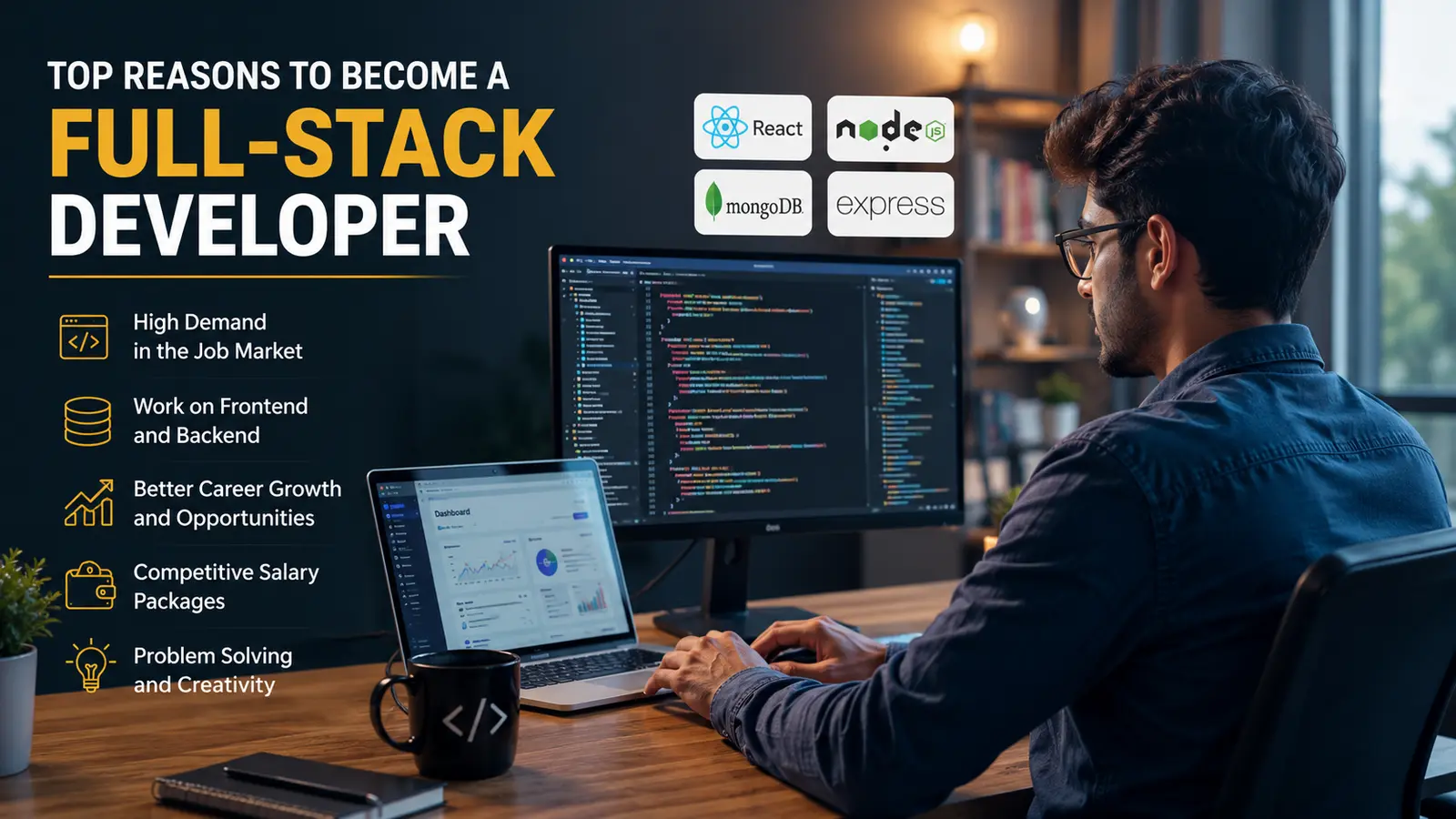
A full stack developer builds the whole product, not just one piece of it. Frontend, backend, database, deployment: all of it. That’s the job. And it’s why companies keep hiring for this role instead of stitching together three separate specialists for every small project.
Think about it from a hiring manager’s side. A 15-person startup doesn’t have a budget for a frontend team, a backend team, and a database admin sitting in separate corners. They need one person (or a small squad) who can ship a working feature end to end. That’s exactly what full stack development gives them.
This blog walks through what the role actually involves, the skills you need to get there, where the career can take you, the salary reality, and a practical path to becoming one. No fluff. Just what you need to know before you commit the next 6 to 12 months of your life to this.
What is a full stack developer?
A full stack developer works across three layers of a web application: the frontend (what users see and click), the backend (the logic and server that runs behind the scenes), and the database (where all the data lives).
On the frontend, you’re dealing with HTML for structure, CSS for styling, and JavaScript for interactivity. Most teams today build frontend interfaces with React, because it makes managing complex UI state a lot less painful than plain JavaScript.
On the backend, Node.js runs your server-side JavaScript, and Express.js sits on top of it to handle routing, requests, and middleware without you writing repetitive boilerplate for every endpoint.
Then there’s the database. MongoDB stores data as flexible documents, which works well for apps where the data structure changes often. MySQL, on the other hand, is a relational database, better suited for apps with strict, structured data relationships, like inventory systems or financial records.
A full stack developer doesn’t need to be a world-class expert in all of these at once. But you do need to understand how they connect. The button a user clicks, the API call it triggers, the server logic that processes it, and the database write that saves it: that’s one continuous chain, and you own the whole thing.
Skills you need to become a full stack developer
HTML and CSS come first. They’re not optional warm-up exercises, they’re the actual skeleton and skin of every website you’ll ever build. Get comfortable with flexbox and grid before you touch a framework.
JavaScript is where most beginners either lock in or drop off. Loops, functions, array methods, asynchronous code with promises and async/await: this is the language doing the heavy lifting across your entire stack, frontend and backend both.
React.js turns JavaScript into reusable components. Once you understand props, state, and hooks like useState and useEffect, building interactive interfaces stops feeling like guesswork.
Node.js lets you run JavaScript outside the browser, which means you can write your server in the same language as your frontend. That’s a big reason the MERN stack (MongoDB, Express, React, Node) took off the way it did.
Express.js handles your routes, middleware, and API structure. Without it, you’d be writing raw HTTP handling logic for every single endpoint, which nobody wants to do in 2026.
MongoDB stores your application’s data in JSON-like documents. Learning basic queries, schema design with Mongoose, and indexing will take you further than most tutorials bother to cover.
Git and GitHub aren’t optional. Every team, every job, every open source contribution runs through version control. If you can’t branch, commit, and open a pull request cleanly, that’s a red flag in any interview.
REST APIs are how your frontend talks to your backend. GET, POST, PUT, DELETE: understanding status codes, request bodies, and endpoint design is core to full stack web development.
SQL basics matter even if you mostly work with MongoDB. A lot of companies still run on MySQL or PostgreSQL, and knowing how to write a JOIN or a WHERE clause will get you through more interviews than you’d expect.
Deployment on platforms like Vercel, Netlify, or Render is the last mile. A project sitting on your laptop isn’t a portfolio piece. A live URL you can share is.
Career opportunities for full stack developers
The full stack developer title itself is the broadest entry point, and it shows up across startups, agencies, and enterprise teams alike.
A MERN stack developer specializes in MongoDB, Express, React, and Node, which happens to be one of the most in-demand combinations in job listings right now, especially at product-based companies building SaaS tools.
A MEAN stack developer swaps React for Angular, a path some developers prefer if they’re coming from a more structured, TypeScript-heavy background.
Software engineer roles often expect full stack knowledge even when the job title doesn’t say so directly. Companies want people who can move between layers of the codebase without needing a handoff meeting every time.
If you’d rather specialize later, backend developer and frontend developer roles are both natural branches once you’ve built a full stack foundation. It’s a lot easier to specialize after you’ve seen the whole picture than to specialize first and try to zoom out later.
Technical consultant roles suit developers who like variety over routine, jumping between client projects, tech stacks, and problem types instead of maintaining one codebase for years.
On salary: full stack developer salary in India typically starts around 4 to 6 lakh per year for freshers with solid project experience, and climbs past 12 to 18 lakh for developers with 3 to 5 years under their belt. In the US, entry-level full stack roles often start in the $70,000 to $90,000 range, with mid-level and senior developers pushing well past $120,000. Numbers shift by city, company size, and how sharp your portfolio is, but the ceiling here is genuinely high.
How to become a full stack developer
Start with HTML and CSS. Build a few static pages before you touch anything else. You need the fundamentals to feel automatic before frameworks make sense.
Move into JavaScript next, and give it real time. This is the language you’ll lean on for the rest of your career, so don’t rush past closures, array methods, or async code just to get to React faster.
Learn React.js once JavaScript feels solid. Build small components first: a counter, a to-do list, a form with validation. Resist the urge to jump straight into a massive project before you understand how state actually flows.
Pick up Node.js and Express.js after that. This is where you start thinking like a backend developer, structuring routes, handling requests, and connecting your server to external data.
Add MongoDB or SQL depending on the kind of projects you want to build. If you’re leaning MERN, MongoDB is the natural next step. If you’re targeting more enterprise-style roles, SQL will serve you better.
Build real-world projects. Not another to-do app clone (every recruiter has seen 500 of those). Build something with actual constraints: an e-commerce cart with real payment logic, a social feed with authentication, a booking system with date conflicts. Projects like these prove you can handle complexity, not just follow a tutorial.
Learn Git and GitHub properly, meaning branches, merge conflicts, and commit history that actually tells a story instead of five commits that all say “fix.”
Create a professional portfolio. Deploy your projects, write clear README files, and make sure a recruiter can understand what each project does within 30 seconds of landing on it.
Then apply. Internships first if you’re starting from zero, full-time roles once you’ve got 2 to 3 solid projects and can talk through your code without stumbling. Don’t wait until you feel “ready.” Nobody feels fully ready. Apply anyway.
Why choose a full stack development course?
Self-teaching works, plenty of developers did it. But a good full stack development course compresses the timeline in ways that matter, especially if you’re switching careers or need a job within a fixed window.
A structured learning path stops you from bouncing between 15 different YouTube tutorials that each teach React a slightly different way, leaving you more confused than when you started.
Hands-on live projects push you to write code under real constraints, with deadlines and feedback, instead of copy-pasting from a tutorial and calling it understanding.
Guidance from experienced trainers means you get answers to the specific bug you’re stuck on at 11pm, not a generic Stack Overflow thread from 2019 that doesn’t quite match your setup.
Placement assistance matters more than most people admit. Knowing how to code and knowing how to get hired are two different skills, and a good course bridges that gap with resume reviews, mock interviews, and direct company connections.
An industry-relevant curriculum keeps you learning what companies are actually hiring for right now, not what was trendy three years ago. Tech moves fast. A course built and updated by people working in the industry keeps you from wasting months on outdated tools.
Conclusion
Full stack development is one of the most future-proof career paths in tech right now. It pays well, it’s in demand across company sizes, and the skill set doesn’t box you into one narrow lane.
Learn the fundamentals properly, build projects that actually solve something, and keep shipping. That’s the whole game. Do that consistently, and the career opportunities, and the full stack developer salary that comes with them, follow naturally.
Frequently asked questions
1. Is full stack developer a good career in 2026?
Yes. Companies of every size need people who can build across the frontend and backend without constant handoffs, and that demand hasn’t slowed down.
2. How long does it take to become a full stack developer?
Most people get job-ready in 6 to 12 months with consistent daily practice, assuming you’re starting from zero and building real projects along the way, not just watching tutorials.
3. What is the difference between full stack developer and MERN stack developer?
A MERN stack developer is a full stack developer who specifically works with MongoDB, Express, React, and Node. Full stack developer is the broader umbrella term; MERN is one specific path within it.
4. Do I need a computer science degree to become a full stack developer?
No. Plenty of full stack developers are self-taught or came through bootcamps and courses. What actually gets you hired is a strong portfolio and the ability to explain your code clearly in an interview.
5. What is the average full stack developer salary for freshers?
In India, freshers with solid projects typically land 4 to 6 lakh per year. In the US, entry-level roles often start around $70,000 to $90,000, depending on location and company.
6. Should I learn MongoDB or SQL first?
If you’re building toward the MERN stack, start with MongoDB. If you want broader options across enterprise roles, learn SQL basics alongside it. Ideally, you’ll know both by the time you’re job hunting.
7. Is React necessary for full stack development?
Not strictly necessary, but practically, yes. React dominates job listings for frontend and full stack roles, and skipping it will narrow your options significantly.
8. Can I become a full stack developer without a coding course?
You can, through self-study and free resources. It just takes longer and requires more discipline, since you won’t have a structured path or someone reviewing your code along the way.
9. What projects should I build as a beginner full stack developer?
Build things with real constraints: an e-commerce site with cart and payment logic, an authenticated social app, or a booking platform with date conflict handling. Skip the fifth to-do list clone.
10 What comes after full stack developer in terms of career growth?
Many full stack developers move into senior engineering roles, tech lead positions, or specialize deeper into backend architecture or frontend performance. Some move into technical consulting or start their own products.