College degrees get you to the starting line. They rarely get you the job.
The 2026 job market requires specific technical skills that universities usually miss. You need practical experience with the tools companies actually use today.
Choosing the right courses after graduation dictates your starting salary. It decides whether you spend six months searching for work or fielding multiple offers.
I see graduates struggle because they pick generic programs. You’ve got to find targeted, skill-based training.
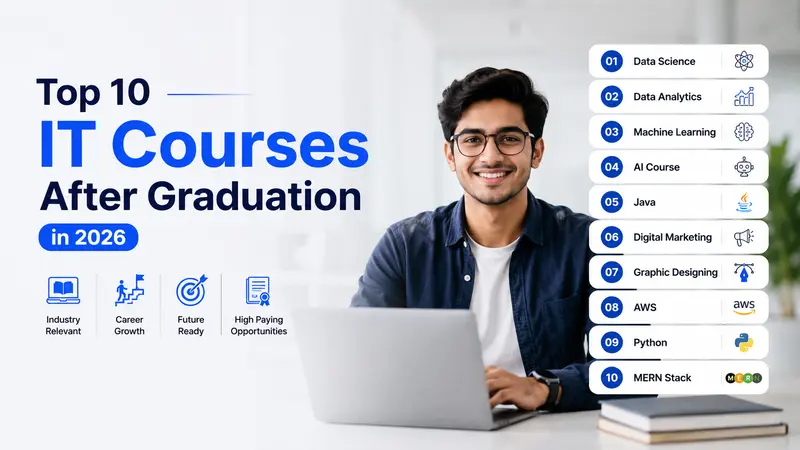
We will look at the top 10 IT courses after graduation that actually matter this year. These programs focus on immediate market needs.
They’re the best courses after graduation because they bridge the gap between academic theory and daily office work.
1. Data Science Course
Data science dictates how modern businesses make decisions. Companies generate massive amounts of information daily.
They need people to interpret that information to increase profits. This makes it a very reliable choice when looking at courses after graduation for a high salary.
Tools and skills you learn
You write code in Python and R. You build statistical models using Pandas and NumPy.
Data visualization is a massive part of the daily work. You will master Tableau and PowerBI to present findings to managers.
You also learn SQL to pull data directly from complex company databases.
Future scope
The global data science platform market is projected to reach $322.9 billion. Growth is consistent and rapid.
Every industry needs data scientists right now. Healthcare uses them for patient diagnostics. Retail uses them for inventory management So the best data science course can help you to grow in this field.
Market demand and stats
The demand for data scientists grew by 56% recently. The Bureau of Labor Statistics projects a 34% employment growth through 2034.
In India, starting salaries hover around 10 to 15 LPA for skilled freshers in tech hubs like Bengaluru. In the US, the median salary sits at $130,000.
Interview expectations
Hiring managers want to see your math skills. They will ask you to explain complex statistical concepts in simple English. You will likely take a live coding test in Python.
Who should take this
You need a deep comfort with mathematics and statistics. If you loved calculus and probability in college, you will thrive here. It’s an excellent choice among job-oriented courses after graduation if you want to work on high-level business strategy.
Get Free Demo Class ➔2. Data Analytics Course
Data analytics focuses purely on solving immediate business problems. You look at past data to figure out why sales dropped. A good data analytics course teaches you how you can grow in this domain.
You calculate how to improve customer retention. It’s one of the most practical job-oriented courses after graduation.
Tools and skills you learn
You spend most of your time in Excel and SQL. These are the core tools for querying and organizing data.
You learn Power BI and Google Looker Studio for building interactive dashboards. You also pick up basic Python for automating repetitive spreadsheet tasks.
Future scope
Analytics is a permanent fixture in corporate strategy. The big data analytics market will hit $447 billion by the end of 2026.
Businesses absolutely depend on real-time analytics. They need analysts to interpret daily operations.
Market demand and stats
Nearly 80% of enterprises state that real-time data analytics is essential for their performance. They are hiring heavily right now.
Data analysts in India earn an average starting salary of 6 to 8 LPA. Senior analysts easily cross the 20 LPA mark.
Interview expectations
You will write SQL queries on a whiteboard. Interviewers will give you a messy dataset and ask how you would clean it. They care heavily about your problem-solving logic.
Who should take this
You need to be detail-oriented and patient. If you enjoy finding patterns in large spreadsheets, this is for you. It serves as one of the best 6-month courses after graduation because the toolset is very focused.
3. Machine Learning Course
Machine learning engineers build systems that learn from data without constant human programming. It’s a highly specialized engineering field.
The complexity of the work makes it one of the top IT courses. After graduation, I think you should take the machine learning course to solve complex problems easily.
Tools and skills you learn
You write heavy Python code daily. You train models using TensorFlow, PyTorch, and Scikit-learn.
You learn to clean datasets and adjust algorithms to improve accuracy. You also learn deployment tools like Docker to get your models running in live applications.
Future scope
Machine learning powers recommendation engines on streaming platforms. It runs fraud detection in banking.
The autonomous AI agent market alone will reach $35 billion by 2030. Companies are investing billions into private models.
Market demand and stats
Job postings requiring machine learning skills grew by 130% last year. Employers are desperate for engineers who can build large models.
A machine learning engineer earns an average of 14 LPA in India. Global salaries average around $133,000 annually.
Interview expectations
Expect heavy mathematical questioning. You must understand the calculus and linear algebra behind the algorithms. Interviewers will ask you how to prevent a model from memorizing training data.
Who should take this
You need a computer science background. The math is brutal and the coding is complex. If you have those skills, this ranks among the absolute best courses after graduation.
4. AI Course
Artificial intelligence went from a research topic to a daily business tool overnight. An AI course teaches you how to implement and manage these new models.
Many consider this the most urgent area for courses after graduation.
Tools and skills you learn
You work with large language models via the OpenAI API and Anthropic API. You build custom applications using LangChain.
Prompt engineering is a core skill. You learn how to format data so the AI produces accurate outputs. You also study vector databases like Pinecone.
Future scope
AI integration is the top priority for almost every tech company in 2026. They need specialists who understand how to connect their old software to new AI models.
Companies now focus entirely on applying existing models to specific industries.
Market demand and stats
Workers with AI skills command wage premiums up to 56% higher than their peers. US job postings requiring AI skills grew 144% recently.
Entry-level generative AI engineers in India start between 8.5 to 17 LPA. This is easily one of the best courses after graduation for high salary.
Interview expectations
You need to explain the difference between various language models. Managers will ask how you handle AI hallucinations in a corporate product. You will write code to connect an API to a basic web interface.
Who should take this
Anyone interested in the absolute edge of technology. You need to be comfortable learning new tools every single week. The fast pace makes it one of the most exciting IT courses after graduation.
Get Free Career Counseling ➔5. Java Course
Java is the backbone of global banking, insurance, and large retail systems. It’s incredibly stable and highly secure.
The constant demand for enterprise software creates a massive shortage of qualified Java developers.
Tools and skills you learn
You learn object-oriented programming principles deeply. You build web applications using the Spring Boot framework.
You manage database connections with Hibernate. You also write unit tests using JUnit to ensure your code never crashes in production.
Future scope
Millions of corporate applications run on Java. Companies will pay well to maintain and upgrade these systems for decades.
Java is also heavily used in Android app development and backend cloud infrastructure. It provides long-term career safety.
Market demand and stats
Java developers are always in demand. The consistency of available jobs is unmatched in the tech sector.
A Java full-stack developer in India earns about 10 to 15% more than average full stack developers. Starting salaries sit around 5 to 7 LPA, scaling rapidly with experience.
Interview expectations
You will answer strict questions about computer memory management. Interviewers will ask you to explain complex object-oriented design patterns. You will write Java code without an editor to prove you know the syntax.
Who should take this
If you want a 30-year career at a massive corporation, Java course is perfect. It’s reliable and heavily structured. It remains one of the safest job-oriented courses after graduation.
6. Digital Marketing Course
Modern digital marketing requires highly technical data tracking. It requires analytical thinking and specific software skills.
Digital Marketing course is one of the most popular 6-month courses after graduation.
Tools and skills you learn
You learn search engine marketing using Ahrefs and SEMrush. You manage paid advertising budgets on Google Ads and Meta Ads.
You track website visitors using Google Analytics 4. You also learn email automation through platforms like HubSpot and Mailchimp.
Future scope
Companies direct almost all their advertising budgets online. They need marketers who can prove a return on investment through hard data.
The integration of AI into marketing tools means you must learn to automate large campaigns.
Market demand and stats
Every business needs customers. The demand for digital marketers scales directly with new business creation.
Starting salaries range from 4 to 6 LPA. Specialists managing massive ad budgets can earn upwards of 15 LPA.
Interview expectations
You will be given a hypothetical budget and asked to plan an advertising campaign. Managers want to hear your logic for dividing money across platforms. You need to know exactly how to calculate customer acquisition costs.
Who should take this
You need a mix of creative thinking and data analysis. If you understand human psychology and basic math, you will do well. It’s an excellent choice when researching courses after graduation.
7. Graphic Designing Course
Graphic design dictates how users interact with software and brands. It’s a mix of visual aesthetics and user psychology.
It’s frequently overlooked when people discuss IT courses after graduation, but it pays very well.
Tools and skills you learn
if you will take a graphic design course You build website and app layouts using Figma. Figma is the absolute industry standard right now.
You edit photos and create brand assets using Adobe Photoshop and Illustrator. You also learn basic animation in After Effects. You study color theory, typography, and user experience principles.
Future scope
The rise of digital products means companies constantly need new interfaces. Good design directly impacts software sales and user retention.
Designers now work alongside AI image generators to speed up their workflow.
Market demand and stats
Startups and established tech firms hire UI/UX designers constantly. The visual identity of a product is highly valued by consumers.
Junior designers earn around 4 to 6 LPA in India. Experienced product designers easily command 15 to 20 LPA.
Interview expectations
Your portfolio is your entire interview. Managers will look at your past work and ask you to explain your design decisions. They want to know why you chose specific layouts and colors.
Who should take this
People with a strong visual sense. You need to handle criticism well, as managers will constantly ask you to change your designs. It’s one of the most rewarding courses after graduation.
Explore Trending Courses ➔8. AWS (Amazon Web Services) Course
Cloud computing runs the modern internet. AWS is the largest cloud provider in the world.
Companies rent server space from Amazon to run their applications. They need cloud engineers to manage these virtual servers.
Tools and skills you learn
You spin up virtual machines using Amazon EC2. You store data using S3 buckets.
In an AWS course, you will learn to build serverless applications using AWS Lambda. You also learn infrastructure as code using Terraform to automate your cloud setups. Security management and cost reduction are massive parts of the training.
Future scope
The migration to the cloud is permanent. Companies will always need professionals to secure their data and keep their websites online.
Cloud computing integrates heavily with daily software development.
Market demand and stats
AWS holds roughly a third of the global cloud market share. Finding jobs specifically asking for AWS certification is easy.
Cloud engineers in India start around 6 to 8 LPA. Professionals with specialized AWS certifications often earn over 20 LPA.
Interview expectations
You will draw network architecture diagrams on a whiteboard. Managers will ask how you secure a database from public internet traffic. They will give you scenarios where a server crashes and ask how you fix it.
Who should take this
You need to be highly organized and focused on security. A mistake in cloud configuration can take down a whole company. AWS certifications are incredible job oriented courses after graduation.
9. Python Course
Python is the most flexible programming language available today. It’s readable, highly logical, and used in almost every tech sector.
It’s the perfect starting point if you are looking for courses after graduation.
Tools and skills you learn
In the python course You learn core programming logic and scripting. You build web servers using frameworks like Django and Flask.
You interact with databases and write scripts to automate boring daily computer tasks. You also learn version control with Git.
Future scope
Python is the foundation for data science, machine learning, and AI. Learning Python opens doors to all those advanced fields.
It’s also heavily used in cybersecurity and network testing.
Market demand and stats
Python regularly tops the charts as the most popular programming language globally. The job market is massive.
A Python developer starts at around 5 to 7 LPA. Because the language is so flexible, you can apply for dozens of different job titles.
Interview expectations
You will solve logic puzzles by writing Python code. Managers will look at how clean and readable your code is. They will ask you to explain different data structures like dictionaries and lists.
Who should take this
Anyone completely new to coding. The syntax is very close to plain English. It’s an ideal choice if you want 6 month courses after graduation to test the waters of the tech industry.
10. MERN Stack Course
The MERN stack is a collection of four specific technologies used to build entire websites. It uses JavaScript for both the frontend and the backend.
It ranks incredibly high among courses after graduation for high salary.
Tools and skills you learn
You manage databases using MongoDB. You build backend servers with Express and Node.js in your MERN Stack Course.
You create interactive user interfaces using React. React is currently the most popular frontend framework in the corporate world. You learn how to connect all these pieces to deploy a full web application.
Future scope
Startups absolutely love the MERN stack. It allows them to hire one developer to handle the whole website.
JavaScript updates frequently, keeping the stack highly relevant for modern web applications.
Market demand and stats
There is a massive demand for React developers globally. MERN stack developers are hired quickly because they can work on any part of a project.
In 2026, the average salary for a MERN stack developer in India is roughly 9.1 LPA. Freshers start around 4 to 7 LPA, while senior developers earn between 14 to 25 LPA.
Interview expectations
You will build a small React application live during the interview. Managers want to see how you manage component state. You will also write basic API endpoints in Node.js.
Who should take this
If you want to build visual products that users interact with directly, this is for you. It requires a lot of typing and debugging. It’s one of the best courses after graduation if you eventually want to launch your own startup.
Which Course You Should Choose
Picking the right path requires looking at your own strengths. You need to match your interests with actual market demand.
All these IT courses after graduation provide a direct route into the tech industry. You just need to commit to learning the tools deeply.
Pick one specialization. Build three solid projects to show employers.
I recommend focusing on courses after graduation for high salary only if you actually enjoy the daily work. High pay comes to people who master their specific software tools.
Start building your portfolio today. The right courses after graduation change everything.