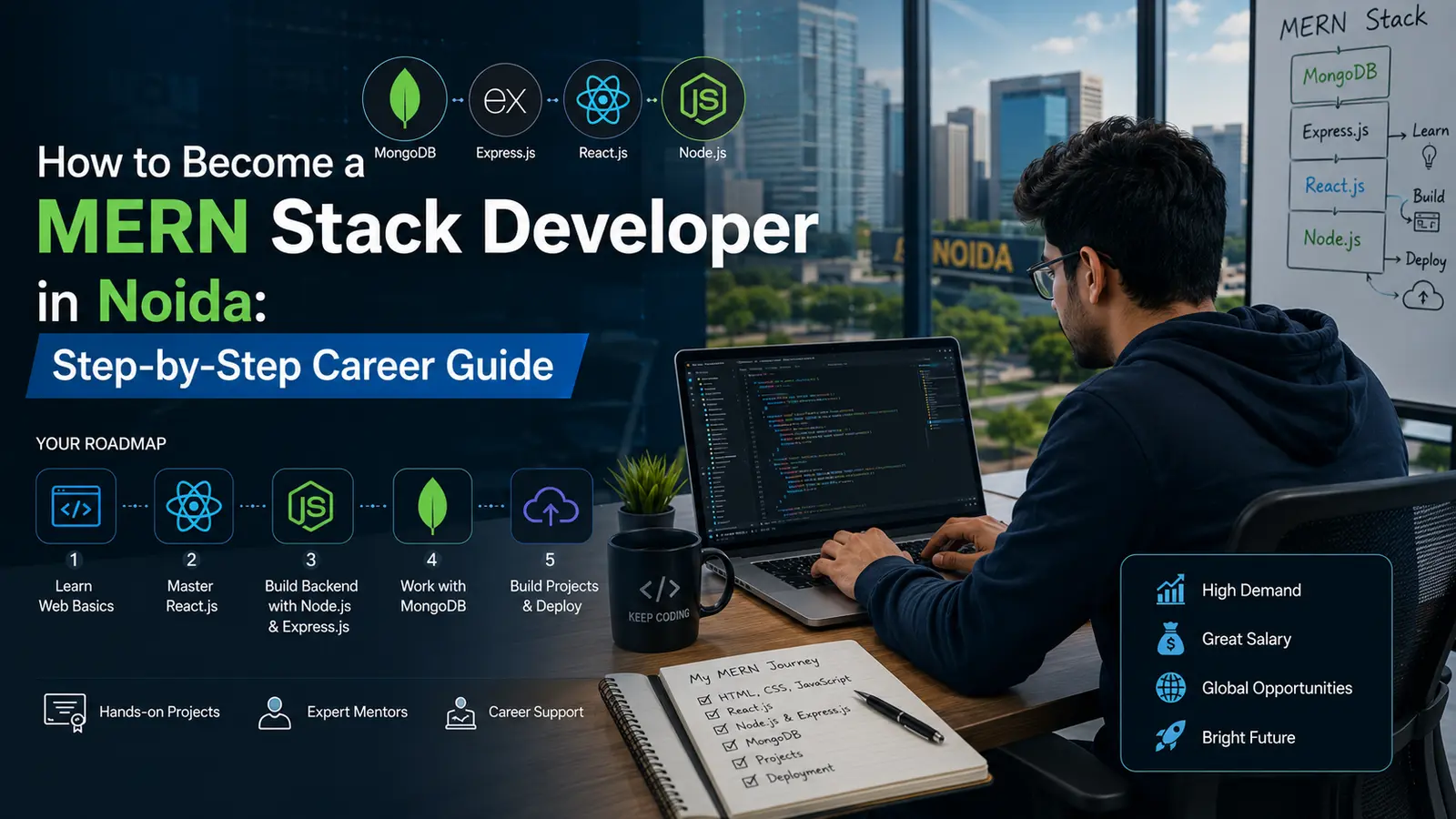
MERN Stack is a powerful web development combination: MongoDB, Express.js, React.js, and Node.js. One language, JavaScript, lets you build a complete web application, frontend to backend. That’s exactly why the demand for MERN in modern web development keeps climbing. Companies want one developer who can handle the whole stack, and that’s why becoming a MERN Stack Developer in Noida is a smart career move right now.
Noida has turned into an IT hub. Sector 62, Sector 18, Sector 135, dozens of startups and MNCs here are hiring full-stack developers. But following random tutorials wastes time. You need the right MERN stack learning path, or you’ll stay stuck on basics for years. A lot of people google “how to become a MERN stack developer” and end up confused by scattered information. This guide walks you through exactly how to become a skilled MERN Stack Developer in Noida: what to learn, which projects to build, and why MERN Stack Training in Noida actually helps.
What is MERN stack development?
MERN is an acronym for four technologies. MongoDB is the database, storing data as JSON-like documents instead of traditional tables. Express.js is a backend framework that runs on top of Node.js and makes building APIs easy. React.js is the frontend library, built by Facebook, used for building user interfaces. Node.js is the runtime environment that lets JavaScript run outside the browser, on a server. A good MERN Stack Development Course in Noida covers these concepts in this exact order, so each layer builds naturally on the last one.
How do all four work together? It’s simple. React shows the user an interface on the frontend. The user does something, say, submits a form. That request travels to the Express server, which runs on Node.js. Express processes the request and fetches or saves data in MongoDB. The response comes back to React and the screen updates. The whole cycle happens in JavaScript, no language switching.
Why do companies use MERN stack? One developer can handle both frontend and backend, which cuts hiring costs. JavaScript has a massive ecosystem, npm alone has millions of packages. And it’s open source, no licensing fees. From scrappy startups to companies like Netflix, almost everyone uses MERN or some variant of it.
Why choose MERN stack development as a career?
Demand for full-stack developers is at its peak right now. Companies want people who can handle both frontend and backend, which keeps teams smaller and projects moving faster. If you’re wondering how to become a MERN stack developer, now is a good time to start, because job openings in cities like Noida keep growing.
Career growth is solid too. You can go from junior developer to senior, then tech lead or architect, in 2-3 years, and this MERN Developer Career Path is fairly structured compared to a lot of niche skills. Salary in Noida for freshers starts around 3-5 LPA, and with experience that can easily climb to 15-20 LPA.
The bigger win is that you can build complete web applications on your own. From idea to deployment, everything stays in your hands. That flexibility opens up real options too: take a job, freelance, or build your own SaaS product. Remote work is easy to land as well, since MERN skills are recognized globally.
Step-by-Step Learning Path to Become a MERN Stack Developer in Noida
Step 1: learn HTML, CSS and JavaScript basics
Every MERN stack learning path starts here. You need to understand HTML structure: headings, paragraphs, forms, tables, all of it. Learn semantic tags too, like header, nav, and footer, since they matter for accessibility and SEO. Then comes CSS: styling, layouts, flexbox, grid, responsive design. Get comfortable with mobile-first design now, since every project expects it. Don’t skip this foundation, this is where your confidence comes from.
JavaScript fundamentals are the most critical piece. Variables, functions, loops, conditionals, arrays, objects, all of it needs to be clear. Pick up ES6 features too, arrow functions, destructuring, template literals, and the spread operator, since React’s code leans on these heavily, and this base fast-tracks you into any React JS Developer Course later. Alongside that, learn DOM manipulation, things like using document.getElementById() to select and change elements on the page. Cover async JavaScript at this stage as well, promises and async/await, you’ll need it for API calls down the line. Until this feels comfortable, jumping into React gets messy. I’d recommend spending at least 4-6 weeks here, and resist the urge to rush into React too soon.
Step 2: master frontend development with React.js
Now comes React.js, the “R” in MERN. Start with components, React’s basic building block. Every piece of UI is a component, reusable and independent. Stick with functional components, class components don’t see much use in the industry anymore.
You need to understand props and state. Props pass data from a parent component to a child, while state manages data inside a component that can change over time. Hooks, like useState and useEffect, are the core of modern React, practice these well. Pick up useContext and custom hooks too once the basics feel solid, they make state management easier on larger projects.
You’ll need React Router for building multi-page applications, even a single-page app needs multiple routes, home page, login page, dashboard, all inside the same app without a page reload. And API integration, using fetch or axios to pull data from the backend, is the heart of any real-world project. People who take a structured React JS Developer Course get these concepts taught in sequence, which avoids confusion, along with real assignments that turn the concept into muscle memory.
Step 3: learn backend development with Node.js and Express.js
After the frontend, move to the backend. Start with Node.js basics: modules, npm packages, file system operations, and how the event loop works. Then comes the Express framework, which makes building routes, using middleware, and setting up a server much easier.
Learn to build REST APIs, the proper use of GET, POST, PUT, and DELETE requests, and understand what status codes actually mean, like 200, 404, 500. Authentication matters too, building login systems with JWT tokens or sessions, and hashing passwords with libraries like bcrypt, never storing them as plain text. Server-side development also covers error handling, validation (tools like express-validator), and security basics, like handling CORS and keeping secrets in environment variables. This phase feels tough at first, but it smooths out with practice, and once your first working API is live, confidence shoots up.
Step 4: understand database management with MongoDB
Get the database concepts clear, MongoDB works quite differently from SQL databases. Instead of tables, you get collections, and instead of rows, you get documents, which store data in JSON format.
Learn CRUD operations, Create, Read, Update, Delete, since you’ll use these basics in every project. Practice working with collections and documents, designing schemas (using Mongoose), and structuring data properly. Data management also covers indexing, optimizing queries, and handling relationships, like linking multiple posts to one user.
Step 5: learn Git, GitHub and deployment
No developer is complete without version control. Learn Git commands: commit, push, pull, branch, merge. Use GitHub for code collaboration, it’s the industry standard, and recruiters check your GitHub profile too.
The last step is hosting. Deploy your projects online, frontend on something like Vercel or Netlify, backend on Render or Railway, and the database on MongoDB Atlas. Until a project goes live, your portfolio stays incomplete.
Essential skills required for a MERN stack developer
On the technical side, you need a strong grip on JavaScript, since every layer depends on it. You should know component architecture and hooks in React.js. Node.js and Express.js are needed for backend logic. MongoDB handles database operations, and REST APIs connect the frontend to the backend. Git and GitHub are must-haves for version control and collaboration. Alongside these, a basic understanding of HTTP, browser dev tools, and the npm ecosystem is expected in interviews too.
But technical skills alone aren’t enough. Problem-solving is probably the most important soft skill, since bugs and unexpected issues show up daily in coding. Communication matters too, especially when working in a team or explaining your work to a client. And debugging is an art, one you only pick up through practice. The developer who reads error messages patiently and solves them systematically is the one who moves forward. Time management is underrated as well, deadlines are part of real projects, and a developer who plans time well becomes someone the team trusts.
Projects every MERN developer should build
Theory alone won’t cut it. Build an e-commerce website with product listings, a cart, checkout, and payment integration using something like Stripe or Razorpay. This is the most popular project to showcase in interviews, since it shows CRUD, authentication, and state management all at once.
Build a blog application where users can create, edit, and delete posts, and add comments too. Add an image upload feature as well, services like Cloudinary make this fairly easy. A task management app, something like Trello, with drag-and-drop, practices both CRUD operations and user authentication.
A chat application teaches real-time features, using tools like Socket.io, where messages send and receive instantly without a page refresh. This shows employers you have exposure to real-time communication too. And build a polished portfolio website where you can showcase all your projects, drop your resume, and add a contact form. This site is usually the first thing recruiters see, so pay attention to both design and performance here.
MERN stack developer career opportunities
There are quite a few roles in the job market. MERN Stack Developer is the most direct title, working across the full stack. Full Stack Developer is a slightly broader title, which can cover other stacks alongside MERN. Completing a MERN Stack Certification Course makes applying for these roles easier too, since recruiters see a verified skill set.
React Developer roles focus specifically on the frontend, good if you have a deeper interest in React, and a solid React JS Developer Course helps build that base. Node.js Developer is for backend-heavy roles. And Web Developer is a general title, often the common entry point for freshers. The MERN Developer Career Path typically moves from junior to senior, then to lead or architect, and with experience you can move into freelancing or consulting too.
Why join MERN stack training in Noida?
Self-learning is possible, but structured MERN Stack Training in Noida has its own advantages. Industry-focused training designs the curriculum around current market demand, not some outdated syllabus. A detailed MERN Stack Development Training in Noida program usually runs 4-6 months, covering every technology in depth.
Experienced trainers share real-world problems that you won’t find in books. Practical projects sit at the core of training, less theory, more hands-on coding. Placement assistance is a major factor too, since good institutes maintain tie-ups with companies.
Real-world exposure, through live projects or internships, builds confidence that’s harder to get through solo learning. If you’re looking for structured MERN Stack Development Training in Noida or a MERN Stack Development Course in Noida, check these factors carefully before enrolling. A good MERN Stack Course in Noida or MERN Stack Developer Course in Noida can save you 6-12 months compared to random YouTube tutorials. Some institutes also offer a MERN Stack Certification Course, which adds weight to your resume and boosts your credibility with recruiters.
Common mistakes beginners make while learning MERN stack
The biggest mistake is sticking to theory only. Watching videos, reading articles, but never actually writing code, a lot of people follow this pattern and get stuck.
Skipping JavaScript basics is another big one. People jump straight into React without clearing JS fundamentals first, and confusion follows. Not building projects is common too, just following tutorials isn’t enough, try building something on your own, even if it breaks at first.
Ignoring Git and GitHub is also a frequent beginner mistake, since it feels “boring.” But this skill gets used daily in any professional setting. And the most important one: not practicing coding regularly. One 5-hour coding session a week is worse than 1 hour every day, consistently.
Conclusion
Becoming a MERN Stack Developer in Noida comes down to a strong foundation, consistent practice, and building real projects. Start with HTML-CSS-JS, learn React, then move to Node-Express-MongoDB, and build something real at every step. Join a structured MERN Stack Course in Noida or MERN Stack Developer Course in Noida, and the learning curve speeds up since you get guidance that’s easy to miss when learning solo.
With the right roadmap, consistent practice, and the right MERN Stack Development Training in Noida, building a successful career in web development isn’t out of reach.