
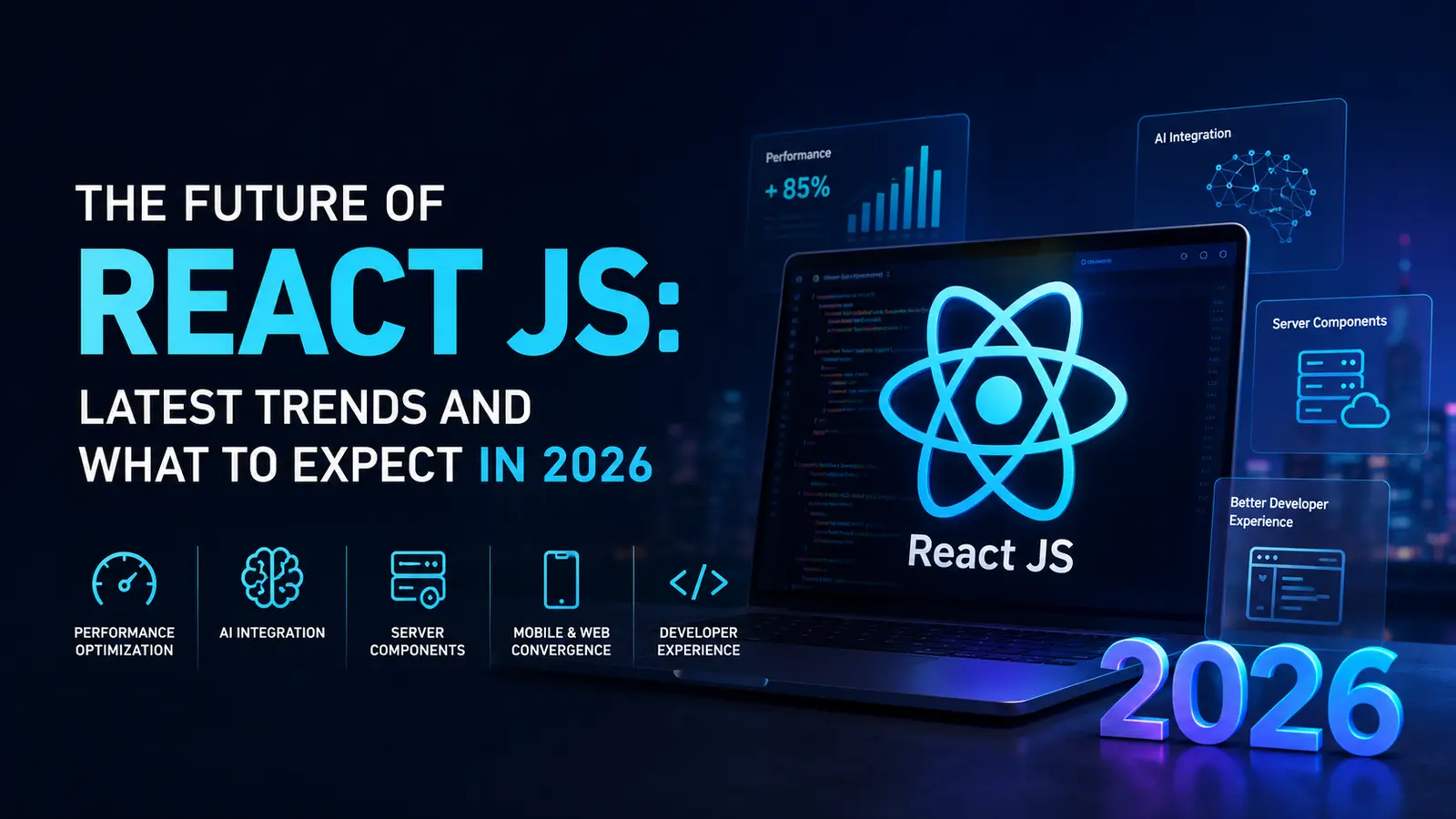
What to expect in 2026 (Updated)
React JS is a JavaScript library for building user interfaces, built and maintained by Meta. It’s been around since 2013, and it’s still the framework most teams reach for first when they start a new frontend project. That’s not an accident.
React got popular because it solved a real problem: building complex, interactive UIs without the spaghetti code that jQuery and early JavaScript frameworks produced. Components, a virtual DOM, one-way data binding. It made big apps manageable. Companies like Netflix, Airbnb, and Facebook itself run on it, and that kind of adoption doesn’t reverse overnight.
There’s also a practical reason React stuck around longer than most JavaScript frameworks from the same era: it didn’t try to own the whole stack. Angular came bundled with routing, forms, and a full opinionated structure. React stayed a library for the view layer and let the community build the rest. That decision turned out to be a strength. When new patterns emerged, server rendering, static site generation, edge functions, the React ecosystem absorbed them through tools like Next.js instead of waiting for a major version rewrite.
So what’s the future of React JS heading into 2026? Strong, honestly. The ecosystem around React, things like Next.js, Server Components, and AI-assisted tooling, has matured fast over the last two years. Developers asking “does React JS have a future” are usually comparing it to newer frameworks like Svelte or SolidJS. Fair question.
But the answer keeps coming back the same way: React’s job market, its tooling, and its community are still way ahead of the alternatives. And when you look at broader frontend development trends, React keeps showing up at the center of them, not on the sidelines.
What is the future of React JS in 2026?
React didn’t get to where it is by staying still. It started as a rendering library focused on the view layer. Then came Hooks in 2019, which changed how people write components. Then Concurrent Mode, then Server Components. Each shift came with complaints (the Hooks transition was rough for a lot of teams who’d built everything around class components), but each one also fixed real pain points around performance and code organization.
Look at the timeline and the pattern is consistent: React ships something that feels disruptive, the community grumbles for a year, and then it becomes the standard way people write code. Class components to function components plus Hooks followed that exact arc. Server Components are following it now, slower adoption at first, then libraries and frameworks build around it until it’s just how things are done.
Companies keep using React for boring, practical reasons. The hiring pool is massive, so finding developers is easier than for niche frameworks. The library itself is stable, Meta has a direct incentive to keep it working since Instagram and Facebook depend on it. And the surrounding tools, testing libraries, component libraries, dev tools, are years ahead of competitors in maturity.
For developers, the future scope is wide. React skills transfer into React Native for mobile, into Next.js for full-stack work, and into countless internal tools companies build on top of it. A react framework 2026 conversation isn’t really about whether React survives. It’s about which patterns inside the React ecosystem win out: more server-rendered logic, less client-side state management, smarter build tools.
This is really the future of React development in a nutshell: not a single big leap, but a steady accumulation of smaller wins that add up to a faster, simpler developer experience. Anyone still wondering does React JS have a future only needs to look at how much of the modern web development future is already built on top of it.
Latest React JS trends in 2026
React Server Components
React Server Components, or RSCs, let parts of your UI render on the server and ship to the browser as already-rendered output instead of as JavaScript that the browser has to execute. The practical effect: your bundle size shrinks, because components that don’t need interactivity never ship their JS to the client at all. If you’re trying to understand the future of React JS in one feature, this is probably it.
The benefit shows up immediately in load times. A product page with static descriptions, pricing tables, and reviews can render server-side, while only the “add to cart” button and quantity selector ship as client components. Users see content faster, and the page feels snappier on slower connections or older phones. Among all the React JS latest updates rolling out right now, this is the one reshaping how teams architect new apps from day one.
AI integration with React applications
AI-powered features aren’t a separate trend from React anymore, they’re built into how people write React code. Copilot-style tools inside editors now suggest entire components based on a comment. Tools like v0 generate working React UI from a text prompt. And inside shipped products, React apps increasingly embed AI features directly: chat interfaces, recommendation widgets, search that understands intent instead of just keywords.
This changes frontend development in a concrete way. Developers spend less time writing boilerplate (form validation, basic layout, standard hooks) and more time on the logic that actually differentiates the product. A developer building a customer support widget in 2024 would have hand-coded a chat UI and wired it to a basic backend. In 2026, that same developer is more likely streaming tokens from an LLM into a React component in real time, handling partial responses, retries, and rate limits as part of the normal build, not a special project.
It also means React developers in 2026 need at least a working understanding of how to call AI APIs and handle streaming responses in the UI, since that’s becoming a standard ask in job descriptions. Skills like managing server-sent events, debouncing rapid input, and rendering partial markdown as it streams in didn’t used to show up in frontend interviews. Now they do, regularly.
Growth of Next.js with React
Next.js has become close to the default way people build with React. It started as a routing and SSR layer on top of React, but by 2026 it’s closer to a full application framework: file-based routing, built-in API routes, image optimization, and tight integration with Server Components. Most discussions about the leading react framework 2026 has to offer end up pointing straight at the Next.js and React combination.
The push toward full-stack development is the bigger story here. Teams don’t want to maintain a separate backend just to serve a frontend’s data needs anymore, at least not for every project. Next.js lets a single codebase handle both the UI and a chunk of the backend logic, particularly for content-driven sites, dashboards, and e-commerce. That’s why so many “learn React” tutorials in 2026 fold Next.js in from the start instead of treating it as an advanced topic.
Performance improvements
React’s compiler work (the React Compiler, formerly known as React Forget) automatically memoizes components without developers manually wrapping everything in useMemo and useCallback. That’s a real shift. For years, performance tuning in React meant developers manually tracking which components re-rendered unnecessarily. Now the compiler handles a lot of that automatically.
Rendering speed has also improved through better reconciliation algorithms and smarter batching of state updates. Combined with Server Components reducing what ships to the browser, the net effect is pages that load faster and feel more responsive, especially on mobile devices where CPU power is limited. Optimization that used to take a senior engineer a day of profiling now often happens by default. It’s part of why React still holds its ground against newer javascript frameworks that market themselves on speed alone.
React Native and mobile development
React Native lets developers write mobile apps using React patterns, and it’s had a real resurgence. The New Architecture (Fabric and TurboModules) fixed a lot of the performance complaints that drove some teams toward Flutter a few years back. Bridging between JavaScript and native code is faster now, and the developer experience is closer to writing regular React.
For React’s future in mobile, this matters because it means the same skill set, components, hooks, state management, applies across web and mobile. A team building a React web app doesn’t need a separate mobile team with separate tooling. That cross-platform efficiency is a big reason companies keep betting on React Native instead of going fully native or switching to Flutter, and it’s a big part of why react future discussions almost always include the mobile side now, not just the web.
Why should developers learn React JS in 2026?
The career opportunities are real and they’re not slowing down. Job boards consistently list React among the top 3 most-requested frontend skills, and that’s been true for several years running now. It’s a high demand skill specifically because so much existing software runs on it. Companies aren’t ripping out React codebases, they’re hiring people to extend them. Anyone tracking frontend development trends will notice the same names come up again and again: React, Next.js, TypeScript.
Industry usage backs this up. E-commerce platforms, SaaS dashboards, internal tools, mobile apps through React Native, React shows up everywhere. And the community support is hard to overstate: Stack Overflow threads going back a decade, an enormous library ecosystem on npm, and constant new content from the React team itself and from companies like Vercel building on top of it.
When you hit a weird bug, someone’s probably already solved it and written about it. For anyone trying to read where the web development future is headed, React’s continued dominance is one of the clearer signals out there. And for developers who already know basic react programming patterns, the path to staying relevant is mostly about layering new tools on top, not starting over.
React JS vs other frontend frameworks
React JS vs Angular
Angular is a full framework with opinions baked in: routing, forms, HTTP client, all included. React is a library, so you assemble your own toolchain. That makes React more flexible but also means more decisions to make early in a project. Performance-wise, both are fast enough for almost any real-world app today, the differences show up mostly in bundle size and how each handles change detection.
The learning curve tips toward React for beginners, partly because JSX maps closely to regular JavaScript, while Angular’s TypeScript-heavy, decorator-based structure takes longer to click. Job-wise, React postings outnumber Angular postings by a wide margin in most markets, though Angular still holds strong in enterprise environments, particularly companies already invested in the broader Google/TypeScript ecosystem.
React JS vs Vue.js
Vue sits somewhere between React’s flexibility and Angular’s structure. Its template syntax (closer to plain HTML) often feels more approachable to people coming from traditional web development. Performance between React and Vue is close enough that it rarely decides a project on its own.
Flexibility favors React again, mostly because of the sheer size of its ecosystem, there’s a library for almost anything you’d want to do. Vue’s learning curve is arguably the gentlest of the three frameworks discussed here. But job opportunities clearly favor React: it shows up far more often in postings across nearly every region and industry, which matters a lot if you’re learning a framework partly to get hired. Whichever way the broader web development future tilts, React’s job numbers alone make it the safer bet right now.
Skills required to become a React developer in 2026
JavaScript fundamentals come first, always. React is JavaScript with extra structure, so weak fundamentals show up fast once you’re past tutorial-level work. Solid react programming habits start here, not with hooks or state libraries. From there, React Hooks (useState, useEffect, useContext, and the custom hooks you’ll inevitably write) are non-negotiable since the class-component pattern is largely legacy at this point.
Working with APIs, fetching data, handling loading and error states, is a daily task, not an edge case. State management matters too: Context API for simpler apps, libraries like Zustand or Redux Toolkit for bigger ones. None of this works without solid HTML/CSS, no framework saves you from understanding how layout and styling actually behave in a browser.
Git is assumed knowledge at this point, every team uses version control, and you’ll be expected to know branching and pull request workflows on day one. Next.js has become close to a required skill rather than a bonus one, given how many production React apps are built on it now. And TypeScript adoption inside the React world has grown to the point where plenty of job listings simply assume you know it. Keeping an eye on React JS latest updates, especially around the compiler and Server Components, will save you from learning outdated patterns that teams are actively moving away from.
Career opportunities after learning React JS
A React developer role typically focuses tightly on building and maintaining UI components, hooking them up to APIs, and optimizing performance within an existing codebase. It’s a specialized role, but a deep one, and it’s central to the future of React development as companies keep extending existing codebases rather than rebuilding from scratch.
Frontend developer is the broader title, covering React work but also general HTML/CSS/JS skills, accessibility, sometimes basic design collaboration. Full stack developer roles, especially with Next.js’s rise, now often expect React on the frontend paired with Node.js, databases, and API design on the backend, all in one person’s job description. UI developer roles lean more toward the visual and interaction side: component libraries, design systems, animation, working closely with designers to turn mockups into working interfaces.
How to stay updated with React trends
Following the official React blog and the React team’s posts on X catches major announcements early, things like new Hooks, the compiler’s progress, or RFC discussions that hint at what’s coming next. Beyond that, build projects. Reading about Server Components is one thing, actually building something with them, hitting the weird edge cases, is how the knowledge sticks.
Learning the modern tools matters too: Next.js, TypeScript, the React Compiler as it stabilizes. And practice coding regularly, even small projects keep your hands on the patterns so you’re not relearning syntax every time a new contract or job starts. The React ecosystem moves fast enough that a developer who stops building for a year will notice real gaps when they come back.
Conclusion
React isn’t going anywhere in 2026. The trends shaping it, Server Components, AI integration, the Next.js ecosystem, performance work through the compiler, and continued strength in React Native, all point toward a library that’s still actively solving real problems, not coasting on past popularity. For developers asking whether to invest time in React, the job market, the tooling, and the community all say the same thing: yes, and the deeper you go into the modern parts of the ecosystem, the better positioned you’ll be.
Whatever react future you’re betting on for your own career or your team’s stack, it looks less like a single dramatic reinvention and more like what React’s always been: steady, practical evolution that keeps pace with what developers actually need.
Read more:- What is Next.js? A Complete Beginner’s Guide