Java Full Stack Development has become one of the most searched career paths among IT aspirants in India, and Noida sits right in the middle of that demand. Companies here are hiring developers who can handle both the frontend and backend without blinking, and that’s exactly what a Java Full Stack Certification Program in Noida is built to deliver. But here’s the catch: not every institute teaching “full stack” actually teaches the full stack. Some skip Spring Boot. Some skip live projects entirely. So picking the right program isn’t a small decision, it’s the decision that shapes whether you land a job in 6 months or spend another year figuring out what went wrong.
This guide walks you through exactly what to check before you enroll, what skills you’ll walk away with, and why the training you choose matters more than the certificate itself.
Why Choose Java Full Stack Development as a Career?
The IT industry isn’t short on job openings, it’s short on developers who can actually build a complete application end to end. That’s where full stack developers come in. Recruiters don’t want three different people handling the UI, the server logic, and the database anymore. They want one person who can move between all three, and that’s pushed Java Full Stack development into one of the highest-demand skill sets in the country right now.
Career growth in this field is fast, and I mean that literally. A fresher with solid Java Full Stack skills can move from a developer role to a senior developer or team lead position within 3 to 4 years, something that took almost double that time a decade ago. Job titles vary, you’ll see openings for Full Stack Developer, Java Developer, Backend Engineer, even Software Engineer roles that expect full stack capability as a baseline.
Salary-wise, freshers with a Java Full Stack certification course completed through hands-on training typically start higher than candidates with only theoretical knowledge. And the scope only widens from there. Banking, e-commerce, healthcare tech, SaaS startups, they all run on Java backends paired with modern frontend frameworks. The future scope isn’t going anywhere soon.
What is Java Full Stack Development?
Full stack, simply put, means you can build the part users see and the part users never see.
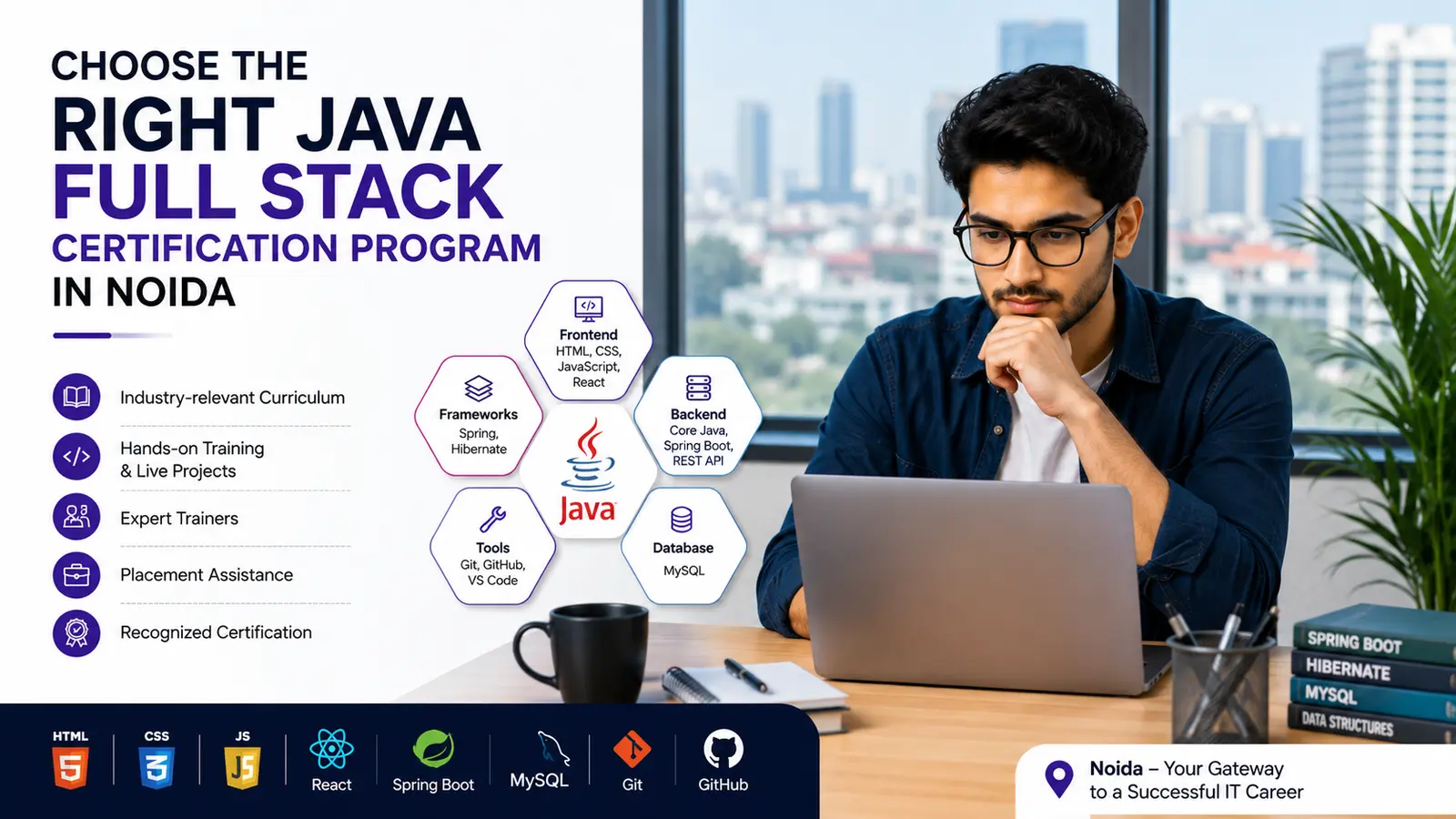
On the frontend, you’re working with HTML, CSS, and JavaScript, then layering on React or Angular to build interactive, responsive interfaces. This is what makes an app feel smooth instead of clunky.
The backend is where Java does its heavy lifting. Core Java and Advanced Java form the foundation, and Spring Boot sits on top of that to handle the application logic, security, and request handling without you writing boilerplate code for every single feature.
Database management is the third leg. You’ll work with SQL to store, retrieve, and manage data, and Hibernate to connect your Java code to that database without writing raw SQL queries every time.
API integration ties the frontend and backend together. Your React or Angular interface talks to your Spring Boot backend through REST APIs, and learning how to design and consume these properly is non-negotiable for any full stack role.
Then there’s deployment. Knowing how to push your application live, whether that’s on a cloud server or an internal company environment, rounds out the skill set. Miss this part of training and you’ll know how to build an app but not how to ship one.
Key Factors to Consider Before Choosing a Java Full Stack Certification Program
This is the section that actually matters. Most people pick an institute based on the brochure. Don’t be most people.
Course Curriculum
Open the syllabus before you open your wallet. A real Java Full Stack training in Noida should cover Core Java and Advanced Java in depth, not as a 2-week afterthought before jumping to frameworks. Spring Boot and Hibernate need dedicated modules, not a single combined session. SQL should be taught with actual database design, not just SELECT statements.
On the frontend side, check that HTML, CSS, and JavaScript fundamentals are taught properly before React or Angular gets introduced. I’ve seen students jump straight into React without understanding JavaScript basics, and it shows later when they can’t debug their own code. Git and GitHub should also be part of the curriculum, version control isn’t optional in any real dev team.
Practical Training & Live Projects
A Java Full Stack development course without live projects is basically a long lecture series. You learn syntax by reading. You learn development by building something that breaks, then fixing it.
Look for programs that include real-world projects, not toy examples. Coding practice needs to happen daily or close to it, muscle memory matters here. Industry-based assignments, the kind that mirror what you’d actually be asked to do at a job, separate institutes that talk about practical training from institutes that deliver it.
Experienced Trainers
A trainer who’s spent years writing production code teaches differently than someone reading from slides. Industry knowledge shows up in the small things, the shortcuts, the common mistakes, the “this is how it’s actually done at companies” comments that textbooks skip.
Practical guidance during coding sessions and proper doubt sessions are what separate a good Java training institute in Noida from an average one. If your questions get answered with “we’ll cover that later” every time, that’s a red flag worth noting.
Certification Value
Not all certificates carry weight. A Java Full Stack certification course should validate actual skills, something an employer recognizes and trusts, not just a participation certificate for showing up.
Ask the institute directly: do recruiters in Noida recognize this certification? Has it helped past students get shortlisted? If they can’t answer with specifics, that tells you something too.
Placement & Career Support
This is where a lot of programs quietly fall short. Java Full Stack placement training should include resume building that actually highlights project work, not generic templates. Interview preparation needs to cover both technical rounds (DSA, Java concepts, project explanations) and HR rounds.
Job assistance matters too, ideally with a track record you can verify. Ask for placement numbers. Ask for company names. A program confident in its outcomes won’t hesitate to share this.
Why Choose Java Full Stack Certification in Noida?
Noida isn’t an accident on this list. It’s genuinely one of the strongest IT hubs in the NCR region, home to a dense cluster of tech companies, from established IT services firms to growing product startups. That density matters because it means internship opportunities, walk-in drives, and networking events happen more often here than in smaller tech markets.
The learning environment in Noida also benefits from this proximity. Institutes here tend to align their curriculum with what local companies are actually hiring for, because trainers and placement teams stay in regular contact with these companies. That feedback loop keeps the Java Full Stack training program relevant instead of outdated.
Career opportunities post-certification are wider too. Being based in Noida means you’re not relocating to chase opportunities in Gurgaon, Delhi, or even Bangalore tech offices that have satellite presence here. The job market comes to you.
Skills You Will Gain After Java Full Stack Training
By the end of a properly structured program, here’s what you should actually be able to do, not just talk about.
Java programming becomes second nature, you’ll be writing clean, functional code without constantly checking syntax references. Web development skills cover both building interfaces and making them respond to user actions correctly.
Database handling means you can design a schema, write queries, and connect that database to your application without someone holding your hand. Backend development skills let you build APIs, handle authentication, and manage server-side logic using Spring Boot.
Problem-solving sharpens naturally through the process, debugging code teaches you to think in a way that lectures never can. And you’ll pick up real software development practices, version control workflows, code reviews, and basic project management habits that mirror an actual dev team environment.
Career Opportunities After Java Full Stack Certification
Once certified, the job titles you can target widen considerably. Java Developer roles focus heavily on backend logic and are often the most common entry point. Full Stack Developer positions expect you to handle both ends of the application, which is the core promise of this training path.
Backend Developer roles narrow in on server-side work, APIs, and database management specifically. Software Engineer is a broader title that many companies use interchangeably with full stack roles, especially at startups where one person wears multiple hats. Web Developer positions, while sometimes more frontend-focused, are also accessible with the skill set you’ll build.
The honest answer to “Which Java Full Stack course is best in Noida” usually comes down to which program prepares you for these specific roles with real project experience behind it, not which one has the flashiest ad.
Why Choose Appwars Technologies for Java Full Stack Certification?
Appwars Technologies approaches Java Full Stack training the way it should be approached: with the job market as the actual target, not just the syllabus completion as a finish line.
The training approach here centers on building, not memorizing. Students write code from day one and keep writing it through increasingly complex projects, rather than sitting through months of theory before touching a keyboard.
Course highlights include comprehensive coverage of Core Java, Advanced Java, Spring Boot, Hibernate, SQL, and modern frontend frameworks like React and Angular, all taught with the depth that an actual Java Full Stack certification program in Noida should have. Live projects form the backbone of the program, giving students real experience solving problems that mirror actual workplace assignments.
The industry-focused learning model means trainers bring real development experience into the classroom, not just academic knowledge. And career support doesn’t stop at certification, resume building, mock interviews, and direct job assistance carry students from classroom to actual employment, which is the entire point of enrolling in the first place.
FAQs
1. How do I choose the best Java Full Stack certification program in Noida?
Check the curriculum depth (Core Java through Spring Boot and Hibernate, plus React or Angular), confirm live project work is included, verify trainer experience, and ask directly about placement support and past student outcomes before enrolling.
2. Is Java Full Stack Development a good career option?
Yes. Demand for developers who can handle both frontend and backend work continues to grow across IT services, product companies, and startups, and Java remains one of the most widely used backend languages in enterprise software.
3. What skills are required for a Java Full Stack Developer?
You’ll need Core Java and Advanced Java, Spring Boot, Hibernate, SQL, HTML, CSS, JavaScript, and a frontend framework like React or Angular, along with basic Git and GitHub workflow knowledge.
4. How long does it take to learn Java Full Stack Development?
Most structured Java Full Stack training programs run between 4 to 6 months for someone starting with basic programming knowledge, though this varies based on prior experience and how intensive the course schedule is.
5. Can beginners learn Java Full Stack Development?
Yes, plenty of beginners start with zero coding background and complete a Java course in Noida successfully, as long as the program builds fundamentals properly before moving into frameworks and advanced topics.
6. Why choose Appwars Technologies for Java Full Stack Certification in Noida?
Appwars Technologies offers industry-focused Java Full Stack training with hands-on learning, live projects, and guidance from experienced trainers. The program includes the latest technologies, practical assignments, interview preparation, and placement assistance to help students become job-ready Java Full Stack Developers.
Conclusion
Picking the right Java Full Stack certification program in Noida comes down to a handful of things that actually matter: a curriculum that covers the full stack properly, real project work instead of just lectures, trainers who’ve actually built software for a living, and placement support that goes beyond a few LinkedIn job postings forwarded to a WhatsApp group.
Skip the institutes that sound impressive on paper but can’t answer specific questions about their curriculum depth or placement track record. Java Full Stack development is a strong, genuinely in-demand career path right now, but only if the training behind your certificate holds up once you’re sitting in an actual interview.
Looking for the best Java Full Stack Certification Program in Noida? Join Appwars Technologies to learn from industry experts, work on live projects, and receive placement assistance.