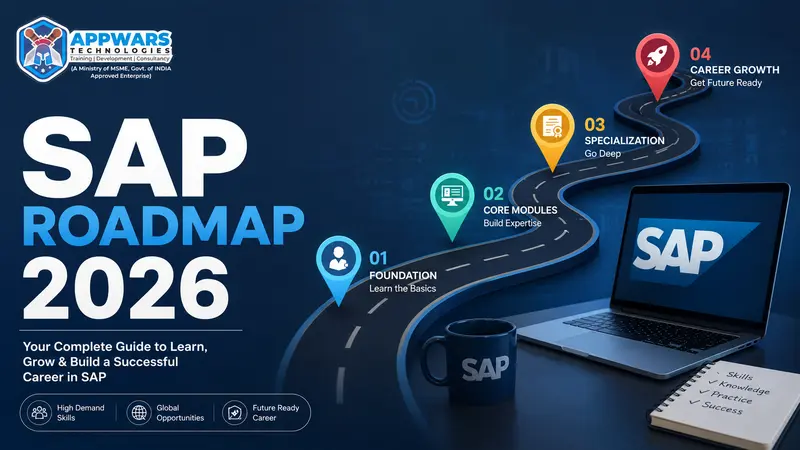
Enterprise software runs the back office of nearly every large organization, and SAP sits at the center of that world. If you are weighing a career in SAP or trying to move from a support role into consulting, a clear SAP roadmap removes the guesswork. This guide lays out the exact SAP learning path, from picking a module to landing your first consultant role, with realistic timelines, salary bands, and the mistakes that slow most beginners down.
2026 adds urgency to this plan. SAP has confirmed that mainstream maintenance for SAP ECC ends on December 31, 2027, which means enterprises across manufacturing, finance, retail, and IT services are racing to complete their move to SAP S/4HANA. That migration wave is creating fresh openings for functional consultants, technical consultants, and support analysts who understand both the old ECC environment and the new S/4HANA architecture. A well-planned SAP career roadmap built around this shift can put you ahead of professionals who are only now starting to notice the deadline.
Why a Structured SAP Roadmap Matters in 2026
SAP is not a single product. It is a family of modules, each tied to a specific business function such as finance, sales, procurement, production, or human resources. Jumping between tutorials without a plan usually produces surface-level knowledge that will not survive a client interview or a real implementation project.
A structured SAP learning roadmap solves three problems at once:
- It tells you which module fits your background, so you are not learning finance concepts when your strength is logistics.
- It sequences your effort in order: foundational ERP concepts first, configuration skills second, and project exposure third, so each stage builds on the last.
- It aligns your training with what employers are hiring for right now, rather than what was in demand five years ago.
Consulting firms, IT service companies, and in-house SAP teams in India are actively hiring for S/4HANA conversion projects, and they consistently favor candidates who can show hands-on configuration work over those who only hold a certificate. That single fact should shape every stage of your preparation.
SAP Roadmap 2026 at a Glance
Use this table as a quick reference for the full journey. Each section below expands on what to actually do at every stage.
| Stage | Typical Duration | Core Focus | What You Should Be Able to Do Afterward |
|---|---|---|---|
| 1. Foundation | 3–4 weeks | ERP concepts, business processes, SAP navigation | Explain how a business transaction flows through an ERP system |
| 2. Module Selection | 1–2 weeks | Comparing functional and technical tracks | Choose one SAP module aligned to your background and goals |
| 3. Core Training | 3–4 months | Module configuration, SAP GUI, Fiori basics | Configure end-to-end processes in a sandbox or training environment |
| 4. Certification | 4–8 weeks | SAP Learning Hub content, practice exams | Hold or be ready to attempt an official SAP certification |
| 5. Project Exposure | 2–6 months | Live projects, internships, support tickets | Handle real business scenarios beyond textbook exercises |
| 6. S/4HANA Specialization | 2–3 months | Fiori apps, embedded analytics, clean core concepts | Work confidently on S/4HANA implementation or migration tasks |
| 7. Consultant Readiness | Ongoing | Client communication, documentation, domain depth | Independently manage a module workstream on a live client engagement |
Most learners complete stages 1 through 4 in six to eight months of consistent study. Reaching genuine consultant readiness, where you can own a workstream without heavy supervision, typically takes twelve to eighteen months, including project experience.
Stage 1: Building Your SAP Foundation
Understand ERP and Business Processes Before Touching a Module
Every SAP Learning Path should begin away from the software itself. Spend your first few weeks understanding what an ERP system actually does: how a purchase order connects to inventory, how inventory connects to production, and how production connects to financial reporting. Skipping this step is the single biggest reason beginners struggle later, because SAP configuration screens only make sense once you understand the business process behind them.
At this stage, get comfortable with SAP terminology, including company code, plant, controlling area, master data, and transaction codes, and spend time navigating the SAP GUI and Fiori Launchpad interfaces. You do not need deep expertise yet; you need familiarity.
Choose Between the Functional and Technical Track
SAP careers generally split into two tracks, and your SAP roadmap should account for this early:
- Functional consulting focuses on configuring business processes within modules like Finance, Sales, or Materials Management. This track suits people with a commerce, operations, or business background.
- Technical development focuses on ABAP programming, system integration, and custom extensions. This track suits people coming from a programming or computer science background.
There is also a growing hybrid path, sometimes called functional-technical, where consultants understand configuration well enough to write functional specifications for developers. This hybrid skill set is increasingly valued as companies run leaner project teams.
Stage 2: Choosing the Right SAP Module
This decision shapes the rest of your career path in SAP, so weigh it carefully rather than picking the module with the most YouTube tutorials.
| Module | Best Suited For | Typical Industry Demand |
|---|---|---|
| SAP FICO (Finance & Controlling) | Commerce and finance graduates, accountants | Consistently high across all industries |
| SAP SD (Sales & Distribution) | Sales, marketing, and operations professionals | Strong in retail, FMCG, and distribution |
| SAP MM (Materials Management) | Supply chain and procurement professionals | Strong in manufacturing and logistics |
| SAP HR/HCM | HR generalists and payroll specialists | Steady, with growth in SuccessFactors-linked roles |
| SAP ABAP | Programmers and computer science graduates | High, especially for custom S/4HANA extensions |
| SAP HANA | Database and analytics-inclined professionals | Growing fast alongside S/4HANA adoption |
| SAP PP (Production Planning) | Manufacturing and engineering professionals | Steady in core manufacturing sectors |
A practical rule: pick the module closest to work you have already done, even informally. A finance graduate who understands ledgers and reconciliations will progress through FICO faster than through an unfamiliar module chosen purely for salary numbers quoted online.
Get Free Demo Class ➔Stage 3: Structured SAP Learning Roadmap: Core Training and Certification
Once you have chosen a module, the next three to four months should be spent on structured, hands-on training rather than scattered videos. A solid SAP training program combines:
- Guided configuration exercises inside a live sandbox system
- Real business scenarios rather than isolated transaction-code drills
- Instructor feedback that explains the reasoning behind each configuration decision, rather than the steps alone
- Exposure to Fiori apps alongside the classic SAP GUI, since most current implementations run on both
Certification is a useful checkpoint, not a substitute for skill. SAP’s official learning content, delivered through the SAP Learning Hub, maps closely to the certification exams and is worth working through systematically once your core training is complete. Employers increasingly ask certified candidates to demonstrate the same tasks in a live system during interviews, so treat the certificate as validation of ability rather than the end goal itself.
If you are early in this stage, an SAP ERP course in Noida that combines classroom configuration practice with real project scenarios will get you to certification readiness faster than self-study alone, particularly for the FICO, SD, MM, HANA, and HR modules.
Stage 4: Gaining Real Project Experience
This is where most self-taught learners stall. Configuration knowledge without project exposure rarely converts into a job offer, because employers want to see that you can handle the ambiguity of a real business requirement rather than a fixed textbook case study.
Ways to build genuine project exposure before your first full-time SAP role:
- Take on internship or live-project components attached to a structured training program, where you work against realistic client scenarios.
- Volunteer for SAP-adjacent tasks in your current job, such as raising support tickets, testing configuration changes, or documenting business processes for an SAP-run department.
- Build a portfolio of end-to-end scenarios you configured yourself, such as order-to-cash, procure-to-pay, or hire-to-retire, and be ready to walk an interviewer through the logic behind each step.
- Join user forums and SAP community groups where real implementation questions are discussed, since this exposes you to problems beyond a fixed curriculum.
Stage 5: Specializing in S/4HANA
No SAP Roadmap 2026 is complete without a dedicated S/4HANA stage. With ECC mainstream maintenance ending in December 2027, organizations are compressing years of planned migration work into the next 18 to 24 months, and that is creating short-term demand that outpaces the supply of ready consultants.
Focus your S/4HANA specialization on:
- Simplified data models and how they differ from classic ECC tables
- Fiori-based transactions and role-based launchpads
- Embedded analytics and how reporting has moved closer to the transaction layer
- Clean core principles, which shape how much custom code is acceptable in new implementations
- Basic exposure to migration concepts such as brownfield, greenfield, and selective data transition approaches, even if you are not leading a migration project yourself
Consultants who can speak knowledgeably about both ECC and S/4HANA are in a stronger position during this transition window than those who only know one environment.
SAP Career Roadmap: From Associate to Senior Consultant
Compensation in SAP careers rises sharply with hands-on project experience and certification, more than with tenure alone. Based on current Indian market data across major job platforms, here is a realistic salary progression by experience level.
| Career Stage | Experience | Typical Annual Salary (India) | Focus Areas |
|---|---|---|---|
| Associate / Fresher Consultant | 0–1 year | ₹3.5–6 lakh | Configuration basics, support tickets, guided implementation tasks |
| Consultant | 1–4 years | ₹6–12 lakh | Independent configuration, testing, documentation |
| Senior Consultant | 4–8 years | ₹12–20 lakh | End-to-end module ownership, client-facing requirement gathering |
| Lead / Solution Architect | 8+ years | ₹20–30 lakh and above | Cross-module design, migration strategy, team leadership |
These ranges vary by city, employer type, and module, with Tier-1 hubs such as Bengaluru, Delhi NCR, Hyderabad, and Pune generally sitting toward the higher end due to the concentration of consulting firms and global capability centers. Consultants who add S/4HANA and Fiori skills to a traditional ECC background typically command a premium over peers with equivalent experience but no S/4HANA exposure.
Explore Trending Courses ➔Skills Beyond the Syllabus: What Makes a Successful SAP Consultant
Technical configuration ability gets you into the interview room, but a few additional habits separate consultants who advance quickly from those who plateau:
- Business communication: explaining a technical configuration decision in terms a finance or operations manager will understand
- Documentation discipline: writing clear functional specifications and test scripts that another consultant could follow without you in the room
- Cross-module awareness: understanding how your module’s changes ripple into adjacent modules, since most business processes cross module boundaries
- Client-handling maturity: staying calm and structured during go-live weeks, when issues surface quickly and stakeholders are under pressure
None of these appear on a certification exam, yet they are frequently what determines who gets promoted from consultant to senior consultant first.
Common Mistakes to Avoid on Your SAP Learning Path
- Chasing every module at once. Depth in one module builds a stronger resume than shallow exposure to five.
- Treating certification as the finish line. Recruiters increasingly test practical configuration skills in live systems during interviews.
- Ignoring Fiori and S/4HANA. Training built only around classic ECC screens is falling out of step with what current implementations actually run on.
- Underestimating soft skills. Technical knowledge without clear communication limits how far a consultant can grow within a project team.
- Learning in isolation. Configuration concepts stick far better when practiced against realistic business scenarios rather than isolated transaction codes.
How Appwars Technologies Supports Your SAP Roadmap
At Appwars Technologies, SAP training is built around this exact roadmap structure, starting with ERP fundamentals, moving through guided module configuration, and finishing with live-project exposure across FICO, SD, MM, HR, HANA, and PP. Trainers bring practical implementation background rather than slide-only teaching, and batches are structured so learners work through real business scenarios before attempting certification. For anyone serious about following this roadmap through to a consultant-level role, the SAP ERP Training Course in Noida is built to cover each stage described above, with placement support once training and project work are complete.
Frequently Asked Questions
How long does it take to become job-ready following this SAP roadmap?
Most learners with a relevant academic or work background reach job-ready configuration skills in six to eight months of structured training, with additional project exposure adding another two to six months before a consultant-level role becomes realistic.
Do I need a technical background to start an SAP learning path?
No. The functional track, covering modules like FICO, SD, MM, HR, and PP, is designed for people from commerce, operations, HR, and business backgrounds. The technical track, centered on ABAP, suits candidates with programming experience.
Is SAP still worth learning with the shift to S/4HANA?
Yes, and arguably more so in 2026. The ECC mainstream maintenance deadline of December 2027 is pushing a large wave of implementation and migration projects, which is increasing demand for consultants trained on both classic ECC and current S/4HANA environments.
Which SAP module has the best career prospects in 2026?
SAP FICO and SAP HANA-related skills currently show the broadest demand, since finance processes exist in every organization and S/4HANA adoption is accelerating. That said, the “best” module is the one that matches your existing background closely enough for you to build genuine depth.
Final Thoughts
A career in SAP rewards consistency more than raw talent. Following a defined SAP roadmap, from foundation and module selection through structured training, certification, project exposure, and S/4HANA specialization, turns a vague ambition into a plan you can actually execute month by month. With the 2027 ECC deadline compressing the industry’s migration timeline, 2026 is a practical year to start, provided the learning path you follow is built around real configuration work rather than recorded lectures alone.