
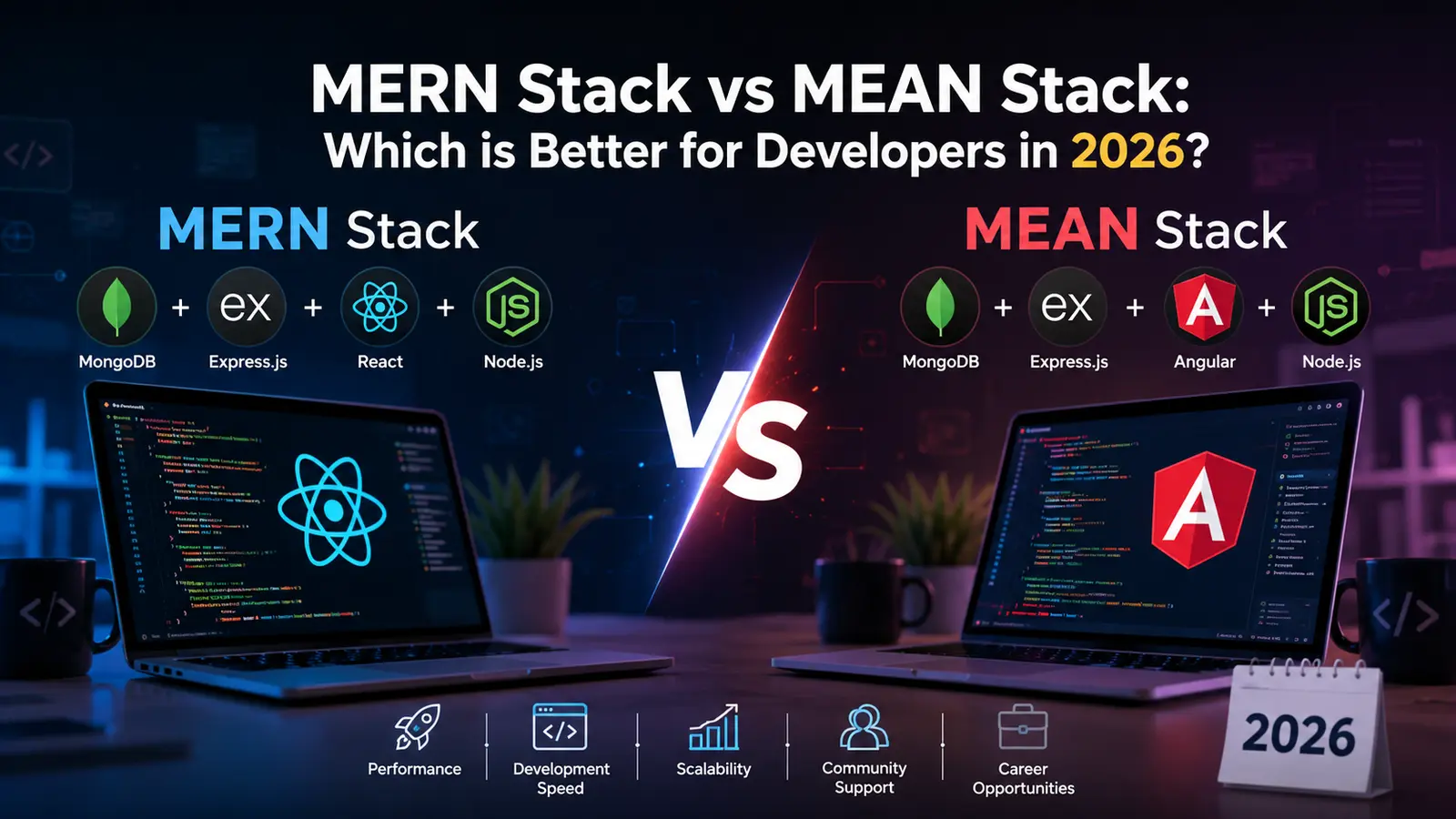
Web development in 2026 looks nothing like it did five years ago. Companies ship products faster, users expect snappier interfaces, and AI tools now write half the boilerplate code developers used to type by hand. In the middle of all this, one decision still trips up beginners and senior engineers alike: should you build your project on MERN or MEAN?
Both stacks run on JavaScript from top to bottom. Both use MongoDB and Express.js on the backend. And both rely on Node.js to tie everything together. The real fork in the road is the frontend: React for MERN, Angular for MEAN. That single difference changes how you write code, how fast you ship features, and even how easily you’ll land your next job.
JavaScript-based full-stack development took over because it solved a real headache. Ten years ago, a single project might run PHP on the server, jQuery in the browser, and a separate team managing the database layer. Today, one language handles all three. Less context switching, fewer hiring headaches, and a much shorter path from idea to working product. That’s exactly why the MERN Stack vs MEAN Stack debate refuses to die down. Picking one shapes your career, your project timelines, and honestly, your sanity during a 2 AM debugging session.
This guide breaks down both stacks in plain language, compares them where it actually counts, and gives you a straight answer on which one fits your goals in 2026.
What is MERN stack?
MERN stands for MongoDB, Express.js, React.js, and Node.js. It’s the stack behind apps like Instagram’s web client and large chunks of Netflix’s internal tooling.
MongoDB stores your data as JSON-like documents instead of rigid tables. If you’re building something where the data shape changes often (think social media posts with varying fields, or e-commerce products with different attributes per category), this flexibility saves you from constant schema migrations.
Express.js sits on top of Node.js and handles your server logic: routing, middleware, API endpoints. It’s lightweight by design. You won’t find a mountain of built-in features here, which means less bloat but also more manual setup for things like authentication.
React.js, built by Meta, runs the frontend. It uses a component-based approach, so you build small reusable pieces (a button, a card, a navbar) and snap them together like Lego. The virtual DOM updates only what changed on the page instead of repainting everything, which is why React apps feel fast even with constant data updates.
Node.js runs JavaScript on the server, which sounds obvious now but was genuinely strange when it launched in 2009. It uses an event-driven, non-blocking model, so it handles thousands of simultaneous connections without choking. Great for chat apps, live dashboards, anything with real-time data.
Here’s how it works together: a user clicks something in your React frontend, that sends a request to your Express server, Express talks to MongoDB to fetch or update data, and Node.js handles the whole exchange without blocking other users’ requests. The data flows back as JSON, React updates the screen, done.
Companies pick MERN when they need a fast frontend with frequent UI updates: social platforms, dashboards, streaming services, marketplaces. Airbnb’s internal tools and parts of Walmart’s web platform lean on React for exactly this reason. If your product lives or dies by how smooth the interface feels, MERN usually wins.
What is MEAN stack?
Swap React for Angular and you get MEAN: MongoDB, Express.js, Angular, and Node.js.
MongoDB and Express.js work the same way they do in MERN. The database stores flexible documents, the server handles routing and middleware. No surprises there.
Angular is where things diverge. Built and maintained by Google, Angular is a full framework, not just a library like React. It comes packed with built-in tools: routing, form validation, dependency injection, HTTP client, all baked in from day one. You write in TypeScript by default, which catches errors before you even run the code. That’s a real advantage on large teams where bugs from loose typing get expensive fast.
Angular uses two-way data binding. Change something in the UI, and the underlying data model updates automatically (and vice versa). React developers handle this manually through state management, so Angular saves a step here, though it also means less control over exactly when updates fire.
The MEAN workflow looks similar to MERN at a high level: Angular handles the frontend, sends requests through Express, Express queries MongoDB, Node.js manages the server. The difference shows up in the day-to-day coding experience. Angular’s structure forces consistency. Every Angular project tends to look like every other Angular project, which sounds boring until you’re the fifth developer joining a two-year-old codebase and you can actually find your way around it.
MEAN tends to show up in enterprise software, banking dashboards, and large internal tools where consistency matters more than flash. Upwork’s platform and parts of Samsung’s internal systems use Angular for this exact reason: big teams, long-term maintenance, predictable structure.
MERN vs MEAN Stack comparison
| Factor | MERN Stack | MEAN Stack |
| Frontend technology | React.js (library) | Angular (full framework) |
| Learning curve | Easier for beginners | Steeper, more concepts upfront |
| Performance | Faster UI rendering via virtual DOM | Slightly heavier due to framework size |
| Flexibility | High, mix and match libraries freely | Lower, Angular’s structure is opinionated |
| Development speed | Faster for small to mid-size apps | Slower start, faster on large team builds |
| Scalability | Strong, used by high-traffic apps | Strong, built for enterprise scale |
| Job opportunities | Higher demand, more open roles | Steady demand, especially in enterprise |
That table answers the surface-level question. The real difference between MERN and MEAN stack shows up once you start building.
Detailed comparison between MERN and MEAN
Performance comes down to how each frontend updates the page. React’s virtual DOM calculates the minimal set of changes needed and applies just those, which keeps things snappy even in apps with constant updates (think live notification feeds or stock tickers). Angular’s two-way binding does more work under the hood to keep the UI and data in sync, so it can feel a touch heavier on very large applications, though Google has closed this gap significantly with Angular’s newer signal-based reactivity.
Architecture is where the philosophies really split. React is a library, not a framework. It handles the view layer and nothing else, so you pick your own router, your own state manager (Redux, Zustand, whatever fits), your own form library. That’s freeing if you know what you’re doing, and overwhelming if you don’t. Angular hands you an opinionated, batteries-included structure. Routing, forms, HTTP calls, all pre-decided. Less decision fatigue, less flexibility.
Developer experience splits along similar lines. React developers write in JSX, mixing HTML-like syntax directly into JavaScript. It feels quick once you’re used to it. Angular developers work in TypeScript with a more rigid file structure: modules, components, services, each in their own place. New developers often find Angular’s onboarding longer, but the payoff is a codebase that stays organized as it grows, which matters a lot on teams above 10 engineers.
Community support is one of React’s biggest strengths. It remains one of the most widely used frontend libraries worldwide, which means developers get access to a huge ecosystem of tutorials, documentation, third-party libraries, and solutions for common problems. This strong community support also makes React training easier for beginners because learners can find plenty of practical resources, projects, and guidance while building real-world applications. Angular’s community is smaller but more focused on enterprise development, with Google backing long-term support and regular major version releases.
Project suitability is the practical takeaway. Pick MERN for startups, MVPs, social apps, and anything where you need to ship fast and iterate based on user feedback. Pick MEAN for large enterprise systems, banking software, or any project where 15 developers will touch the same codebase over 3 years and consistency matters more than initial speed.
MERN vs MEAN stack for career growth in 2026
Job board data tells a clear story here. Search any major job platform for “React developer” and you’ll find roughly 3 to 4 times more listings than “Angular developer” in most markets, particularly in the US startup scene and at companies like Meta, Netflix, and Airbnb that built their products on React.
That said, MEAN stack career opportunities haven’t dried up. Angular dominates in banking, insurance, healthcare IT, and government contracts. Companies like Deutsche Bank, Microsoft, and Google itself (for internal tools) lean heavily on Angular because of its structure and TypeScript-first approach. If you want to work in fintech or enterprise software specifically, Angular skills open doors that React skills sometimes don’t.
For freshers, MERN is usually the easier on-ramp. React’s learning curve is gentler, the job market is bigger, and the path from “I just learned this” to “I have a working portfolio project” is shorter. You can build a decent MERN project in a few weeks and start applying.
So, is MERN stack in demand in 2026? Yes, and the demand keeps climbing. The shift toward AI-integrated apps, real-time dashboards, and component-driven UIs plays directly into React’s strengths. A MERN Stack Developer with even 1-2 years of experience is finding it easier to get interviews than equivalent candidates in many other stacks, simply because so many companies are hiring for exactly this skill set.
A MEAN Stack Developer, meanwhile, finds steadier (if less flashy) demand in enterprise hiring, where companies value Angular’s long-term maintainability over rapid prototyping speed.
React vs Angular for developers: the real difference
This deserves its own breakdown because it’s the actual decision point. React gives you freedom and a shallower learning curve, but that freedom means you’ll spend time researching and choosing libraries for routing, state management, and forms. Angular gives you everything out of the box, at the cost of a longer ramp-up and less wiggle room to do things your own way.
If you like structure and plan to work on long-term enterprise projects, Angular fits naturally. If you want speed, flexibility, and a frontend skill that transfers to the widest range of companies, React is the safer bet for most developers starting out in 2026.
Future of MERN and MEAN stack
AI-powered applications are reshaping both stacks. React’s component model makes it straightforward to bolt on AI features (chatbots, recommendation widgets, generative UI elements) without rewriting your whole frontend. Angular’s structured approach works well for AI-driven enterprise tools where consistency and type safety matter, like internal analytics platforms processing sensitive data.
Modern web development trends point toward server-side rendering, edge computing, and faster initial page loads. Next.js (built on React) has become close to the default choice for production-grade React apps because it solves SEO and performance problems that plain React struggles with. Angular Universal does something similar for Angular, though adoption is smaller.
Cloud and scalable application development favors both stacks almost equally, since the real scalability work happens at the Node.js, database, and infrastructure layer (AWS, Azure, containerization with Docker and Kubernetes), not the frontend framework. What does matter: Node.js full stack development continues to dominate cloud-native app building because JavaScript runs everywhere, from server to browser to even IoT devices now.
Neither stack is going anywhere in the next few years. The best stack for web development in 2026 depends entirely on what you’re building and who’s hiring you, not on some abstract notion of which technology is objectively superior.
Frequently asked questions
1. Is MERN stack still in demand in 2026?
Yes. React remains one of the most widely used frontend libraries, and companies building consumer apps, dashboards, and AI-integrated products continue hiring MERN developers at a steady pace.
2. Which is easier to learn, MERN or MEAN?
MERN is generally easier for beginners since React has a smaller learning curve than Angular’s full framework structure with TypeScript, modules, and dependency injection.
3. Do MERN and MEAN developers earn similar salaries?
Salaries are close overall, though MEAN developers in enterprise and fintech roles sometimes earn slightly more due to specialized domain knowledge, while MERN developers see more total job openings across industries.
4. Can I switch from MEAN to MERN, or the other way around?
Yes, easily. Since both stacks share MongoDB, Express.js, and Node.js, switching mainly means learning a new frontend framework, which takes weeks, not a full restart.
5. Which stack is better for startups?
MERN tends to fit startups better because of faster development speed and a larger pool of React developers to hire from when the team needs to scale quickly.
6. Is Angular dying because of React’s popularity?
No. Angular has a smaller but stable share of the market, backed by Google’s continued investment and strong adoption in enterprise software where long-term maintainability matters more than rapid iteration.
Conclusion
There’s no universal winner here, and anyone who tells you otherwise is selling something.
Go with MERN if you’re a fresher, building a startup MVP, or targeting companies in the consumer app, social media, or SaaS space. The shorter learning curve and bigger job market make it the practical first choice for most new developers in 2026.
Go with MEAN if you’re aiming for enterprise software, fintech, healthcare IT, or government contracts, or if you already know TypeScript and like working within a structured framework. The MEAN stack statistics on job stability in large corporations make a solid case for sticking with Angular if that’s where your career interests point.
Honestly, the smartest long-term move for many developers is learning both. The backend (MongoDB, Express, Node.js) stays identical either way, so once you know one stack, picking up the other frontend framework takes a few weeks, not months. That flexibility alone makes you a stronger hire in any market.