If you’ve spent any time browsing job boards or scrolling through developer forums, you’ve seen the acronym everywhere: MERN. It shows up in course titles, job postings, and half the “how I got my first dev job” posts on Reddit. There’s a reason for that.
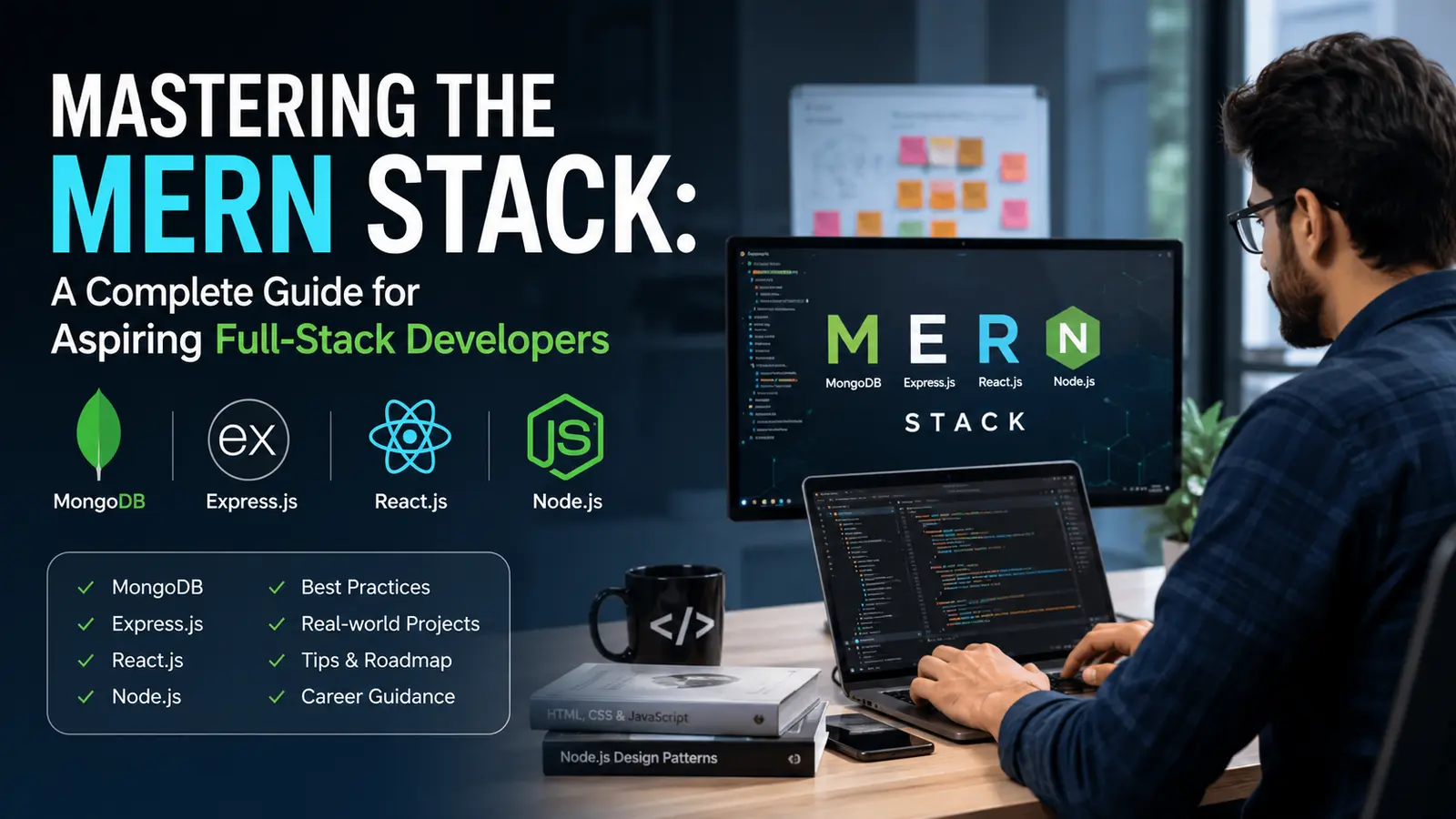
The MERN stack (MongoDB, Express.js, React, and Node.js) lets you build a complete web application using one language: JavaScript. Frontend, backend, database, all of it. No switching between Python for the server and PHP for the templates and SQL for the database. Just JavaScript, top to bottom.
This guide walks through what the MERN stack actually is, why it’s still worth learning in 2026, how each piece fits together, and what a realistic learning path looks like. Whether you’re a student picking your first stack, a career changer coming from a different field, or a working professional trying to add full-stack skills to your resume, you’ll find a practical roadmap here. Not theory. Not hype. Just what works.
What is the MERN stack?
MERN is a shorthand for four technologies that work together to build web applications:
MongoDB handles the database. Express.js runs the backend server framework. React builds the user interface. Node.js runs JavaScript outside the browser, powering the server itself.
Put them together and you get a full-stack development environment where a single language, JavaScript, handles everything from the database query to the button a user clicks. That’s the appeal. You’re not learning four separate ecosystems. You’re learning one language and four tools that speak it fluently.
Compare that to older stacks like LAMP (Linux, Apache, MySQL, PHP), where you’d juggle PHP for logic, SQL for queries, and JavaScript for the frontend. MERN collapses that complexity. One mental model. One syntax to think in.
Why learn the MERN stack in 2026?
JavaScript isn’t going anywhere. It’s been the most used language on GitHub for over a decade, and demand for full-stack developers who can move between frontend and backend keeps climbing. Companies want people who can ship a feature end to end, not just half of it.
React alone powers interfaces at Meta, Netflix, Airbnb, and thousands of smaller companies you’ve never heard of but might apply to next year. Node.js runs the backend at Uber, PayPal, and LinkedIn. MongoDB is the default choice for startups that need to move fast without locking themselves into a rigid schema on day one.
MERN Stack Development training is one of the fastest ways to become job-ready as a full-stack developer because it helps you build practical, transferable skills. Learning React makes it easier to transition to frameworks like Next.js, while Node.js provides a strong foundation for understanding server-side development and serverless functions. Express.js helps you understand how REST APIs are designed and work behind the scenes. These are fundamental web development skills that remain valuable even if you switch companies, projects, or technology stacks in the future.
And if you’re a student or someone learning MERN stack for the first time, there’s another benefit: the community is huge. Stuck on a bug at 1am? Someone’s already asked that exact question on Stack Overflow.
Components of the MERN stack
MongoDB
MongoDB is a NoSQL database, meaning it stores data as flexible JSON-like documents instead of rigid rows and columns. If you’re building an e-commerce app and a product needs extra fields tomorrow (say, a new “eco-friendly” badge), you just add the field. No migration scripts, no altering table schemas across environments.
Real example: imagine a blog platform where some posts have a video embed and some don’t. In a traditional SQL database, you’d need a separate table or a lot of nullable columns. In MongoDB, each post document just includes the fields it needs. That flexibility is why so many startups default to MongoDB when they’re still figuring out what their data will look like six months from now.
You’ll interact with MongoDB using Mongoose, a library that adds structure and validation on top of MongoDB’s flexibility, so you get the best of both: speed of development, plus guardrails against messy data.
Express.js
Express.js is a minimal backend framework that runs on top of Node.js. It handles routing (deciding what happens when someone hits /api/users versus /api/products), middleware (functions that run between a request coming in and a response going out, like checking if a user is logged in), and connecting your server to the database.
Think of Express as the traffic controller of your backend. A request comes in from the browser, Express routes it to the right function, that function talks to MongoDB, and Express sends the response back. It’s lightweight by design, which means you’re not fighting against a bloated framework that assumes it knows better than you do.
Most REST APIs you’ll build in a MERN app are Express routes: GET /api/tasks, POST /api/tasks, DELETE /api/tasks/:id. Simple, predictable, and the pattern shows up in almost every job you’ll interview for.
React
React is the frontend library that builds what users actually see and click. Instead of writing a wall of HTML and manually updating it every time data changes, you build reusable components: a navbar component, a product card component, a comment box component. Each one manages its own logic and re-renders automatically when its data changes.
Real example: on an online store, the “Add to Cart” button, the cart icon with the item count, and the cart page itself are usually three separate components that all read from the same shared state. Change the cart in one place, and React updates all three without you writing a single line of manual DOM manipulation.
React also introduced patterns like hooks (useState, useEffect) that changed how an entire generation of developers think about managing state and side effects in JavaScript full-stack development. Learn React well, and picking up React Native for mobile apps or Next.js for server-side rendering becomes a lot less intimidating.
Node.js
Node.js lets JavaScript run on a server instead of just inside a browser tab. Before Node existed, JavaScript was stuck client-side. Node changed that by wrapping Chrome’s V8 engine into a runtime that can read files, connect to databases, and handle thousands of simultaneous network requests.
Its biggest strength is the event-driven, non-blocking architecture. Real example: if your app needs to fetch data from a database, send an email, and log an analytics event, Node doesn’t wait around for each task to finish before starting the next one. It fires them off and handles the results as they come back. That’s why Node.js handles high-traffic, real-time applications (chat apps, live dashboards, streaming platforms) so well.
npm, Node’s package manager, also gives you access to over a million open-source packages, so you’re rarely building things from scratch.
How the MERN stack works together
Here’s the flow, start to finish. A user clicks a button in your React frontend. React sends an HTTP request to your Express.js server (running on Node.js). Express routes that request, maybe checks if the user is authenticated, then queries MongoDB for the data it needs. MongoDB sends the data back to Express, Express formats it as JSON, and sends it back over the network. React receives that JSON and updates the interface, no page reload required.
This request-response cycle, built on REST APIs, is the backbone of almost every modern web application. Once you understand this loop in MERN, you’ll recognize it in Django apps, Ruby on Rails apps, and Spring Boot apps too. The naming changes. The pattern doesn’t.
Benefits of learning the MERN stack
One language across the entire application means less context-switching and fewer bugs from translation errors between languages. Faster development, since JSON flows naturally from MongoDB to Express to React without conversion. A massive job market, given how many companies run on this exact combination. A huge open-source ecosystem, so you’re rarely solving a problem nobody’s solved before. And strong career flexibility, since the underlying skills (APIs, databases, component-based UI, authentication) transfer to other stacks the moment you need them to.
Skills required to become a MERN stack developer
You’ll need solid JavaScript fundamentals first: variables, functions, arrays, objects, promises, and async/await. Skipping this step and jumping straight into React usually backfires, because half of React’s confusion actually comes from shaky JavaScript basics.
Beyond that, you’ll want a working understanding of HTML and CSS for structure and styling, Git and GitHub for version control, REST API design, basic database concepts, and authentication methods like JWT (JSON Web Tokens). Deployment knowledge matters too: knowing how to get your app onto a real server (Render, Railway, or a cloud provider) instead of leaving it running only on localhost.
None of this needs to be mastered before you start. You build these skills while building projects, not before.
Step-by-step MERN stack learning roadmap
Step 1: JavaScript fundamentals
Spend 3 to 4 weeks here. ES6+ syntax, array methods like map and filter, promises, async/await, and how the this keyword actually behaves. Our JavaScript guide breaks this down if you want a structured path.
Step 2: Frontend basics
HTML5 semantics, CSS (flexbox and grid especially), and enough responsive web design to make a page look decent on both a phone and a laptop.
Step 3: React.js.
Components, props, state, hooks, conditional rendering, and React Router for multi-page apps. Build small projects here: a to-do list, a weather app pulling from a public API. Check our React.js guide for a deeper walkthrough.
Step 4: Node.js and Express.js.
Learn how to set up a server, define routes, use middleware, and build a working REST API. Our Node.js guide covers this step in more depth.
Step 5: MongoDB and Mongoose
Schema design, CRUD operations, and connecting your Express server to a real database instead of hardcoded arrays.
Step 6: Authentication and security
JWT-based login systems, password hashing with bcrypt, and protecting routes so only logged-in users can hit certain endpoints.
Step 7: Full MERN projects
Combine everything. Build something with a frontend, backend, database, and login system, deployed live where anyone can use it.
Step 8: Deployment and portfolio
Deploy your projects (Vercel for the frontend, Render or Railway for the backend, MongoDB Atlas for the database), and put them on GitHub with clear READMEs. This is what recruiters actually look at.
Most beginners moving at a steady pace, a few hours a day, get through this roadmap in 4 to 6 months. Slower if you’re doing it alongside a full-time job, faster if you’re studying full-time. There’s no fixed timeline, and anyone promising you “job-ready in 2 weeks” is selling something.
Best MERN stack projects for beginners
A to-do list app with full CRUD (create, read, update, delete) functionality is the classic starting point, and for good reason: it touches every part of the stack without overwhelming you.
From there, try a blog platform with user authentication, where users can write, edit, and delete their own posts. An e-commerce product catalog with a shopping cart teaches you state management across multiple components. A real-time chat app introduces you to Socket.io and WebSockets, which sit outside core MERN but pair naturally with Node’s event-driven design. And a personal expense tracker with charts gives you practice pulling in a charting library and working with aggregated data from MongoDB.
Pick projects that solve a problem you actually have. You’ll finish them. Projects you don’t care about tend to get abandoned around week 2.
How to learn MERN stack effectively
Don’t learn all four technologies in isolation before building anything. Learn just enough React to build a static page, then just enough Node and Express to serve it real data, then just enough MongoDB to store that data permanently. Building in small connected loops keeps things concrete instead of abstract.
Follow official documentation over random YouTube tutorials once you have the basics down. Docs get updated when the technology changes. A 3-year-old tutorial often doesn’t. Read code, not just write it: open source projects on GitHub show you patterns you won’t find in beginner courses. And build in public. Post your progress, even small wins. It keeps you accountable and sometimes gets you feedback from developers further along than you.
Common mistakes beginners should avoid
Skipping JavaScript fundamentals to jump straight into React is the biggest one. You’ll hit a wall within a week and not understand why.
Copy-pasting code without understanding it is another. It feels productive in the moment and costs you later, usually during a job interview when someone asks you to explain a line you copied 6 months ago.
Building only tutorial projects, never original ones, keeps you in a comfortable loop that doesn’t build real problem-solving muscle. Ignoring Git and version control until “later” (later never comes, and then you lose work). Not learning how to deploy, so your only proof of skill is code sitting on your own laptop. And trying to learn everything at once instead of following a sequence. MERN has four parts for a reason. Learn them in order.
Career opportunities after learning MERN stack
MERN stack developers get hired as full-stack developers, frontend developers (if you lean into React specifically), backend developers (if Node and Express become your focus), and increasingly, in freelance and contract roles building custom web apps for small businesses.
Startups particularly like MERN developers because one person can often build an entire MVP (minimum viable product) without needing a separate frontend and backend hire. That versatility is part of why the stack stays popular for early-stage companies with small teams and tight budgets.
MERN stack salary trends
Salaries for MERN stack developers vary a lot by location, experience level, and company size, so treat any specific number as a rough starting point rather than a guarantee. In India, entry-level MERN developers typically start somewhere in the ₹4 to ₹8 LPA range, with experienced developers (3+ years) often moving well beyond that depending on the company and city. In the US, junior full-stack developers commonly start in the $65,000 to $85,000 range, with senior developers earning significantly more.
These numbers shift year to year and vary by market, so check current job listings on sites like LinkedIn, Glassdoor, or AmbitionBox for your specific region before treating any figure as fixed. What tends to move the needle more than the stack itself is your project portfolio and how well you can explain your decisions in an interview.
How to choose the best MERN stack course
Look for a course that includes hands-on projects, not just video lectures you watch passively. Check whether it covers deployment, since a course that stops at “and now it runs on localhost” leaves you without the skill that actually gets you hired.
Read reviews from people who finished the course, not just the marketing page. Confirm it teaches current React patterns (hooks-based, not outdated class components) and current Node.js practices. And check if there’s a community or support system for when you get stuck, because you will get stuck, probably around week 3.
Free resources (official docs, freeCodeCamp, YouTube channels like Traversy Media or The Net Ninja) can absolutely get you to a job-ready level. Paid courses buy you structure and accountability, not knowledge you couldn’t find elsewhere.
Conclusion
The MERN stack rewards people who build instead of just watching tutorials. Pick one small project today, even something as basic as a to-do list, and get JavaScript, Express, MongoDB, and React talking to each other. That first working loop, from button click to database and back, teaches you more than another week of passive video lectures would.
Start with the JavaScript fundamentals, work through each piece of the stack in order, and build something real along the way. The roadmap above is proven. All that’s left is putting in the hours.
Frequently asked questions
1. Is MERN stack still relevant in 2026?
Yes. React, Node.js, and MongoDB remain among the most widely used technologies in web development, and job postings for full-stack JavaScript developers continue to show steady demand.
2. How long does it take to learn the MERN stack?
Most beginners need 4 to 6 months of consistent study, a few hours a day, to reach a job-ready level. It depends heavily on your prior programming background and how much time you can commit each week.
3. Do I need to know JavaScript before learning MERN?
Yes, and this is the step most beginners rush. Solid JavaScript fundamentals (functions, arrays, promises, async/await) make everything after this point easier. Skipping ahead to React without this foundation is the most common reason people get stuck.
4. Is MongoDB better than SQL databases?
Neither is objectively better. MongoDB fits projects with flexible or evolving data structures. SQL databases (like PostgreSQL or MySQL) fit projects needing strict relationships and transactions, like banking systems. Learn the one that matches your project’s needs.
5. Can I get a job with just MERN stack skills?
Yes, especially at startups and small to mid-size companies looking for versatile full-stack developers. Larger companies may also expect knowledge of testing, TypeScript, or specific cloud platforms, so treat MERN as your foundation, not your entire toolkit.
6. What is the difference between MERN and MEAN stack?
Both share MongoDB, Express.js, and Node.js. The difference is the frontend: MERN uses React, MEAN uses Angular. React tends to have a gentler learning curve and a larger job market currently, though Angular remains strong in enterprise environments.
7. Do I need to learn TypeScript for MERN stack development?
Not to get started, but it’s worth adding once you’re comfortable with plain JavaScript. Many companies now use TypeScript with React and Node.js because it catches errors before your code even runs.
8. What projects should I build to get hired as a MERN stack developer?
Aim for 2 to 3 complete, deployed projects with authentication, database integration, and a clean GitHub README. Quality over quantity. One well-built, fully functional app beats five half-finished tutorial clones.
9. Is MERN stack good for beginners in programming?
It’s approachable if you learn JavaScript first, but it’s not the gentlest entry point into programming overall. If you’ve never written code before, spend a few weeks on plain JavaScript basics before touching React, Node, or MongoDB.
10.What comes after learning the MERN stack?
Many developers move on to Next.js (for server-side rendering and better SEO), TypeScript, testing frameworks like Jest, or cloud deployment platforms like AWS. The MERN stack becomes the foundation you build additional specializations on top of.
Related article- Full stack developer roadmap