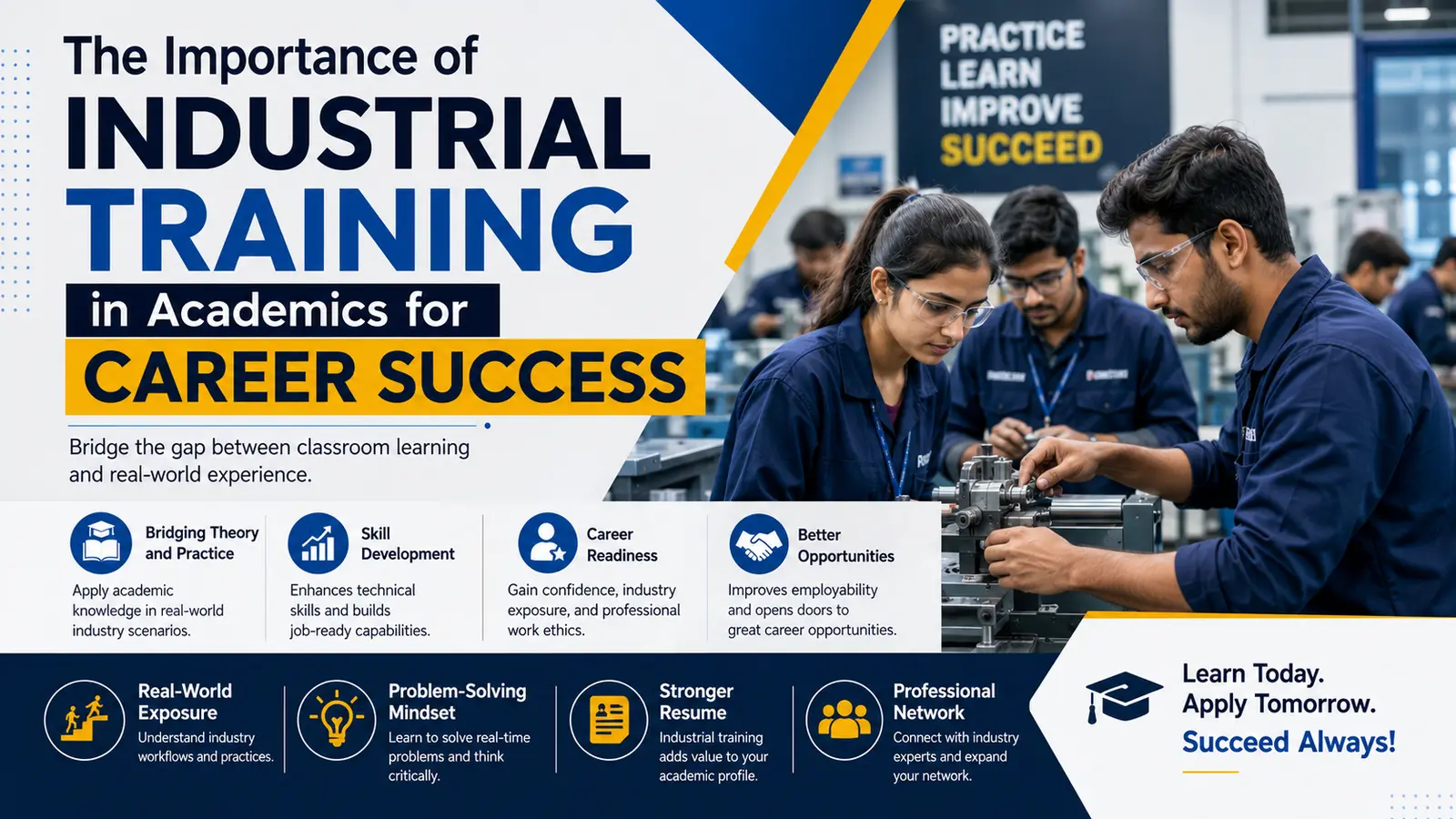
Sit in any final-year classroom and ask students one question: do you feel ready for a job? Half the hands stay down. That gap between a degree and actual job readiness is why the importance of industrial training keeps coming up in every placement cell meeting, every parent-teacher conversation, and every LinkedIn post from a hiring manager complaining about “fresher skills.” A degree tells an employer you passed exams. It doesn’t tell them you can debug a broken script at 6 PM on a deadline. Industrial training is the part of your education that actually proves that.
What is industrial training?
Definition and purpose
Industrial training is a structured period where students step out of the classroom and into a real work environment, an IT company, a manufacturing unit, a research lab, whatever matches their field, and apply what they’ve studied to actual problems. The industrial training meaning isn’t complicated: it’s supervised, hands-on exposure to how your industry actually functions, usually lasting anywhere from a few weeks to six months depending on the course and institute.
The purpose of industrial training is simple to state and hard to fake: close the distance between theory and practice. You can read about database normalization for a whole semester. You understand it differently once you’ve fixed a slow query that’s been annoying an actual team for a week.
Types of industrial training
Not all industrial training looks the same. Some students do it inside a single company for the full duration, working on one product or client project start to finish. Others rotate through departments, spending a few weeks each in development, testing, and deployment to get a broader picture. In IT industrial training specifically, a lot of programs are project-based: you’re handed a real or simulated client requirement and expected to build something, often in a small team, with actual deadlines and actual code reviews.
Industrial training vs internships
People use these words interchangeably, and honestly, in casual conversation that’s fine. But there’s a real difference. Internships are often shorter, sometimes unpaid, and can be somewhat informal about learning outcomes. Industrial training is usually built into the academic curriculum, has defined objectives set by the institute, and ends with an evaluation, a certificate, or a project report that counts toward your degree. Think of an internship as optional exposure. Industrial training is closer to a required rite of passage.
Why industrial training is important in academics
Here’s the honest version of why colleges push this so hard. Classrooms are built for depth of concept. Industry is built for speed of application. Neither one alone makes a competent professional.
When a computer science student studies networking protocols in a textbook, it stays abstract, diagrams, acronyms, exam questions. Put that same student in front of a company’s actual network setup and suddenly the protocol has a job to do. That’s the entire value of the objective of industrial training: it forces theory to earn its keep.
There’s also the workplace culture piece nobody tests you on in exams. Reporting to a manager. Explaining a delay honestly instead of hiding it. Sitting through a stand-up meeting that runs long. None of that shows up on a mark sheet, and all of it shows up on day one of a real job. Industrial training is where students get their first honest look at what a workplace actually feels like, before the stakes are as high as a full-time salary depending on it.
Top benefits of industrial training for students
The benefits of industrial training show up in layers, and it’s worth naming them individually instead of lumping them into one vague “it’s good for you” statement.
Hands-on learning is the obvious one. You stop memorizing syntax and start writing code that has to actually run. Technical skill development follows close behind: tools, frameworks, and workflows that your syllabus mentioned in passing become things you can actually operate.
Then there’s the part that surprises a lot of students: how much it improves soft skills. Communication gets tested for real when you have to explain a bug to a senior developer who doesn’t have time for a long story. Teamwork gets tested when your part of the project depends on someone else finishing theirs on time. Problem-solving stops being a theoretical chapter and becomes what you do for eight hours a day.
Confidence is the quieter benefit, but it might matter most. A student who has already sat through a code review, already missed a deadline once and recovered, already explained a mistake to a manager, walks into a placement interview differently than one who hasn’t. That confidence isn’t fake, it’s earned through repetition.
And practically speaking, industrial training gives you something to put on a resume that isn’t a course name. Employers scanning fifty identical resumes stop at the one that says “built and deployed a customer management tool during a 3-month training program” instead of just listing subjects passed. It’s real industry exposure, and often it opens networking doors too, a mentor who remembers you, a manager who refers you later, a teammate who tips you off about an opening.
How industrial training helps build a successful career
This is where the return on investment becomes obvious. Employers today aren’t just checking your CGPA, they’re checking whether you can be productive within the first month instead of the first year. Industrial training makes students job-ready in a way lecture halls simply can’t replicate.
It also shapes how you handle problems you weren’t taught to solve. Textbooks give you clean problems with clean answers. Real projects give you a client who changes requirements halfway through, or a bug that doesn’t match anything you’ve seen before. Working through that builds problem-solving muscle that shows up later in every role you take.
There’s a portfolio angle too. A student who’s worked on live projects during training walks into interviews with something concrete to talk about, not “I studied this,” but “I built this, here’s what broke, here’s how I fixed it.” That single shift changes how interview conversations go. Recruiters aren’t asking you to define a concept anymore, they’re asking you to walk them through a decision you made, and you actually have one to share.
Skills students gain during industrial training
The technical skills are the most visible outcome, whether that’s a programming language, a testing tool, or a specific software stack used by the company. But industrial training quietly builds a second set of skills that matter just as much long-term.
Project management becomes real once you’re tracking your own tasks against a deadline instead of just submitting an assignment. Time management gets forced into existence the moment you’re juggling a training module, a project deliverable, and a documentation deadline in the same week. Communication improves simply from having to explain your work to people who weren’t in the room when you built it.
Team collaboration teaches you something no group assignment in college manages to: how to work with people you didn’t choose, who have different working styles, under a deadline that doesn’t care about personality clashes. Critical thinking sharpens because industry problems rarely have one textbook-correct answer. And adaptability, maybe the most underrated skill on this list, gets built every time a requirement changes on you without warning and you have to adjust the same week.
How to choose the right industrial training program
Not every training program delivers the same value, and picking one carelessly wastes months you can’t get back. Start with the curriculum. Ask whether it’s been updated in the last year or two, because a course still teaching outdated frameworks isn’t preparing you for the industry you’re about to enter.
Check who’s actually teaching. Trainers with real industry experience talk differently than ones who’ve only ever taught. They’ll mention real client situations, actual mistakes they made, tools they’ve used under pressure, not just slide decks.
Live projects matter more than almost anything else on this list. A program that lets you sit through lectures and call it “training” isn’t industrial training in any meaningful sense. You want your hands on an actual project, ideally one with a real or realistic client brief.
Certifications add weight to your resume, but only if they come from a program with actual credibility, so it’s worth checking whether the certificate is recognized or just decorative. Placement assistance is worth asking about directly: does the institute help you find your first job after training, or do they just wave goodbye at graduation? And make sure the technologies being taught are the ones companies are actually hiring for right now, not the ones that were relevant five years ago.
Before signing up anywhere, look at student reviews. Not the ones on the institute’s own website, the ones on Google, on forums, from people who actually sat through the program and can tell you honestly whether it delivered.
Common mistakes students should avoid
Choosing training purely because it’s the cheapest option is the mistake that costs the most in the long run. A low fee often means outdated content, no live projects, and trainers with limited industry background.
Ignoring practical project work is another one. Students sometimes finish a training program having only watched demonstrations instead of building anything themselves, and that shows immediately in an interview when asked to explain their own contribution.
Not checking a trainer’s actual experience is a mistake that’s easy to avoid with one phone call or one honest question during enrollment. Skipping certifications because they seem like a formality is short-sighted too, since recruiters do look for them as a quick credibility signal.
Probably the biggest mistake of all: waiting until graduation to get any practical exposure. By then, everyone else already has a head start, and cramming industry-relevant skills into the final semester rarely works as well as building them gradually.
Who should join industrial training?
Engineering students across branches benefit obviously, since most engineering curricula are built with a practical component in mind. BCA and MCA students need it just as much, arguably more, since software roles are almost entirely judged on practical ability rather than theory scores.
B.Sc IT and computer science students fall into the same bucket, especially with how fast the tech industry itself moves. Polytechnic students, often stepping straight from a technical diploma into the job market, gain enormously from training that mirrors what a real job will demand of them.
Fresh graduates who missed out on structured practical exposure during their degree can still catch up through a focused training program before their first job search. And career changers, people moving from an unrelated field into IT or another technical industry, often find industrial training is the fastest legitimate way to build a credible skill set and a project to show for it.
Conclusion
A degree gets you through the door of eligibility. Industrial training is what makes you someone worth hiring once you’re in the room. It builds the technical ability, the soft skills, and the confidence that no textbook chapter can fully deliver, and it gives students a real answer when an interviewer asks “what have you actually built?”
If you’re a student still weighing whether to prioritize it, don’t wait until placement season to figure out you should have. Pick a program with real projects, real trainers, and real outcomes, and treat it as seriously as you’d treat your final semester exams. It’s often the difference between a resume that gets shortlisted and one that doesn’t.
Frequently asked questions
1. Why is industrial training important for students?
It closes the gap between what’s taught in a classroom and what an actual job demands, giving students real exposure to tools, workflows, and workplace expectations before they ever apply for a job.
2. What are the benefits of industrial training?
Better technical skills, stronger soft skills like communication and teamwork, a resume that stands out, real project experience, and often a network of contacts that helps later during job hunting.
3. Is industrial training compulsory?
It depends on the course and institute. Many engineering, BCA, and MCA programs make it a mandatory part of the curriculum, while for others it’s optional but still strongly recommended.
4. What is the best time to join industrial training?
Most students benefit from joining during their pre-final or final year, once they have enough foundational knowledge to actually apply during training, rather than waiting until right after graduation.
5. How does industrial training improve employability?
It gives students actual project experience to discuss in interviews, familiarity with tools companies use daily, and workplace habits like time management and clear communication that employers specifically look for.
6. Does industrial training help in placements?
Yes, quite directly. Many institutes with strong industrial training programs also have placement partnerships, and students with live project experience tend to perform better in technical interviews.
7. What skills are developed through industrial training?
Technical skills specific to the field, along with project management, time management, communication, team collaboration, critical thinking, and adaptability.
8. How do I choose the best industrial training institute?
Look at the curriculum’s relevance, the trainers’ real industry background, whether live projects are actually included, certification credibility, placement support, and genuine student reviews, not just testimonials on the institute’s own site.
9. Can industrial training be done online?
Yes, plenty of institutes now offer remote industrial training with live projects and mentorship conducted virtually, though it’s worth checking that the practical component isn’t diluted in the online format.
10. Does industrial training guarantee a job?
No program can guarantee a job, but it significantly improves the odds by making a student’s resume and interview performance noticeably stronger than someone with no practical exposure at all.