
A few years ago, a friend of mine ran a small clothing store. She used to guess how much stock to order every season. Some months she had too many jackets sitting unsold. Other months, she ran out of best-sellers during festival sales.
Then she switched to a simple AI-based inventory tool. It looked at past sales, weather patterns, and local trends to predict demand. Within two seasons, her wasted stock dropped by almost 30%. She didn’t hire a data scientist. She just used a tool built on AI and Data Science.
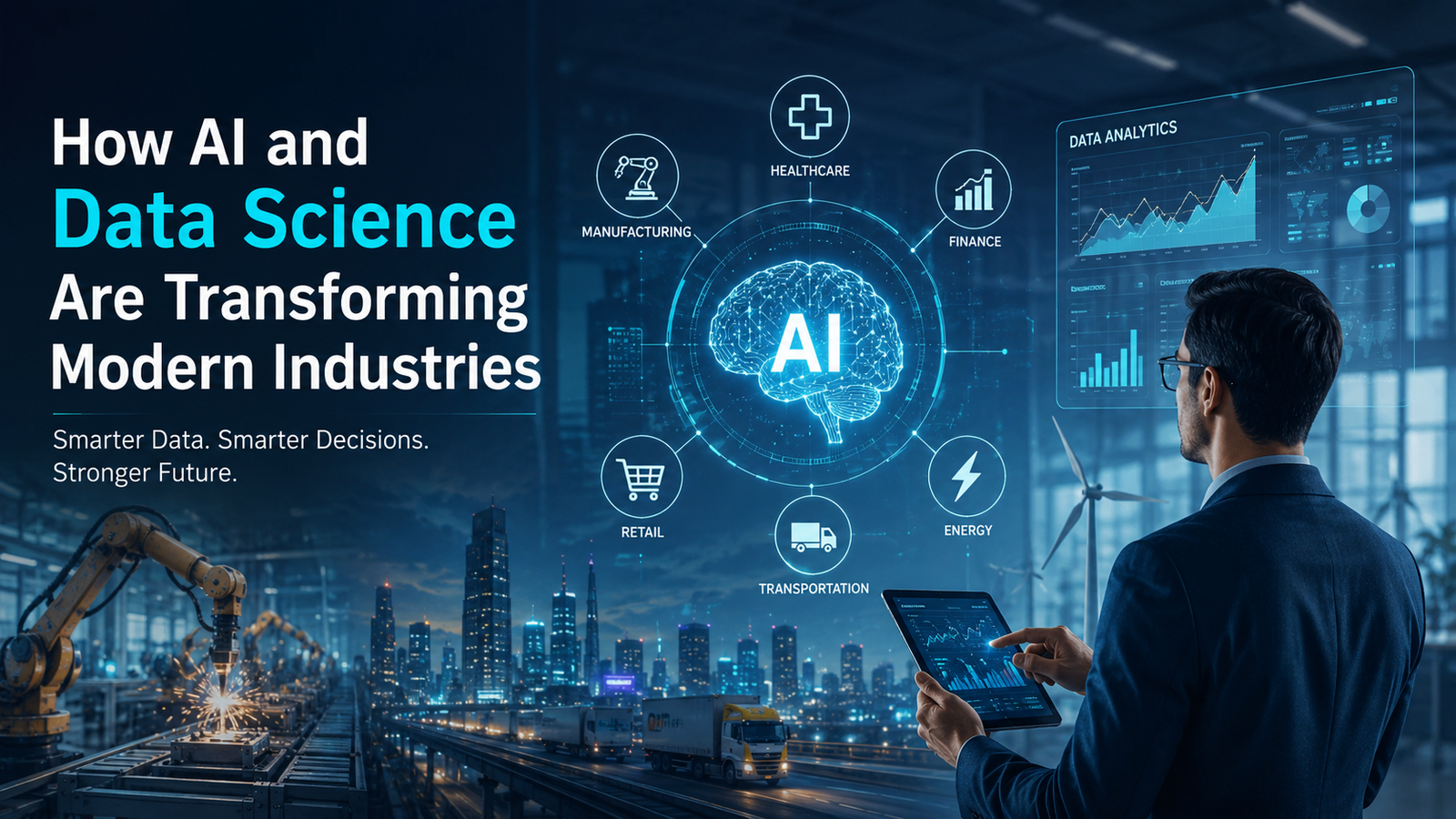
This is happening everywhere, not just in retail. Hospitals are catching diseases earlier. Banks are stopping fraud in seconds. Farmers are checking soil health from their phones. AI and Data Science are no longer futuristic ideas they are already changing how everyday industries work.
In this guide, you’ll get a clear, beginner-friendly look at what AI and Data Science actually mean, how they are reshaping 15 major industries, what skills and careers are opening up, and how you can start learning even with zero coding background.
What You’ll Learn
- What AI, Data Science, and Machine Learning really mean (in plain English)
- How they’re different from each other, with a comparison table
- How 15 industries are using AI and Data Science right now
- The real benefits and real challenges of this technology
- Popular tools professionals use daily
- Career paths, salaries, and required skills
- A step-by-step roadmap to start learning
- Best certifications and how to pick the right course
What is Artificial Intelligence (AI)?
Artificial Intelligence is the ability of a computer system to perform tasks that normally need human thinking like recognizing speech, making decisions, or spotting patterns.
How AI works (in simple terms): AI systems learn from large amounts of data. Instead of being told exact rules for every situation, they study examples and learn patterns on their own. The more good data they see, the better they get at making predictions.
Everyday AI examples you already use:
- Google Maps predicting traffic and travel time
- Netflix suggesting shows based on what you watched
- Gmail filtering spam automatically
- Voice assistants like Siri and Alexa understanding your commands
- Face unlock on your phone
You interact with AI dozens of times a day, often without noticing it.
What is Data Science?
Data Science is the field of collecting, cleaning, analyzing, and interpreting data to find useful insights and support better decisions.
The Data Science process usually looks like this:
- Collecting raw data (sales records, app logs, sensor readings, etc.)
- Cleaning the data (removing errors, duplicates, missing values)
- Analyzing patterns and trends
- Building models to predict outcomes
- Presenting insights through reports, charts, or dashboards
Real-world example: A food delivery app studies order data to figure out which areas need more delivery riders during lunch hours. That’s Data Science solving a real business problem.
What is Machine Learning?
Machine Learning (ML) is a part of AI where computers learn from data instead of being programmed with fixed instructions.
Think of it like teaching a child to recognize cats. You don’t give them a rulebook you show them many pictures of cats. Over time, the child naturally learns the pattern. Machine learning models learn in a similar way, except they use data instead of pictures shown by a parent. A well-designed Machine Learning course helps you understand how this learning process works, from preparing data and training models to evaluating their performance and applying them to real-world problems.
Types of Machine Learning:
- Supervised Learning – The model learns from labeled data (example: predicting house prices using past sale prices).
- Unsupervised Learning – The model finds hidden patterns without labels (example: grouping customers by shopping behavior).
- Reinforcement Learning – The model learns by trial and error, getting rewards for good decisions (example: AI playing chess or controlling robots).
- Get Free Demo Class ➔
AI vs Data Science vs Machine Learning vs Data Analytics
People often confuse these four terms. Here’s a simple comparison:
| Aspect | Artificial Intelligence | Data Science | Machine Learning | Data Analytics |
| Definition | Building systems that mimic human intelligence | Extracting insights and knowledge from data | Teaching machines to learn from data | Examining data to answer specific questions |
| Purpose | Automate tasks and decisions | Solve business problems using data | Improve predictions through learning | Understand past and present trends |
| Skills Required | Programming, ML, neural networks | Python/R, statistics, SQL, ML | Math, statistics, algorithms | SQL, Excel, visualization tools |
| Applications | Chatbots, self-driving cars, recommendation engines | Business forecasting, customer insights | Fraud detection, spam filters, personalization | Sales reports, performance dashboards |
| Career Opportunities | AI Engineer, AI Research Scientist | Data Scientist, Data Engineer | ML Engineer, MLOps Engineer | Data Analyst, BI Analyst |
In short: Data Science is the broad field, Machine Learning is a tool used within it, AI is the bigger goal of intelligent systems, and Data Analytics focuses on understanding existing data.
Why AI and Data Science Matter Today
Digital transformation: Companies are moving operations online and generating huge volumes of data every second. AI and Data Science help make sense of that data.
Automation: Repetitive tasks like data entry, basic customer support, and quality checks are increasingly automated, freeing people for higher-value work.
Business intelligence: Companies use data dashboards to track performance in real time instead of waiting for monthly reports.
Decision making: Instead of relying on gut feeling, businesses now use data-backed predictions to make pricing, hiring, and marketing decisions.
Competitive advantage: Companies that use AI and Data Science well can respond faster to market changes, understand customers better, and cut costs giving them a real edge over competitors who don’t.
How AI and Data Science Are Transforming Different Industries
Healthcare
Current use cases: AI helps doctors detect diseases like cancer and diabetic retinopathy from scans faster and more accurately. Hospitals use predictive models to identify patients at risk of readmission.
Benefits: Earlier diagnosis, reduced human error, faster drug discovery, and personalized treatment plans.
Real company examples: Google’s DeepMind has worked on AI models for detecting eye diseases from retinal scans. IBM Watson Health has been used for cancer treatment recommendations.
Future potential: AI-powered robotic surgery, real-time health monitoring through wearables, and faster vaccine development.
Finance
Current use cases: Banks use AI for credit scoring, algorithmic trading, and fraud detection.
Benefits: Faster loan approvals, reduced financial fraud, and smarter investment strategies.
Real company examples: PayPal uses machine learning to flag suspicious transactions in real time. Robo-advisors like Betterment use algorithms to manage investment portfolios.
Future potential: Fully AI-driven personal finance assistants and real-time risk prediction for markets.
Banking
Current use cases: Chatbots handle customer queries, AI detects unusual account activity, and credit risk models assess loan applicants.
Benefits: 24/7 customer service, reduced fraud losses, and faster processing times.
Real company examples: HDFC Bank’s chatbot “Eva” and Bank of America’s virtual assistant “Erica” handle millions of customer queries.
Future potential: Fully personalized banking experiences and predictive financial advice based on spending habits.
Retail
Current use cases: AI predicts demand, personalizes product recommendations, and manages inventory automatically.
Benefits: Reduced stockouts, better customer targeting, and higher sales conversion.
Real company examples: Walmart uses AI-driven demand forecasting across thousands of stores. Target analyzes shopping patterns to personalize offers.
Future potential: Smart stores with cashier-less checkout and AI-powered personal shopping assistants.
E-commerce
Current use cases: Product recommendations, dynamic pricing, and chatbots for customer support.
Benefits: Higher average order value, better customer retention, and reduced cart abandonment.
Real company examples: Amazon’s recommendation engine drives a large share of its sales. Flipkart uses AI for demand forecasting during big sale events.
Future potential: Virtual try-on tools using AI and highly personalized shopping journeys.
Manufacturing
Current use cases: Predictive maintenance flags machine failures before they happen. AI-powered quality checks spot defects on production lines.
Benefits: Reduced downtime, lower maintenance costs, and improved product quality.
Real company examples: Siemens uses AI-driven predictive maintenance in its factories. Tesla uses AI extensively in its automated production lines.
Future potential: Fully autonomous smart factories with self-correcting production systems.
Education
Current use cases: Adaptive learning platforms adjust content difficulty based on student performance. AI grades assignments and detects plagiarism.
Benefits: Personalized learning paths, faster feedback, and better student engagement.
Future potential: AI tutors available 24/7 and fully personalized curriculums for every student.
Marketing
Current use cases: AI segments audiences, predicts customer churn, and optimizes ad spending in real time.
Benefits: Higher return on ad spend, better-targeted campaigns, and improved customer retention.
Real company examples: Netflix uses data science to decide which shows to promote to which users. Spotify’s “Discover Weekly” is built on machine learning.
Future potential: Fully automated, real-time personalized marketing campaigns for every individual customer.
Agriculture
Current use cases: AI analyzes satellite images and sensor data to monitor crop health, soil quality, and irrigation needs.
Benefits: Higher crop yields, reduced water usage, and early detection of pest problems.
Real company examples: John Deere uses AI-powered equipment for precision farming. Microsoft‘s FarmBeats project supports data-driven agriculture.
Future potential: Fully autonomous farming equipment and AI-based climate-adaptive crop planning.
Transportation & Logistics
Current use cases: Route optimization, demand prediction, and fleet management all rely on data science.
Benefits: Lower fuel costs, faster deliveries, and better fleet utilization.
Real company examples: UPS uses an AI-driven route optimization system called ORION to save millions of miles driven each year. Uber uses AI for dynamic pricing and driver-rider matching.
Future potential: Wider adoption of self-driving delivery vehicles and drones.
Cybersecurity
Current use cases: AI detects unusual network activity, identifies malware, and flags phishing attempts.
Benefits: Faster threat detection, reduced false alarms, and proactive defense against attacks.
Real company examples: Darktrace uses machine learning to detect cyber threats in real time across organizations.
Future potential: AI systems that predict and stop attacks before they happen, based on behavior patterns.
Telecommunications
Current use cases: AI predicts network congestion, detects equipment failures, and personalizes customer plans.
Benefits: Improved network reliability, reduced customer churn, and optimized infrastructure spending.
Real company examples: AT&T and Vodafone use AI-driven analytics to manage network performance and reduce downtime.
Future potential: Self-optimizing 5G and 6G networks that adjust automatically to demand.
Government
Current use cases: AI supports traffic management, public safety monitoring, and fraud detection in welfare programs.
Benefits: More efficient public services, better resource allocation, and improved citizen services.
Real company examples: India’s Digital India and IndiaAI initiatives use data-driven systems for governance and public service delivery.
Future potential: Smart cities with AI-managed traffic, energy, and waste systems.
Entertainment & Media
Current use cases: Content recommendation, audience analysis, and AI-assisted content creation.
Benefits: Higher viewer engagement, better content targeting, and reduced production costs.
Real company examples: Netflix and YouTube both rely heavily on recommendation algorithms to keep users engaged.
Future potential: AI-generated personalized content and interactive storytelling experiences.
Real Estate
Current use cases: AI predicts property prices, analyzes market trends, and powers virtual property tours.
Benefits: More accurate pricing, faster property matching, and reduced buyer search time.
Real company examples: Zillow uses data-driven models to estimate home values (known as “Zestimate”).
Future potential: Fully AI-driven property recommendations based on lifestyle and financial data.
Benefits of AI and Data Science
- Automation: Repetitive tasks get done faster and with fewer errors.
- Better decisions: Data-backed insights replace guesswork.
- Cost reduction: Predictive maintenance and process optimization lower operational costs.
- Productivity: Employees focus on high-value work while AI handles routine tasks.
- Customer experience: Faster support and personalized service improve satisfaction.
- Personalization: Products and content are tailored to individual preferences.
- Innovation: New products and business models become possible with data-driven insights.
Challenges and Limitations
- Bias: AI models can reflect biases present in their training data, leading to unfair outcomes.
- Privacy: Collecting large amounts of personal data raises serious privacy concerns.
- Security: AI systems can be targeted by cyberattacks or misused for malicious purposes.
- Ethics: Questions around job displacement and decision transparency remain unresolved.
- High implementation cost: Building and maintaining AI systems requires significant investment.
- Skill gap: There aren’t enough trained professionals to meet growing industry demand.
- Regulations: Laws around AI use and data protection are still evolving worldwide.
Popular AI and Data Science Tools
| Tool | Use |
| Python | Main programming language for AI and Data Science |
| SQL | Querying and managing databases |
| Excel | Basic data analysis and reporting |
| Power BI | Business intelligence and dashboards |
| Tableau | Data visualization |
| Pandas | Data manipulation in Python |
| NumPy | Numerical computing in Python |
| Scikit-learn | Building traditional machine learning models |
| TensorFlow | Building deep learning models (by Google) |
| PyTorch | Deep learning framework popular in research |
| Jupyter Notebook | Writing and testing code interactively |
| Git | Version control for code projects |
| VS Code | Code editor used by most data professionals |
Skills Required
Technical Skills:
- Programming (Python or R)
- SQL and database management
- Statistics and probability
- Machine Learning fundamentals
- Data visualization
Soft Skills:
- Problem-solving
- Communication
- Curiosity and attention to detail
- Critical thinking
Business Skills:
- Understanding business goals
- Translating data insights into actionable strategy
- Basic project management
- Explore Trending Courses ➔
Career Opportunities
| Role | Job Description | Key Skills | Career Growth |
| Data Analyst | Analyzes data to find trends and create reports | Excel, SQL, Power BI/Tableau | Moves into Data Scientist or BI roles |
| Data Scientist | Builds predictive models and extracts insights | Python, ML, statistics | Moves into Senior Data Scientist or AI roles |
| AI Engineer | Builds and deploys AI-powered applications | Python, deep learning, cloud platforms | Moves into AI Architect roles |
| Machine Learning Engineer | Builds and optimizes ML models for production | Python, ML frameworks, MLOps | Moves into ML Lead roles |
| Data Engineer | Builds data pipelines and infrastructure | SQL, Python, cloud, big data tools | Moves into Data Architect roles |
| Business Intelligence Analyst | Creates dashboards and business reports | SQL, Power BI/Tableau, business knowledge | Moves into BI Manager roles |
| MLOps Engineer | Manages deployment and monitoring of ML models | DevOps, cloud, ML pipelines | Moves into Senior MLOps roles |
| AI Research Scientist | Researches new AI methods and algorithms | Advanced math, deep learning, research skills | Moves into Lead Researcher roles |
Note: Salaries vary significantly by company, location, and experience – see the salary trends table below for general ranges.
AI and Data Science Salary Trends
| Experience Level | India (Annual) | USA (Annual) |
| Entry Level (0-2 years) | ₹4-8 LPA | $70,000-$95,000 |
| Mid Level (3-6 years) | ₹10-20 LPA | $100,000-$140,000 |
| Senior Level (7+ years) | ₹25 LPA+ | $150,000+ |
Figures are general industry estimates and can vary based on company size, city, and specialization.
Who Should Learn AI and Data Science?
- Students: Build a strong foundation early and stand out in placements.
- Engineers: Add high-demand skills to existing technical knowledge.
- Commerce Graduates: Use data skills in finance, accounting, and business analytics.
- MBA Students: Combine business strategy with data-driven decision making.
- Working Professionals: Upskill to stay relevant as industries adopt AI.
- Career Switchers: Enter one of the fastest-growing job markets, even from a non-technical background.
Prerequisites
- Mathematics: Basic statistics and algebra are helpful, but you don’t need to be a math expert to start.
- Logical Thinking: The ability to break problems into steps matters more than memorizing formulas.
- No coding experience required: Most beginners start from zero and learn programming step by step.
- Laptop requirements: A basic laptop with at least 8GB RAM is enough to start learning and practicing.
Step-by-Step Learning Roadmap
- Python – Learn programming basics and syntax
- SQL – Learn to query and manage databases
- Excel – Master basic data analysis
- Statistics – Understand averages, probability, and distributions
- Data Cleaning – Learn to handle messy, real-world data
- Visualization – Learn Power BI, Tableau, or Python plotting libraries
- Machine Learning – Learn core algorithms and model building
- Deep Learning – Explore neural networks and advanced models
- Projects – Apply skills to real datasets and problems
- Portfolio – Showcase your best projects online
- GitHub – Maintain and share your code professionally
- Interview Preparation – Practice technical and case-study questions
- Job Applications – Apply strategically and network actively
How to Choose the Right AI and Data Science Course
- Curriculum: Check if it covers both fundamentals and advanced, in-demand topics.
- Live Projects: Practical, real-world projects matter more than theory alone.
- Industry Mentors: Learning from working professionals adds real perspective.
- Placement Support: Look for structured career and interview support.
- Certifications: Recognized certificates add credibility to your resume.
- Internship: Hands-on internship experience strengthens your portfolio.
- Alumni Reviews: Genuine reviews from past students reveal the real course experience.
Future Scope of AI and Data Science
- Generative AI: Tools that create text, images, and code are reshaping content creation and software development.
- Large Language Models (LLMs): Models like these power chatbots, coding assistants, and search tools.
- AI Agents: Systems that can complete multi-step tasks autonomously are gaining traction across industries.
- Robotics: AI-powered robots are expanding in manufacturing, logistics, and healthcare.
- Healthcare AI: Faster diagnosis and drug discovery will continue to expand.
- Climate Tech: AI is being used to model climate patterns and optimize energy usage.
- IndiaAI Mission: India’s national initiative aims to boost AI research, infrastructure, and talent development.
- Global Job Market: Demand for AI and Data Science professionals continues to grow across nearly every industry worldwide.
Frequently Asked Questions
1. What is the difference between AI and Data Science?
AI focuses on building intelligent systems, while Data Science focuses on extracting insights from data. Data Science often uses AI and Machine Learning as tools.
2. Do I need a coding background to learn Data Science?
No. Most learners start with zero coding experience and build skills step by step through structured courses.
3. How long does it take to learn AI and Data Science?
On average, it takes 6 to 12 months of consistent learning to become job-ready, depending on prior background.
4. Is math necessary for Data Science?
Basic statistics and algebra help, but you don’t need advanced math to start. You can build math skills alongside practical learning.
5. Which industries hire AI and Data Science professionals?
Almost every industry hires them today, including healthcare, finance, retail, manufacturing, and government.
6. What is the average salary of a Data Scientist in India?
Entry-level Data Scientists in India typically earn between ₹6-10 LPA, increasing significantly with experience.
7. Can commerce or arts students learn Data Science?
Yes. Many successful data professionals come from non-technical backgrounds and learn the required skills through courses.
8. What is the best programming language for Data Science?
Python is the most widely used language due to its simplicity and strong library support.
9. Will AI replace jobs?
AI will automate certain repetitive tasks, but it also creates new roles focused on managing, building, and improving AI systems.
10. What is the difference between Data Analyst and Data Scientist?
Data Analysts focus on interpreting existing data, while Data Scientists build predictive models and work with more complex problems.
Conclusion
AI and Data Science are no longer optional skills they are becoming core to how modern industries operate, from healthcare and finance to agriculture and entertainment. Whether you’re a student, a working professional, or someone looking for a career change, understanding these fields opens doors to some of today’s most in-demand careers.
The good news is that you don’t need a technical background or years of preparation to begin. With the right roadmap, consistent practice, and real-world projects, anyone can build a strong foundation in AI and Data Science.
If you’re ready to take the next step, consider exploring a structured AI and Data Science course that offers hands-on projects, mentorship, and career support to help you transition confidently into this growing field.
Also read :- How Appwars Technologies Shaping the Future of Data Science Training in Noida