I get this question almost every week from students at Appwars Technologies. Someone’s picked their laptop, downloaded Figma or Canva, maybe even watched a few YouTube tutorials on Google Ads. And then they freeze.
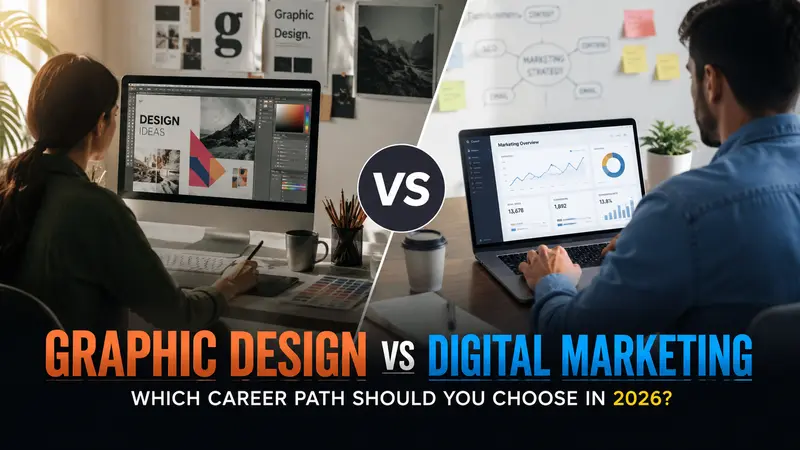
Graphic design vs digital marketing. Two completely different worlds, both promising good money and creative freedom. Both flooding LinkedIn with “hiring now” posts. So which one actually fits you?
I’ve mentored students who picked the wrong path for the right reasons and watched others switch lanes 6 months in and finally feel at home. There’s a real difference between graphic design and digital marketing, and once you see it clearly, the decision gets a lot easier.
Let’s break it down properly: what each field actually involves, what you’ll earn, what a real day looks like, and how to figure out which one matches how your brain works.
What is graphic design, really?

Graphic design is visual communication. You’re translating a message, a feeling, a brand, into something people see and instantly understand.
Logos. Posters. App interfaces. Packaging. Instagram carousels. Brand guidelines that tell a whole company what shade of blue to use and why.
A graphic designer at a startup might spend Monday morning sketching wireframes for a new app screen, Tuesday afternoon picking typography for a client’s rebrand, and Wednesday in a feedback loop where the client wants the logo “a little more bold but also more friendly” (every designer has heard this exact sentence).
The tools of the trade are Adobe Photoshop, Illustrator, InDesign, and Figma, sometimes After Effects if motion graphics are involved. You’re solving a communication problem with pixels and proportion in every single brief.
Good design has a point of view. Bad design is “We made the logo bigger because the client said so.” Good design is knowing when to push back and why.
What is digital marketing, really?

Digital marketing is getting the right message to the right person at the right moment, using digital channels. SEO, social media, email, paid ads, content, analytics. All of it.
Where a designer asks, “Does this look right?” a marketer asks, “Did this work?” Did the campaign get clicks? Did it convert? What’s the cost per lead, and is that number going up or down month over month?
A digital marketer’s week might include setting up a Google Ads campaign on Monday, writing a blog post optimized for search on Tuesday, pulling open-rate data from an email campaign on Wednesday, and spending Thursday afternoon staring at Google Analytics trying to figure out why traffic dropped 12% (it’s always either a tracking issue or a Google algorithm update; in my experience, it’s usually the algorithm).
Marketing leans on data the way design leans on visual instinct. You’re constantly testing this headline vs that one, this ad creative vs another, and this subject line vs the alternative. Numbers tell you who won.
Get Free Career Counseling ➔Graphic design vs digital marketing: the core difference between graphic design and digital marketing
Here’s the cleanest way I can put it.
Design is about how something looks and feels. Marketing is about how something performs.
A designer cares about visual hierarchy, color theory, typography, spacing, and whitespace. A marketer cares about click-through rate, conversion rate, cost per acquisition, and engagement rate.
Design output: a finished visual asset. Marketing output: a number that went up (hopefully).
Design timelines tend to be project-based: you finish the logo, you ship the website, you’re done until the next brief. Marketing is ongoing. Campaigns never really “finish.” You optimize, you test, you adjust, every single week, sometimes every single day.
That doesn’t mean the two don’t talk to each other. They talk constantly. A marketer needs a designer’s banner ad to actually convert. A designer needs a marketer’s data to know if the new packaging is working in the market. The best campaigns I’ve seen come out of designers and marketers respecting each other’s lane instead of competing over it.
Are digital marketing and graphic design the same?
No. And I want to be direct about this because a lot of students ask it like there’s a trick answer.
People sometimes assume digital marketing and graphic design are the same because both show up on Instagram, both involve “creative” work, and both get lumped into “marketing department” on an org chart at smaller companies. But the actual skill sets, the daily tasks, and the way success gets measured are completely different.
A graphic designer’s success is judged by a creative director or client: does this look professional, on-brand, and polished?
A digital marketer’s success is judged by a dashboard: did the number move?
If you’ve ever wondered, “Are digital marketing and graphic design the same?” the honest answer is they overlap at the edges (both need some visual sense, and both need to understand a brand), but they’re separate disciplines requiring separate skills.
Get Free Demo Class ➔Digital marketing vs graphic design career: paths, growth, and where each one takes you
Graphic design career path
Most designers start as a junior graphic designer or visual designer, usually at an agency or in-house design team. From there, the typical climb looks like:
Junior Designer → Senior Designer → Art Director → Creative Director
Specializations open up fast too. UI/UX design (designing app and website interfaces) has become its own massive field, often paying more than traditional graphic design. Motion graphics, packaging design, brand identity design, illustration. Each one is its own little career inside the bigger career.
Freelancing is huge in design. A skilled designer with a strong portfolio can go independent fairly early and build a client base on Behance, Dribbble, or just word of mouth.
Digital marketing career path
Marketers usually start as a digital marketing executive or SEO/social media associate. The ladder:
Marketing Executive → Digital Marketing Manager → Head of Marketing → CMO
Specializations here include SEO specialist, performance marketing manager (paid ads), content strategist, marketing automation expert, and growth marketer. Each of these can become a full career track on its own.
Marketing roles open up faster in sheer number, because every single company with a website needs marketing. Every company doesn’t necessarily need an in-house designer (some outsource it entirely).
If you’re weighing a digital marketing vs graphic design career on job availability alone, marketing currently has the volume advantage. But design, especially UI/UX, is catching up fast as more companies build their own apps and products.
Graphic design vs digital marketing salary: what you’ll actually earn
Let’s talk numbers, because this is usually the real question underneath the polite one.
In India, an entry-level graphic designer typically starts around ₹2.5 to 4 LPA. With 3 to 5 years of experience and a strong portfolio, that climbs to ₹6 to 10 LPA. Senior designers and art directors at bigger brands or agencies can cross ₹12 to 18 LPA, and freelancers with the right clients sometimes earn more than that, just less predictably.
UI/UX designers tend to sit higher on this scale, often starting closer to ₹4 to 6 LPA fresh out of training, because the demand is sharper right now.
Entry-level digital marketers typically start around ₹2.5 to 4.5 LPA as well, pretty close to design at the junior level. With 3 to 5 years of experience, especially if you specialize in SEO, performance marketing, or marketing automation, ₹7 to 12 LPA is realistic. Digital marketing managers and heads of marketing at growing companies often land ₹15 to 25 LPA, sometimes higher at larger firms or with a strong track record of campaign results.
So on a graphic design vs digital marketing salary comparison, they start in a similar range, but marketing salaries tend to scale up faster in the mid-career stretch, mostly because measurable results (leads, revenue, ROI) are easier to negotiate a raise around than “the brand identity looks great.”
A designer who specializes in UI/UX or moves into a creative director role can absolutely out-earn a generalist marketer, though. It depends more on specialization and skill depth than the field itself.
Explore Trending Courses ➔Which one fits your brain better?
This is the part people skip, and it’s the part that actually matters most.
Ask yourself: when you’re scrolling Instagram, do you notice the font choice on a post, or do you wonder why it showed up in your feed in the first place?
If you’re someone who redesigns your friend’s wedding invite for fun, who has opinions about kerning, and who gets genuinely annoyed by a misaligned logo, design might be home for you.
If you’re the person asking, “But how did they get 50,000 views on that?” Analyzing why one Instagram reel did better than another, curious about the mechanics behind virality—that’s a marketer’s brain.
Neither is better. They’re just wired differently. I’ve seen students with strong art backgrounds struggle in marketing roles because the ambiguity of “we don’t know why this campaign underperformed, test 5 more variations” drove them up the wall. And I’ve seen naturally analytical students get bored stiff doing the fifth round of logo revisions for a client who keeps changing their mind.
A quick story that actually shows the difference
A student of mine, let’s call her Priya, joined our digital marketing course thinking she’d be making Instagram graphics all day. Three weeks in, she was knee-deep in Google Analytics, tracking which blog post drove the most newsletter signups for a client project. She told me it felt like solving a puzzle where the answer is hidden in spreadsheets.
Another student, Rohan, joined thinking marketing was the safer bet job-wise. Two months into the graphic design course, he was the one staying late perfecting kerning on a poster nobody had even asked him to redo. He’d found his thing by accident.
Both ended up in the right place. Neither would have guessed it walking in.
Can you do both?
Yes, and honestly, a hybrid skill set is becoming one of the more valuable things you can offer right now.
A marketer who understands design basics, color theory, layout, and visual hierarchy can brief a designer better and even create quick assets without waiting on someone else. A designer who understands marketing fundamentals, what converts, what gets clicked, and how SEO affects a webpage’s design builds things that actually perform in the market and look good in a portfolio too.
Roles like “marketing designer” or “growth designer” exist specifically because companies want this overlap. If you’re genuinely torn between the two, you don’t have to fully commit to one and abandon the other. Plenty of professionals build a base in one and pick up working knowledge of the other along the way.
So, digital marketing or graphic design?
If you’re still asking yourself “digital marketing or graphic design” after everything above, here’s the short version.
Pick graphic design if you think visually first, you get energy from making things look right, and you want a craft you can keep sharpening for years (typography alone is a lifetime study).
Pick digital marketing if you think in numbers and patterns first, you like the chase of figuring out what works, and you want a field where every company, forever, will need someone to do your job.
Both pay well. Both have real career ladders. Both are in genuine demand in 2026, with companies hiring for both roles constantly, whether it’s a startup building its first website or an enterprise scaling its content engine.
If you’re still unsure, here’s a practical move: try a short project in each before committing to a full course. Design a simple poster. Run a tiny test ad campaign on a $5 budget. See which one you think about after you’ve closed the laptop.
That instinct, the thing you keep thinking about, is usually your answer.
If design is calling, our graphic design course is built to take you from fundamentals to a portfolio that gets you hired. If the numbers and strategy side excites you more, our digital marketing course covers SEO, paid ads, content, and analytics, the full stack employers are actually looking for in 2026.
Either way, stop deliberating and start building. The portfolio (or the campaign results) will make the case for you better than any career quiz ever could.