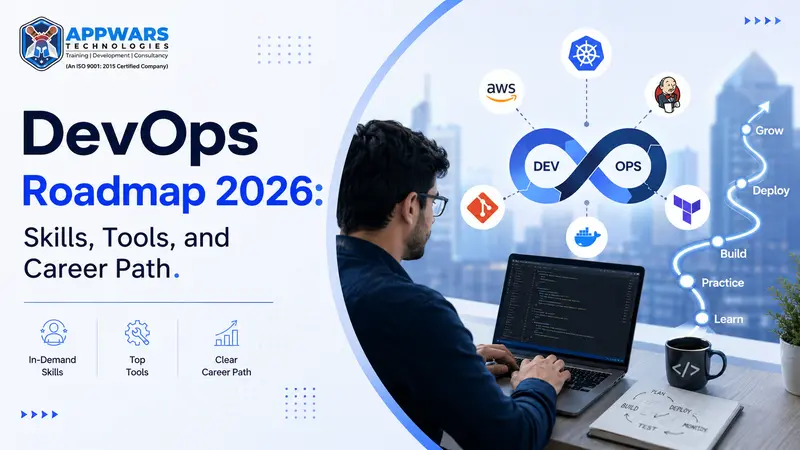
So you want to become a DevOps engineer. Good call. Every company shipping software at scale needs someone who can bridge development and operations, and right now, that person is in short supply.
A DevOps roadmap sounds simple on paper. Learn Linux, pick up Docker, and touch Kubernetes. Done. In practice, most people get stuck halfway. They memorize tool names without understanding why the tools exist, then wonder why interviews go badly.
This guide lays out an honest DevOps engineer roadmap for 2026: what to learn, in what order, which tools actually matter on the job, and where the career goes after your first role. I’ll cover the AWS DevOps roadmap and Azure DevOps roadmap separately too, since cloud choice changes a chunk of what you study.
This works whether you’re a final-year B.Tech student with zero industry exposure or a working professional switching out of a manual QA or system admin role. The order of learning stays the same either way. What changes in your pace, and how much of Stage 1 can you skip because you already know it?
What DevOps actually means (skip if you already know)
DevOps isn’t a job title someone invented to sound fancy. It’s the practice of getting code from a developer’s laptop to production, fast and without breaking things, by tying development and operations together instead of keeping them in separate silos.
Before DevOps, a developer would write code, throw it over the wall to an ops team, and wait. Deployments took weeks. Blame games were common. DevOps replaced that handoff with automation, shared ownership, and continuous feedback.
That’s it. Everything else, the tools, the pipelines, the dashboards, exists to make that handoff faster and safer.
Get Free Career Counseling ➔Why this roadmap matters right now
Cloud adoption in India hasn’t slowed down. Every mid-size company migrating to AWS or Azure needs engineers who can automate deployments, manage infrastructure as code, and keep systems running at 2 a.m. when something breaks.
Job postings for DevOps roles have grown steadily across Delhi NCR, Bengaluru, Hyderabad, and Pune. Fresh graduates with hands-on project experience routinely out-negotiate candidates who only hold a certificate. That’s the gap this roadmap is built to close, with real project work at every stage.
A structured devops career roadmap also helps you avoid the trap most self-taught learners fall into: bouncing between YouTube tutorials with no sense of sequence. Foundation first. Tools second. Cloud and orchestration third. Specialization lasts.
This sequence isn’t a guess. It’s pulled from what trainers at Appwars Technologies see repeatedly across batches: students who skip Linux and Git to jump straight into Kubernetes videos take longer to get job-ready than students who spend three extra weeks on fundamentals first. Ten-plus years of running IT training programs in Noida tends to surface the same pattern over and over.
The DevOps engineer roadmap: four stages
Here’s how the roadmap breaks down, stage by stage.
| Stage | Focus | Core skills | Rough timeline |
|---|---|---|---|
| 1. Foundation | Systems thinking | Linux, networking basics, shell scripting, Git | 1 to 2 months |
| 2. Core DevOps | Automation | CI/CD pipelines, configuration management, containers | 2 to 3 months |
| 3. Cloud and orchestration | Scale | AWS or Azure, Kubernetes, infrastructure as code | 2 to 3 months |
| 4. Specialization | Depth | Security, monitoring, SRE practices, architecture | Ongoing |
Let’s go through each one.
Stage 1: Foundation
Skip this stage and everything after it gets harder. Most DevOps interviews open with a Linux question, not a Kubernetes question.
Learn:
- Linux file systems, permissions, process management
- Basic networking: DNS, load balancers, ports, firewalls
- Shell scripting (bash, at minimum)
- Git: branching, merging, pull requests, resolving conflicts
Nobody hires a DevOps engineer who can’t navigate a terminal comfortably. Get fast at this before moving on.
Get Free Demo Class ➔Stage 2: Core DevOps tools
This is where automation starts. You’re learning to build pipelines that take code from a commit to a running application without a human clicking “deploy” fifteen times.
Learn:
- CI/CD: Jenkins, GitHub Actions, GitLab CI
- Configuration management: Ansible, Chef, or Puppet (Ansible is the most common ask in Indian job listings right now)
- Containers: Docker, image builds, multi-stage builds
- Basic infrastructure as code: Terraform fundamentals
Build a small pipeline yourself. Take a sample app, containerize it, and push it through a CI/CD pipeline to a test server. That project alone will teach you more than a month of video lectures.
Stage 3: Cloud and orchestration
Pick a cloud platform. AWS and Azure both dominate hiring in India, and I’ll cover the differences below.
Learn:
- Your chosen cloud’s core services (compute, storage, IAM, networking)
- Kubernetes: pods, deployments, services, Helm charts
- Infrastructure as code at scale: Terraform modules, state management
- Monitoring basics: Prometheus, Grafana, or the cloud-native equivalents
This stage takes longer because Kubernetes has a real learning curve. Budget extra time here. Don’t rush it.
Stage 4: Specialization
Once the fundamentals are solid, pick a direction. Security-focused DevOps (DevSecOps), site reliability engineering, or platform architecture all branch off from here.
This stage doesn’t really end. Even senior engineers keep learning new tools as the ecosystem shifts.
Tools you’ll actually use on the job
Course syllabi list dozens of tools. In practice, most teams run a smaller, fairly standard stack. Here’s what shows up most often in Indian job postings:
| Category | Common tools |
|---|---|
| Version control | Git, GitHub, GitLab, Bitbucket |
| CI/CD | Jenkins, GitHub Actions, GitLab CI, Azure Pipelines |
| Containers | Docker, Podman |
| Orchestration | Kubernetes, Helm, ArgoCD |
| Infrastructure as code | Terraform, AWS CloudFormation, Azure Bicep |
| Configuration management | Ansible, Chef, Puppet |
| Monitoring and logging | Prometheus, Grafana, ELK stack, Datadog |
| Cloud platforms | AWS, Microsoft Azure, Google Cloud |
You don’t need to master all of these before applying to jobs. Pick one tool per category, get genuinely good at it, and list the rest as familiar on your resume. Depth beats a long list of tools you’ve only skimmed.
AWS devops roadmap: the cloud-specific path
If you’re picking AWS, your roadmap gets a specific shape after Stage 2.
Focus on:
- EC2, S3, and IAM as your baseline
- CodePipeline and CodeBuild for native CI/CD
- Elastic Container Service (ECS) or Elastic Kubernetes Service (EKS) for orchestration
- CloudFormation or Terraform for infrastructure as code
- CloudWatch for monitoring and alerting
AWS still holds the largest share of cloud infrastructure jobs in India, which is why most DevOps job descriptions list it as a requirement even for teams primarily running on Azure. If you want structured, hands-on training instead of piecing this together from documentation, Appwars Technologies runs an AWS course in Noida that walks through these services with live projects.
The AWS DevOps Engineer Professional certification is worth pursuing once you’ve got 6 to 12 months of hands-on practice. It’s not a shortcut around experience, but it does signal to recruiters that you understand the platform beyond a beginner level.
Azure DevOps roadmap: the Microsoft path
Azure’s DevOps roadmap overlaps with AWS’s on concepts (CI/CD, IaC, containers), but the tools differ, and so does the hiring pool. Azure shows up heavily in enterprises already running Microsoft stacks: banks, insurance firms, and large Indian IT services companies.
Focus on:
- Azure DevOps Services (Boards, Repos, Pipelines, Artifacts)
- Azure Kubernetes Service (AKS)
- Azure Resource Manager (ARM) templates or Bicep for infrastructure as code
- Azure Monitor for observability
- Azure Active Directory for identity and access management
One thing worth knowing: Azure DevOps (the product) and “DevOps on Azure” (the practice) get confused constantly in job postings. Read the description carefully. Some roles want Azure DevOps Services experience specifically, not general Azure cloud administration.
Appwars Technologies offers an Azure course in Noida that covers both sides: the DevOps tooling and the underlying cloud infrastructure work.
DevOps architect roadmap: what changes at the top
A DevOps architect roadmap picks up where the engineer roadmap ends. The tools stay familiar, but the job changes shape.
At the architect level, you’re not writing every pipeline yourself. You’re deciding:
- Which cloud services the organization standardizes on
- How environments are structured (dev, staging, production, disaster recovery)
- Security and compliance boundaries across the infrastructure
- Cost management across the entire cloud footprint
- How multiple teams’ pipelines and tooling stay consistent with each other
Getting here usually takes 6 to 8 years of hands-on engineering work first. There’s no shortcut through certifications alone. Architects need scar tissue, the kind you only get from debugging a production outage at 3 a.m. and tracing the problem back to its root cause.
DevOps career roadmap: titles, timeline, and pay in India
Here’s roughly how the career ladder looks and what it pays in India as of 2026.
| Level | Typical title | Years of experience | Approximate salary (India, per annum) |
|---|---|---|---|
| Entry | DevOps Engineer / Junior DevOps Engineer | 0 to 2 | Rs 4 to 7 lakh |
| Mid | DevOps Engineer / Cloud Engineer | 2 to 5 | Rs 10 to 18 lakh |
| Senior | Senior DevOps Engineer / SRE | 5 to 8 | Rs 18 to 35 lakh |
| Lead / Architect | DevOps Architect / Platform Lead | 8 plus | Rs 35 lakh and up |
Numbers shift with city, company type, and certification, but that’s the general shape. Product companies and GCCs (global capability centers) tend to pay more than traditional service companies for the same experience band. Bengaluru and Hyderabad lead on average pay, with Delhi NCR close behind.
Certifications move the needle too. An AWS Certified DevOps Engineer or a Certified Kubernetes Administrator (CKA) credential, backed by real project work, can add a meaningful bump to your starting offer. Certifications without hands-on skills, though, don’t fool anyone past the first technical round.
Skills beyond the tool list
Tools get all the attention in roadmap videos, but two skills quietly decide who gets promoted and who plateaus.
Incident response. When production goes down, someone has to stay calm, diagnose fast, and communicate clearly while fixing it. That’s a skill you build through practice drills, not documentation reading.
Cross-team communication. DevOps sits between developers, QA, security, and business teams. If you can’t explain a deployment risk in plain language to a non-technical manager, your technical skills lose half their value.
Neither shows up on a resume as a bullet point. Both show up in interviews fast.
Building a portfolio that actually gets you hired
Recruiters skim resumes in under 30 seconds. A GitHub profile with real, documented projects does more work than another line item on your resume.
Build:
- A CI/CD pipeline for a sample application, documented with a README explaining your decisions
- A Terraform module that provisions a small piece of infrastructure (a VPC, an EC2 instance, an S3 bucket)
- A Kubernetes deployment with at least two services talking to each other
- A monitoring dashboard tracking a metric that actually matters, like response time or error rate
Four solid, documented projects beat twelve half-finished ones. Pick quality over quantity every time.
Mistakes people make on this roadmap
A few patterns show up again and again with students starting out:
- Jumping straight to Kubernetes before understanding Docker properly
- Collecting certifications without building anything alongside them
- Learning tools in isolation instead of connecting them into a working pipeline
- Ignoring Linux and networking fundamentals because they feel boring
- Picking a cloud platform based on hype rather than the local job market
Each of these costs time. Fix the sequence, and the roadmap moves a lot faster.
Frequently Asked Questions
Is DevOps a good career in 2026?
Yes. Cloud adoption and automation demand keep growing, and companies still struggle to find engineers who understand both infrastructure and software delivery. Entry-level competition is real, but a solid portfolio cuts through it fast.
How long does the full DevOps roadmap take?
Budget 6 to 9 months for Stages 1 through 3 if you’re studying seriously, more like 4 to 5 months if you already have a development or sysadmin background. Specialization keeps going for years after that.
Do I need to know coding to start a DevOps career roadmap?
You need scripting, not full software development. Bash and Python cover most of what you’ll do day to day: automating tasks, writing small tools, and gluing pipelines together.
AWS or Azure: which should I learn first?
Check job postings in your target city first. Delhi NCR runs a healthy mix of both, with a slight lean toward AWS in product companies and Azure in enterprise and BFSI firms. Pick the one with more local openings, then add the other later.
Can a non-IT graduate switch into DevOps?
It happens regularly, usually from QA, system administration, or network engineering backgrounds. The transition is smoother than switching from a completely unrelated field, since you already understand systems and troubleshooting.
Where to start
If you’re mapping out a roadmap for devops from zero, don’t try to self-teach every stage in isolation. Structured training with real mentorship catches gaps that YouTube playlists miss, especially around debugging pipelines that break in ways tutorials never show you.
Appwars Technologies runs a DevOps course in Noida built around this exact roadmap: Linux and Git fundamentals, CI/CD, containers, cloud (AWS and Azure), and Kubernetes, with hands-on projects at every stage and placement support once you’re through.
Pick your stage, start there, and build something real before moving to the next one. That’s the whole roadmap: sequence, practice, and enough patience to not skip the boring parts.