A friend of mine spent six months learning AWS from YouTube videos. He could recite what an EC2 instance was. He’d never actually launched one, configured a security group, or fixed a broken deployment at 2 a.m. When he finally sat for an interview, the panel asked him to design a simple three-tier architecture on a whiteboard. He froze. That’s the gap between knowing about AWS and knowing AWS.
Cloud computing isn’t a trend anymore, it’s just how companies build software now. Startups don’t buy servers. Banks don’t run their own data centers if they can help it. And AWS sits at the center of almost all of it, holding roughly a third of the global cloud market, way ahead of Azure and Google Cloud.
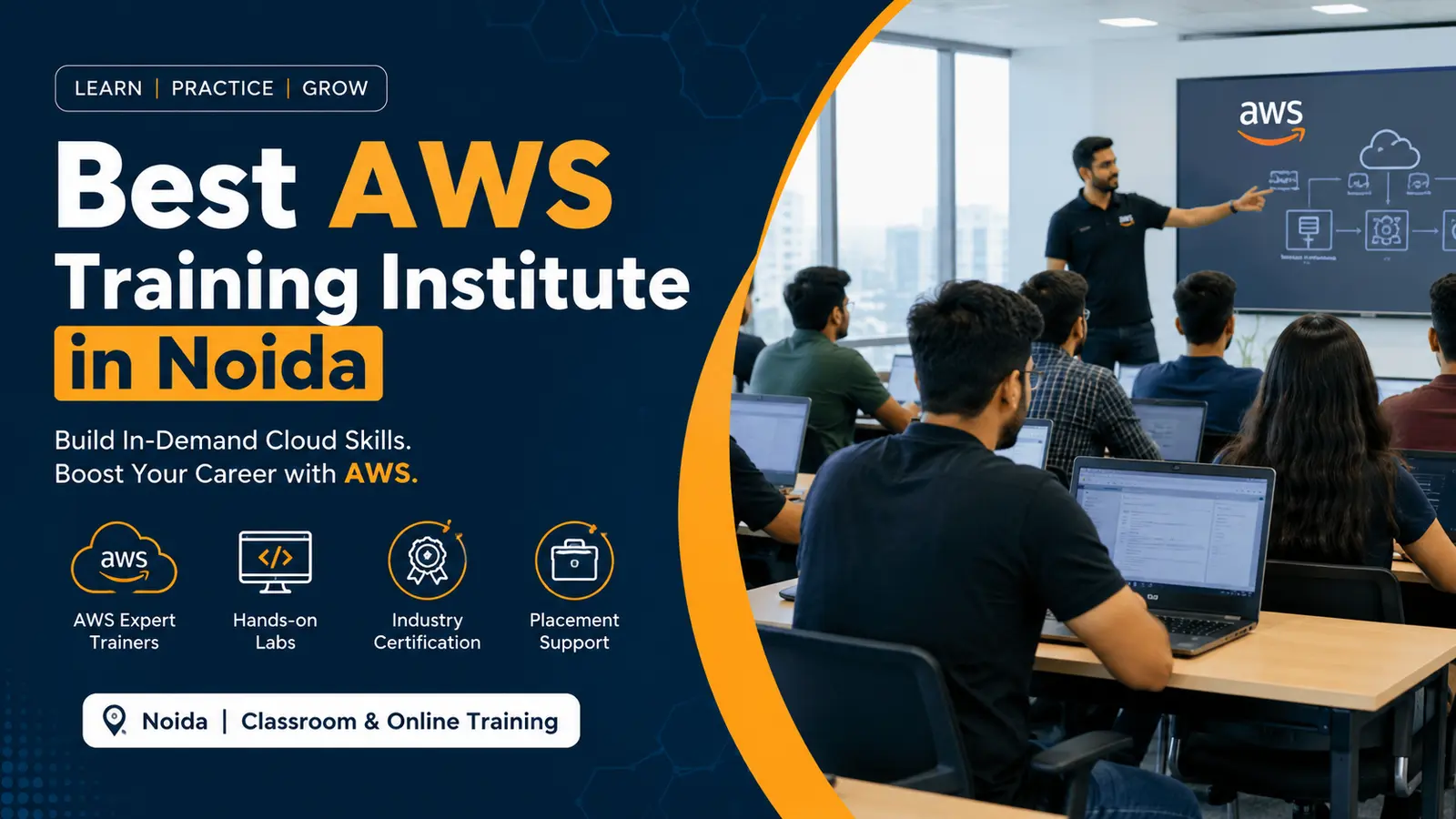
If you’re searching for an AWS training institute in Noida, you’re probably trying to figure out how to close that same gap my friend fell into: turning theory into something you can actually do on the job. This piece walks through what AWS is, what a good course should teach you, which certifications matter, and how to pick an institute that won’t waste your time.
What is AWS and why is it so popular?
Amazon Web Services is Amazon’s cloud computing arm. Instead of buying physical servers, storage, and networking gear, companies rent computing power from AWS and pay for what they use. That’s the whole idea behind cloud computing: on-demand infrastructure instead of owning hardware that sits idle half the time.
AWS runs data centers across more than 30 geographic regions worldwide, each split into multiple availability zones so a single hardware failure doesn’t take down an entire application. That’s a big part of why banks, hospitals, media companies, and government agencies trust it with real workloads.
The appeal is practical. You don’t need capital to buy servers. You scale up during a traffic spike and scale down when it’s quiet, paying only for what you use. Netflix runs on AWS. So does Airbnb, Samsung, and a huge chunk of the fintech and healthtech industry in India. When companies this size bet their infrastructure on one platform, engineers who know that platform become valuable fast.
Why choose an AWS training institute in Noida?
Noida isn’t just a satellite city near Delhi anymore. It’s turned into a genuine IT hub, home to companies like HCL, Adobe, Paytm, and dozens of smaller product startups and service firms that are actively hiring cloud engineers. That local demand matters more than people realize.
An online course from a random platform teaches you the syllabus. A good AWS institute in Noida connects you to the local hiring pipeline, alumni working at nearby companies, and instructors who know exactly what interview panels at these firms are asking right now. Classroom learning, or even live online batches, gives you something self-paced videos can’t: a trainer who notices you’re stuck on IAM policies and stops to fix it before you fall further behind.
There’s also a networking angle people underestimate. Sitting next to someone from a different company background, comparing notes on a lab exercise, asking a working professional in your batch how they use AWS at their job, that kind of exchange doesn’t happen watching a recorded video alone at midnight.
Features of the best AWS training institute in Noida
Not every institute advertising “AWS training” actually delivers it well. Here’s how to tell the difference.
Trainers who’ve actually worked with AWS
There’s a real difference between someone who’s read the documentation and someone who’s debugged a production outage on AWS at 3 a.m. Ask about the trainer’s background before you enroll. If they can’t describe a real project they’ve built, that’s a red flag.
A curriculum that’s actually current
AWS releases new services and updates old ones constantly. A course still teaching the old EC2 console from three years ago, or skipping newer services like ECS and EKS, is teaching you to fail an interview in 2026.
Hands-on labs, not just slides
You learn AWS by breaking things and fixing them, not by watching someone else click through a console on a projector. The best institutes give you your own AWS account access or sandbox environment for every module.
Live cloud projects
A resume that says “completed AWS course” means nothing. A resume that says “deployed a scalable three-tier web app with auto scaling and load balancing” gets a callback. Look for institutes that build at least one or two full projects into the course, not just isolated exercises.
Certification preparation built in
If certification prep is an afterthought, tacked onto the last week, you’ll likely need to relearn material on your own before the exam. Good programs weave certification objectives into the curriculum from day one.
Flexible batch timings
Working professionals need weekend or evening batches. Students need day batches. If an institute only offers one rigid schedule, it’s telling you something about how much they’ve thought about their actual audience.
Doubt-clearing and placement support
Doubt sessions outside class hours, resume reviews, mock interviews, and real placement assistance, not just a WhatsApp group with job postings, separate serious institutes from the rest.
What will you learn in an AWS course?
A solid AWS course starts with cloud computing fundamentals: what IaaS, PaaS, and SaaS mean, and how AWS’s pricing and shared responsibility model actually work. From there it moves into Identity and Access Management (IAM), which controls who can do what inside your AWS account, arguably the single most important topic for security.
Then comes compute: EC2 for virtual servers, and how to size, launch, and secure them properly. Networking follows with VPC, where you design your own private network inside AWS, controlling subnets, routing, and internet access.
Storage gets covered through S3 for object storage and EBS for block storage attached to EC2 instances. Route 53 handles DNS and domain routing. Auto Scaling and Load Balancer work together to keep applications running smoothly under variable traffic, spinning up more servers when demand rises and removing them when it drops.
CloudWatch teaches you to monitor everything, logs, metrics, alarms, so you know when something’s wrong before a customer tells you. RDS covers managed relational databases. Lambda introduces serverless computing, running code without managing any servers at all.
Container orchestration shows up through ECS and EKS, both increasingly common in real job postings. CloudFormation teaches Infrastructure as Code, writing your infrastructure as reusable templates instead of clicking buttons manually. The course should close with security best practices, ongoing monitoring, cost optimization strategies, and backup and disaster recovery planning, the stuff that separates a working AWS engineer from someone who just passed an exam.
Industry best practices you should learn during AWS training
Passing a certification exam and being useful on a real project are two different skills. Good training bridges that gap by teaching you how AWS is actually used in production, not just how it’s tested.
Designing secure cloud architecture
Security isn’t a module you finish and forget. It’s baked into every decision: which resources talk to each other, what’s publicly accessible, and what absolutely shouldn’t be.
Least privilege access
Every IAM user, role, and service should have exactly the permissions it needs and nothing more. Give too much access and one compromised credential can take down your entire environment.
Multi-AZ deployments
Running your application across multiple availability zones means a single data center failure doesn’t take your app offline. This is standard practice for anything handling real users.
Infrastructure as Code
Writing your infrastructure in CloudFormation or Terraform instead of manually configuring it means you can rebuild an entire environment in minutes, track changes, and avoid the “it worked on my machine” problem entirely.
Monitoring and logging
If you can’t see what’s happening inside your system, you can’t fix it when it breaks. CloudWatch, CloudTrail, and proper logging discipline turn a mystery outage into a five-minute fix.
High availability and scalability
Systems built for one is never built for real. Designing for growth from day one, with auto scaling groups and load balancers, saves a painful rebuild later.
Cost optimization
AWS bills can spiral fast if nobody’s watching. Reserved instances, spot instances, right-sizing, and regularly reviewing unused resources keep costs sane.
Automation and backup strategy
Manual processes break under pressure. Automating deployments, backups, and recovery procedures means your systems survive human error, and there’s always a human error waiting to happen.
AWS certifications you can pursue
The AWS Certified Cloud Practitioner is the entry point, ideal for beginners, non-technical stakeholders, or anyone wanting to confirm they understand the basics before going deeper.
The AWS Solutions Architect – Associate is the most popular certification among engineers, covering how to design cost-effective, resilient systems on AWS. It’s a strong first technical certification for most career switchers.
The AWS Developer – Associate suits people writing application code that runs on AWS, focusing on services like Lambda, DynamoDB, and API Gateway.
The AWS SysOps Administrator – Associate fits people handling day-to-day operations: deployment, monitoring, and managing AWS environments.
The AWS DevOps Engineer – Professional is for experienced engineers already comfortable with AWS, layering in CI/CD pipelines, automation, and advanced operational practices. It’s not a starting point, it’s where you end up after a couple of years working with AWS.
Career opportunities after AWS training
A Cloud Engineer builds and maintains cloud infrastructure, handling everything from networking to storage to compute resources. An AWS Developer writes and deploys applications specifically built for AWS’s ecosystem, often working closely with serverless services like Lambda.
A DevOps Engineer bridges development and operations, building automated pipelines that take code from a developer’s laptop to production without manual intervention. A Solutions Architect designs the overall system, choosing which AWS services fit a business problem and how they connect.
A Cloud Administrator manages day-to-day operations, security patches, backups, user access, and system health. A Site Reliability Engineer (SRE) focuses on keeping systems running reliably at scale, often the person paged when something breaks at 3 a.m. A Cloud Consultant advises companies on migration strategy, cost optimization, and architecture decisions, usually after a few years of hands-on experience.
Salaries scale fast with experience and certification. Entry-level cloud roles in Noida typically start somewhere in the 4 to 7 lakh range annually, and experienced Solutions Architects or DevOps engineers with 4 to 5 years of experience often cross 15 to 20 lakh, sometimes more depending on the company and specialization.
How to choose the right AWS training institute in Noida
Start with the trainer. Ask what companies they’ve worked with and what projects they’ve actually built. A trainer who can only speak in textbook definitions won’t prepare you for a real interview.
Look at the curriculum in detail, not just a marketing page listing service names. Ask specifically whether the course includes live projects, and ask to see an example of what a past student built.
Check student reviews on Google and LinkedIn, not just testimonials posted on the institute’s own website. Ask about placement support specifically: how many students from the last batch got placed, and where.
Ask about certification guidance. Does the institute help you register for the exam, provide practice tests, or just mention the certification exists? Check batch flexibility against your own schedule, and ask whether lab access continues after the course ends, since you’ll want to keep practicing.
Get clarity on fees upfront. Hidden costs for “advanced modules” or certification vouchers should be disclosed before you pay, not after. And take a demo class if one’s offered. Ten minutes in an actual session tells you more than any brochure.
Common mistakes students make while learning AWS
Skipping cloud fundamentals to jump straight into services is one of the most common mistakes. Without understanding networking basics or how IAM works, everything after feels like memorizing random facts instead of grasping how they connect.
Memorizing exam answers instead of practicing in a real AWS console is another trap. You might pass the certification and still freeze the first time you’re asked to actually configure something.
Ignoring IAM and security fundamentals is a mistake that shows up later, often in an interview when someone asks how you’d secure a resource and there’s no good answer ready. Not building any projects is closely related: recruiters want to see something you built, not a list of services you can define.
Skipping the AWS Free Tier means missing months of free hands-on practice that costs nothing. Avoiding certification preparation until “later” often means later never comes. And not building any kind of portfolio, even a simple GitHub repo showing a project you deployed, leaves you with nothing concrete to point to when someone asks what you actually know.
Conclusion
Picking the best AWS training institute in Noida comes down to a few things that actually matter: trainers who’ve done real work, a curriculum that’s current, hands-on labs instead of slide decks, live projects you can talk about in interviews, and placement support that goes beyond a job board link. Skip the institutes selling hype and look for the ones teaching the practices that actual cloud teams use every day: security-first design, automation, monitoring, and cost control.
If you’re ready to move past tutorials and actually build something, look for an institute offering a demo class, real project work, and certification guidance built into the course from day one. That’s the difference between adding “AWS” to your resume and actually being able to back it up.
Frequently asked questions
1. Which AWS course is best for beginners?
Start with a foundational course covering cloud basics and the AWS Certified Cloud Practitioner syllabus before moving into technical, service-specific training.
2. How long does AWS training take?
Most structured programs run 2 to 4 months, depending on whether you’re attending part-time or full-time and how deep the curriculum goes into certifications.
3. Do I need coding knowledge to learn AWS?
Not for foundational or administrative roles like Cloud Administrator. But roles like Developer or DevOps Engineer benefit from at least basic scripting knowledge in Python or Bash.
4. What is the AWS Free Tier?
It’s a program letting new AWS accounts use many services free for 12 months, within usage limits. It’s the best way to practice hands-on without spending money.
5. Which AWS certification should I start with?
The Cloud Practitioner if you’re completely new, or Solutions Architect – Associate if you already understand the basics and want a technical credential recruiters recognize.
6. Can non-IT students learn AWS?
Yes. Plenty of successful cloud professionals switched from mechanical engineering, commerce, or other unrelated fields. AWS doesn’t require a computer science degree, just consistent practice.
7. Is AWS training worth it in 2026?
Cloud adoption keeps growing, and companies keep hiring for these roles faster than they can find qualified people. If you’re willing to actually practice and build projects, yes, it’s worth it.
8. What salary can AWS professionals expect?
Entry-level roles in Noida generally start around 4 to 7 lakh annually. With 3 to 5 years of experience and strong certifications, professionals often reach 15 to 20 lakh or higher.
9. Do I need a laptop with high specifications to practice AWS?
No. AWS runs in the cloud, so a basic laptop with a stable internet connection is enough to access the console and labs.
10. How much does AWS certification cost? A
ssociate-level exams typically cost around $150, while professional-level exams cost more, usually around $300. Prices are set globally by AWS and may vary slightly with currency conversion.
Read also more:- Complete AWS Roadmap in 2026