AI can now do much more than answer a question in a chat window. Some AI tools write emails, explain code, summarize reports, or help you research a topic. Others can take a goal, decide what steps are needed, use software tools, and complete a multi-step workflow.
That difference explains why AI agents vs AI assistants has become an important topic for students, developers, marketers, business owners, and working professionals in 2026.
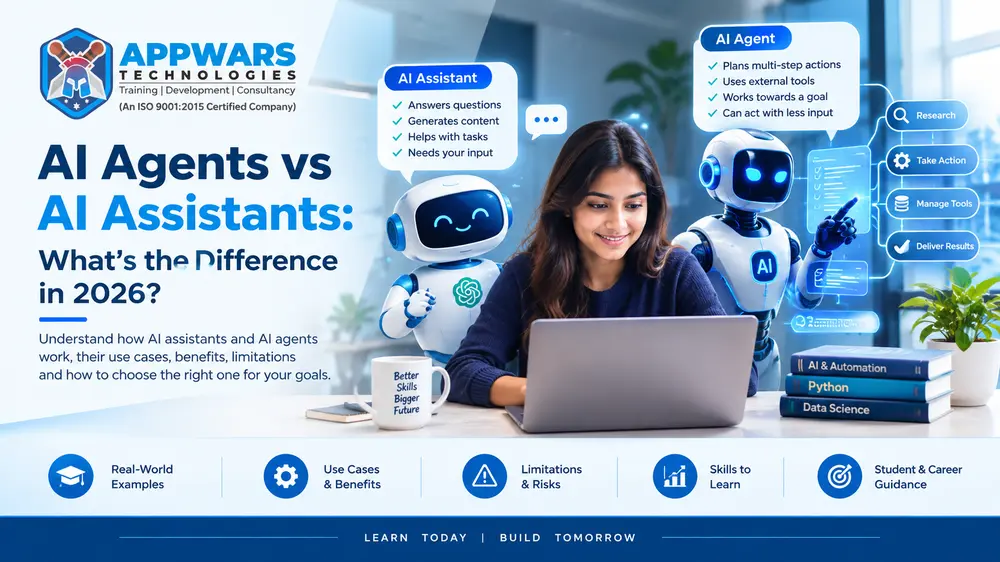
An AI assistant usually waits for your instruction and helps you complete a task. An AI agent can work toward a defined goal by planning actions, using tools, and making decisions within the permissions it has.
So, where does ChatGPT fit? What about Microsoft Copilot? When should a business use an AI assistant, and when does an AI agent make more sense?
Let’s break it down.
AI agents vs AI assistants at a glance
| Factor | AI assistant | AI agent |
|---|---|---|
| Main role | Helps a user with tasks | Works toward a defined goal |
| User input | Usually needs prompts | Can start from a goal or trigger |
| Autonomy | Lower | Higher |
| Planning | Usually limited | Can plan multiple steps |
| Tool usage | Uses tools when instructed | Can decide when tools are needed |
| Decision-making | Mostly user-directed | Can make decisions within set rules |
| Workflow | Usually one or a few tasks | Can manage multi-step workflows |
| Human involvement | Frequent | Can be limited after approval |
| Example | Draft an email | Research leads, qualify them and update a CRM |
| Best fit | Personal productivity and support | Process automation and complex workflows |
IBM describes assistants as systems that generally respond to user prompts, while AI agents can plan workflows and take actions toward a goal using available tools. Microsoft similarly describes agents as systems that perceive inputs, make decisions, and take actions to achieve defined goals.
What is an AI assistant?
An AI assistant is software designed to help you perform tasks through natural-language interaction.
You give it an instruction. It processes your request and gives you an answer, recommendation, generated piece of content, or action.
Think about asking an AI assistant:
“Summarize this 20-page report in 5 bullet points.”
The assistant reads the material and produces the summary.
You might then ask:
“Turn those points into a LinkedIn post.”
It handles the second request after you provide another instruction.
Common AI assistant examples
AI assistants can help with:
- Writing emails
- Creating social media content
- Summarizing documents
- Answering questions
- Explaining programming concepts
- Generating ideas
- Translating text
- Analyzing information
- Creating reports
- Helping with research
- Preparing interview questions
Tools such as ChatGPT, Microsoft Copilot, and other conversational AI systems can work as assistants depending on how they’re configured and what tools they can access.
The key idea is simple: the user remains closely involved in directing the work.
What is an AI agent?
An AI agent is a software system designed to pursue a defined goal by deciding which steps to take and using available tools to complete those steps.
For example, imagine a company wants to process incoming sales leads.
An assistant might help an employee write a follow-up email after being asked.
An AI agent could be configured to:
- Detect a new lead.
- Read the submitted information.
- Check the lead’s company details.
- Score the lead using predefined rules.
- Search the company’s CRM for existing records.
- Draft a personalized follow-up.
- Send the message when permitted.
- Update the CRM.
- Notify the sales team when human attention is needed.
That’s a workflow.
The agent is working toward an outcome rather than simply responding to individual questions.
Microsoft describes AI agents as systems that can interpret inputs, reason through problems, decide on actions, and use tools to achieve specific goals.
The biggest difference between AI agents and AI assistants
The easiest way to understand AI agents vs AI assistants is to look at how they handle work.
An assistant generally follows the user’s direction step by step.
An agent can receive a goal and determine a sequence of actions required to reach it.
For example:
AI assistant
You: “Find 10 blog ideas about AI marketing.”
Assistant: “Here are 10 ideas.”
You: “Group them by search intent.”
Assistant: “Here are the groups.”
You: “Create a content calendar.”
Assistant: “Here’s the calendar.”
AI agent
You: “Build a 30-day content plan for our AI marketing course.”
The agent could potentially research available information, classify topics, create a schedule, connect the topics to business goals, and prepare the output through several steps, depending on the tools and permissions provided.
That’s the core difference in AI agents vs AI assistants: the amount of independent planning and action involved.
AI agents vs AI assistants: how they work
How an AI assistant works
A typical assistant workflow looks like this:
User prompt → AI model → response → user reviews → next prompt
The user stays in the loop.
This model works extremely well for tasks where you want control over every major decision.
For example, a digital marketer might ask an AI assistant to:
- Write 5 ad headlines.
- Analyze a Google Ads report.
- Suggest SEO keywords.
- Rewrite landing-page copy.
- Explain a GA4 report.
The marketer reviews the output and decides what happens next.
How an AI agent works
An agent can follow a longer workflow:
Goal → planning → tool selection → action → result → next action → completion
The exact process depends on the agent’s design.
An agent may connect with:
- APIs
- Databases
- CRMs
- Search systems
- Email platforms
- Business software
- Code execution tools
- File systems
- Internal knowledge bases
This tool access is a major part of agent-based systems.
But giving an AI model access to tools doesn’t automatically make it a fully autonomous agent. The system also needs a goal, instructions, decision logic, and permissions that define what it can do.
AI agents vs AI assistants examples
Let’s use real workplace scenarios.
1. Digital marketing
AI assistant:
A marketer asks:
“Write 5 Google Ads headlines for a digital marketing course.”
The assistant generates the headlines.
AI agent:
A marketing agent could receive a broader task such as
“Review this week’s campaign data and prepare optimization recommendations.”
Depending on its connected tools, it could retrieve campaign data, compare performance against rules, identify campaigns that need attention, prepare recommendations, and send the report to the marketer for approval.
For marketers, AI assistants remain useful for content, analysis, research, and creative work. Agents become more relevant when several systems and repeated steps are involved.
If you’re learning AI for marketing, see the Digital Marketing Course in Noida page for related training topics such as AI SEO, GEO, Google Ads, social media marketing, and analytics.
2. Software development
AI assistant:
A developer asks:
“Explain why this Python function is returning an error.”
The assistant explains the likely problem and suggests a correction.
AI agent:
A coding agent could receive a larger task:
“Fix the failing tests in this project.”
Depending on its environment, it may inspect files, identify relevant code, run tests, modify code, run the tests again, and prepare the changes for review.
The developer still needs appropriate controls, especially when code can affect production systems.
Students interested in programming can explore the Python Training in Noida program, which covers Python programming, API integration, web scraping, testing, asynchronous programming, and other development topics.
3. Customer support
AI assistant:
A customer asks:
“Where is my order?”
The assistant checks available information and provides the status.
AI agent:
A support agent could receive a request such as:
“Resolve this delivery issue.”
It might check the order, review delivery information, identify the problem, create a support ticket, contact another system, and escalate the case if it falls outside predefined rules.
The difference becomes clearer as the number of steps increases.
4. Data analysis
AI assistant:
“Explain why website conversions dropped last week.”
The assistant analyzes the supplied data and gives possible explanations.
AI agent:
“Monitor conversion performance and alert the marketing team when a campaign falls below our defined threshold.”
An agent could monitor incoming data, check conditions, investigate related metrics, and notify the appropriate person.
For learners interested in data and AI, the Data Science Course in Noida page covers Python, machine learning, AI, and project-based learning.
AI agents vs AI assistants for students
Students don’t need to jump straight into building complex agents.
Start with assistants.
Use an AI assistant to:
- Learn difficult concepts.
- Practice Python.
- Generate quiz questions.
- Review code.
- Summarize study material.
- Prepare interview questions.
- Create project ideas.
- Explain errors.
- Practice technical interviews.
Once you understand how AI models, APIs, prompts, tools, and workflows work, you can start building simple agents.
A practical learning path
Step 1: Learn Python
Python is useful for AI development, automation, data processing, and API work.
Step 2: Understand APIs
Learn how applications exchange information.
Step 3: Learn LLM basics.
Understand prompts, tokens, context, embeddings, retrieval, and model limitations.
Step 4: Learn tool calling.
Understand how an AI model can interact with external functions and services.
Step 5: Build small workflows
Start with something simple, such as an agent that reads a document and creates a structured report.
Step 6: Add decision logic
Give the system rules that determine what happens next.
Step 7: Add human approval
Keep sensitive actions behind an approval step.
Step 8: Build a complete project
For example, create a customer-support agent, lead-qualification agent, research agent, or reporting agent.
AI agents vs AI assistants for working professionals
For working professionals, the choice depends on the task.
An assistant is useful when you want direct control.
An agent becomes useful when a workflow contains repeated steps that can be handled according to clear rules.
Consider an SEO professional.
An assistant can:
- Generate title ideas.
- Analyze keywords.
- Create meta descriptions.
- Suggest internal links.
- Explain Search Console data.
An agent could be configured around a larger SEO workflow, such as checking a defined set of pages, collecting specified metrics, identifying pages that meet certain conditions, and preparing an audit report.
Human review still matters, especially when changes affect important pages or business campaigns.
Advantages of AI assistants
AI assistants are useful when you want a conversational tool that responds to your instructions.
Main benefits
- Easy to use
- Natural-language interaction
- Fast content generation
- Useful for research and learning
- Good for repetitive individual tasks
- Keeps the user closely involved
- Easier to supervise
They work particularly well for students, marketers, developers, analysts, writers, and office professionals.
Advantages of AI agents
AI agents become useful when a process has multiple connected steps.
Main benefits
- Can work toward a defined goal
- Can manage multi-step workflows
- Can use external tools
- Can make decisions within defined rules
- Can react to new information
- Can reduce manual handoffs
- Can coordinate actions across systems
The trade-off is control.
The more freedom an agent has, the more carefully its permissions, data access, instructions, monitoring, and approval rules need to be designed.
Microsoft’s guidance for organizations specifically discusses planning, security, governance, building, and managing AI agents.
AI agents vs AI assistants: limitations
Neither approach is perfect.
AI assistant limitations
An assistant can produce incorrect information. It can misunderstand a prompt, miss context, or generate an answer that sounds convincing but needs verification.
The user usually catches these issues through review.
AI agent limitations
Agents introduce another layer of risk because they can take actions.
A poorly configured agent could:
- Use the wrong data.
- Take an incorrect action.
- Follow a bad instruction.
- Make an incorrect decision.
- Spend resources unnecessarily.
- Access information it shouldn’t access.
- Repeat an error across a workflow.
That’s why permissions and human approval matter.
An agent that can draft an email is one thing.
An agent that can send emails, modify customer records, make purchases, or change production code needs much tighter controls.
AI agents vs AI assistants: which should you learn first?
For most beginners, an AI assistant is the easier starting point.
You can learn how AI responds to prompts, handles context, works with documents, and uses tools without immediately building an autonomous workflow.
Then move toward agents when you’re comfortable with:
- Python
- APIs
- LLMs
- Prompt engineering
- Databases
- Automation
- Tool calling
- Basic software development
- AI safety and permissions
If your goal is an AI-focused career, learning both concepts gives you a broader technical foundation.
Students can also explore the AI Course in Noida, which covers Python, machine learning, deep learning, NLP, computer vision, and AI projects.
AI agents vs AI assistants in different careers
| Career | AI assistant use | AI agent use |
|---|---|---|
| Digital marketer | Content, keyword research, reports | Campaign monitoring and workflow automation |
| SEO specialist | Content briefs, audits, keyword ideas | Technical audits and recurring reports |
| Data analyst | Data explanations and report writing | Automated monitoring and reporting workflows |
| Software developer | Code explanation and debugging | Code testing and multi-step development workflows |
| Sales professional | Email writing and lead research | Lead qualification and CRM workflows |
| Customer support | FAQ responses and summaries | Ticket routing and multi-step resolution |
| HR professional | Job descriptions and candidate summaries | Candidate workflow automation |
| Student | Learning, coding help and exam practice | AI projects and automation experiments |
What is agentic AI?
You may also see the term agentic AI when researching AI agents.
Agentic AI generally refers to AI systems designed to take actions toward goals with a degree of autonomy.
A simple agent might handle one defined workflow.
A more complex system may use several agents that coordinate different parts of a larger task.
For example:
Research agent → analysis agent → writing agent → review agent
Each part can have a specific responsibility.
The actual architecture depends on the problem, tools, data, and level of human control required.
IBM describes agentic AI as systems involving coordinated AI agents working toward more complex goals.
Are AI agents replacing AI assistants?
The two technologies can exist together.
An AI assistant can provide the conversational interface a person uses to interact with an agent.
For example:
User → AI assistant → AI agent → business tools → result
The assistant understands what the user wants.
The agent handles the workflow.
The tools provide access to external systems.
The user reviews the final result when required.
Microsoft also describes agents as specialized AI assistants with custom knowledge, skills, and tools in some of its documentation. The terminology isn’t completely uniform across the industry, so the exact meaning of “assistant” and “agent” can vary by product.
AI agents vs AI assistants: the simple rule
Use an AI assistant when you want help completing a task through conversation.
Use an AI agent when you want a system to work toward a defined goal across multiple steps and tools.
Here are 2 quick examples:
“Write a product description.”
AI assistant.
“Find products that match these criteria, compare the available information, prepare a shortlist, and send it for approval.”
Potential AI agent workflow.
The boundary isn’t always fixed. Modern AI products can combine assistant-style conversations with agent capabilities.
Frequently asked questions
What is the main difference between AI agents and AI assistants?
AI assistants generally respond to user instructions, while AI agents can plan and execute multiple actions toward a defined goal using available tools.
Is ChatGPT an AI assistant or an AI agent?
It depends on the specific capabilities and configuration being used. A conversational use of ChatGPT can function as an AI assistant, while systems with tool use and multi-step task execution can have agent-like behavior.
Are AI agents more advanced than AI assistants?
They can have a higher level of autonomy, but “more advanced” isn’t always the right comparison. An assistant can be a better fit when a person wants direct control over each task.
Can students learn AI agents?
Yes. Students can start with Python, APIs, LLM fundamentals, tool calling, databases, and automation before building small AI agent projects.
Do AI agents need human supervision?
The level of supervision depends on the task and permissions. Actions involving sensitive data, money, customer records, production systems, or important business decisions generally need appropriate controls and review.
Which skills are useful for building AI agents?
Useful skills include Python, APIs, LLM concepts, prompt engineering, databases, automation, tool calling, software development, and basic knowledge of AI security and permissions.
Will AI assistants disappear?
There is no reason to assume that. Assistants and agents can work together, and many products are combining conversational interfaces with agent capabilities.
Final takeaway
The difference between AI agents vs AI assistants comes down to how work gets done.
An AI assistant is usually user-directed. You ask, review, refine, and decide.
An AI agent can take a defined goal, plan a sequence of actions, use tools, and continue through a workflow within the permissions it has.
For students, learning assistants first can make AI concepts easier to understand. For working professionals, the bigger opportunity is identifying repetitive workflows where an agent could handle several connected steps while people retain control over important decisions.
And that’s where AI skills are heading in 2026: understanding the model matters, but knowing how that model connects to real tools, data, and workflows matters just as much.