You’ve seen the job postings. “Generative AI experience required.” “LLM projects preferred.” Even roles that had nothing to do with AI 2 years ago now list it as a bonus skill.
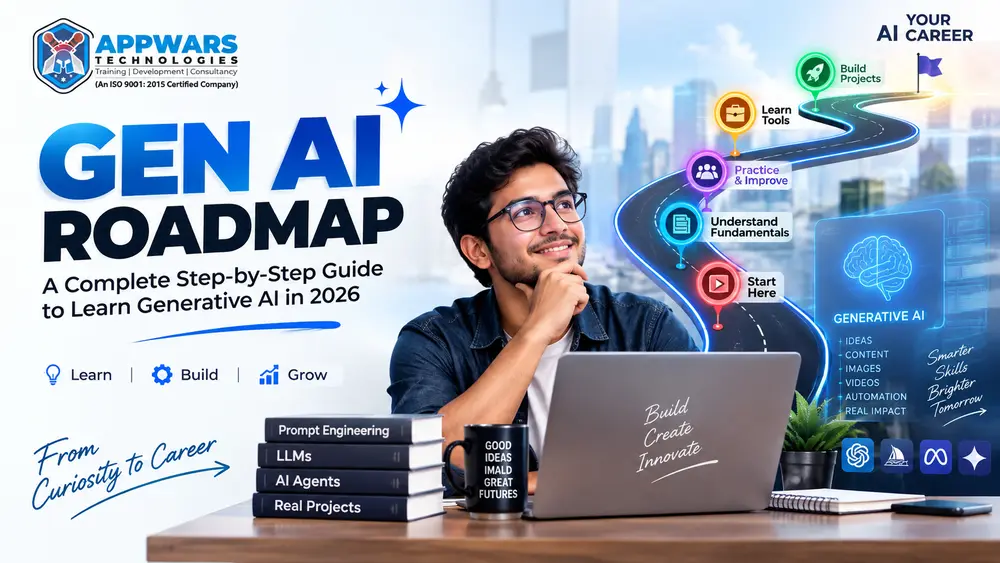
If you’re trying to figure out where to start, this Gen AI roadmap lays out the exact order to learn things, what to skip, and how long each stage realistically takes. It’s built for 2 kinds of readers: students who are starting from zero and working professionals who want to add generative AI on top of an existing tech background.
No fluff. Just the path.
Who is this Gen AI roadmap for?
Not everyone starting a generative AI roadmap is starting from the same place. A first-year computer science student and a 5-year backend developer need different pacing, even if the end goal looks similar.
| Reader | Starting point | Realistic timeline |
|---|---|---|
| Student, non-technical background | No coding experience | 9-12 months |
| Student, CS, or related degree | Basic Python and DSA | 6-8 months |
| Working professional, non-tech role | Wants to add AI to their resume | 4-6 months, part-time |
| Working developer or data analyst | Already codes daily | 3-5 months |
If you already fall into the last 2 rows, feel free to skim stages 1 and 2 below and spend most of your time from stage 4 onward.
Get Free Career Counseling ➔What generative AI actually means
Generative AI is the branch of artificial intelligence that creates new content instead of just analyzing existing data. Text, images, code, audio, and video: a generative model produces all of it from a prompt.
ChatGPT, Claude, Gemini, and Midjourney are the tools everyone recognizes. Underneath them sit large language models (LLMs) and diffusion models, trained on huge datasets to predict what comes next, whether that’s the next word in a sentence or the next pixel in an image.
Here’s the distinction that trips people up: machine learning predicts or classifies. Generative AI creates. That single difference is why the field needs its own roadmap instead of borrowing one from classic data science.
Why start a generative AI roadmap in 2026?
A few numbers explain the rush better than any pep talk.
- NASSCOM puts India’s demand for AI professionals as growing over 40% every year.
- India is projected to need more than 1 million skilled AI professionals by the end of 2026.
- LinkedIn India has reported triple-digit year-over-year growth in postings that mention “Gen AI” or “LLM” in the job title.
Salaries reflect the shortage. A fresher with a documented generative AI project can outearn a fresher in general software roles by a wide margin, simply because so few candidates can show real, working proof of skill.
That’s the opening. A structured generative AI roadmap is how you walk through it instead of guessing.
The Gen AI roadmap 2026: 8 stages in order
Skipping stages is the most common reason people stall out on their generative AI roadmap. Each stage below builds on the one before it.
1. Python and math foundations
You don’t need a math degree. You need working comfort with:
- Python: variables, loops, functions, and libraries like NumPy and pandas
- Linear algebra: vectors, matrices, and dot products (this is what neural networks run on)
- Probability and statistics: distributions, mean, variance, conditional probability
- Basic calculus: derivatives and gradients, enough to understand how models learn
Give this stage 4 to 6 weeks if you’re starting from scratch. Skip it if you’re already a working developer.
2. Machine learning basics
Before generative models make sense, you need to understand the models that came before them. Cover:
- Supervised vs. unsupervised learning
- Regression and classification algorithms
- Train/test splits, overfitting, and evaluation metrics
- Scikit-learn, hands-on, not just theory
Build 2 or 3 small projects here. A spam classifier. A house price predictor. Nothing fancy, just working code you built yourself.
3. Deep learning and neural networks
This is where generative AI actually starts. Learn:
- Perceptrons and how a neural network is structured
- Backpropagation and gradient descent
- Convolutional neural networks (CNNs) for images
- Recurrent neural networks (RNNs) and why they got replaced
Use PyTorch or TensorFlow. Most job postings lean toward PyTorch in 2026, so if you have to pick one, pick that.
4. Natural language processing (NLP)
Text is where most generative AI work happens, so this stage matters more than people expect.
- Tokenization, embeddings, and word vectors
- Sequence-to-sequence models
- Attention mechanisms (this idea leads directly into transformers)
- Libraries: NLTK, spaCy, Hugging Face Transformers
5. Transformers and large language models
The transformer architecture, introduced in the 2017 “Attention Is All You Need” paper, is the backbone of every major LLM today. Study:
- Self-attention and multi-head attention
- Encoder-decoder vs. decoder-only architectures
- How GPT, LLaMA, Claude, and Gemini differ under the hood
- Tokenizers and context windows
You don’t need to train an LLM from scratch. You need to understand what’s happening inside one well enough to work with it intelligently.
6. Prompt engineering
This is the fastest-growing skill on any generative AI roadmap and also the most underrated.
- Zero-shot, few-shot, and chain-of-thought prompting
- System prompts vs. user prompts
- Structured output (JSON mode, function calling)
- Prompt evaluation and iteration
Good prompt engineers get better output from the same model than average users do. That gap is worth real money in a production environment.
Get Free Demo Class ➔7. RAG, fine-tuning, and AI agents
Once you can use a model well, learn to extend it.
- Retrieval-augmented generation (RAG): connecting an LLM to your own documents or database
- Vector databases: Pinecone, Chroma, FAISS
- Fine-tuning vs. prompting: when each makes sense
- AI agents: models that plan, call tools, and take multi-step actions
This is where generative AI overlaps with a related field, agentic AI. If you want a deeper comparison of the 2, our Generative AI vs Agentic AI guide breaks down where one ends and the other begins and which path fits your goals.
8. Tools, deployment, and portfolio projects
Knowledge without proof doesn’t get you hired. Build:
- 3 to 5 end-to-end projects: a chatbot with RAG, an AI content tool, an image generation app
- A GitHub portfolio with clean documentation
- Familiarity with LangChain, LlamaIndex, and OpenAI’s or Anthropic’s APIs
- Basic deployment: Streamlit, FastAPI, or a simple cloud hosting setup
Recruiters skim resumes in seconds. A live demo link does more work than a bullet point ever will.
Tools you’ll actually use
Courses love to list 20 tools. In practice, most generative AI work in 2026 runs through a smaller set.
| Category | Tools worth learning | Where they fit |
|---|---|---|
| Core language | Python | Every stage of this roadmap |
| Deep learning framework | PyTorch, TensorFlow | Stage 3 onward |
| LLM APIs | OpenAI, Anthropic, Google Gemini | Stage 5 onward |
| Orchestration | LangChain, LlamaIndex | Stage 7 |
| Vector databases | Pinecone, Chroma, FAISS | Stage 7 |
| Deployment | Streamlit, FastAPI, Hugging Face Spaces | Stage 8 |
| Version control and hosting | Git, GitHub | Throughout |
You don’t need all of these on day 1. Add them as the roadmap calls for them, not before.
Generative AI roadmap: phase-wise breakdown
| Phase | Focus area | Typical duration | Key tools |
|---|---|---|---|
| 1 | Python and math foundations | 4-6 weeks | Python, NumPy, pandas |
| 2 | Machine learning basics | 3-4 weeks | Scikit-learn |
| 3 | Deep learning | 4-6 weeks | PyTorch, TensorFlow |
| 4 | NLP fundamentals | 3-4 weeks | NLTK, spaCy, Hugging Face |
| 5 | Transformers and LLMs | 4 weeks | Hugging Face, OpenAI API |
| 6 | Prompt engineering | 2-3 weeks | ChatGPT, Claude, Gemini |
| 7 | RAG, fine-tuning, agents | 4-6 weeks | LangChain, Pinecone, FAISS |
| 8 | Projects and deployment | Ongoing | GitHub, Streamlit, FastAPI |
A working professional with a coding background can often compress this to 4 or 5 months by moving faster through stages 1 and 2. A student starting from zero should plan on 8 to 10 months for a solid, job-ready foundation.
Generative AI jobs and salary in India
Pay varies a lot by company type, city, and whether you show real project work. These ranges reflect 2026 industry data from Glassdoor, Naukri, and LinkedIn salary insights.
| Role | Experience | Salary range (INR, annual) |
|---|---|---|
| Generative AI developer | 0-2 years | 6-15 LPA |
| Prompt engineer | 0-2 years | 6-10 LPA |
| NLP engineer (LLM-based) | 2-4 years | 10-18 LPA |
| AI application developer (RAG) | 2-4 years | 10-18 LPA |
| Machine learning engineer (GenAI) | 3-6 years | 14-25 LPA |
| Generative AI architect | 6+ years | 25-45 LPA |
Bangalore, Pune, and Hyderabad pay the highest averages, largely because of the concentration of Global Capability Centres (GCCs) hiring for AI teams. Noida and the wider Delhi NCR region are catching up fast, with several product companies and GCCs opening AI-focused teams here too.
Explore Trending Courses ➔Common mistakes on a generative AI roadmap
- Jumping straight to LLMs. Skipping machine learning and deep learning fundamentals leaves gaps that show up in interviews fast. An interviewer who asks why a model overfits deserves a real answer, not a guess.
- Collecting certificates instead of building projects. A certificate proves you finished a course. A project proves you can build something, and hiring managers know the difference immediately.
- Ignoring the math. You don’t need to derive backpropagation by hand, but you do need to know why a learning rate matters and what happens when it’s set wrong.
- Learning only 1 tool. LangChain today, something else in 18 months. Learn the underlying concepts, retrieval, embeddings, and orchestration, not just a specific library’s syntax.
- Never deploying anything. A model running only in a Jupyter notebook doesn’t demonstrate real-world skill. Put it behind a simple interface, even a rough one.
- Studying alone with no feedback loop. Code reviews, peer critique, and mentor feedback catch bad habits early. A structured generative AI roadmap with an instructor built in tends to move faster than solo study for exactly this reason.
Where Appwars Technologies fits in
Appwars Technologies runs a structured generative AI course in Noida that walks through this roadmap with instructor-led sessions, hands-on projects, and placement support. If you’re coming from a data background, our Data Science course in Noida covers the machine learning foundation stages 1 through 3 above in depth before you move into generative AI specifically.
Already comparing career paths? Our Agentic AI roadmap blog covers the next layer once you’re comfortable with the fundamentals here.
FAQs
Is a coding background required to follow a Gen AI roadmap?
It helps, but it’s not required. Python is beginner-friendly, and most generative AI courses build coding skills alongside AI concepts.
How long does it take to become job-ready in generative AI?
For most learners, 6 to 10 months of consistent study and project work, depending on your starting point.
Do I need a GPU to learn generative AI?
No. Most of your early learning happens through APIs (OpenAI, Anthropic, Hugging Face) rather than training models from scratch. A GPU only becomes useful once you’re fine-tuning models yourself.
Which matters more in 2026, prompt engineering or fine-tuning?
Both, for different situations. Prompt engineering is faster and cheaper for most use cases. Fine-tuning matters when you need consistent output at scale or domain-specific behavior a prompt can’t reliably produce.
Should I follow a self-study Gen AI roadmap or join a structured course?
Self-study works if you’re disciplined and already comfortable with Python. A structured course helps more if you want a fixed schedule, project feedback, and placement support, especially for stages 5 through 8, where mistakes are easy to make and hard to spot on your own.
Is generative AI a good career switch from a non-tech background?
Yes, with the right pacing. Marketers, analysts, and content professionals who understand a business domain and add generative AI skills on top are often more hireable than generalist coders with no domain context.
The bottom line
A generative AI roadmap only works if you follow it in order and build as you go. Skip the math, and the transformer stage won’t make sense. Skip the projects, and no amount of theory gets you hired.
Pick a start date. Work through the 8 stages above, 1 at a time, and you’ll have a portfolio worth showing by the end of it.