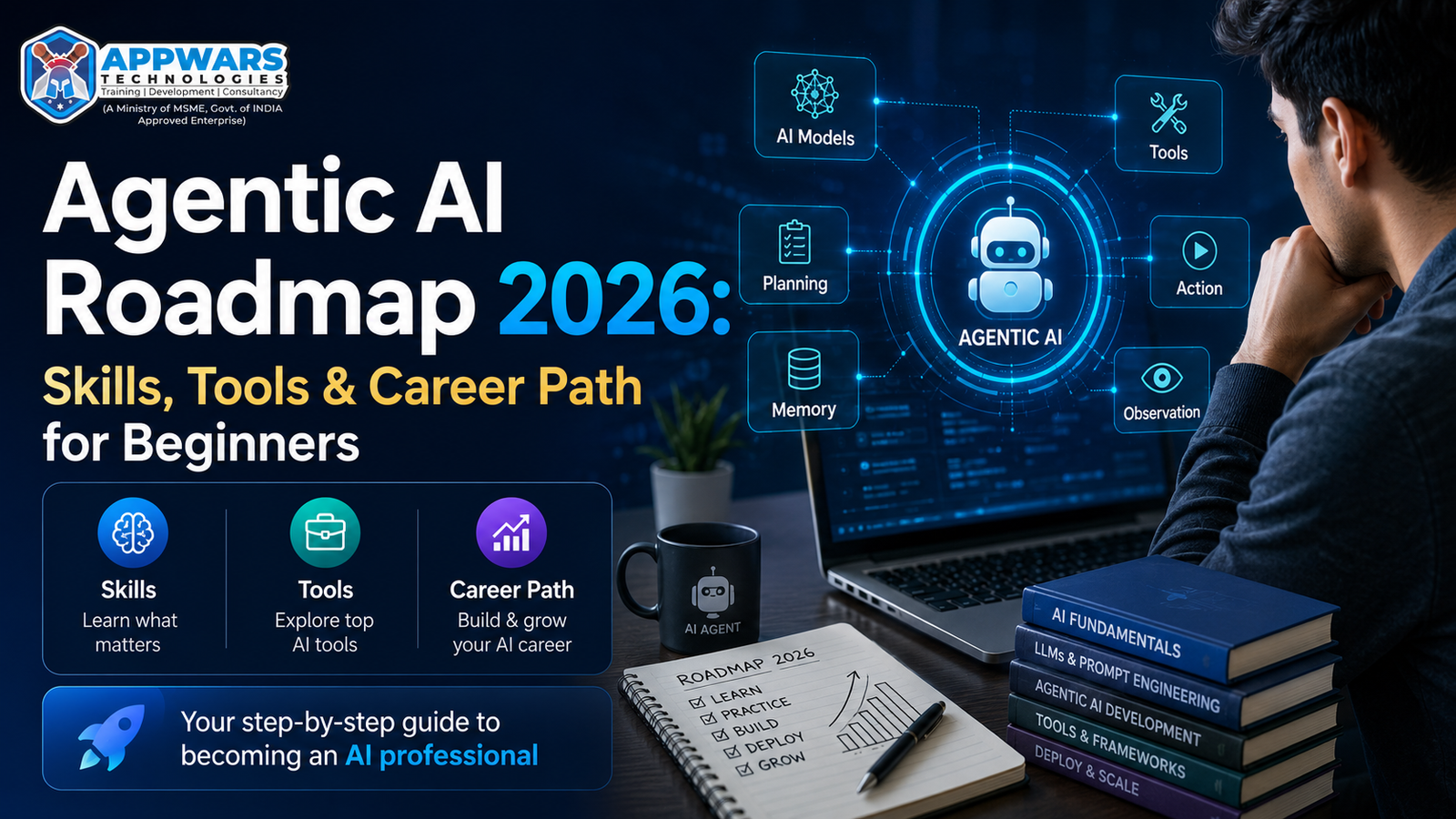
Six months ago, a friend of mine who’s a backend developer in Bangalore asked me where to start with AI agents. He’d read about AutoGPT, played with a LangChain tutorial, and felt completely lost by hour two.
That confusion is the whole reason this post exists.
There’s no shortage of AI content online right now. What’s missing is an Agentic AI roadmap that actually tells you what to learn first, what to skip, and what to build so you have proof you can do this when someone asks.
So let’s fix that.
I’ve spent the last year watching this space move fast: new frameworks every other month, job postings that didn’t exist 18 months ago, and a lot of noise drowning out the actual skills you need. This guide strips that noise out. By the end, you’ll have a clear Agentic AI development roadmap you can follow without second-guessing every step.
What is Agentic AI, actually?
Agentic AI refers to systems that don’t just respond to a prompt. They plan, take actions, use tools, and adjust based on what happens next.
A regular chatbot answers your question and stops. An agent might check your calendar, draft an email, send it, and then log the action in a spreadsheet, all without you clicking through every step.
Think of the difference between a vending machine and an assistant. The vending machine gives you exactly what you pressed the button for. The assistant figures out what you need, even if you didn’t spell it out perfectly.
In 2024 and 2025, most of the AI hype was about generative models that produce text, images, and code. In 2026, the shift is toward systems that act on that output. That’s the core reason every Agentic AI career roadmap looks different from a typical “learn machine learning” path.
Here’s a real example. Klarna’s customer service agent handles work that used to require 700 full-time agents, resolving most tickets without a human ever stepping in. That’s not a chatbot answering FAQs. That’s a system making decisions, pulling data, and closing out tasks on its own. Once you see one example like that, you stop thinking of agents as a buzzword and start thinking of them as infrastructure.
Why 2026 is the right time to start
I’ll be honest: a year ago, building agents meant duct-taping together unreliable frameworks and praying the LLM didn’t hallucinate mid-task.
That’s changed.
Frameworks have matured. Tool-calling is now a native feature in most major models. Companies are hiring for “AI agent developer” roles that didn’t exist on LinkedIn in 2023. Salesforce, Microsoft, and a wave of startups are shipping agent products into production, not just demos.
If you’re mapping out an Agentic AI development roadmap, you’re not early anymore, but you’re also not late. You’re right in the window where skills convert into jobs.
Get Free Career Counseling ➔The Agentic AI Roadmap: Step by Step
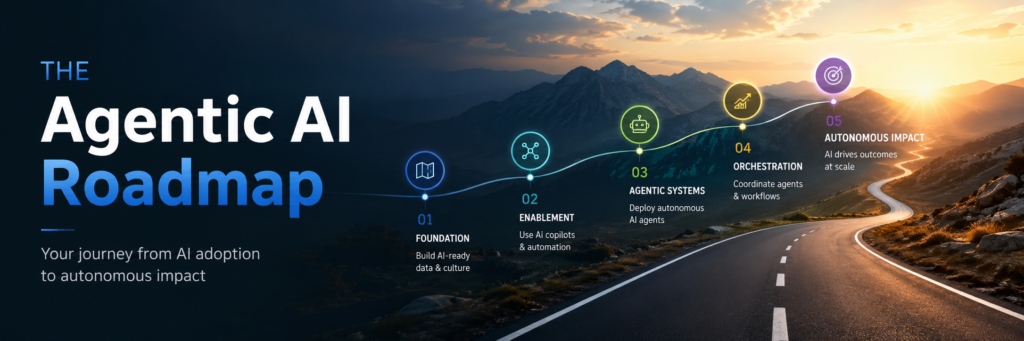
Here’s how I’d break this down if I were starting from scratch today.
Step 1: Lock down the Generative AI fundamentals
You can’t skip this. Agents are built on top of large language models, so you need to understand what’s actually happening under the hood.
Focus on:
- How LLMs generate text (tokens, context windows, temperature)
- Prompt engineering (zero-shot, few-shot, chain-of-thought)
- Embeddings and vector representations
- The basics of fine-tuning vs. prompting
This is where most generative AI roadmap guides start, and for good reason. If you don’t understand how the model “thinks,” you won’t know why your agent fails when it does.
I’d give this stage 2 to 3 weeks if you’re consistent. Not months. You don’t need a PhD-level grasp, just enough to debug intelligently.
Try building a tiny script that calls an LLM API and varies the temperature parameter from 0 to 1. Watch how the output changes from rigid and repetitive to loose and creative. That 20-minute exercise teaches you more about how these models behave than an hour of reading theory.
If you want structured fundamentals instead of piecing together random YouTube videos, an AI course can save you weeks of trial and error here.
Step 2: Learn Python (or sharpen what you have)
Almost every agent framework runs on Python. JavaScript is catching up with libraries like LangChain.js, but Python still dominates.
You need:
- Functions, classes, and async programming
- Working with APIs (requests, JSON handling)
- Basic error handling (your agents WILL throw errors, constantly)
If you already code, skip ahead. If you don’t, this is non-negotiable. I’ve seen people try to build agents by copy-pasting code they don’t understand. It works until it doesn’t, and then you’re stuck. Every solid Agentic AI roadmap treats this step as mandatory, not optional.
Step 3: Understand tool use and function calling
This is where agentic behavior actually starts.
Function calling lets an LLM decide when to use an external tool: search the web, query a database, call an API, or run code. The model doesn’t just generate text anymore. It generates a structured request, your code executes it, and the result feeds back into the conversation.
Try this exercise: build a simple agent that can check the weather. Give it access to a weather API as a “tool.” Watch it decide on its own when to call that tool versus when to just answer from its training data.
That single exercise will teach you more than reading 10 articles about function calling.
Get Free Demo Class ➔Step 4: Pick a framework and actually build something
This is the step in most AI agent development roadmap guides where people freeze up. There are too many options: LangChain, CrewAI, AutoGen, LangGraph, OpenAI’s Assistants API.
My advice: don’t try to learn all of them. Pick one. Build with it. Switch later if you need to.
For beginners, I’d lean toward:
- LangChain/LangGraph: huge community, tons of documentation, steep-ish learning curve
- CrewAI: simpler mental model, good for multi-agent setups, faster to get a demo working
Build a project where an agent has a clear goal and at least 2 tools to choose from. A research assistant that searches the web and summarizes findings works well as a first project. It’s small enough to finish in a weekend and complex enough to teach you real lessons.
Structured learning vs. self-teaching
A question I get constantly at this stage: should you follow a paid course or self-teach from documentation?
Self-teaching works if you’re disciplined and comfortable hunting through docs when you get stuck. It’s flexible and forces you to build troubleshooting instincts early.
A structured agentic AI learning roadmap through a guided course works better if you’re new to AI entirely or if you tried self-teaching once already and gave up halfway through. That happens to most people; there’s no shame in it.
My honest take: use structure for the fundamentals (Steps 1 through 3), then go fully self-directed once you hit framework choice and real projects. That’s where documentation, GitHub repos, and Discord communities teach you faster than any course module.
Step 5: Get comfortable with vector databases and RAG
Agents need memory and context beyond what fits in a single prompt. That’s where retrieval-augmented generation (RAG) comes in.
Learn:
- How embeddings turn text into searchable vectors
- Vector databases (Pinecone, Chroma, Weaviate, FAISS)
- Chunking strategies for documents
- When RAG is overkill vs. when it’s necessary
A lot of beginners jump straight to building “smart” agents without giving them any real memory. Then they wonder why the agent forgets what happened 3 messages ago. RAG is the fix.
Step 6: Multi-agent systems and orchestration
Once you can build a single agent that works reliably, the next stage is coordinating multiple agents.
Picture a content pipeline: one agent researches a topic, another writes a draft, a third agent reviews it for factual accuracy, and a fourth formats it for publishing. Each agent has a narrow job. Together, they handle something a single agent would struggle with.
This is where frameworks like CrewAI and AutoGen genuinely shine. They’re built around the idea of agents talking to each other, handing off tasks, and checking each other’s work.
Multi-agent systems also expose new problems: cost (each agent call burns tokens), latency (more steps means more waiting), and debugging (good luck tracing a bug across 4 agents talking to each other). Budget extra time here.
I worked through a version of this myself: a 3-agent setup where one agent pulled product reviews, another scored sentiment, and a third wrote a summary report. The first version took 40 seconds to run and cost more per execution than I expected. I cut it down to 2 agents and cached the sentiment scoring step. Runtime dropped to 12 seconds. Small architectural decisions like that matter more than which framework logo is on your README. This is also where a real AI agent development roadmap separates from a tutorial: tutorials show you the happy path, and production teaches you the failure modes.
Step 7: Deployment, monitoring, and real-world reliability
Building a demo that works on your laptop is the easy part. Most Agentic AI learning roadmap content stops right there, which is a problem, because deploying agents reliably is its own skill set.
You’ll need:
- Logging and observability (LangSmith, Helicone, or custom logging)
- Rate limiting and cost controls
- Guardrails to stop agents from doing something dumb or expensive
- Basic understanding of cloud deployment (AWS Lambda, Google Cloud Run, or similar)
I’ve watched a demo agent rack up a $400 API bill overnight because nobody set a usage cap. Don’t be that person.
Step 8: Specialize
By this point you’ve got the core skills. Now pick a direction.
Some paths worth considering:
- Enterprise automation: agents that handle internal workflows, customer support, data entry
- Coding agents: tools like Cursor and Devin-style agents that write and debug code
- Research agents: scientific literature review, market research, competitive analysis
- Personal assistants: scheduling, email management, task tracking
Specializing makes you hireable. “I build AI agents” is vague. “I build agents that automate insurance claims processing” gets you interviews. This is the stage where your Agentic AI career roadmap stops looking like everyone else’s and starts looking like yours.
Tools you’ll actually use
Here’s the practical toolkit, not a wishlist of everything that exists:
| Category | Tools to learn |
|---|---|
| LLM providers | OpenAI API, Anthropic API, open-source models via Ollama |
| Agent frameworks | LangChain, LangGraph, CrewAI, AutoGen |
| Vector databases | Chroma (for learning), Pinecone (for production) |
| Observability | LangSmith, Helicone |
| Deployment | Docker, AWS Lambda, Modal |
| Version control | Git, GitHub (non-negotiable, even for AI work) |
Don’t try to learn every tool in every category. Pick one per row, build something real, then expand if needed.
Explore Trending Courses ➔How this connects to data science
A question I get a lot: Do I need a data science background to follow an AI agents learning path?
Not strictly, but it helps more than people expect. Understanding data structures, basic statistics, and how models are evaluated will make you a sharper agent builder. You’ll know why your retrieval results are bad, not just that they’re bad.
I’ve seen this play out directly. Someone on a team I advised built an agent that pulled sales data and generated weekly reports. The agent worked, technically. But the numbers were wrong because nobody checked for duplicate rows in the source data before feeding it to the model. A basic data science instinct (always profile your data first) would have caught that in 5 minutes instead of after a client complained.
If you’re starting from zero and want both the data foundation and the AI layer on top of it, a Data Science Course alongside your agent-building practice gives you a much stronger base than jumping straight into frameworks.
A realistic timeline
People ask me to put a number on this, so here’s my honest estimate for someone studying 10 to 15 hours a week:
- Months 1 to 2: Generative AI fundamentals, Python, prompt engineering
- Months 3 to 4: Tool use, your first single-agent project, basic RAG
- Months 5 to 6: Multi-agent systems, a portfolio project worth showing
- Months 7 to 8: Deployment, monitoring, specialization, job applications
That’s roughly 8 months from zero to job-ready. Some people move faster if they already code. Some take a year. Both are fine. What matters is consistent building, not speed. Stick to this AI agents learning path and adjust the pace, not the order.
What actually gets you hired
Recruiters and hiring managers in this space don’t care about certificates nearly as much as they care about working projects.
Build 2 to 3 agents that solve a real problem, even a small one. Put them on GitHub. Write a README that explains what they do and why you made the choices you made. Record a 2-minute video walkthrough.
I know someone who landed an interview at a mid-size startup purely because they’d built a customer support agent that handled refund requests for a fake e-commerce store. It wasn’t perfect. It was real enough to talk about for 20 minutes in an interview.
That’s worth more than a stack of course completion badges.
Common mistakes beginners make
A few patterns I keep seeing on any Agentic AI development roadmap, regardless of background or experience level:
Skipping the fundamentals. Jumping straight to LangChain without understanding how LLMs work means you can’t debug anything when it breaks.
Framework hopping. Switching from LangChain to Crew AI to Auto Gen every week because each one promises to be easier. Pick one, finish a project, then explore.
No error handling. Agents fail constantly: API timeouts, malformed JSON, hallucinated tool calls. If your code doesn’t expect failure, your agent will crash in front of whoever’s watching the demo.
Ignoring cost. Multi-agent loops can burn through API credits fast. Track your spend from day one.
Where this is heading
Agent frameworks will keep getting simpler. Models will get better at tool use natively, which means some of the scaffolding you learn today might become unnecessary in 18 months. Any generative AI roadmap you follow now needs to assume that churn, not fight it.
That’s fine. The underlying skill, teaching a system to plan and act, isn’t going anywhere. Learn the principles, not just the syntax of one library, and you’ll adapt as the tools change.
Final thought
My friend from Bangalore eventually built his first agent: something that monitors GitHub issues and drafts responses for routine bug reports. Took him about 6 weeks of evenings and weekends.
It’s not flashy. It works.
That’s the whole point of following an Agentic AI roadmap: not chasing every new tool that trends on Twitter, but building something real, one step at a time, until you can call yourself an agent developer and actually mean it.