
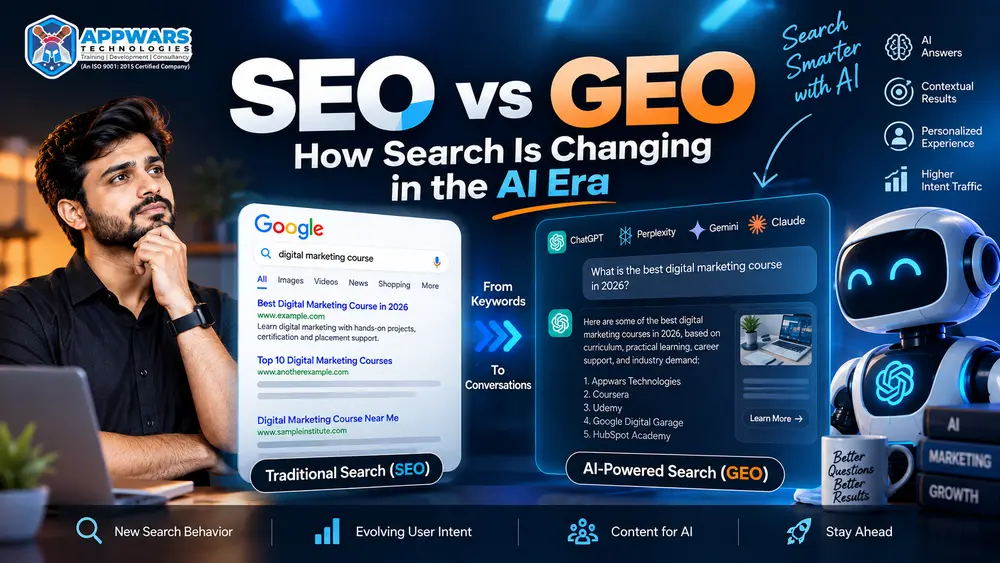
Search has changed.
For years, businesses and content creators focused on one main goal: getting their pages to appear in Google search results. Keywords, backlinks, technical SEO, content quality, and rankings shaped the strategy.
Now, people can ask ChatGPT, Google AI Overviews, Gemini, Perplexity, and other AI systems a question and receive a direct answer.
That shift has created a new discipline: Generative Engine Optimization (GEO).
So, where does SEO fit into this new search experience? And what exactly is the difference between SEO vs GEO?
The easiest way to understand it is to look at what each one is trying to achieve.
What is SEO?
Search Engine Optimization (SEO) is the process of improving a website and its content so search engines can understand, index, and rank it for relevant queries.
Traditional SEO usually focuses on search engines such as Google and Bing.
An SEO strategy can include:
- Keyword research
- Search intent analysis
- On-page SEO
- Technical SEO
- Internal linking
- Backlink building
- Content optimization
- Website speed
- Mobile usability
- Structured data
- Search performance analysis
For example, suppose a student searches:
“best digital marketing course in Noida”
An SEO-focused website might create a detailed course page targeting that search intent. The page needs useful information about the course, curriculum, duration, fees, projects, instructors, and other details that help both users and search engines understand the page.
The goal is visibility in traditional search results.
Get Free Career Counseling ➔What is GEO?
Generative Engine Optimization (GEO) focuses on improving the chances that an AI-powered search or answer system will use, understand, and cite information from your content when generating an answer.
Instead of thinking only about rankings, GEO considers how information is selected and presented inside AI-generated responses.
A user might ask:
“What are the best skills to learn for digital marketing in 2026?”
An AI system can combine information from multiple sources and produce a direct answer.
If your content is clear, well-supported, specific, and easy for AI systems to interpret, it has a better chance of becoming part of that answer.
This is where SEO vs GEO becomes an important discussion for content teams.
SEO vs GEO: What’s the difference?
The biggest difference is the search experience each approach addresses.
| Factor | SEO | GEO |
|---|---|---|
| Main focus | Search engine visibility | AI-generated answers |
| Common platforms | Google, Bing | ChatGPT, Gemini, Perplexity, Google AI Overviews |
| Primary goal | Improve organic rankings and traffic. | Increase chances of being mentioned or cited in AI answers. |
| Content format | Web pages, blogs, landing pages | Clear, answer-focused information that AI systems can interpret |
| Keyword role | Very important | Still useful, but context and meaning matter heavily. |
| Search result | Links and pages | Generated answers with possible citations |
| Measurement | Rankings, impressions, clicks, organic traffic | Mentions, citations, visibility in AI answers |
| Main user behavior | Browse and click | Ask and receive an answer. |
| Content priority | Search intent and relevance | Clarity, factual support, context, and answerability |
SEO and GEO overlap heavily.
A technically strong website with useful content gives you a better foundation for both.
Generative Engine Optimization vs SEO
The debate around Generative Engine Optimization vs SEO sometimes makes the two disciplines look completely separate.
They’re closely connected.
Think about a well-written article answering a specific question. SEO helps search engines discover and rank that article. GEO focuses on whether the information inside the article can be understood and reused when an AI system generates an answer.
A single piece of content can therefore support both strategies.
For example, an education website publishes an article called
“What is Google Ads, and how does it work?”
The article can target traditional searches such as
- What is Google Ads?
- How does Google Ads work?
- Google Ads for beginners
- Google Ads campaign types
The same article can also contain concise explanations that answer questions an AI system might need to address.
For example:
Google Ads is Google’s advertising platform that allows businesses to display paid advertisements across Google Search and other Google properties.
That sentence gives a search engine and an AI system a clean piece of information to understand.
How does GEO work?
The exact systems used by AI search platforms aren’t completely public, and different platforms work differently.
Still, there are practical principles you can follow when asking how GEO works.
AI systems need information they can interpret and use when producing answers. Content that clearly explains a subject, supports claims with credible sources, and provides specific information is easier to work with than vague promotional copy.
A GEO-focused content process can include:
1. Understand the question behind the search
People don’t always search with short keywords.
They ask complete questions.
For example:
“How long does it take to learn digital marketing?”
That’s different from simply targeting:
“digital marketing course”
Your content should address the actual information need.
2. Give direct answers
Place a clear answer near the beginning of a relevant section.
For example:
What is technical SEO?
Technical SEO is the process of improving the technical parts of a website so search engines can crawl, understand, and index its pages effectively.
Then expand on the topic.
This structure works well for readers because they can find the answer quickly. It also creates clearly defined information that AI systems can interpret.
3. Support factual claims
If you make a claim about statistics, research, industry trends, or platform behavior, provide an appropriate source.
Useful sources can include:
- Government websites
- Universities
- Research papers
- Official platform documentation
- Industry organizations
- Original research
This connects directly with Google’s E-E-A-T principles: experience, expertise, authoritativeness, and trustworthiness.
4. Build topical depth.
One article rarely answers every question around a subject.
Create related content and connect those pages through internal links.
For an education website, a topic cluster could look like:
Digital Marketing
→ What is Digital Marketing?
→ SEO for Beginners
→ Keyword Research Guide
→ What is AEO?
→ What is GEO?
→ SEO vs GEO
→ Google Ads for Beginners
This gives users a clear path through the subject.
5. Make information easy to extract
Use:
- Short paragraphs
- Descriptive headings
- Lists
- Tables
- Definitions
- Examples
- FAQs
- Step-by-step explanations
A wall of text makes information harder to consume.
Clear structure makes it easier for both people and machines to locate specific information.
Why AI Overviews Matter for SEO
Google has introduced AI Overviews, which can provide an AI-generated response directly within search results for some queries.
This changes how users interact with search.
A person may see an answer before deciding whether to visit a website.
For publishers, this creates an important question:
How do you create content that remains useful when search results increasingly provide answers directly?
The answer starts with understanding the user’s information need.
Suppose someone searches:
“What is keyword research?”
A page that takes 800 words before explaining the definition creates unnecessary work for the reader.
A better page gives the definition early, then explains:
- Why keyword research matters
- Search intent
- Keyword types
- Research methods
- Useful tools
- Examples
- Common mistakes
The page becomes useful whether the visitor arrives directly from Google or discovers the information through an AI-generated answer.
Optimizing content for ChatGPT and Google AI Overviews
Optimizing content for ChatGPT and Google AI Overviews requires a different way of thinking about content structure.
You can’t simply add a phrase like “AI optimized content” to a page and expect an AI system to cite it.
Focus on the information itself.
Use clear definitions.
Start important sections with direct explanations.
Answer specific questions.
Create sections around real questions your audience asks.
Use factual language.
Avoid vague statements such as
“Our course is the best choice for everyone.”
A stronger approach is
“The course includes SEO, Google Ads, Meta Ads, email marketing, analytics, and practical campaign projects.”
The second statement gives specific information.
Add evidence where appropriate.
If you’re discussing a statistic or research finding, identify the source.
Keep important information visible.
Don’t hide essential information inside images, accordions, or complicated layouts when plain text would work.
Show first-hand experience
For education websites, this can include:
- Instructor experience
- Real project examples
- Student projects
- Course methodology
- Practical assignments
- Industry tools used in training
These details help demonstrate experience rather than simply claiming expertise.
The role of large language models (LLMs)
Large language models, commonly called LLMs, are central to many AI-powered search and answer experiences.
An LLM processes language and uses patterns learned from large amounts of data to generate responses.
When someone asks:
“Explain technical SEO to a beginner.”
The system isn’t simply displaying a list of ten blue links. It generates an answer based on information available to the system and, depending on the product and query, may retrieve additional information from external sources.
That changes the role of content.
Your article needs to communicate clearly enough that its individual facts, explanations, and relationships can be understood in context.
This is one reason semantic SEO remains useful.
Explore Trending Courses ➔Semantic SEO and GEO
Semantic SEO focuses on the meaning and relationships behind a topic rather than repeating the exact keyword again and again.
For SEO vs GEO, related concepts include:
- Search engine optimization
- Generative Engine Optimization
- AI search
- AI Overviews
- Search intent
- Answer engine optimization
- Large language models
- AI-generated answers
- Content citations
- Zero-click search
- Organic search
- Entity understanding
- Structured data
These terms help establish the subject of the page.
But don’t turn your article into a keyword warehouse.
Write for the question first.
Where does AEO fit?
Answer Engine Optimization (AEO) focuses on creating content that can provide direct answers to user questions.
AEO and GEO overlap, but they’re commonly discussed in slightly different contexts.
AEO has traditionally focused on answer-based search experiences, including featured snippets and voice search.
GEO is associated more closely with generative AI systems that create responses from multiple information sources.
In practice, the techniques can overlap:
- Answer questions directly
- Structure information clearly
- Use concise definitions
- Cover related questions
- Establish topical authority
- Support important claims
- Keep information accurate
For an education website, combining SEO, AEO, and GEO principles can create a stronger content system.
Zero-click search is changing user behavior.
Zero-click search happens when a user gets the information they need directly from the search results without visiting a website.
Featured snippets, knowledge panels, calculators, maps, and AI-generated answers can all reduce the need for a traditional click.
For example, someone searching:
“What is the difference between SEO and SEM?”
might get enough information directly in the search interface.
That doesn’t make website content irrelevant.
It changes what you should measure.
A user may discover your brand through an answer, remember the name, and visit your website later using a branded search.
So organic traffic remains useful, but it isn’t the only signal worth watching.
Content citations matter in AI search.
One of the biggest differences between traditional search and AI answers is the role of content citations.
When an AI search experience provides citations, users can sometimes click through to the sources used for the answer.
That creates a new visibility opportunity for publishers.
To improve the quality of your content:
- Make factual claims clear.
- Cite original or authoritative sources where appropriate.
- Keep author information clear.
- Update outdated information.
- Explain complex topics with evidence.
- Avoid unsupported statistics.
- Create content around questions your audience actually asks.
Citations can’t be guaranteed. AI platforms choose sources using systems that aren’t fully controlled by publishers.
Your job is to publish information worth referencing.
A practical AI search optimization strategy
If you’re building an AI search optimization strategy for an education website, start with your existing content.
You don’t need to rewrite 500 articles overnight.
Use this process.
Step 1: Find your strongest topics.
Look at pages already receiving:
- Organic impressions
- Organic clicks
- Branded searches
- Backlinks
- Engagement
- Conversions
These pages already have some level of visibility.
Step 2: Identify question-based searches
Use Google Search Console, keyword research tools, customer questions, sales calls, student feedback, and support queries.
Find questions such as:
- What is SEO?
- How long does SEO take?
- Is SEO difficult to learn?
- What is GEO?
- SEO vs GEO, What’s the difference?
- How does AEO work?
Step 3: Improve the answer structure
Add direct definitions and useful examples.
Break large sections into smaller question-based sections.
Step 4: Add first-hand experience
If you’re an education business, explain how your instructors teach the topic.
Use real projects and examples where you have permission to publish them.
Step 5: Strengthen internal linking
Connect related articles.
For this article, relevant internal links could include:
- SEO guide for beginners
- What is generative engine optimization?
- AEO vs SEO vs GEO
- Keyword research guide
- Technical SEO guide
- Digital marketing course page
Use descriptive anchor text instead of generic phrases such as “click here.”
Step 6: Review the page regularly
AI search and traditional search both change.
Review important pages when:
- Search behavior changes
- Google introduces new search features
- Your industry changes
- Course information changes
- Statistics become outdated
- Search Console data shows new queries
SEO vs GEO: Which metrics should you track?
SEO has established measurement systems.
You can track:
- Organic impressions
- Organic clicks
- CTR
- Keyword positions
- Organic sessions
- Conversions
- Backlinks
- Indexed pages
GEO measurement is less standardized.
Depending on your tools and workflow, you might monitor:
- AI mentions
- Brand mentions in AI answers
- Content citations
- Referral traffic from AI platforms
- Branded search growth
- Visibility for question-based topics
Don’t treat an AI mention as equal to a website visit.
They’re different user actions.
Common GEO mistakes
Writing only for AI
Your reader still matters.
If an article sounds unnatural because you’ve stuffed it with questions, definitions, and keywords, the page becomes harder to read.
Making unsupported claims
Statements such as “AI always chooses websites with schema markup” need evidence.
Search systems are complicated. Avoid presenting assumptions as guaranteed rules.
Copying AI-generated answers
Publishing generic AI text doesn’t automatically create useful GEO content.
Add original examples, first-hand knowledge, research, and specific information.
Ignoring traditional SEO
Technical problems can still prevent search engines from accessing or understanding your content.
Crawlability, indexing, page quality, internal links, and website performance still matter.
Chasing every new AI platform
You don’t need a separate content strategy for every AI tool.
Build a strong information base first.
SEO vs GEO: A practical comparison for students and professionals
If you’re learning digital marketing, you should understand both.
| Skill | Why you should learn it |
|---|---|
| Keyword research | Helps you understand what people search for |
| Search intent | Helps you create content that answers the real query |
| On-page SEO | Helps search engines understand pages |
| Technical SEO | Helps with crawling and indexing |
| Content writing | Helps communicate useful information |
| AEO | Helps structure direct answers |
| GEO | Helps you prepare content for AI-powered search |
| Analytics | Helps measure search performance |
| Internal linking | Connects related information across your website |
| Research | Helps you create trustworthy content |
For working professionals, the useful skill is knowing how these pieces fit together.
A marketer who can research a topic, understand search intent, create useful content, improve technical SEO, and evaluate AI-search visibility has a much broader search skill set.
The future of search engine optimization
The future of search engine optimization will probably involve more than traditional rankings.
Search interfaces are already becoming more conversational.
Users can ask follow-up questions, compare options, request explanations, and receive synthesized answers.
For content teams, this means the unit of competition is increasingly the answer.
A page can rank well and still fail to satisfy the user.
Another page may receive fewer clicks but become a source referenced in an AI answer.
Search measurement will have to account for these different journeys.
The fundamentals still matter: useful information, clear structure, technical accessibility, credible sources, and a good experience for the person reading the page.
How an education website can prepare for AI search
An education website has a natural advantage: it already creates information around questions.
Students ask:
- What should I learn first?
- Is SEO difficult?
- Which digital marketing skills are useful?
- How long does it take to learn Google Ads?
- What is GEO?
- What is AEO?
- What tools should a beginner learn?
Turn those questions into useful content.
Create detailed guides.
Add examples from real training projects.
Show who wrote the content.
Keep course information accurate.
Connect related articles with internal links.
And review important pages instead of publishing them once and forgetting them.
SEO vs GEO: The key takeaway
SEO vs GEO isn’t really a choice between 2 completely separate strategies.
SEO helps your content become discoverable and understandable within search engines.
GEO focuses on how your information can appear within AI-generated search experiences.
The strongest approach is to build content around genuine user questions, explain subjects clearly, support important claims, demonstrate first-hand knowledge, and maintain a technically healthy website.
Search will keep changing.
People will still need good information.
That’s the part worth building around.
FAQs about SEO vs GEO
What is the difference between SEO and GEO?
SEO focuses on improving visibility in traditional search engines. GEO focuses on improving the chances that content will be understood, mentioned, or cited in AI-generated answers.
Is GEO replacing SEO?
GEO is becoming another consideration for search visibility, while SEO continues to matter for traditional search engines and website discovery.
How does GEO work?
GEO involves structuring useful, factual, clearly written content so AI-powered search systems can understand and potentially use the information when generating answers.
Does keyword research matter for GEO?
Yes. Keyword research can reveal the questions and topics your audience cares about. GEO adds more attention to context, meaning, question-based content, and clear answers.
What are AI overviews?
AI Overviews are AI-generated summaries that can appear within Google Search for certain queries. They can provide users with a direct response and links to supporting sources.
What is AEO?
Answer Engine Optimization is the practice of creating content that can provide direct answers to user questions in answer-focused search experiences.
What is zero-click search?
Zero-click search occurs when a user gets the information they need directly within a search interface without clicking through to a website.
Can you guarantee that ChatGPT or Google will cite your content?
No. Publishers can’t guarantee that an AI system will mention or cite a particular page. Content quality, relevance, authority, retrieval systems, and the specific query can all affect which sources appear.
Should students learn GEO?
Students interested in SEO, content marketing, digital marketing, or AI search should understand the basic principles of GEO alongside traditional SEO and AEO.
What should businesses do first?
Start with existing content. Identify important topics, improve answer quality, strengthen internal links, add credible sources, demonstrate first-hand experience, and monitor both traditional search performance and AI-search visibility.
Conclusion
Search is becoming more conversational, and AI systems are changing how people discover information.
For students and working professionals, understanding SEO vs GEO gives you a clearer view of where search marketing is heading.
Learn how search engines work.
Learn how people ask questions.
Learn how AI systems present information.
Then build content that deserves to be found, read, and referenced. You can also join our SEO course in noida to get more clarity on this topic.