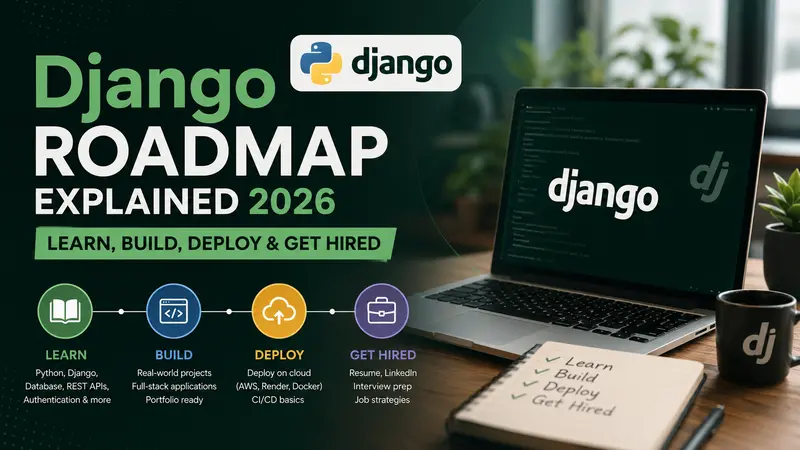
Every batch, I get some version of the same question: “I know Python, so should I just start Django?” The honest answer is yes, but the order you learn things in decides whether you build real projects in 3 months or stay stuck on tutorials for a year. This Django roadmap is the one I hand out to students and working professionals switching into backend development, updated for what’s actually getting people hired in 2026.
No fluff, no “watch 40 hours of videos first.” Just the sequence that works. Whether you typed “Django roadmap” or “roadmap Django” to land here, you’re asking the same thing: what do I actually learn, in what order, to go from zero to hired?
Why Django still matters in 2026
Python keeps climbing hiring charts, and Django is still the framework most Indian product companies, startups, and service firms reach for when they need a web backend fast. Instagram runs on it. So does Pinterest’s core stack, in parts. That’s not nostalgia; that’s a framework mature enough to trust with real traffic.
Here’s what makes it worth your time specifically:
- Batteries included. Authentication, admin panel, ORM, and security defaults ship with the framework. You’re not stitching together 10 libraries on day one.
- Job demand is steady, not hype-driven. Django roles show up consistently on Naukri and LinkedIn for backend, full-stack, and Python developer postings.
- It plays well with modern needs. Django REST Framework makes it a solid choice for building APIs that feed React or mobile frontends, which is how most companies build products now.
If you’re choosing between Flask and Django as a beginner, Django’s structure is actually easier to follow long-term. Flask gives you freedom; Django gives you a system. Beginners usually need the system first.
The complete Django learning roadmap, phase by phase
This is the core of the roadmap. Follow it in order. Skipping phase 1 is the single biggest reason students stall out later.
Phase 1: Python fundamentals (before you touch Django)
You need this locked in first:
- Variables, data types, loops, conditionals
- Functions and how arguments work (positional, keyword, *args, **kwargs)
- Object-oriented programming: classes, inheritance, and how Django models actually use this
- File handling and basic error handling with try/except
- Comfort with pip and virtual environments
I’ve seen students jump into Django with shaky Python and burn 2 weeks debugging things that were never a Django problem to begin with. Don’t skip this.
Get Free Career Counseling ➔Phase 2: Django fundamentals
This is where the actual Django roadmap begins:
- Installing Django, starting a project with
django-admin startproject, and understanding the folder structure - The MVT pattern (model, view, template), and how it’s different from MVC
- URLs and routing, using
urls.pyto map paths to views - Models and the Django ORM: creating tables through Python classes instead of raw SQL
- Migrations:
makemigrationsandmigrate, and why they matter - Django admin panel: registering models and customizing it
- Templates: Django Template Language, template inheritance, static files
Build something small here. A to-do list or a notes app. Nothing fancy, just get the request-response cycle into your hands.
Phase 3: Building real features
Once the basics feel natural, move here:
- Forms: Django Forms and ModelForms, validation, CSRF protection
- User authentication: login, logout, signup, password reset flows
- Sessions and cookies
- Class-based views versus function-based views, and when each makes sense
- Querysets in depth: filtering, aggregation,
select_relatedandprefetch_relatedfor performance - File and image uploads
By this phase, you should be able to build a functioning blog or a job board with user accounts.
Phase 4: REST APIs with Django REST Framework
Most jobs in 2026 want you to know this, not just plain Django:
- Serializers: converting model data to JSON and back
- ViewSets and routers
- Authentication for APIs: token-based and JWT
- Permissions and throttling
- API documentation basics (Swagger or DRF’s built-in browsable API)
This phase is where a plain “I know Django” resume line turns into “I can build the backend for a React or mobile app,” which is a very different conversation in an interview.
Phase 5: Testing, security, and performance
Skipped by most beginners, checked by every decent interviewer:
- Writing unit tests with Django’s test framework
- Common security issues: SQL injection, XSS, CSRF, and how Django’s defaults protect against them
- Caching basics with Django’s cache framework
- Background tasks with Celery for anything that shouldn’t block a request (sending emails, processing files)
- Logging and debugging in a real project, not just
print()statements
Phase 6: Deployment
A project sitting on your laptop doesn’t count on a resume. Get it live:
- Environment variables and settings for production versus development
- Setting up PostgreSQL instead of SQLite for production use
- Docker basics: containerizing a Django app
- Deploying to a platform like Render, Railway, or a VPS with Gunicorn and Nginx
- Basic CI/CD: pushing to GitHub and having it auto-deploy
Phase 7: Job-ready portfolio
- 2 to 3 complete projects with authentication, a database, and a deployed link
- Clean GitHub with proper READMEs, not just code dumps
- At least one project using Django REST Framework, since most job descriptions ask for API experience now
- A short write-up for each project explaining what problem it solves and what you built with
Django roadmap at a glance
| Stage | What you’re learning | Rough time needed | You’ll know it’s working when |
|---|---|---|---|
| Python basics | Syntax, OOP, functions | 3 to 4 weeks | You can write a small script without checking syntax constantly |
| Django fundamentals | MVT, ORM, admin, templates | 3 to 4 weeks | You can build a CRUD app from scratch |
| Real features | Forms, auth, class-based views | 3 to 4 weeks | You can add login and user-specific data to an app |
| REST APIs | DRF, serializers, JWT | 3 weeks | You can build an API that a frontend can actually consume |
| Testing and security | Unit tests, Celery, caching | 2 weeks | You stop shipping code that breaks on the second edge case |
| Deployment | Docker, PostgreSQL, hosting | 2 weeks | Your project has a live URL you can send someone |
| Portfolio | 2 to 3 projects, GitHub | Ongoing | Recruiters can see your work without asking you to explain it |
This isn’t a rigid calendar. Someone coding 1 hour a day will move slower than someone doing 4. Use it as a checklist, not a countdown.
How long does this Django learning roadmap actually take
For a complete beginner putting in consistent daily hours, 4 to 6 months gets you from zero to job-ready with a portfolio. Someone who already codes in another language, say Java or JavaScript, can often compress this to 2 to 3 months, since the programming logic transfers and only the Django-specific parts are new.
Working professionals switching careers usually take longer, not because the material is harder, but because they’re fitting it around a job. I’d rather see someone finish this Django developer roadmap in 6 honest months than rush it in 6 weeks and forget half of it by the time of the interview.
Explore Trending Courses ➔Django roadmap for freshers versus working professionals
The path is the same. The pace and priorities differ.
If you’re a fresher (student or recent graduate):
- You have more time, so go deeper into each phase. Don’t rush past testing and deployment.
- Build projects tied to problems you actually understand: a college event manager’s or a local shop’s inventory system.
- Contribute to a small open-source Django project if you can. It’s a talking point in interviews that most freshers don’t have.
If you’re a working professional switching tracks:
- Skip nothing in Phase 1 if your current work isn’t code-heavy, but move fast if you already program daily.
- Prioritize Phase 4 (DRF) early. A lot of professional Django work in 2026 is API-first.
- Use your current domain knowledge. If you work in finance, build a Django project for expense tracking or invoicing. It shows you can apply the framework to a real business problem, which is exactly what a hiring manager wants to see.
Mistakes that stall people on this roadmap
I see the same 4 mistakes on repeat:
- Tutorial hopping. Starting a new course every time the last one feels “too basic,” without ever finishing a project alone.
- Skipping plain Django to jump straight to DRF. You need to understand models, views, and templates before APIs make sense.
- Never deploying anything. A project that only runs on
localhostdoesn’t prove you can ship. - Ignoring the admin panel and ORM depth. These are exactly what interviewers probe, because they separate people who followed a tutorial from people who understand the framework.
What recruiters actually check before hiring a Django developer
Having sat through hiring conversations with our placement partners, here’s what comes up again and again:
- Can you explain your own project’s models and why you structured them that way, not just recite what Django does
- Do you understand querysets well enough to avoid the N+1 query problem
- Have you deployed something, even a small project, to a live server
- Can you read and debug someone else’s Django code, not just write your own from scratch
- Basic Git workflow: branches, pull requests, resolving a merge conflict
None of this is exotic. It’s the difference between finishing a course and actually owning the material.
Project ideas worth putting on your resume
Pick 2 or 3, not all of them:
- A job board with employer and candidate logins, built with DRF for the API layer
- An expense tracker with charts, using Django plus a frontend library for visualization
- A blog platform with comments, tagging, and search
- A booking system for a gym, salon, or clinic, with admin-side management
- An inventory or order management tool for a small business
Each of these touches authentication, database relationships, and at least one tricky feature (search, file uploads, or real-time-ish updates). That combination is what makes a project interview-worthy instead of forgettable.
What’s different about this roadmap in 2026
A Django roadmap from 2018 and one from 2026 aren’t the same document anymore. A few things shifted:
- Async views are no longer optional trivia. Django’s async support has matured, and more job postings mention it, especially for teams handling real-time features or heavy I/O.
- DRF is assumed, not a bonus. A few years back, plain Django was often enough. Now, most product companies expect you to ship an API-first backend from day one.
- Deployment is part of the job, not a separate skill. Docker and basic CI/CD used to be DevOps territory. Today, a Django developer roadmap without deployment knowledge is incomplete.
- AI-assisted coding tools are common in workflows. Knowing Django well enough to review and fix AI-generated code matters more than typing speed.
None of this changes the order you learn in. It changes what “job-ready” means at the end of it.
Career growth after you finish this roadmap
Most people who complete this Python Django roadmap start as junior backend or full-stack developers. From there, the usual path runs through mid-level backend roles, then into either a senior engineering track or a specialization, like API architecture, DevOps-leaning backend work, or team lead positions.
I won’t throw exact salary figures at you; they shift by city and company size, and inflated numbers on training websites are part of why students get disappointed later. What I can say from watching placements is that Django plus DRF experience, backed by 2 to 3 real deployed projects, consistently opens more interview doors than Django knowledge alone.
Frequently asked questions
Is Django still worth learning in 2026?
Yes. It’s still one of the most requested backend skills for Python roles in India, and DRF keeps it relevant for API-first development.
How long does the Django roadmap take for a complete beginner?
Around 4 to 6 months with consistent daily practice, longer if you’re learning alongside a full-time job.
Do I need to learn Flask too, or is Django enough?
Django alone is enough to get hired. Learning Flask later is useful for understanding lightweight alternatives, but it’s not a prerequisite for this roadmap.
Should I learn Django or move straight to Django REST Framework?
Learn plain Django first. DRF builds directly on models, views, and querysets, so skipping ahead usually means backtracking later.
Where to start
Reading a roadmap gets you oriented. Following it alone, without feedback on your code or a structured project pipeline, is where most self-taught learners lose months. If you’d rather learn this Python Django roadmap with a mentor checking your work, live projects, and placement support built in, our Django Training in Noida program is built around exactly this sequence, from Python fundamentals through deployment and interview prep.
Whichever way you go, the roadmap doesn’t change. Python first, Django fundamentals next, then APIs, testing, deployment, and a portfolio that proves you can build. Start today, and 2026 is a realistic year to walk into an interview with something real to show.