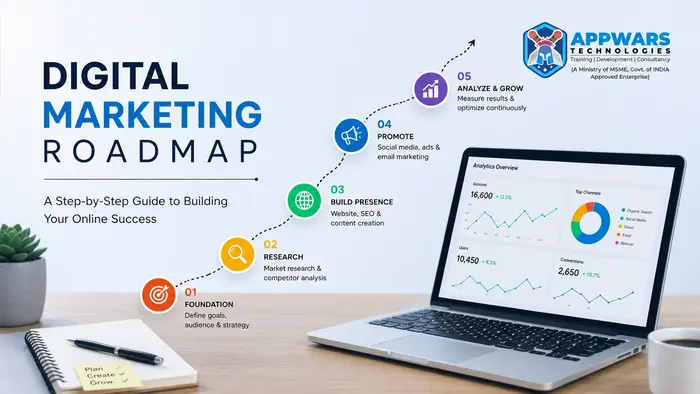
You’ve decided to get into digital marketing. Maybe you’re a student figuring out a career path or a working professional looking to switch lanes. Either way, you’re staring at a list of things you’re supposed to learn: SEO, social media, paid ads, email marketing, content, and analytics. It’s a lot.
Here’s the thing: you don’t need to learn all of it at once. You need a clear digital marketing roadmap that tells you what to do, when to do it, and why it matters.
That’s exactly what this is.
Why you need a roadmap before you start
Most beginners make the same mistake. They pick a random YouTube tutorial on Facebook ads, spend 3 weeks on it, then jump to SEO because someone told them it’s more important, then abandon that for a content writing course.
A month in, they know a little about a lot and can actually do none of it.
A proper digital marketing roadmap for beginners fixes this. It gives you a sequence. Skills build on each other. You don’t learn paid ads before you understand how a website converts visitors. You don’t run social campaigns before you know who you’re talking to.
Start at the right point, and every next step feels logical rather than random.
Stage 1: Understand the big picture first (Weeks 1-2)
Before touching any digital marketing tools, spend a week just understanding how digital marketing actually works as a system. This is Step 1 of any solid digital marketing roadmap for beginners, and most people skip it entirely.
Digital marketing is the practice of promoting products, services, or brands through online channels. But that definition doesn’t tell you much. What helps more: understanding that every piece of digital marketing comes down to 3 things.
Getting traffic. Converting it. Keeping those people.
That’s it. SEO gets you traffic. A good landing page converts it. Email marketing keeps people coming back. Once you see the whole thing as one connected system, every sub-topic clicks into place.
Read about the major channels at a high level: Search Engine Optimization (SEO), Pay-Per-Click (PPC), Social Media Marketing, Content Marketing, Email Marketing, and Web Analytics. Don’t go deep yet. You’re building a map of the territory.
A good starting point: You can take the digital marketing course for your proper guidance. Most beginners skip this because it feels slow. Don’t.
Get Free Demo Class ➔Stage 2: Learn how websites work (Weeks 2-3)
Every online marketing roadmap skips this step. Big mistake.
You need to understand how websites are built, what a landing page is, how a conversion funnel works, and what basic HTML looks like. You’re not becoming a developer. But if you don’t know what a meta title is or why page speed matters, you’ll hit a wall the moment you start doing real SEO or running ads.
Spend a few days on:
- How CMS platforms work (WordPress is still the most common)
- What a URL structure looks like and why it matters
- Basic HTML: headings, anchor tags, image alt text
- What a conversion rate is and how it’s calculated
This stage usually takes a week. After it, you’ll speak the same language as the developers and designers you’ll eventually work with.
Stage 3: Pick your foundation skill (Month 1-2)
The digital marketing learning roadmap forks here. You need to pick one foundational skill and go deep before adding the second. Every good online marketing roadmap will tell you the same thing: breadth before depth is a trap.
The 2 best starting points for beginners are SEO and content marketing. They work together naturally, they’re free to practice, and the skills transfer to every other channel.
SEO (Search Engine Optimization) is how you get your website to appear on Google when someone searches for something relevant. It splits into 3 areas:
- On-page SEO: Using the right keywords, writing good page titles, structuring content with headings, and optimizing images.
- Technical SEO: Site speed, mobile usability, crawlability. This is where the basic HTML knowledge from Stage 2 pays off.
- Off-page SEO: Getting other websites to link to yours. This one takes time to see results.
Content Marketing is creating blog posts, videos, or guides that attract the right audience. It’s the engine that powers SEO. You write content targeting specific keywords, Google ranks that content, and people find you.
Pick one. Practice it. Build a test WordPress site and actually run the experiments yourself, even if it’s a fake company. Reading about SEO without doing it is like reading about swimming without getting in the pool.
Resources worth your time: Moz’s Beginner’s Guide to SEO (free), Ahrefs Blog, and Google Search Central documentation.
Stage 4: Add social media marketing (Months 2-3)
After you’ve got a handle on SEO basics, layer in social.
Social media marketing doesn’t mean posting on every platform. That’s a trap beginners fall into because it feels productive. Pick 1 or 2 platforms where your target audience actually is. If you’re a B2B marketer, that’s LinkedIn and maybe Twitter/X. Consumer brands? Instagram or TikTok, depending on the demographic.
Learn the mechanics of each platform: how the algorithm works, what content formats perform best, and how to read the analytics.
The most important skill in social media isn’t creativity. It’s consistency. Brands that post 3 times a week for 6 months beat brands that post 15 times in January and disappear. Anyone who’s grown an account from scratch knows this.
Spend time studying accounts in your niche that are already working. What kind of content are they posting? What gets the most engagement? What’s the posting frequency? You can learn more from 30 minutes of competitive analysis than from 3 hours of theory.
Explore Trending Courses ➔Stage 5: Email marketing (Month 3-4)
Email marketing has the highest ROI of any digital channel. Around $36 back for every $1 spent, according to data from Litmus’s 2023 State of Email report. That number has stayed roughly consistent for years.
And yet beginners always treat it as an afterthought.
Start with the basics: how to build an email list (opt-in forms, lead magnets), how to segment subscribers, and how to write subject lines that actually get opened.
Tools like Mailchimp offer free tiers. Build a small list, even 50 people. Send 4-5 emails. Watch the open rates, click rates, and unsubscribes. You’ll learn more from a real lesson than from any course.
Two things beginners get wrong with email: they write too long, and they send too infrequently. Aim for emails you’d actually want to read. Short, relevant, with one clear action.
Stage 6: Paid advertising basics (Month 4-5)
Paid ads come this late in the online marketing roadmap for a reason. You need to understand organic traffic first. If you don’t know what makes a good landing page, running Google Ads is just burning money.
Start with Google Ads before Facebook Ads. Why? Because Google Ads targets intent. Someone searches “buy running shoes online” and sees your ad. They’re already looking. Facebook Ads is interruption marketing; you’re putting an ad in front of someone who wasn’t looking for you. Both work, but intent-based advertising is easier to understand and measure when you’re starting out.
Learn these basics:
- Search campaigns vs display campaigns
- How bidding works (CPC, CPM, CPA)
- Quality Score and why it matters for your ad costs
- How to set up conversion tracking
You don’t need a huge budget to learn. Google sometimes offers $500 in free credits for new accounts. Even $50-100 in real spend will teach you things no tutorial can.
Stage 7: Analytics and data (Month 5-6)
Every stage of this digital marketing roadmap generates data. Stage 7 is where you learn to use it. And honestly, analytics is the piece that most digital marketing learning roadmap guides treat as optional. It isn’t.
Google Analytics 4 (GA4) is the standard. Set it up on any website you’re working on. Learn to read:
- Traffic sources: where visitors come from (organic search, social, direct, email)
- Behavior: what pages they visit, how long they stay
- Conversions: what actions they take (purchases, sign-ups, contact form submissions)
The goal here isn’t to become a data scientist. It’s to make better decisions. If your blog post on “beginner email tips” gets 3x more traffic than anything else, that tells you where to put your energy.
Google Analytics Academy has free courses. The Measurement Lab certification is solid and takes about 6 hours. Worth doing before you claim analytics experience on a resume.
Stage 8: Pick a specialization (Month 6 and beyond)
By now, you’ve got a functional understanding of most major digital marketing channels. That’s unusual. Most people 6 months in still can’t do the thing. If you’ve actually practiced each stage, you’re ahead. This is where a proper roadmap for digital marketing pays off: you’re not guessing what to specialize in; you’ve already tested it.
Now pick a direction.
The market pays well for specialists. A generalist with surface-level knowledge in everything is hard to hire. A specialist who goes deep in one area and can prove results is much easier to place.
The main jobs for digital marketing to consider:
SEO Specialist: Deep technical and content-based SEO work. Especially relevant if you enjoy research and writing.
Paid Media / PPC Specialist: Paid search and social ads. Data-heavy, fast feedback loops. Good if you enjoy testing and optimization.
Content Strategist: Planning and creating content that ranks and converts. Strong writing skills are a requirement.
Social Media Manager: Building and managing brand presence on social platforms. Creative plus analytical.
Email Marketing Specialist: CRM, automation, list growth, and campaign strategy.
Each specialization has its own deeper learning path. But the foundation from stages 1-7 applies everywhere.
Building a portfolio while you learn
Here’s something they don’t teach in most courses: you need proof, not just knowledge. Any honest digital marketing learning roadmap should include a portfolio-building phase, because certificates alone won’t get you hired.
Start a personal project. A blog, a local business you help for free, or a mock brand you run campaigns for. Document your results: traffic numbers, conversion rates, follower growth. Even small wins count.
A student who grew a blog from 0 to 2,000 monthly visitors in 4 months will get interviews. A student who completed 5 courses but has nothing to show won’t. That’s just how the market works.
Certifications have some value: Google Ads, Google Analytics, HubSpot (free), Meta Blueprint. Get 2 or 3. They don’t replace experience, but they’re table stakes for entry-level roles.
Common mistakes on the digital marketing roadmap for beginners
Skipping the fundamentals. Everyone wants to run ads before they understand how a customer makes a buying decision. You’ll waste time and money.
Trying to learn everything simultaneously. Pick one channel, go deep, get results. Then add the next.
Not building anything. Consuming content all day is not learning. Apply what you study to a real project.
Expecting fast results. SEO takes 3-6 months to show traction. Email lists take time to grow. Paid ads need testing cycles. Digital marketing rewards patience and iteration, not one-off efforts. Any realistic roadmap for digital marketing will account for this, so plan accordingly.
Your 6-month digital marketing roadmap, summarized
| Month | Focus |
|---|---|
| Month 1 | Big picture: how websites work; pick foundational skill |
| Month 2 | Go deep on SEO or content |
| Month 3 | Add social media marketing |
| Month 4 | Email marketing basics |
| Month 5 | Paid advertising fundamentals |
| Month 6 | Analytics, specialization choice |
This is a rough guide, not a rigid schedule. Some people move faster. Some need more time on specific stages. The sequence matters more than the timeline. As a digital marketing roadmap for beginners goes, this one is designed to be practical, not perfect.
Final word
A roadmap for digital marketing only works if you actually follow it. The people who get hired, get clients, or build something real from digital marketing are the ones who stopped planning and started doing.
Pick Stage 1. Start today. The rest follows from there.